Oversized Leather Sofa: Guide to Comfort & Style

A lot of oversized sofa shopping starts the same way. Someone stands in the living room, looks at the wall behind the current couch, and thinks the decision is mostly about length. Then the deeper questions arrive. Will the seat feel deep enough to stretch out after work? Will the leather age well or start looking tired too soon? And in Southeast Michigan, will that beautiful piece even make it through the front door, around the stair turn, or up to a second-floor loft without a last-minute surprise?
That's why an oversized leather sofa deserves more thought than a quick showroom glance or a swipe through product photos. It's usually the seat where movie nights happen, guests gather, dogs claim the warm corner cushion, and Sunday afternoons disappear into a good nap. Bought well, it becomes an heirloom piece that settles into the rhythm of a home for years.
The category is also growing in a meaningful way. The global leather sofa market is projected to reach USD 14.0 billion by 2033, up from USD 9.4 billion in 2023, with a 4.1% CAGR from 2024 to 2033. North America accounted for a 31.7% revenue share of the global sofa market in 2025, and the U.S. leather furniture market is projected to reach USD 13,383.68 million by 2029 with a 7.3% CAGR according to Market.us leather sofa market projections. Shoppers aren't just buying for today. They're buying for durability, comfort, and long-term value.
The Enduring Appeal of an Oversized Leather Sofa
An oversized leather sofa earns its place differently than a trend-driven piece. It doesn't rely on novelty. It wins by offering the kind of comfort that invites people to stay seated longer, settle in deeper, and use the room more often.
Leather also changes the experience of a large sofa. The surface has a quiet richness to it. Good leather feels smooth without feeling slick, substantial without feeling stiff, and it develops character with use instead of looking worn out too early. In a family room, den, or open-concept main living area, that matters. A large piece always draws the eye, so the material has to look better with time, not worse.
Why size feels different in daily life
A properly scaled oversized piece creates a different kind of living room behavior. People don't perch on the edge. They lounge, tuck in a leg, stretch across the cushion, or share the seat without feeling crowded. That's a practical comfort upgrade, not just a style decision.
For many households, that's what turns a sofa into a long-term investment instead of a short-term replacement cycle. Cost per year matters more than sticker shock. A sofa that still looks handsome and feels supportive years later often carries more value than one that seemed appealing at first and quickly lost shape.
A well-made oversized leather sofa isn't just bigger. It changes how the room gets used.
A forever-piece mindset
The appeal also ties into how people are furnishing homes today. In 2024, the U.S. sofa market reached $40 billion within a $264 billion national furniture market, while the U.S. upholstered furniture market was valued at USD 45.2 billion in 2024 and is projected to reach USD 70.8 billion by 2032, with a 6% CAGR from 2026 to 2032, according to this U.S. sofa market analysis. The interest in oversized seating reflects a broader shift toward comfort, customization, and pieces with staying power.
For shoppers exploring American-made leather sofas, that's usually the right lens. The better question isn't “How big can the sofa be?” It's “Which sofa will still feel right in this room, and in this home, years from now?”
Defining the Dimensions of Comfort
The word oversized gets used loosely. Some sofas are just long. A true oversized leather sofa goes beyond length and adds the one dimension that changes comfort the most, which is depth.
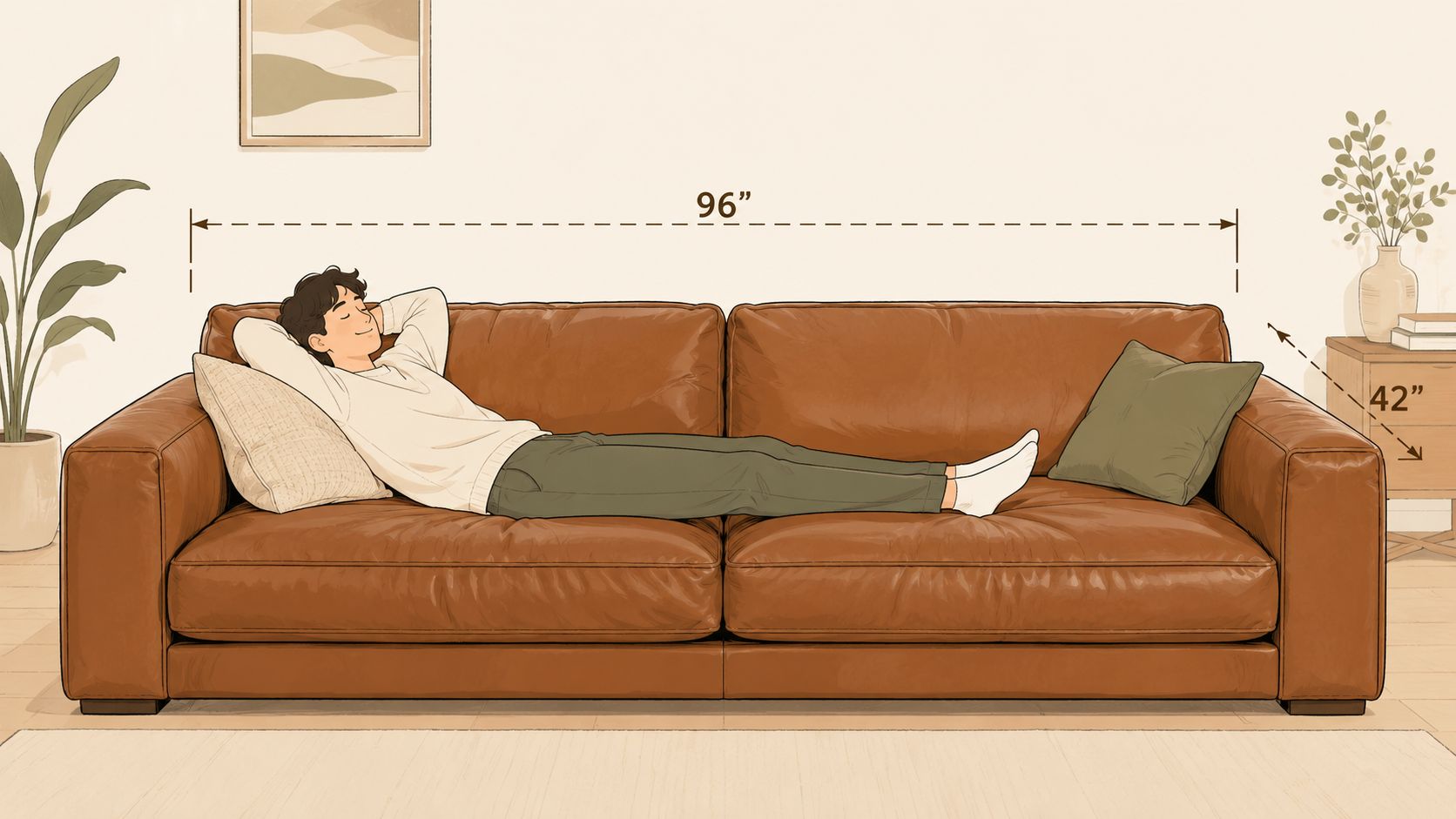
A true oversized leather sofa typically requires a minimum seat depth of 40 to 42 inches and a total width of 96 to 120 inches, exceeding standard sofa dimensions by 20 to 30%. That depth helps maintain a proper knee-to-chest angle that can reduce lumbar strain, according to this guide on what counts as an oversized sofa.
Depth matters more than most buyers expect
Many shoppers measure only the wall and focus on whether the sofa will visually fit. But comfort often depends more on seat depth than overall width. A shallow long sofa can still feel formal and upright. A deeper sofa lets the body settle back.
That's why a large sofa can look impressive in a photo and still disappoint in person. If the seat depth doesn't support relaxed posture, the piece may read as generous but does not feel restful.
What to evaluate first
- Seat depth: This is what separates a lounge-worthy sofa from one that only looks substantial.
- Overall width: Wide enough for shared seating, but not so broad that arms and proportions start swallowing the room.
- Back angle: The best models support the body without forcing a stiff sit.
- Arm scale: Wide arms can add comfort, but they also consume usable seating width.
How to judge it in a real room
Think about how the room is primarily used. If the sofa is the place for reading, napping, or family movie nights, extra depth usually improves the experience. If the room is mostly formal and used for shorter visits, too much depth can feel less natural.
A practical measuring step is to compare the furniture dimensions to both the room and the people using it. A household of taller loungers often appreciates the deep-seat category immediately. Mixed-height households may prefer supportive back cushions that keep the depth comfortable for everyone.
For homeowners trying to sort out dimensions before visiting a showroom, a guide on how to measure furniture is useful because it forces attention onto actual fit instead of guesswork.
Practical rule: If a sofa only fits on paper because every surrounding walkway is squeezed tight, it's not the right size for the room.
Planning for a Perfect Fit in Your Michigan Home
The most expensive oversized-sofa mistake often happens after the purchase. The sofa fits the wall beautifully, but it can't make the final turn through the entry, around the stair landing, or past the hallway radiator.
That problem shows up often in Southeast Michigan because the housing stock varies so much. Newer builds may allow broad entries and easier sight lines. Older Ann Arbor homes can have narrow stairwells, tighter vestibules, sharper corners, and room transitions that punish assumptions.
Room fit and delivery fit are not the same thing
Most buying guides focus on room-scale fit but neglect delivery fit, leading to failed deliveries when a sofa fits the wall yet can't fit through tight doorways or stairwells. That's especially relevant in older Ann Arbor homes, as noted earlier in the oversized-sofa guidance.
Oversized leather presents greater demands than oversized fabric. Leather doesn't flex the same way. The sofa usually carries more weight, more structure, and less forgiveness at the corners.
A better measuring routine
Before ordering, measure the entire path from truck to room. That means more than the front door.
- Start outside: Check gate openings, porch clearances, railings, and any sharp approach into the home.
- Move to entry points: Measure door width, door height, and the clear opening once the door is fully open.
- Track every turn: Hallway corners and stair landings often cause significant trouble.
- Watch overhead obstacles: Low light fixtures, ceiling drops, and handrails can steal space.
- Measure the destination room last: The room matters, but it's only the final checkpoint.
For anyone preparing for delivery day, a practical guide on how to safely move heavy furniture offers smart reminders about protecting floors, planning turns, and avoiding rushed lifting decisions.
Common trouble spots in Southeast Michigan homes
A few patterns come up repeatedly in local homes:
- Older staircases: Narrow runs with abrupt top turns.
- Split-level entries: Short landings that leave little room to pivot.
- Historic door frames: Attractive trim, limited clearance.
- Condo elevators: Plenty of lobby space, then a depth issue inside the cab.
A shopper can avoid most of this by sketching the route on paper and marking each dimension. It sounds simple because it is. It's also the difference between a smooth delivery and a sofa that ends up back on the truck.
If there's one measurement to respect as much as the wall, it's the tightest turn between the truck and the room.
Understanding Heirloom-Quality Leather
A large sofa exposes weak materials faster than a smaller one. More seat area means more stretching, more shifting, more contact, and more visible wear. That's why leather grade matters even more on an oversized frame than on a compact apartment sofa.
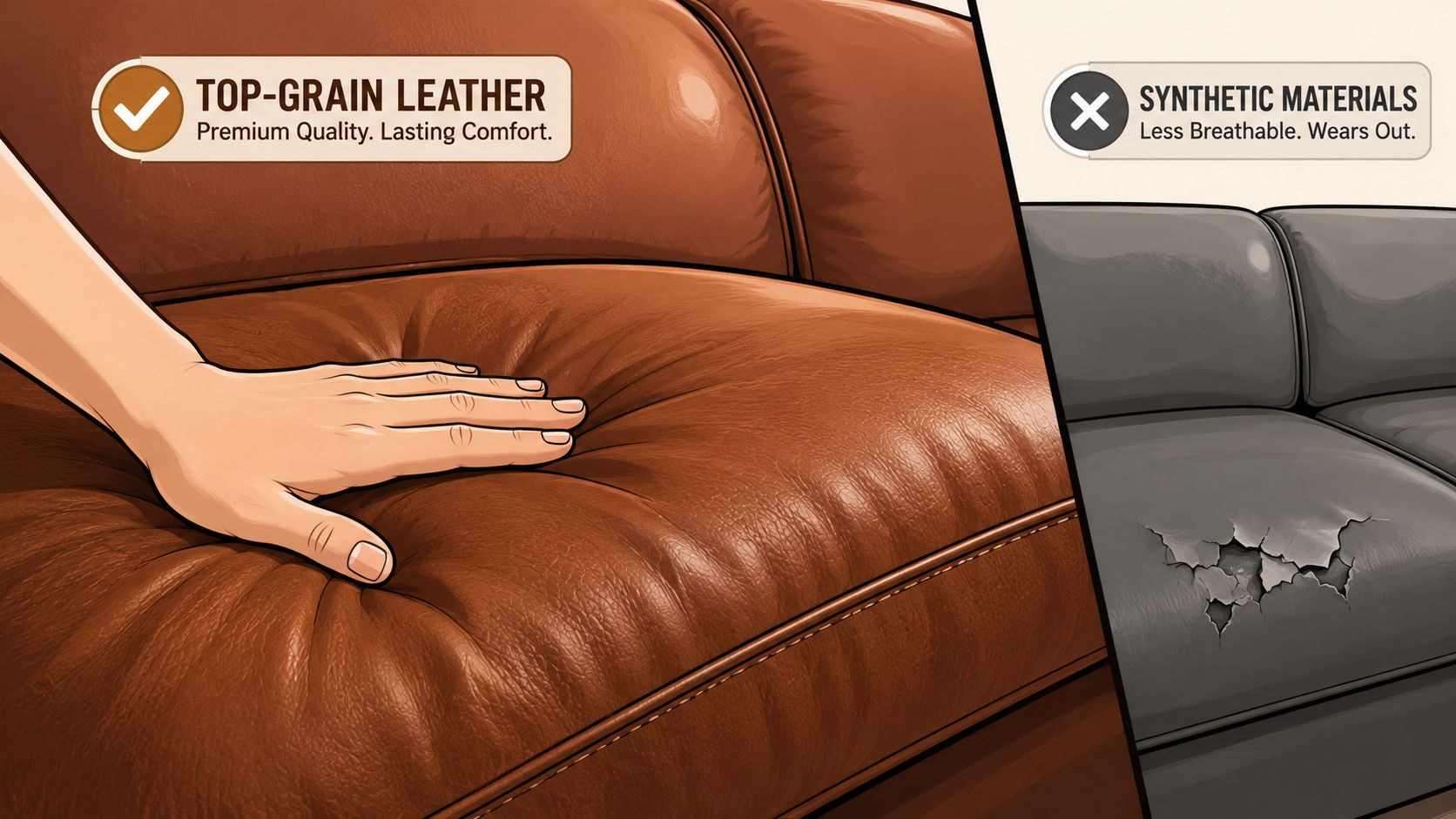
The high surface area of a 90+ inch sofa magnifies the durability risks of inferior materials. Bonded leather on an oversized model faces exponentially higher failure rates from cracking and peeling due to tension stress across the larger frame, as explained in this discussion of top-grain versus bonded leather performance.
What good leather should feel like
Top-grain leather usually gives the clearest signal in person. It has a buttery hand, a natural grain pattern, and a surface that feels substantial rather than plasticky. It doesn't try to imitate quality. It carries it.
Premium oversized sofas also demand better technical specs. Top-grain leather used in these pieces should meet a minimum tensile strength of 35 N/mm² or more and a Crockmeter abrasion resistance of at least 10,000 cycles, while thickness should land around 1.2 to 1.4 mm to balance durability and comfort. Those standards matter because oversized sofas experience 1.7x more surface friction per square inch than standard models due to increased movement and contact area.
What doesn't age well
Bonded or recycled leather often looks acceptable under showroom lighting or in a small product thumbnail. The trouble starts with use. On a large sofa, repeated flexing around seams, front rails, cushion crowns, and arm tops can reveal its limits quickly.
That's why surface area changes the buying equation. A material that seems passable on a smaller occasional seat can become a weak point on a broad family-room piece designed for daily use.
Warning signs to watch for
- Overly uniform grain: Natural leather has variation. Perfect repetition can be a clue that the surface is engineered to imitate, not endure.
- Plastic-like feel: If the hand feels cold and synthetic, the long-term aging may disappoint.
- Suspiciously thin upholstery: Thin coverings tend to show stress earlier at arms, seams, and front edges.
- Gloss without depth: Good leather has richness. Poor material often has shine only.
Cost per year beats purchase-day thinking
The topic of value warrants careful consideration. An oversized leather sofa asks a lot from its upholstery. If the material can't keep up, the visual damage becomes hard to ignore because the sofa is usually the largest object in the room.
For shoppers sorting through leather terminology, this guide on top-grain leather vs bonded leather helps separate labels from real-world performance.
A well-selected top-grain sofa tends to soften, patina, and gain personality. A weak substitute often flakes, cracks, or peels. That's the difference between heirloom value and replacement regret.
The Unseen Craftsmanship Beneath the Cushions
The leather gets the attention, but the frame decides whether the sofa will still feel solid years from now. Beneath the cushions, craftsmanship either protects the investment or undermines it.
A quality oversized sofa needs a frame that can handle broad spans without twisting or loosening. Bigger seating puts more demand on every internal component. If the structure is weak, the sofa may start creaking, dipping, or leaning long before the leather shows its age.
The frame is the backbone
The best frames rely on material integrity and sound joinery. In handcrafted furniture, that same principle shows up across categories. Amish dining furniture finished with conversion varnish can extend finish life 2 to 3 times compared with standard lacquer, according to this look at American-made dining chair construction. Different category, same lesson. Lasting furniture starts with what's built underneath and how carefully it's finished.
For upholstery, shoppers should look for hardwood frames, reinforced corners, and construction that feels planted when pressure shifts across the seat.
Suspension and cushion quality
After the frame, the suspension determines how the sofa carries weight over time. Good support keeps cushions from feeling hollow or collapsing into hammocks. Cushion quality then decides whether the comfort lasts past the honeymoon period.
A true oversized leather sofa also benefits from high-resilience foam. Deeper seats can support proper posture and reduce lumbar strain when paired with a foam core density of 2.5 lb/ft³ or higher, and ergonomic studies cited in the verified data connect deeper seats and contoured backrests with improved postural stability.
What to inspect
- Frame feel: Lift one front corner slightly. A stable sofa shouldn't feel flimsy or loose.
- Seat recovery: Sit, stand, and watch how quickly the cushion regains shape.
- Edge support: Front rails should feel supportive, not collapsed.
- Suspension consistency: One seat shouldn't feel dramatically softer than the next.
For shoppers interested in how support systems affect long-term comfort, 8-way hand-tied sofas are worth studying because they reveal what separates upholstery built for years of use from upholstery built for a quick sale.
Styling Your Sofa Without Overwhelming Your Space
An oversized leather sofa can dominate a room, but it doesn't have to. The trick is to let it act as the anchor while the rest of the room supports it with proportion, breathing room, and softer visual edges.
The open-concept anchor
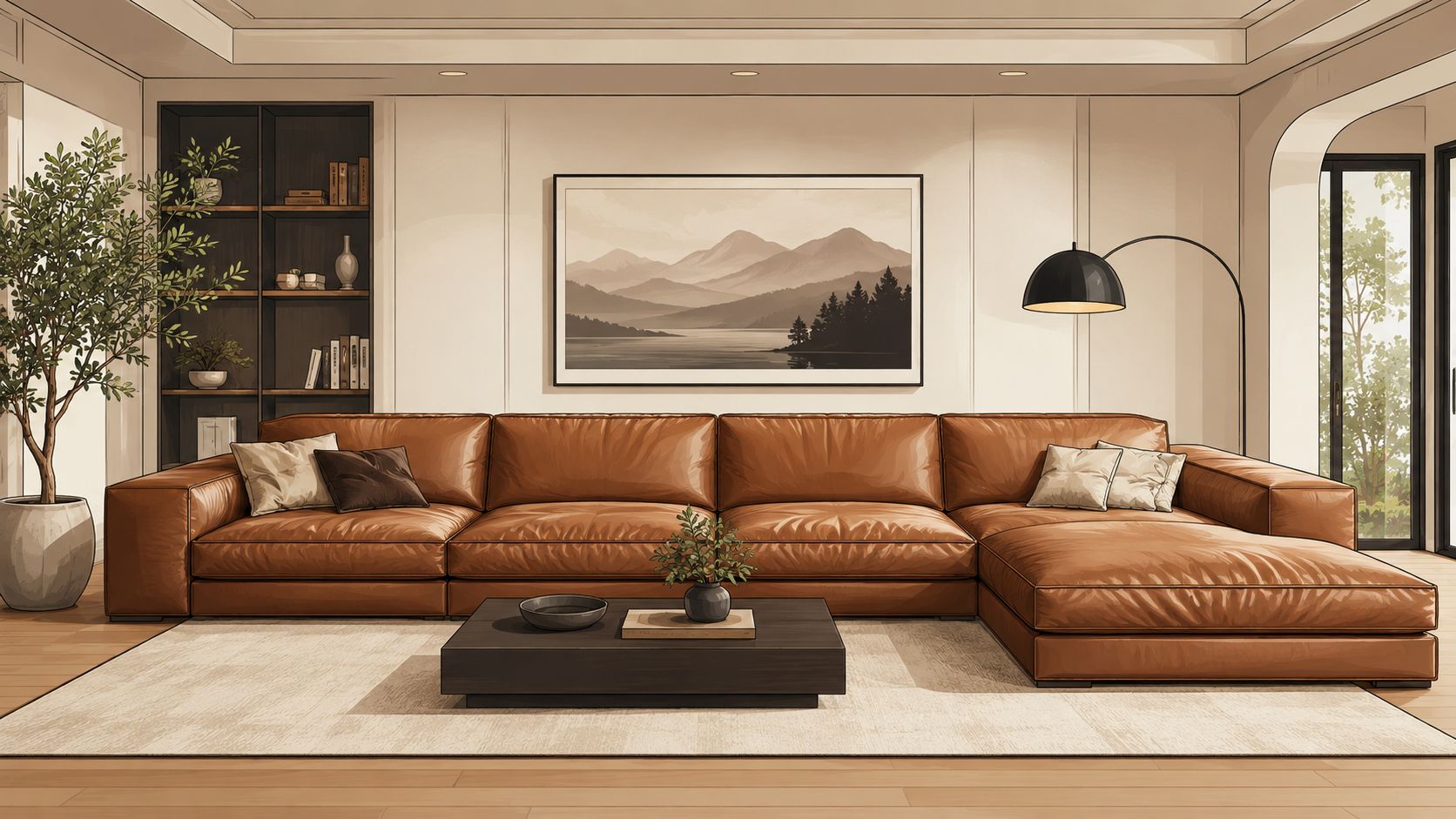
In a larger main room, the sofa can define the living zone without adding walls or dividers. A broad area rug helps hold the seating group together. A coffee table with enough visual weight keeps the sofa from feeling like a single oversized block.
Accent chairs work best when they don't try to compete. Slimmer frames, lighter upholstery, or visible legs can offset the visual density of leather.
The cozy den
A den or media room benefits from warmth. Leather already brings richness, especially in cognac, walnut, or deep brown tones. The room often needs contrast more than more heaviness.
That's where textiles matter. A wool rug, tactile pillows, and drapery can soften the firmness of leather without making the room feel fussy. Lighting also changes everything. For readers interested in layering soft light effectively, the key idea applies well here. Use a mix of lamps and indirect glow to keep a large sofa from reading too dark or too dense in the evening.
The modern entertainer's lounge
In a social room, the oversized sofa becomes the hospitality piece. It should face conversation, not just a screen. Leave enough clearance around the coffee table for easy movement, and avoid crowding the perimeter with too many occasional pieces.
A few styling choices help immediately:
- Use one substantial rug: Tiny rugs make large sofas look even larger.
- Keep tables in scale: Undersized tables disappear and make the sofa feel bulky.
- Add height with lighting: Floor lamps and taller greenery pull the eye upward.
- Choose edited accessories: A few strong pieces feel calmer than many small ones.
A room can still feel spacious with a large anchor piece. The balance comes from scale, not from stripping the room bare. For more layout ideas, how to make a small room feel big offers useful guidance that applies even when the seating itself is generous.
The Tyner Furniture Advantage in Southeast Michigan
A great oversized leather sofa purchase depends on three things working together. The dimensions need to suit the way the household lives. The leather and internal construction need to justify the investment. And the piece needs to be fitted to the home instead of forcing the home to adapt to a standard model.
That's where a strong local showroom matters. In Southeast Michigan, a buyer may be furnishing a downtown Ann Arbor condo, an older home with tighter access, or a newer open-concept family room. Those are not interchangeable situations. A one-size-fits-all approach rarely serves them well.
Why customization matters

For high-end sectional sofas, the in-stock model is just the starting point. Customization removes long-term compromises by allowing adjustments to fabric, cushion depth, and configuration to match specific room dimensions, as described in this overview of high-end sectional sofa customization.
That principle extends well beyond a sectional. It's what makes bespoke furniture valuable. The shopper doesn't have to settle for a close-enough depth, an almost-right configuration, or a leather choice that misses the tone of the room.
The same custom mindset shows up in other categories too. Canadel offers made-to-order flexibility for dining and interior design coordination. Stressless brings ergonomic precision with Small, Medium, and Large sizing, which supports the active-release spine mechanism in a way generic seating often can't match, according to Stressless customization details.
Local legacy and full-home perspective
A local legacy matters because furniture decisions rarely happen in isolation. The best living room purchase also has to make sense with adjoining dining spaces, home office pieces, bedroom furniture, and even outdoor spaces. Since 1957, the Ann Arbor showroom on South State St. has served that broader role for Southeast Michigan households.
There's also practical value in reducing the barrier to entry for better furniture. Special Financing helps spread the investment over time, and a Low Price Promise adds confidence for shoppers comparing long-term value rather than chasing short-lived trends. For buyers furnishing a forever home, those details matter.
The best oversized leather sofa is the one that feels right in the showroom, fits the home in real life, and still earns its place years later.
For anyone ready to move from measuring tape to a real sit test, Tyner Furniture is a strong next stop. Visit the Ann Arbor showroom on South State St. to feel the buttery hand of top-grain leather, compare ergonomic seat depths, and explore bespoke options from living room seating to Canadel dining, Stressless recliners, home office pieces, bedroom furniture, and outdoor spaces. If the timing is better for research first, browse the online Quick Specs for special orders, then use Special Financing and the Low Price Promise to make an heirloom-quality choice with confidence.