American Made Leather Sofas: Quality & Durability Guide

The usual sofa story goes like this. A piece looks good online, arrives looking decent, then a few years later the seat loses shape, the surface starts showing hard wear, and the room suddenly feels tired again. Shopping starts over, delivery has to be scheduled again, and the original “good deal” doesn't feel like much of one.
That cycle is exactly why American made leather sofas deserve a different lens. In Ann Arbor and across Southeast Michigan, many households aren't just buying a place to sit. They're choosing the piece that anchors movie nights, conversations, naps, and the everyday rhythm of a home. Since 1957, local furniture shoppers have learned that the smarter question isn't just “What does this sofa cost today?” It's “What will this sofa cost over the years it's used?”
Table of Contents
- Why Your Next Sofa Should Be an Investment Not a Purchase
- What American Made Really Means for Your Sofa
- A Guide to Choosing the Right Leather
- Creating a Bespoke Sofa That Is Uniquely Yours
- Calculating the True Cost of Your Furniture Investment
- How to Care for Your Leather Sofa for a Lifetime of Use
- Your Checklist for Choosing the Perfect Sofa at Tyner Furniture
Why Your Next Sofa Should Be an Investment Not a Purchase
The biggest mistake in sofa shopping is treating the price tag as the whole story. It isn't. A sofa is one of the hardest-working pieces in the house, and hard-working furniture should be judged by how it holds up, how it feels after years of use, and how often it needs to be replaced.
That's where cost-per-year becomes useful. A sofa with a higher ticket price can still be the more economical choice if it stays comfortable, keeps its structure, and avoids the churn of replacing a worn-out piece too soon. The math changes quickly when delivery fees, disposal hassle, and another round of shopping enter the picture.
One practical benchmark stands out. The break-even point for a $3,000 American-made sofa against a $1,200 fast-furniture piece that needs replacement every 6 years can be as short as 4 years. That kind of cost-per-year thinking is often missing from furniture marketing, even though it's the question careful buyers pose.
Practical rule: If a sofa will be used daily, evaluate it like an appliance or mattress, not like a decorative accessory.
High-consideration purchases deserve patience. That's especially true for a main living room sofa, where the wrong decision lingers in the room every day. Shoppers who want a clearer framework for that decision can use this guide on why furniture purchases are high consideration decisions to think through comfort, longevity, and fit before they buy.
The mindset shift that saves money
An investment sofa does three things well:
- Keeps its shape: The seat shouldn't look tired long before the room does.
- Ages with character: Good leather tends to settle into a lived-in look rather than looking worn out.
- Stays relevant: A balanced silhouette outlasts trend-heavy styling.
The other benefit is emotional, even if the decision starts financially. People get attached to a good sofa. It becomes part of the house. That's a very different experience from buying a placeholder and hoping it lasts long enough.
For households building a forever home in Southeast Michigan, that investment mindset usually leads to better choices. It also lowers the odds of buying twice.
What American Made Really Means for Your Sofa
“American made” should mean more than a label on a tag. For a sofa, it should point to construction choices, material standards, and the kind of workmanship that can stand up to years of regular use.
A quality piece starts under the leather, not on top of it.
Start with what you can't see
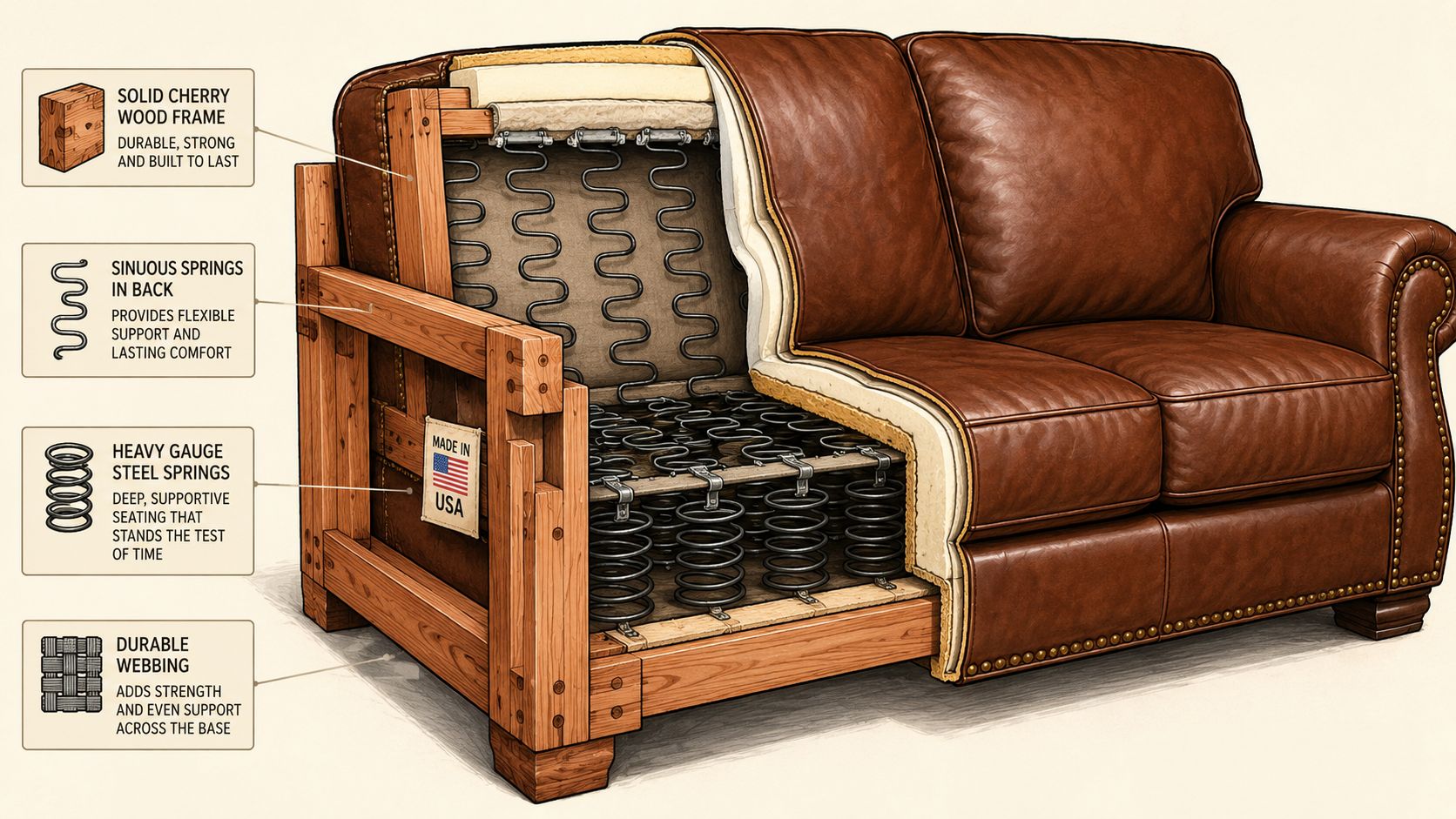
The frame is the skeleton of the sofa. If that foundation is weak, no premium leather or attractive styling can rescue it for long. In better upholstery, shoppers should look for solid hardwood framing, because frame integrity affects everything from arm stability to how the seat deck performs over time.
That same construction mindset shows up across better American furniture categories, especially in American-made solid wood furniture, where material integrity and joinery matter more than surface appearance alone. The principle is the same with sofas. Hidden structure decides long-term value.
Signs of a better-built sofa often include:
- Solid hardwood support: A stronger foundation than lighter composite-heavy builds.
- Clean tailoring: Straight seams and consistent upholstery usually reflect better production discipline.
- Weight and steadiness: A sofa shouldn't rack or wobble when pressure shifts across the frame.
Why suspension changes everything
The suspension system is where comfort and durability meet. One of the clearest premium indicators is true eight-way hand-tied spring construction, where each coil is secured in eight directions. That design gives more uniform support and helps distribute weight more evenly over years of use, as described by this upholstery construction overview.
That matters because sagging usually starts below the cushion, not inside it. A well-built support system helps the seat feel consistent from one side to the other instead of developing soft spots and uneven ride.
A sofa can have attractive leather and still fail where it matters most. The lasting comfort comes from the frame and suspension working together.
There is a trade-off. This kind of construction takes more labor, and labor shows up in the selling price. But that added cost is tied to a real structural difference, not decorative markup. For buyers who want an heirloom feel instead of a short-cycle piece, this is one of the details worth paying for.
A Guide to Choosing the Right Leather
Leather is where most shoppers feel both excited and overwhelmed. They see a wall of swatches, hear a few technical terms, and suddenly every sample starts sounding the same. It helps to simplify the decision and focus on feel, appearance, and how the surface will behave in daily life.
The right leather should fit the household, not just the showroom lighting.
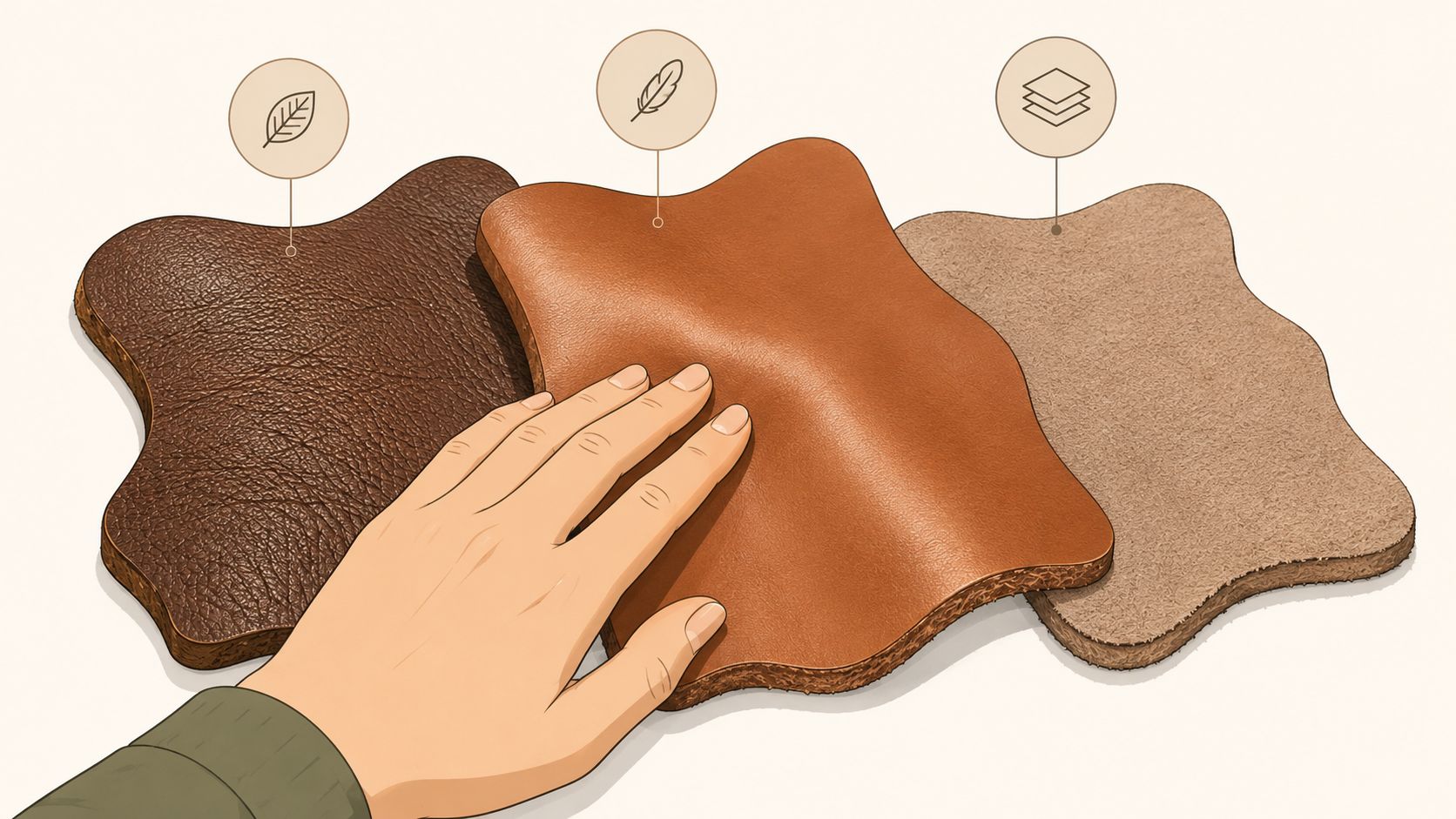
A simple leather hierarchy
At the top, full-grain leather keeps the natural character of the hide most intact. It usually carries more visual variation, more natural markings, and the kind of patina that deepens with time. This is often the choice for shoppers who want authenticity and don't mind a more organic look.
Just below that, top-grain leather is often the practical sweet spot. It has a smoother, more uniform appearance and that buttery hand many shoppers respond to immediately in a showroom. For many homes, it offers a strong balance of refinement and resilience.
Lower-tier options deserve more caution. They may look acceptable at first glance, but they don't usually deliver the same feel, depth, or long-term performance. For a deeper explanation of material differences, this guide to top-grain leather vs bonded leather is useful before making a final choice.
Match the leather to the household
The smartest way to choose leather is to think about use patterns.
- For a formal living room: A more natural leather with visible character can be a beautiful fit.
- For a busy family space: A more protected finish often makes daily life easier.
- For pet households: Texture and color matter. Some surfaces are better at disguising light wear than others.
- For design-driven rooms: Leather with subtle variation often adds depth that flat, uniform materials can't.
Good leather doesn't just look luxurious. It feels alive in the hand, warms with use, and develops personality instead of looking printed on.
Color deserves patience too. Warm browns, grounded neutrals, and softer earth tones often age better in the room than highly trendy shades. Leather reflects light differently than fabric, so a sample should be viewed in both daylight and evening light before a custom order is placed.
Creating a Bespoke Sofa That Is Uniquely Yours
The strongest argument for American made leather sofas isn't only craftsmanship. It's also the ability to shape the piece around the room and the people using it. That's where made-to-order upholstery stands apart from buying only what happens to be sitting in a warehouse.
A shopper might start with a sofa on the showroom floor, then realize the arm style is right but the depth feels too generous, or the leather color is close but not quite right against the flooring. Made-to-order programs solve that problem by turning the floor model into a starting point rather than a limitation.
How made-to-order changed the category
The premium end of the market shifted in a major way when made-to-order production scaled in the 1990s, allowing manufacturers to offer personalization in style, frame, and leather grade. That change became a defining feature of the category, as shown in this overview of American Leather's made-to-order model.
That history matters because it explains what shoppers are really buying today. They're not only buying domestic production. They're buying a manufacturing approach built around configuration.
One practical note matters here. “Custom” doesn't always mean unlimited. In many programs, customization is modular rather than fully bespoke. That usually means shoppers can choose from curated arm styles, seat depths, leather grades, finishes, and configurations, but they may not be able to alter every dimension freely.
What customization usually includes
A typical custom-order journey often looks like this:
- Start with silhouette: Choose the overall style, whether the room calls for clean modern lines or a softer transitional shape.
- Refine the seating feel: Cushion firmness affects posture, lounge comfort, and everyday ergonomics.
- Select the covering: Leather color, grain, and finish change both maintenance needs and visual mood.
- Finish the details: Leg finish, seam treatment, and configuration complete the piece.
For shoppers exploring that process, getting started with custom order is often the useful first step because it clarifies what can be changed and what usually stays fixed within a frame program.
This is also where a local showroom has an advantage. A shopper can compare details side by side, test comfort in person, and discuss other custom categories that may matter elsewhere in the home, including Canadel dining programs and Stressless ergonomic seating. The point isn't to customize for the sake of customizing. The point is to get the room, scale, and comfort right the first time.
Calculating the True Cost of Your Furniture Investment
A sofa shouldn't be judged only by the number on the tag. It should be judged by how many comfortable, good-looking years that number buys. That's the heart of the cost-per-year approach.
A useful durability benchmark comes from one American manufacturer, which notes that a quality American-made leather sofa with a solid hardwood frame can last 15 to 20 years or even a lifetime with proper care, as outlined in this reference on leather sofas made in America. That kind of lifespan changes the math dramatically.
The cost-per-year view
A less expensive sofa often feels safer at checkout. But if it needs replacement far sooner, the lower initial price can become the more expensive path over time. Cost-per-year strips away the sticker shock and asks a better question: how long does this comfort last before the household has to pay again?
That framework also connects to sustainability. Buying once and buying well generally means fewer replacements moving through the home, fewer disposal headaches, and fewer furnishing decisions repeated on a short cycle.
The lowest upfront price and the lowest long-term cost are often two different things.
For buyers who want to spread out a larger purchase, financing can change the decision without changing the standard. Tyner Furniture offers special financing options and a Low Price Promise, which can make a made-to-order or heirloom-grade piece more manageable while keeping the focus on long-term value rather than short-term compromise.
20-Year Sofa Cost Comparison
| Metric | Heirloom Leather Sofa | Fast-Furniture Sofa |
|---|---|---|
| Starting price example | $3,000 | $1,200 |
| Expected ownership horizon used in this comparison | Up to 20 years based on the durability benchmark above | Replacement cycle used in the break-even example is every 6 years |
| How many purchases over 20 years | Often one purchase if the sofa is well built and properly cared for | Multiple purchases may be required within the same period |
| Comfort consistency over time | More likely to remain supportive when construction is strong | More likely to lose support and appearance sooner |
| Disposal and re-shopping burden | Lower | Higher |
| Cost-per-year logic | Higher upfront outlay, spread across a longer use period | Lower upfront outlay, but repeated spending can narrow or erase the savings |
The exact outcome depends on use, care, and construction quality. But the decision framework is solid. Shoppers who focus only on the opening number usually miss the true cost.
How to Care for Your Leather Sofa for a Lifetime of Use
A well-made leather sofa doesn't need fussy treatment, but it does need consistent habits. Most long-term wear comes from neglect, not from normal use. A few routine steps make a major difference in how the surface looks and feels over time.
Daily habits that help
Keep leather out of prolonged direct sun when possible. Light and heat can dry the surface and shift the color unevenly. Placement matters more than people think, especially in rooms with strong afternoon exposure.
Dusting helps too. A soft dry cloth removes surface grit before it gets rubbed into the leather through normal sitting. Cushions also wear more evenly when seats are used and rotated thoughtfully instead of favoring the same spot every day.
A seasonal reminder helps many households stay on track. This fall furniture maintenance checklist is a practical reference for broader upkeep habits around the home.
Pro-tips for spills and maintenance
- Blot, don't scrub: If a spill happens, use a clean dry cloth and lift moisture gently.
- Condition with restraint: Use leather care products carefully and only as appropriate for the finish. More product isn't better.
- Test first: Any cleaner should be tried on an inconspicuous area before broad use.
- Respect the finish: Natural-looking leathers and more protected leathers won't respond the same way to maintenance.
For deeper cleaning in commercial or hospitality settings, upholstery specialists can also offer a useful benchmark for process and care standards. This overview of commercial furniture care gives a helpful look at how professionals approach upholstery maintenance.
Leather care works best when it's gentle and consistent. Harsh scrubbing and over-conditioning usually create more problems than they solve.
The goal isn't to keep leather frozen in time. Good leather should soften, relax, and show some life. Proper care protects that evolution instead of fighting it.
Your Checklist for Choosing the Perfect Sofa at Tyner Furniture
By the time a shopper reaches the showroom, the goal should be clarity. Not confusion. A good checklist keeps attention on the details that matter and filters out the features that only sound impressive.

Bring this checklist to the showroom
- Check the frame story: Ask what supports the sofa beneath the upholstery and whether solid hardwood is part of the build.
- Ask about the suspension: Seat comfort on day one matters, but support retention matters more.
- Compare leather by touch: Look beyond color. Pay attention to texture, softness, and visual depth.
- Think about room fit: Measure walls, traffic paths, and any tight entries before falling in love with a scale that won't work.
- Clarify the custom options: Confirm what can be changed and what belongs to a fixed frame program.
- Plan for the whole home: A store that handles living room, dining, bedroom, home office, and outdoor spaces can help keep the overall design language consistent.
For local shoppers, the South State Street showroom in Ann Arbor makes the next step simple. Leather has to be touched. Seat depth has to be felt. Arm height, back pitch, and cushion firmness all read differently in person than they do on a product page.
Why the sit test matters
A sofa can look perfect and still sit wrong. That's why the final filter should always be the sit test.
Sit upright. Sit sideways. Lean back the way people do at the end of a long day. Notice whether the seat edge cuts into the legs, whether the back supports the shoulders well, and whether getting up feels easy or awkward. Those are the details that separate a piece that merely photographs well from one that belongs in the room for years.
Since 1957, that kind of practical guidance has mattered to furniture shoppers across Southeast Michigan. It still does.
Visit Tyner Furniture to do a real sit test in the Ann Arbor showroom on South State Street, or browse the online Quick Specs for special-order possibilities. For shoppers building a long-term home, whether that means a leather sofa, Amish hand-crafted bedroom and dining pieces, a home office upgrade, ergonomic Stressless seating, Canadel customization, or outdoor spaces, the goal is the same. Buy with clarity, choose lasting craftsmanship, and bring home furniture that earns its place year after year.