Ergonomic Sofa for Back Pain: A Complete Guide for 2026


After a long day, sinking into a soft sofa can feel like the perfect reward. An hour later, the lower back may feel tighter, standing up may take more effort, and the cushion that felt wonderfully plush may suddenly seem like part of the problem. That experience leaves many homeowners wondering whether an ergonomic sofa for back pain should feel firm, upright, adjustable, or more supportive.
The answer isn't found in softness alone. Seat depth, pelvic position, lumbar support, cushion resilience, and the ability to change posture all matter. For households in Ann Arbor and Southeast Michigan, furniture shopping can feel overwhelming, especially when a sofa must balance daily comfort, interior design, durability, and long-term value. A showroom sit test can make those trade-offs much easier to understand.
Why Your Sofa Might Be Making Back Pain Worse
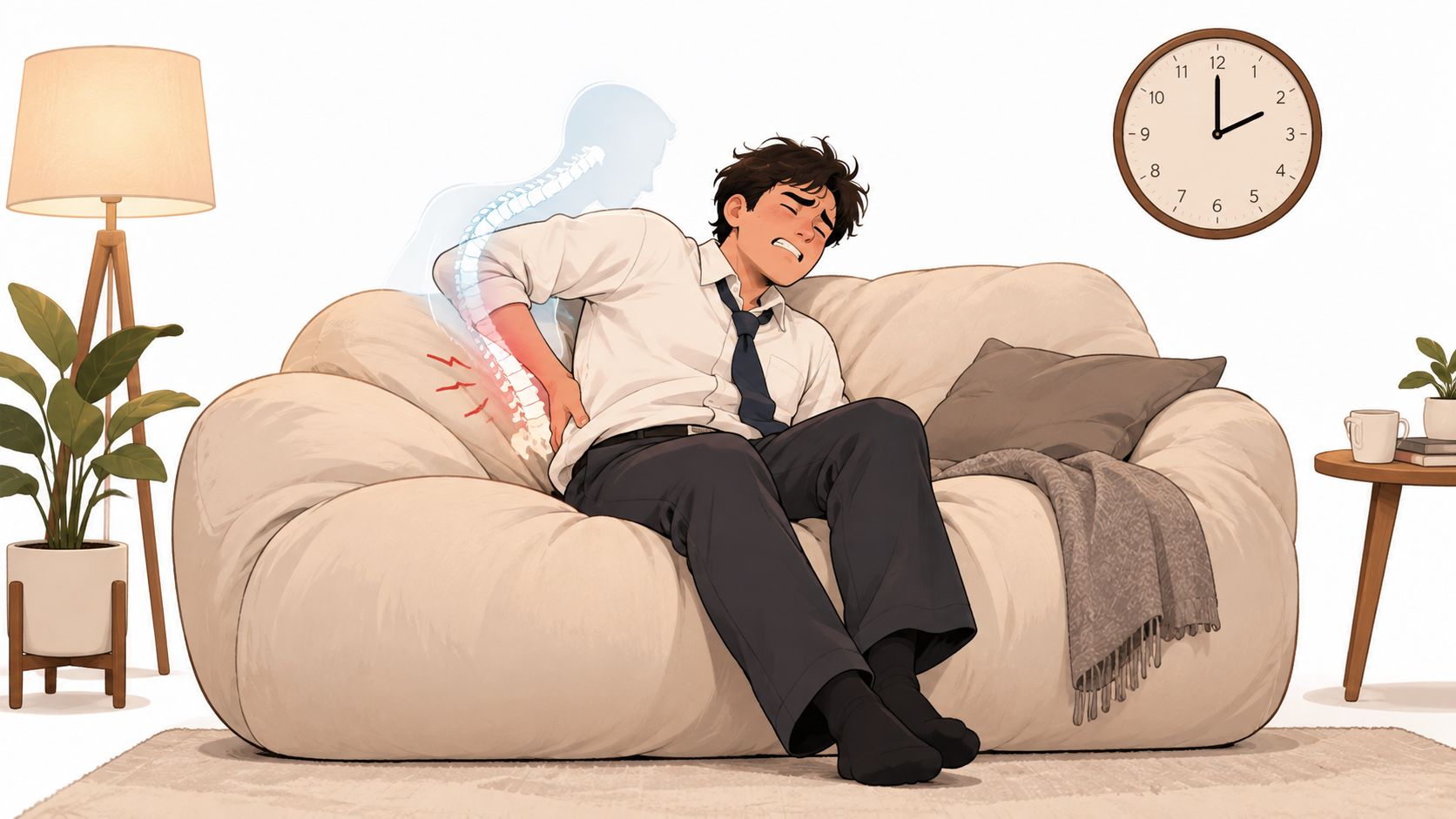
The familiar evening scene often begins innocently. A person arrives home, drops into a deep sofa, and lets the hips slide forward as the cushion gives way. The knees rise, the feet reach for the coffee table, and the lower back rounds away from the backrest. The sofa feels soft against the body, but the posture becomes less stable with every passing minute.
That distinction matters. A 2025 systematic review found mixed evidence linking total sitting time with low back pain, with 8 studies reporting a relationship and 5 reporting no relationship. Evidence was more consistent for sitting posture and behavior, with 7 studies connecting posture to low back pain and 12 connecting sitting behavior, compared with only 1 study that did not (systematic review of sitting behavior and low back pain04415-3)). The practical lesson is simple: a sofa shouldn't only feel comfortable at first contact. It should help the sitter maintain a neutral, supported position.
Softness can hide poor alignment
A low, deep sofa encourages the pelvis to roll backward, a position known as posterior pelvic tilt. As that happens, the natural curve of the lower spine becomes flatter, and the torso may slump into the cushions. The result can be a sofa that feels inviting for a few minutes but becomes tiring during reading, television, conversation, or work.
A 2026 clinical study of prolonged sofa sitting in people with nonspecific chronic low back pain found that symptoms worsened mainly through posterior pelvic tilt rather than increased lumbar muscle activity (clinical study on sofa sitting and pelvic tilt). That finding shifts attention away from the idea that every uncomfortable sofa needs a harder cushion. The better question is whether the seat and backrest keep the pelvis steady while supporting the lumbar curve.
Practical rule: A comfortable sofa should make good posture feel easy, not require constant muscular effort or a collection of pillows.
Existing back pain deserves medical attention when symptoms are persistent, severe, or affecting ordinary activities. Furniture can support better sitting habits, but it isn't a substitute for professional care. Readers looking for broader information can review treatments for lower back pain from Interventional Pain Management.
Tyner Furniture has served the local community since 1957, and that long local legacy provides a useful perspective. A sofa is part of the household's daily infrastructure, not a quick style purchase. The buttery feel of top-grain leather, the steady lift of a supportive seat, and a frame that remains sound over years all contribute to its cost-per-year value.
Readers can also explore how to improve posture while sitting before visiting a showroom. The purpose isn't to find one rigid sitting position. It's to choose furniture that supports natural movement, lets the body shift comfortably, and doesn't force a slumped posture.
What Makes a Sofa Truly Ergonomic for Back Pain
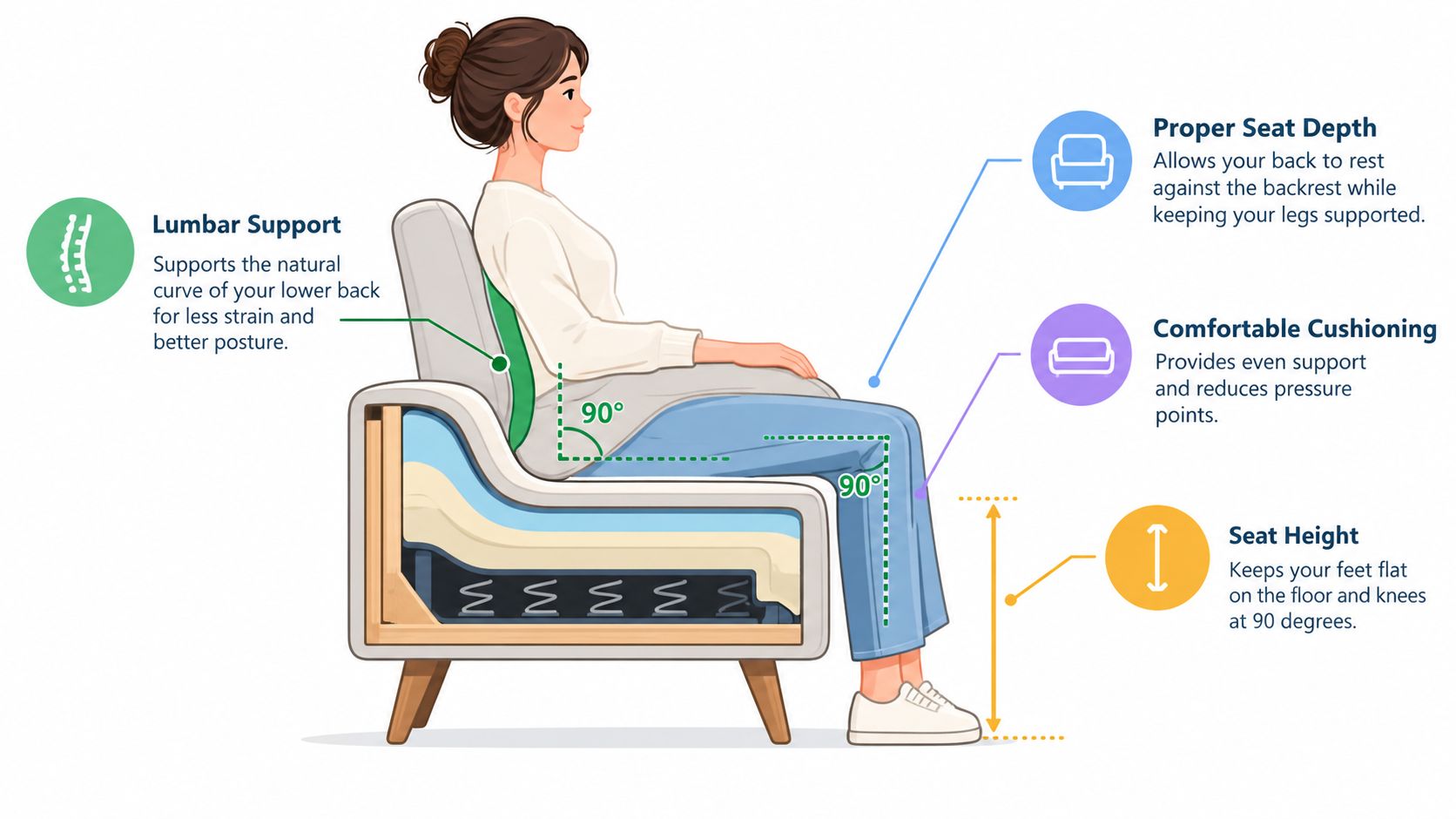
A sofa earns the ergonomic label through the relationship between its parts. A lumbar cushion can't compensate for a seat that's too deep, and a firm seat can't solve a backrest that leaves the lower spine unsupported. Five features deserve attention during every sit test.
Lumbar support should meet the natural curve
The lower back needs stable contact, not a dramatic lump that pushes the torso forward. A radiographic study found that lumbar lordosis increased from 20° without support to 25° with 2 cm of support and 30° with 4 cm of support, with the comparison between no support and 4 cm reaching p < 0.0001 (radiographic study of lumbar support and seated posture). The study illustrates why lumbar support changes posture rather than serving as decoration.
A 2025 meta-analysis also reported that lumbar support significantly reduced low back pain, with an overall standardized mean difference of -1.33, a 95% confidence interval of -2.09 to -0.57, and p = 0.0006 (meta-analysis of lumbar support and low back pain). Shoppers should assess whether the support lands at the small of the back without creating pressure.
Seat height controls the base of the posture
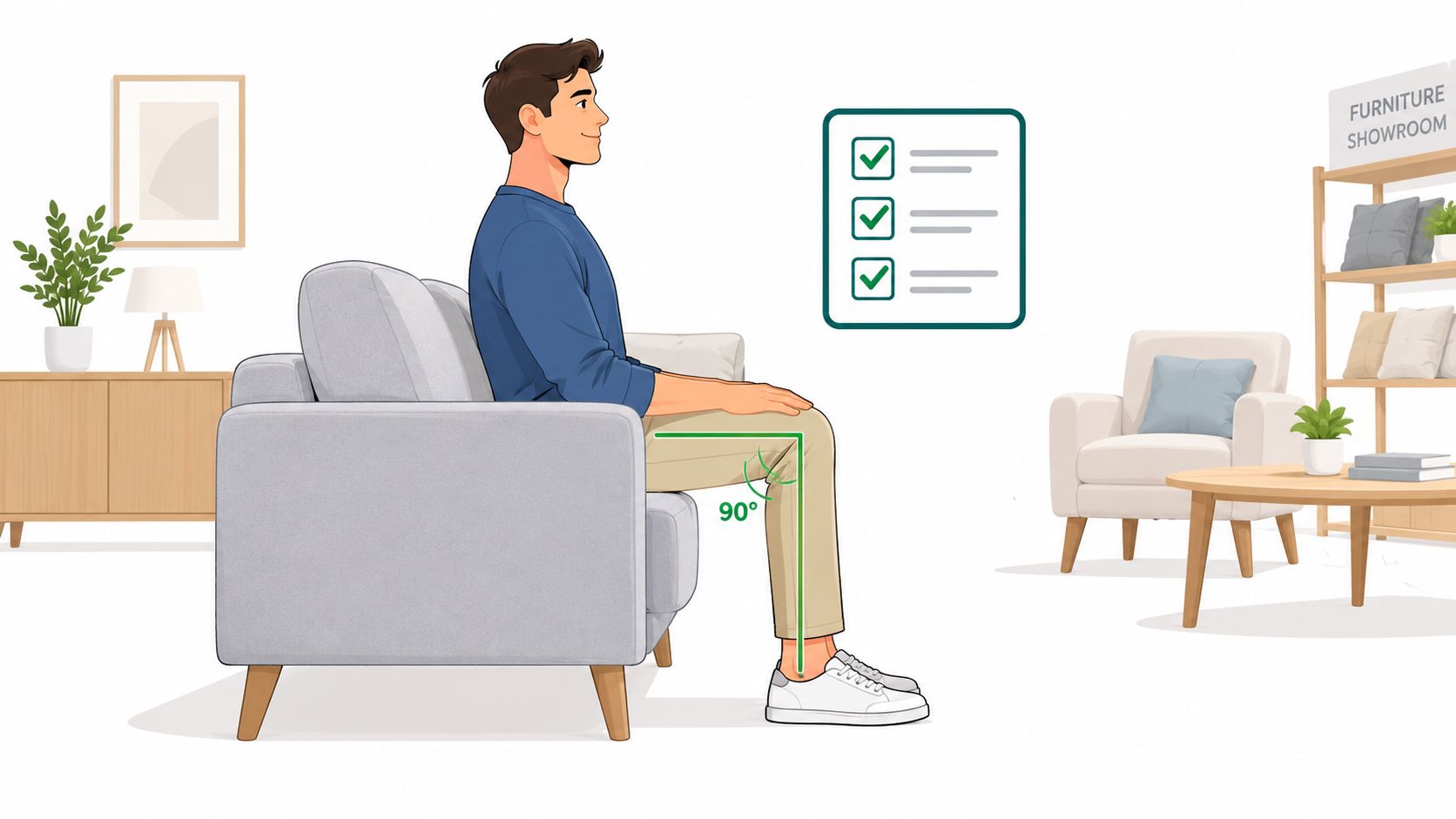
The feet should rest flat on the floor, with the hips and knees near a right angle. If the seat is too low, the knees rise above the hips and the pelvis tends to roll backward. If it's too high, the feet may dangle, placing pressure beneath the thighs and making standing less stable.
The correct height depends on leg length, not a universal showroom specification. A shorter sitter may need a lower seat, while a taller sitter may need more elevation to keep the hips and knees comfortably aligned.
Seat depth decides whether the back reaches the backrest
A deep seat can look generous but still be a poor fit. If the sitter can't place the lower back against the backrest while keeping the feet grounded, the body must choose between unsupported upright sitting and slumping.
A sofa should support the lower back while the feet remain connected to the floor. If both conditions can't happen at once, the seat depth needs reconsideration.
Backrest angle and firmness should support change
An upright sofa can suit someone who reads, talks, or works from the living room. A reclined posture may suit someone who needs to vary spinal loading or raise the feet. Either option should provide steady lumbar contact rather than allowing the body to sink into a hollow.
Biomechanical research found that reducing ischial support while increasing lumbar support redistributed load away from the sitting bones and reduced lumbar muscular activity. The same research found that forward seat-pan inclination significantly increased low-back discomfort at p < 0.001 and overall body discomfort at p = 0.016, while the backrest itself didn't change discomfort (biomechanical research on adjustable seating). That makes an overly soft front edge or forward-tilted seat a warning sign.
Armrests should let the shoulders relax
Armrests support more than the hands. When they sit near elbow height, they can reduce the tendency to shrug the shoulders or brace the upper body. A shopper should rest the forearms naturally and check whether the shoulders remain loose.
For more general seating guidance, readers can review these ergonomic chair support tips. Sofa ergonomics follows the same basic principle, support should meet the body without forcing it into a fixed shape. Additional seating ideas are available through Tyner's ergonomic seating solutions.
How to Measure Your Space and Your Body for the Right Fit
A successful sofa purchase begins at home, before the showroom visit. A tape measure, a sheet of paper, and a few minutes of careful observation can prevent the common mistake of choosing a beautiful sofa that can't pass through the doorway or doesn't fit the sitter.
Start with the room and entry route
Measure the wall where the sofa will sit, then record the width of nearby paths. Note the position of doors, stairways, radiators, vents, and tables. A sofa's overall depth can matter as much as its length because it affects walking space and the visual balance of the room.
Measure the narrowest doorway, hallway turn, and stair landing. Record ceiling height where the sofa may need to be tilted during delivery. The showroom team can use these details when discussing configurations, removable legs, sectional orientation, and delivery planning.
The guide to how to measure furniture can help organize those notes before a visit.
Measure the person, not just the room
Seat depth should allow the sitter to rest the lower back against the backrest while keeping a comfortable space behind the knees. Seat height should let both feet settle flat without the knees rising sharply or dangling above the floor. Back height should support the torso and, when desired, the head without pushing the shoulders forward.
Because bodies vary, in-stock is just the beginning. Made-to-order and bespoke options can adjust upholstery, configuration, and sizing. Stressless seating, for example, offers Small, Medium, and Large sizing options, which gives shoppers a more useful starting point than trying to make one standard sofa fit every household.
Try a simple home simulation
Place a dining chair on the floor and sit with the feet flat. Add a folded blanket or firm pillow behind the lower back until the pelvis feels balanced and the lumbar curve feels supported. Then observe how much seat depth remains comfortable before the knees feel pressured.
A second chair can help compare an upright posture with a slightly reclined one. The goal isn't to reproduce a finished sofa. It's to identify whether the body prefers an active upright base, a more relaxed angle, or the ability to move between both.
Bring these observations to the South State St. showroom in Ann Arbor. A made-to-order configuration can combine preferred seat feel, fabric, leather, arm style, and room scale rather than forcing a compromise based on one floor model.
Cushions Materials and Craftsmanship That Support Your Spine
Cushion comfort changes over time, so shoppers should assess the construction beneath the upholstery. A sofa may feel supportive on a showroom floor yet lose its shape if the cushion core, suspension, and frame can't handle regular use. The right comparison considers spinal support today and cost-per-year value over the life of the piece.
Cushion choices involve a trade-off
High-resilience foam generally provides a stable seating platform and returns to shape more consistently than loose fills. Foam with a lumbar insert can add targeted support, especially when the back cushion itself has a softer wrap. Down-blend cushions offer a relaxed, enveloping feel, but they need regular attention to maintain an even surface.
No single fill suits every pain pattern. A person who tends to slide into a slouch may benefit from a structured cushion, while another sitter may need a softer, more adaptive surface paired with a firm internal support layer.
Suspension affects how the seat carries weight
Sinuous springs can provide dependable flex and a familiar, responsive feel. Eight-way hand-tied suspension uses extensive hand work to distribute support through the seat and can contribute to a more refined, durable build. The important question is whether the suspension keeps the sitter level and prevents a permanent sag where the pelvis settles.
Frames deserve equal scrutiny. A North Carolina State University paper found that mortise-and-tenon joints had the highest moment capacity among the tested furniture-frame joints, along with 99.99% reliability (research on furniture-frame joint performance). That supports a broader craftsmanship principle: durability comes from how components connect, not from a label such as solid wood.
Compare the construction before choosing the cover
| Construction Option | Back Support | Durability and Value | Best For |
|---|---|---|---|
| High-resilience foam | Stable base that resists excessive sinking | Consistent support and strong cost-per-year value | Upright daily sitting |
| Foam with lumbar insert | Adds targeted lower-back contact | Useful when posture needs more guidance | Sitters who lose contact with the backrest |
| Down-blend cushion | Softer, adaptive surface | Comfortable but requires reshaping and maintenance | Relaxed lounging with regular upkeep |
| Sinuous spring suspension | Responsive support under the cushion | Practical durability when paired with a strong frame | Everyday family rooms |
| Eight-way hand-tied suspension | Even, controlled load distribution | Hand-crafted construction with heirloom potential | Long-term investment seating |
| Solid wood frame with quality joinery | Provides a stable foundation for the upholstery system | Durable, repairable, and sustainable in spirit | Forever-home furnishing |
Amish hand-crafted furniture offers a clear contrast to mass-produced veneer frames. The weight of solid cherry wood, the tactile precision of a mortise-and-tenon joint, and the possibility of a custom finish create a piece with heirloom character rather than a disposable visual trend.
Upholstery also affects daily pleasure. The buttery feel of top-grain leather develops character with care, while a carefully selected fabric can provide warmth, texture, and practical performance. A guide to upholstery material choices can help households match covering, maintenance, and lifestyle.
Canadel expands the customization conversation through made-to-order finishes, fabrics, and configurations. That same approach applies to seating. A sofa should support the body and belong naturally in the room.
How to Test a Sofa in Store and at Home Before You Buy
A sit test should last long enough for the body to reveal what the first minute conceals. At Tyner Furniture's Ann Arbor showroom, shoppers can treat the process like a practical assessment rather than a performance. The best sofa isn't the one that feels most luxurious at first touch. It's the one that continues to feel balanced as the sitter relaxes.
Begin with the feet and pelvis
Sit all the way back without forcing the shoulders against the cushion. Place both feet flat and notice whether the hips and knees remain near a right angle. The lower back should meet the support without a large gap, while the pelvis should feel level rather than rolled backward.
Hold that position for a few minutes, then shift slightly. A supportive sofa should allow ordinary movement, such as turning to speak, reaching for a drink, or changing from upright sitting to relaxed lounging.
Watch for these red flags
- Sliding forward: The cushion may be too soft or the seat angle may encourage the pelvis to roll backward.
- Raised knees: The seat may be too low, or the sitter may be sinking too much.
- Dangling feet: The seat may be too high for that body.
- Lumbar gap: A pillow may temporarily fill the space, but a built-in fit could be more practical.
- Shoulder tension: The armrests may be too high, too low, or too far forward.
- Difficult standing: The seat may be too low or too soft for the sitter's strength and daily needs.
Sit-test note: A sofa that requires constant repositioning during a short visit may become frustrating during an evening at home.
Test movement, not just stillness
Spend an extended period on the sofa, ideally long enough to read a few pages or watch part of a program. Stand up without using the arms if possible, then sit again. Notice whether the body feels compressed, whether the cushion rebounds, and whether the lower back remains supported after movement.
A partner can observe from the side. The observer should look for the pelvis sliding forward, the lower spine rounding, the chin reaching toward the screen, or the shoulders lifting toward the ears. These visible signs often reveal poor fit before discomfort becomes obvious.
Decide between fixed and adjustable support
An upright ergonomic sofa can suit people who want active support for conversation, reading, or regular sitting. A recliner or adjustable posture tool may suit someone who benefits from foot elevation, head support, or frequent changes in spinal angle. Power reclining sofas with adjustable headrests, footrests, and lumbar support can offer more positioning choices than a fixed couch, but adjustment won't correct a seat that lets the pelvis sink or the lower back lose contact.
The right choice depends on pain pattern, body size, and daily use. A sitter who struggles with slumping may need stable upright support, while someone who alternates between sitting and reclining may value controlled movement more than one prescribed angle.
Bringing It Home With Confidence From Custom Order to Everyday Comfort
The buying decision becomes clearer when comfort, construction, and room fit receive equal weight. A made-to-order sofa can be configured around the household's space, preferred seat feel, upholstery, and posture needs. That may include fabric or leather selection, arm design, sectional orientation, reclining functions, and sizing that suits the people who use the room most.
The custom-order furniture process gives shoppers a way to move beyond the assumption that an in-stock sofa is the only option. In-stock is just the beginning. Canadel supports customized finishes, fabrics, and configurations, while Stressless offers personalized seating sizes and adjustable posture options. These choices can make a sofa feel more bespoke without sacrificing practical comfort.
Long-term value also depends on care. Upholstery should be vacuumed and cleaned according to its material, spills should be addressed promptly, and cushions should be maintained as directed. Guidance on how to extend the life of upholstery can help protect both appearance and support.
Tyner Furniture has served Ann Arbor and Southeast Michigan since 1957, with furniture for every part of the home, from the Home Office to Outdoor Spaces. Special Financing can help qualified shoppers plan for a larger investment, and the Low Price Promise adds value protection without reducing the focus on craftsmanship. Delivery, warranty coverage, fabric care, and service should all be discussed before a made-to-order piece is finalized.
An ergonomic sofa for back pain should support daily well-being for years, not win a showroom first impression. The most satisfying choice combines a neutral pelvic position, steady lumbar contact, appropriate dimensions, resilient materials, and craftsmanship that earns its place as an heirloom.
Visit Tyner Furniture at the Ann Arbor South State St. showroom for a guided sit test focused on pelvic alignment, lumbar support, and everyday movement. Shoppers can also browse the online Quick Specs for special orders and discuss made-to-order fabrics, finishes, configurations, and ergonomic seating options.