Dining Room Storage That Lasts Generations


A family can reach the dining room ready to set the table, only to find the everyday plates buried behind a serving platter, table linens stacked on top of glassware, and the hutch's display shelves doing little to help. The problem isn't always a lack of space. Often, the storage was chosen for appearance or capacity without considering how the household uses it.
Good dining room storage should make daily routines easier, support the room's changing roles, and hold up to years of opening, serving, and gathering. That takes more than a large cabinet. It takes sound materials, thoughtful proportions, accessible storage, and craftsmanship that earns its cost over time.
Why Dining Room Storage Deserves a Second Look
A crowded hutch can look impressive and still frustrate the people who use it. The family may need space for plates and linens, but also a clear surface for serving dishes, room for a homework session, or a place to set groceries before dinner. If the cabinet's shelves are awkward to reach or its doors block circulation, its nominal capacity won't translate into useful storage.
In Southeast Michigan homes, dining rooms often have to adapt. A room that hosts holiday meals may also handle weekday dinners, puzzles, paperwork, or a second work surface. A thoughtfully chosen sideboard, buffet, hutch, server, or made-to-order cabinet can serve those needs without making the room feel like a storage closet.
That's why the right question isn't just, "How much can this piece hold?" It's, "Will it keep the things this household uses accessible, and will it still fit if the room's purpose changes?" A well-built, appropriately sized piece can offer better long-term value than a larger mass-produced cabinet whose depth, finish, or fixed configuration doesn't suit the home.
Practical rule: Choose storage around the items people reach for most often, not the empty volume a cabinet promises.
The broader furniture market reflects a lasting demand for storage that combines organization with space efficiency. Storage cabinets were the largest product category in the global storage and modular furniture market in 2025, accounting for 28.6%, or about $32.3 billion; the category includes cabinets, cupboards, shelving, drawers, and related furniture, though the market data isn't specific to dining rooms. The practical point is straightforward: storage has a real job to do, and dining rooms benefit when that job is planned rather than improvised.
For a helpful starting point on room layout, Tyner's guide to designing a dining room can help households consider the relationship between furniture, circulation, and everyday use. Tyner Furniture has served the Southeast Michigan community since 1957, and its Ann Arbor showroom gives shoppers a place to assess proportions and finishes in person. A local legacy matters most when it comes with useful guidance, not pressure to buy more cabinet than the room needs.
Understanding Sideboards, Buffets, Hutches, and Servers
The names used for dining storage can overlap, so shoppers should start with the piece's job. Does the household need a long serving surface, concealed storage, display shelves, or a compact cabinet that fits beside the table? Form follows function.
Start with the surface
A sideboard is generally a long, low storage piece with a top that can hold serving dishes, a lamp, or decorative objects. It works well when a room needs both closed storage and a generous landing place for food during a gathering. A buffet often serves a similar purpose, with a shape and storage layout suited to dining-room service. The distinction varies by design, so drawer placement, cabinet depth, and overall scale matter more than the label.
A server is often a more compact serving cabinet. It can be a good choice when the room has limited wall space or when the household needs drawers for cutlery and concealed shelves for dishes. Before choosing one, check whether its top has enough depth for the serving pieces the family uses.
Decide what should be seen
A hutch pairs a lower storage cabinet with an upper display or shelving section. It offers a way to keep frequently used pieces close while showing off glassware, ceramics, or heirlooms. A china cabinet is typically designed more specifically for display and protected storage, often with glazed doors. Neither is automatically the better choice. A room with cherished serving pieces may benefit from display space, while a household that values a calmer look may prefer closed doors.
- Measure the wall and walking path: A piece that looks modest online can feel imposing once its doors are open.
- Check the storage mix: Drawers suit linens and smaller tools; shelves suit dishes and serving bowls.
- Consider the surface: A smooth, substantial top should feel steady under the weight of a platter or serving tray.
At the Ann Arbor showroom, the weight of solid cherry and the feel of a finished wood surface are easier to judge than they are on a screen. For additional inspiration on traditional proportions and styling, these traditional sideboard decor ideas can help clarify how a sideboard can anchor a room without overwhelming it. The right piece should look balanced in the room and make serving feel natural, not like a workaround.
Why Solid Wood and Real Joinery Change Everything
A cabinet's appearance can't tell the whole story. The long-term value of dining room storage depends on what the piece is made from and how its parts are joined. A solid-wood label alone isn't enough. Shoppers should ask about the wood, construction, drawer joints, and how the maker allows for natural movement.
Tyner's Amish hand-crafted furniture uses solid North American hardwoods such as cherry, oak, and maple. These woods have distinct grain and color, and a finished surface carries a depth that a printed veneer can't reproduce. Mass-produced furniture may use veneer over engineered material, which can be appropriate for some budgets and settings, but it isn't the same construction as a solid-hardwood case built for repair and long service.
Look inside the drawer
Dovetail joints interlock shaped pieces at the corners of a drawer, helping resist the repeated pull and push of everyday use. Mortise-and-tenon joinery connects a projecting tenon to a fitted opening, creating a strong structural joint. The design and execution matter, not just the name of the joint.
Independent furniture-joint tests reported that a tested mortise-and-tenon joint with the tenon cheek and shoulder cut from the same stock withstood more than 26 kilonewtons before elastic failure, compared with just over 12 kilonewtons for a tested number-20 biscuit joint (independent joint-testing research). Those figures describe specific test configurations, not a guarantee for every cabinet, but they show why shoppers should ask what holds a piece together.
Dovetail geometry also affects strength. Research on dovetail-keyed box construction found that joint dimensions changed compression and tensile performance, reinforcing that construction details matter even when the design and surrounding material are otherwise comparable (study of dovetail-keyed box construction).
A substantial cabinet should be judged by its structure, not just by how substantial it looks.
The cost-per-year perspective is useful here. A higher initial investment can make sense when the piece serves the home for decades, remains useful as needs change, and can be cared for rather than replaced when a disposable finish or weak joint fails. For a closer look at species and durability, Tyner's guide to choosing hardwood for furniture helps explain why material integrity belongs in the buying decision.
Planning Storage Around How People Actually Use the Room
The best storage plan follows reach and routine, not a cabinet's advertised volume. Everyday plates, glasses, linens, and serving bowls should sit where household members can retrieve them without stretching, crouching, or unloading other items first. Seasonal décor and rarely used pieces can go higher or lower.
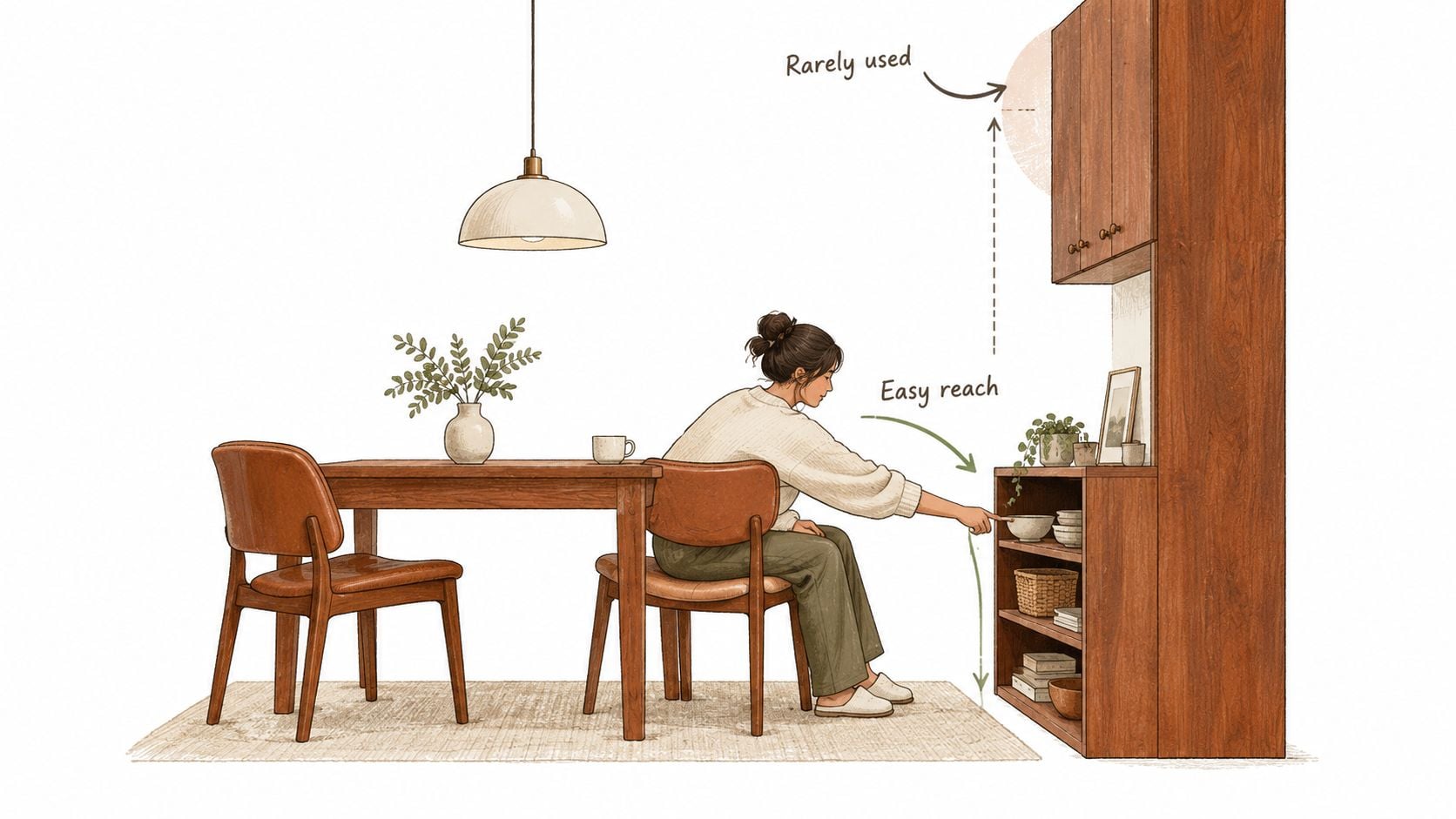
A rapid review of kitchen-ergonomics research found that high or poorly positioned cabinets can make storage harder to reach and lead to awkward reaching, bending, and lifting. A separate ergonomic study identified 800–1,100 mm above the floor as an optimal storage zone and found wall-cabinet storage above 600 mm to be about 30% less effective for women than more accessible locations. Those findings come from kitchen research, but the reach principle applies to dining rooms as well (review and study discussed in the ergonomics research).
Assign a place by frequency
| Storage Zone | Height Range | Best Contents |
|---|---|---|
| Everyday reach | Around 800–1,100 mm above the floor | Frequently used plates, glasses, linens, and serving bowls |
| Higher shelves | Above the everyday reach zone | Seasonal décor and occasional-use items |
| Lower cabinets | Below the everyday reach zone | Heavier or infrequently used pieces, provided they're safe to lift |
Treat those ranges as a planning reference, not a substitute for checking the actual users' reach. Size the most-used storage for the shorter intended user. Full-extension drawers and pull-outs can help prevent the back of a deep cabinet from becoming inaccessible storage that everyone forgets.
For aging in place, multigenerational households, or changing mobility, accessibility should be part of the initial furniture choice. Keep heavy serving pieces between hip and shoulder height where practical, and leave enough circulation space for walkers, canes, and serving carts. If a cabinet can't be used comfortably by the people who live there, its capacity isn't serving the household.
Start by listing what the family stores and how often each item comes out. Put daily dishes in easy reach, occasional entertaining pieces in closed storage, and anything used only seasonally in the least convenient zone. The guide to dining-space planning and seating arrangements can also help households check that storage placement works alongside the table and its circulation needs.
Custom Canadel and Made-to-Order Options
A fixed showroom configuration isn't the only path to a good fit. In-stock is just the beginning: a made-to-order piece can be selected or configured around the room's dimensions, the dining set already in the home, and the household's preferred finish. That matters when a standard size leaves too little walking space or a stock stain clashes with a table that's already an investment.
Canadel's dining customization program offers shoppers a broad choice of wood finishes and upholstery fabrics, and some collections allow dimensional adjustments. Across the brand's wider collection, its choices contribute to more than 9 million possible combinations, including differences in table dimensions, finishes, fabrics, bases, and other details (Canadel customization information). The available options depend on the collection and specific piece, so shoppers should confirm the choices for the item under consideration.
For dining-room storage, customization begins with the room, not a color chip. Measure the wall, note door and walkway clearances, and compare the intended piece with the existing table and chairs. Then consider finish, wood tone, hardware, and configuration. The aim isn't to match every item exactly. It's to create a room that feels considered, with pieces that work together in scale and character.
Pro-tip: Bring room measurements and a photo of the existing dining set when discussing a made-to-order piece. Those details make finish and proportion decisions more concrete.
The same principle applies to bespoke work in a home: the useful question is how a piece fits the building and the household, not whether it follows a standard template. For a broader look at that approach, bespoke carpentry for Rathmines terraces offers relevant context on tailoring woodwork to a specific space.
A custom piece is an investment, so the purchase should be planned clearly. Tyner Furniture offers Special Financing, subject to approval, and a Low Price Promise; shoppers can ask how those options apply to a made-to-order order. The guide to getting started with a custom order can help prepare for the choices involved. Customization is most valuable when it solves a real fit or finish problem, not when it adds options for their own sake.
Built-Ins Versus Movable Storage for a Forever Home
Built-ins can make use of an awkward wall and create a continuous look. They can also lock a room into one layout. A movable sideboard, server, or hutch takes up floor space, but it can move with the household through a remodel, a new dining arrangement, or a change in how the room is used.
More storage isn't automatically better. Housing evidence has highlighted a question homeowners often skip: which belongings deserve permanent space in the dining room, and which should be stored elsewhere or removed? The verified data notes that a 2025 clutter survey found 54% of respondents used 100–500 square feet for possessions rarely used, nearly three-quarters experienced stress or anxiety around clutter, and 56% bought organizational products at least annually (clutter and housing discussion). Those findings don't mean every built-in is a mistake. They do show why adding capacity without editing what goes into it may not solve the underlying problem.
Choose fixed cabinetry when
A built-in can make sense when the room has a clear, lasting purpose, the wall needs a purpose-built solution, and the household expects to stay with the arrangement. Fixed storage may also be useful where a movable piece would obstruct a door or take up needed floor space. The trade-off is reduced flexibility if the room's needs change.
Choose a movable piece when
A freestanding cabinet is a stronger choice when a household may downsize, remodel, host in different configurations, or use the dining room as a work or homework space. It can be moved, restyled, or placed in another room rather than becoming part of a renovation. A solid-wood made-to-order piece can combine that flexibility with a specific fit, rather than forcing the homeowner to choose between character and adaptability.
Before committing, sort the contents into daily, occasional, and rarely used categories. Assign a realistic amount of dining-room storage to the first two groups, then consider whether the rest belongs elsewhere. Durable furniture should support the way a home changes, not demand that the home remain frozen around it.
Styling, Finishes, and Caring for Heirloom Storage
Once the piece fits the room and its job, styling should make the storage useful and calm. Keep everyday items behind doors or in drawers if visual order matters; use open shelves or glass doors for pieces that are attractive and used often enough to justify their place. A few well-chosen objects usually give a cabinet more presence than filling every shelf.
Finish the room with intention
A warm cherry finish can bring depth to a dining room; oak and maple offer different grain patterns and tones. Hardware should feel comfortable to use and suit the character of the piece. Lighting can draw attention to a hutch's display shelves, but it shouldn't compete with the table or make the room feel overworked.
Protect the top by using serving mats or trivets where appropriate, and wipe spills promptly with a soft cloth. Water marks and other finish concerns call for care suited to the specific surface; this wood stain guide from Sweet Home Cleaning Service provides useful background on water marks. For broader protection habits, Tyner's guide to guarding wood furniture against scratches and stains can help households think through everyday care.
Allow solid wood to move
Solid wood responds to changes in indoor humidity. It gains or loses moisture and expands or contracts, with movement varying by grain direction. For furniture made in northern and central parts of the United States, technical guidance places typical wood near 8% moisture content; wood can approach fiber saturation near 30% moisture content, where dimensional behavior changes substantially (wood movement technical guidance).
That's why good construction doesn't trap wide panels rigidly on every side. Frame-and-panel or floating-panel construction allows room for seasonal movement, and sensible acclimation before final assembly helps reduce the risk of binding drawers, split panels, and warped doors. In Southeast Michigan, steady indoor conditions and careful construction support the long-term performance expected from an heirloom piece.
A practical visit should include more than looking at a finish. Open the drawers, test the doors, notice how the hardware feels, and check whether the shelves make sense for the items the household owns. The same hands-on approach helps shoppers judge ergonomic seating, including Stressless options, as well as dining storage. Tyner's selection extends from the Home Office to Outdoor Spaces, so design guidance can consider more than one room or one stage of life.
Visit Tyner Furniture's Ann Arbor showroom to compare dining storage in person, check the reach and feel of drawers and doors, and discuss made-to-order options. For special orders, browse the online Quick Specs before visiting Tyner Furniture, then bring room measurements and the pieces the new storage needs to serve.