A Buyer’s Guide to American Made Dining Chairs


A lot of dining chair shopping starts the same way. A household wants something better than what it has now. The old chairs wobble, the finish has chipped at the corners, and nobody enjoys sitting through a long dinner in them anymore. What looked fine on a screen or under bright showroom lighting didn't hold up to homework at the table, holiday meals, and the ordinary wear that tells the truth about furniture.
That's why american made dining chairs continue to matter. They answer a different question than “What looks good today?” The better question is, “What still works and still looks right years from now?” For families building a forever home in Ann Arbor or updating a dining room anywhere in Southeast Michigan, that shift in mindset changes everything. It turns a chair from a short-term purchase into part of the home's daily rhythm.
A family business that has served the community since 1957 learns something simple over time. Most regret in furniture shopping doesn't come from buying quality. It comes from buying around quality.
The Search for Dining Chairs That Truly Last
A dining chair has one of the hardest jobs in the house. It gets pulled, scooted, leaned back in, climbed on by kids, and used for far more than dinner. It hosts coffee in the morning, bills in the afternoon, and long conversations late at night. If the build is weak, the chair tells on itself quickly.
That's why many shoppers feel stuck. They can find plenty of chairs that photograph well, but not enough that feel like they belong in a home for the long haul. The market is large, yet the number of domestic makers is still relatively concentrated. The U.S. Household Furniture Manufacturing industry is projected to reach $27.1 billion in revenue in 2026, with exactly 3,656 businesses operating nationwide, according to IBISWorld's household furniture manufacturing industry outlook. That scale matters, but so does selectivity. A big market doesn't guarantee a well-built chair.
What shoppers are usually reacting to
Many people say they want “better chairs,” but they're usually reacting to a familiar list of frustrations:
- Loose joints: The chair starts to sway side to side after routine use.
- Thin surfaces: Edges nick easily and the top layer shows wear fast.
- Uncomfortable proportions: A chair may look elegant and still feel wrong after one meal.
- No path to repair: Once the surface fails or the structure loosens, replacement becomes the only option.
Practical rule: If a chair already feels light, hollow, or unstable on the sales floor, it won't improve with age.
A more useful way to shop is to think in terms of service life, repairability, and comfort over time. That's the standard behind heirloom furniture. It isn't only about style. It's about whether the chair can keep doing its job as the years pile up.
Start with the right buying lens
A dining chair should be judged on what happens after the delivery truck leaves. That means looking past the first impression and asking better questions about structure, wood integrity, and fit. A good starting point is this guide to how to choose dining chairs, which helps narrow the decision before a single finish sample gets involved.
In a region like Southeast Michigan, where homes range from classic colonials to sharp modern builds, the best choice usually isn't the trendiest chair. It's the one that still feels right after years of use, and still belongs in the room after everything else around it evolves.
What American Made Really Means for Your Dining Room
“American made” should mean more than a label. In dining furniture, it should point to better material integrity, stronger repair potential, and a chair with real substance in the hand. The difference often starts with the wood itself.
Solid wood versus surface-deep construction
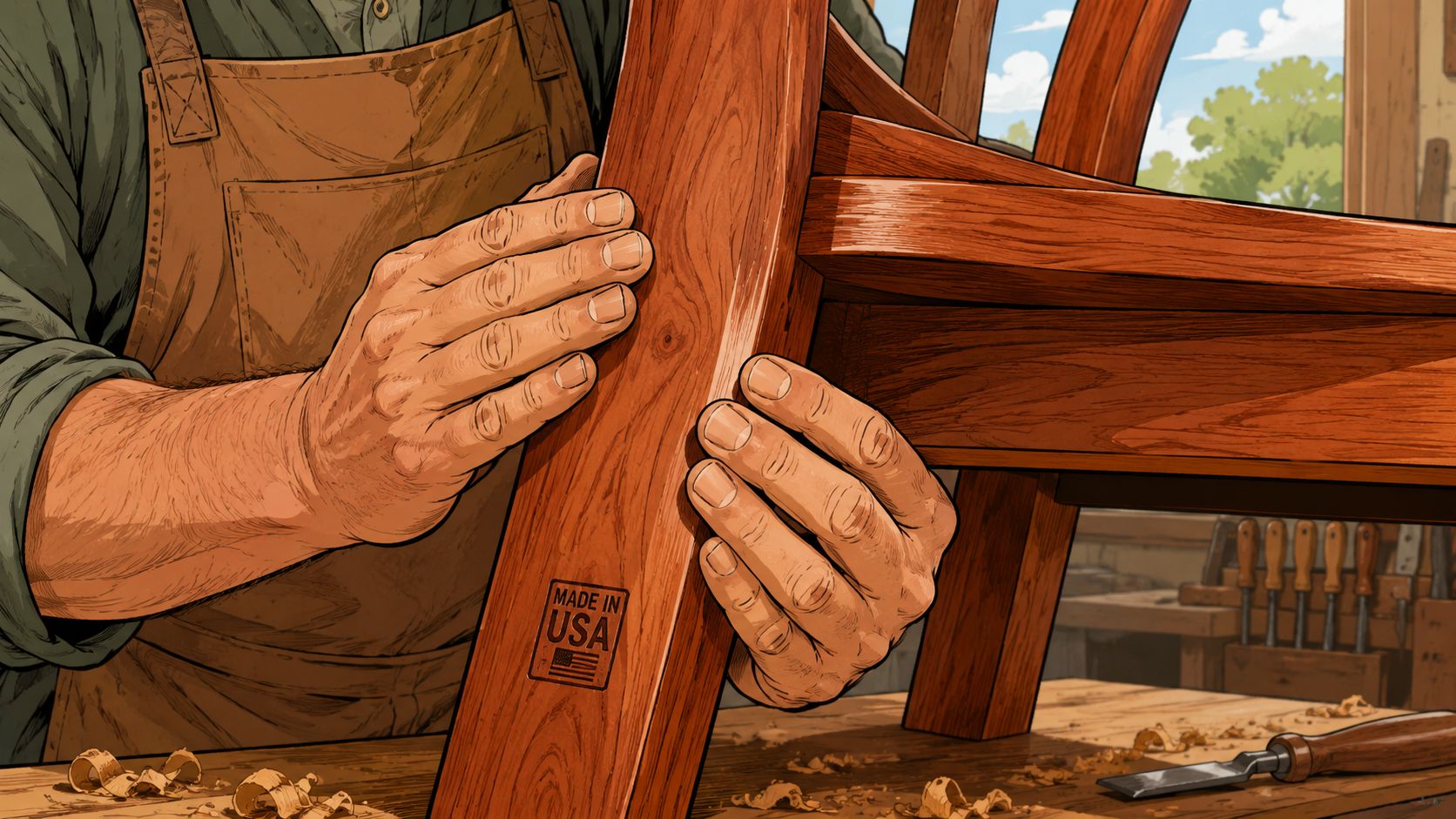
The strongest american made dining chairs are typically built from solid North American hardwoods such as cherry, oak, and maple rather than veneered composites. That choice matters because it gives the chair consistent density throughout the component instead of a thin decorative layer over a different core. According to this buyer's guide to Amish dining chairs, that material approach correlates to a 3 to 5 times longer service life in high-traffic dining environments.
That's the practical dividing line. A veneered chair may look smooth and polished on day one, but its surface and structure are often less forgiving over time. Once the outer layer is damaged, there may be little room for repair. Solid wood behaves differently. It carries visual depth, noticeable weight, and the possibility of refinishing later.
A shopper can often feel the difference before understanding it. Solid cherry has a steady, grounded heft. Maple feels dense and clean. Oak shows grain with a bold, tactile honesty. That sensory part matters because furniture is physical. It's not only seen. It's touched, leaned into, and lived with.
What to look for in the showroom
A quick material check doesn't need a workshop background. It helps to focus on a few basics:
- Edge quality: Solid wood tends to look substantial at edges and transitions, not thin or wrapped.
- Surface character: Real hardwood shows natural variation and depth rather than a repeated printed look.
- Weight and steadiness: A chair should feel planted when moved, not flimsy.
- Future maintenance: Solid wood gives owners more options if the finish needs attention years later.
A dining chair should age like a floor or a good table. It should gather character, not simply wear out.
For shoppers who like understanding how origin labels shape expectations in other home categories too, Understanding what Australian made means offers a useful parallel way to think about provenance, standards, and buying with more intention.
Those who want to see how this standard applies across the category can browse American made solid wood furniture. The main lesson is simple. If the wood core is right, the chair starts with a real chance to become an heirloom instead of a replacement cycle.
The Art of Heirloom Craftsmanship and Joinery
Good wood alone doesn't guarantee a lasting chair. A dining chair survives years of shifting weight because somebody joined the parts correctly. That invisible work is where heirloom construction separates itself from furniture that loosens with normal use.
Why joinery matters more than most shoppers realize
Dining chairs deal with constant racking force. That's the side-to-side strain created when someone shifts, leans, or scoots the chair across the floor. Weak construction usually fails at the joints first, not in the middle of a leg or seat rail.
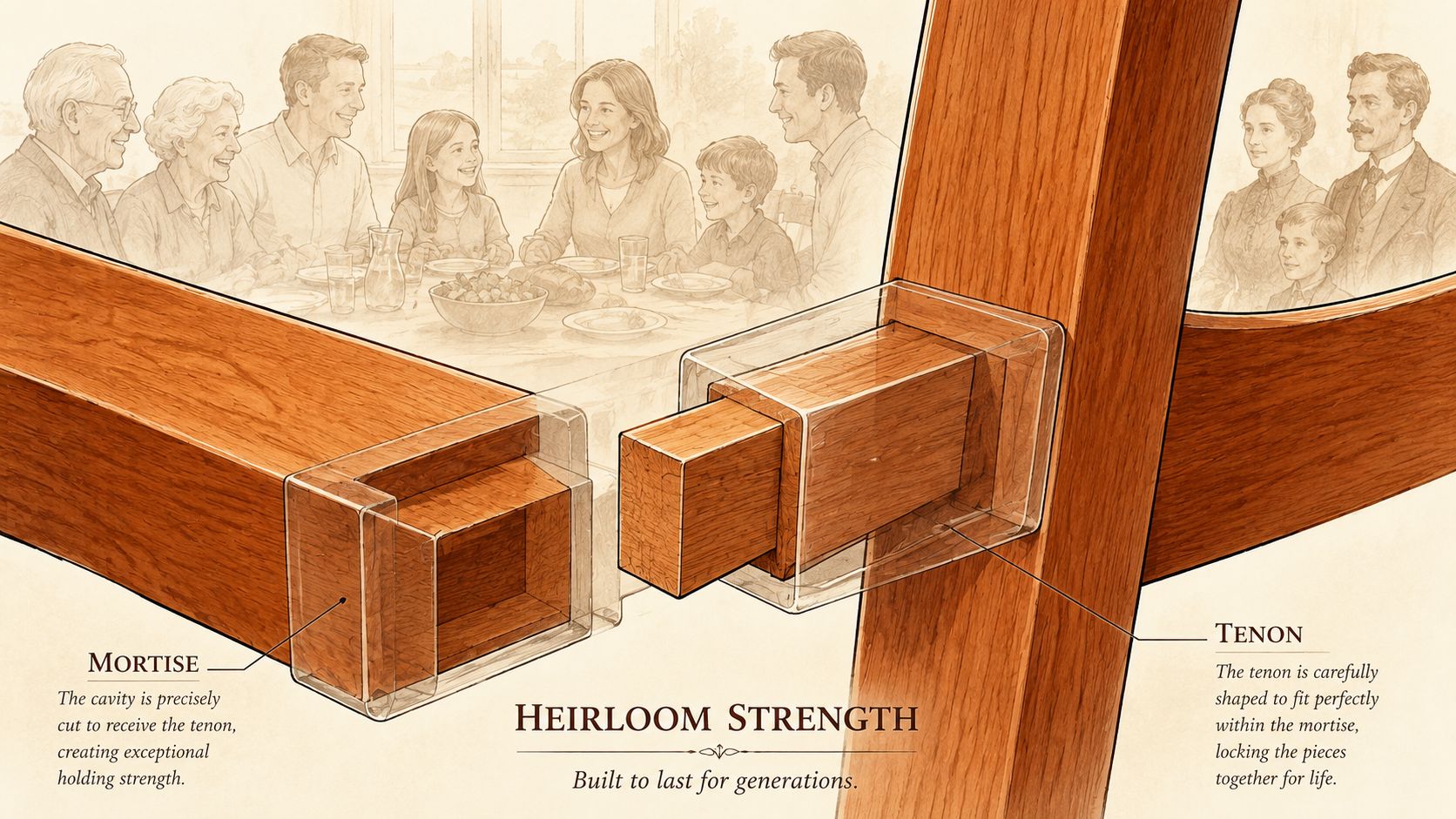
That's why traditional joinery keeps coming up in serious furniture conversations. American-made Amish dining chairs commonly use mortise-and-tenon joinery where the tenon is typically one-third of the board's thickness, creating a connection strong enough to resist racking forces without weakening the surrounding wood, as explained in this mortise-and-tenon joinery overview. In plain terms, that ratio helps the joint hold over time without relying on screws, nails, or metal fasteners to do the heavy lifting.
Another respected approach in chair and case construction is dovetailing. Along with mortise-and-tenon, it creates a mechanical bond instead of a surface bond. That distinction matters. Glue has a role, but glue alone shouldn't be the whole plan.
The difference between interlock and attachment
The easiest way to understand traditional joinery is to think in terms of interlock. One part is shaped to fit another with intention. The joint resists movement because the wood components are working together, not just attached at the surface.
Here's what that means in practical use:
- Mortise-and-tenon: Excellent for legs, rails, and structural chair frames.
- Dovetailing: Commonly prized where pull-apart strength matters.
- Simple fastener-based assembly: Often quicker to produce, but more likely to loosen under repeated daily stress.
Workshop insight: The best chair frames don't ask hardware to compensate for weak design.
A chair can have a beautiful finish and still be poorly built underneath. That's why experienced shoppers ask how the frame is joined, not just what color stain is available.
What hand-crafted construction changes
Hand-crafted work often shows itself in the small areas buyers don't always notice at first. Transitions feel cleaner. The chair sits square. Pressure points at joints don't telegraph through the frame. The whole piece feels settled.
This matters beyond dining, too. Anyone furnishing a coordinated home often sees the same values show up across case goods and upholstery. A collection like Hickory Craft furniture reflects that larger idea. Better furniture isn't merely attractive. It's resolved, inside and out.
For an heirloom chair, craftsmanship isn't decoration. It's engineering with a human hand behind it.
Finding Your Perfect Fit Style Size and Comfort
A well-built chair can still be the wrong chair if it doesn't fit the table, the room, or the people using it. Comfort isn't a luxury detail. It's the reason the chair earns its place every day.
The sit test beats the photo test
Photos flatten scale. They also hide the details that determine whether a chair feels supportive for ten minutes or for an entire evening. Back pitch, seat depth, arm clearance, and the way the front rail meets the legs all shape comfort in use.
That's why the sit test matters so much in a real showroom setting, especially in Ann Arbor where shoppers often bring a clear design point of view and equally high expectations for function. A chair may suit the interior design beautifully and still miss the mark ergonomically.
If a chair only works when no one sits in it for long, it's decor pretending to be dining furniture.
Fit checklist for daily use
Before choosing a style, it helps to check the fundamentals:
- Seat relationship to the table: Knees need room, and the apron or pedestal shouldn't crowd the sitter.
- Back support: Some people prefer a firmer upright posture. Others want a gentler, more relaxed angle.
- Width between chairs: A row that looks tidy on paper can feel cramped during a meal.
- Upholstered versus all wood: Upholstery can soften the seat experience, while wood often gives a more structured, architectural look.
Style is personal, but fit is objective. A chair should let people sit naturally with shoulders relaxed and feet grounded. If the seat is too deep, shorter sitters tend to perch at the edge. If the back is too straight, long meals can become tiring.
Matching comfort to household habits
Different households use dining spaces in different ways. A formal room used mostly for gatherings can support a more sculptural silhouette. A breakfast area that doubles as homework central usually benefits from a more forgiving back and seat.
This is also where made-to-order thinking becomes useful. In-stock is often just the beginning. Many shoppers discover that the right chair isn't just a style choice. It's a combination of dimensions, upholstery, and support details that fits the way the room works.
The same thinking shows up in other categories, too. Across the home, from the Home Office to Outdoor Spaces, the most successful rooms tend to prioritize comfort and function first. A dining chair should do the same.
The Power of Personalization With Custom Dining
One of the biggest mistakes in furniture shopping is assuming the floor sample is the only version that exists. In custom dining, it's often just the starting point.

In-stock is only the first draft
A chair may have the right silhouette but the wrong stain. The frame may suit the room while the seat fabric doesn't. One household needs a softer upholstered seat for long dinners. Another wants the crisp lines of exposed wood because the dining room already includes plenty of texture elsewhere.
That's where bespoke and made-to-order programs change the experience. They let shoppers build around the room they have, not the sample they happened to see.
A strong custom program usually allows adjustments such as:
- Wood species: Cherry, oak, and maple each bring a different visual weight.
- Finish tone: Light natural finishes read very differently from deeper, richer stains.
- Seat treatment: Wood, fabric, and leather all shift the comfort and design language.
- Configuration choices: Side chairs, host chairs, benches, and coordinated table pairings can be mixed with intention.
Where Canadel and Stressless fit into the picture
Canadel is one of the clearest examples of bespoke dining done well. It gives shoppers room to choose finishes, leg styles, shapes, and upholstery details so the final piece feels connected to the home instead of borrowed from a display. For households trying to bridge traditional craftsmanship with a more current interior design plan, that flexibility can solve problems that off-the-floor shopping can't.
Stressless belongs in the conversation for a different reason. While it isn't a dining line, it reinforces an important principle about customization. Comfort isn't one-size-fits-all. Its ergonomic sizing approach reminds shoppers that furniture works best when proportion and support are suited to the person using it.
Design note: Customization works best when it solves a real room problem, not when it adds options for their own sake.
Those exploring the process in more detail can review custom furniture made simple. It's a useful reminder that bespoke furniture doesn't have to feel intimidating. The best custom buying process is structured, visual, and easy to understand.
For many dining rooms in Southeast Michigan, the winning combination is straightforward. Start with hand-crafted construction. Add the right wood and finish. Then personalize comfort and style so the final result looks settled, not compromised.
Investing in Longevity Care and Cost Per Year
The sticker price on a dining chair tells only part of the story. A better question is how much value the chair returns over the years it serves the home.
That's where cost per year becomes the right measuring stick. A chair that lasts, stays comfortable, and can be maintained over time often costs less in the long run than a sequence of replacements. The purchase may feel larger up front, but the value spreads out over daily use, year after year.
Care habits that protect the investment
Long service life doesn't happen by accident. Even heirloom pieces benefit from smart care.
A few habits make a real difference:
- Lift rather than drag: This protects joints and reduces unnecessary strain.
- Wipe spills promptly: Dining chairs see food, moisture, and frequent cleaning.
- Use the right cleaners: Harsh chemicals can dull or damage the finish.
- Tighten attention early: If a chair ever feels off, addressing it quickly is better than ignoring it.
Solid wood also gives owners a practical advantage. It can often be maintained, refreshed, and lived with more gracefully than surfaces that depend on a thin outer layer.
Finish durability matters
The finish is not a cosmetic afterthought. It's the working shield between the wood and daily life. On custom Amish dining furniture, conversion varnish can extend finish life 2 to 3 times compared with standard lacquer, according to this overview of custom Amish furniture. That matters in dining settings where water, household cleaners, and abrasion are part of normal use.
A durable finish helps the chair keep its appearance without demanding constant worry from the owner. That's what people want from a dining room investment. They want to use it.
A good finish should support living in the furniture, not tiptoe living around it.
This value mindset also changes how people think about purchase timing. Waiting for the “perfect” moment to invest can keep a room in limbo for years. Special Financing can make a higher-quality decision manageable now, and a Low Price Promise helps lower the barrier to entry for a purchase built around long-term value rather than short-term compromise.
In that sense, longevity is both financial and practical. It's sustainable because it avoids unnecessary replacement. It's economical because the chair keeps paying back its cost over a long service life.
Why Shop Local Your Southeast Michigan Advantage
Buying a dining chair locally gives shoppers one advantage that no product listing can duplicate. It lets them verify quality with their own eyes and hands before they commit.
In a market where an estimated 60 to 70 percent of U.S. dining chair unit volume comes from low-cost import hubs, heirloom-quality domestic options are comparatively rare, according to this U.S. dining chair market analysis. That rarity makes local expertise more valuable, not less. When better construction is harder to find, guidance matters.
What local shopping adds
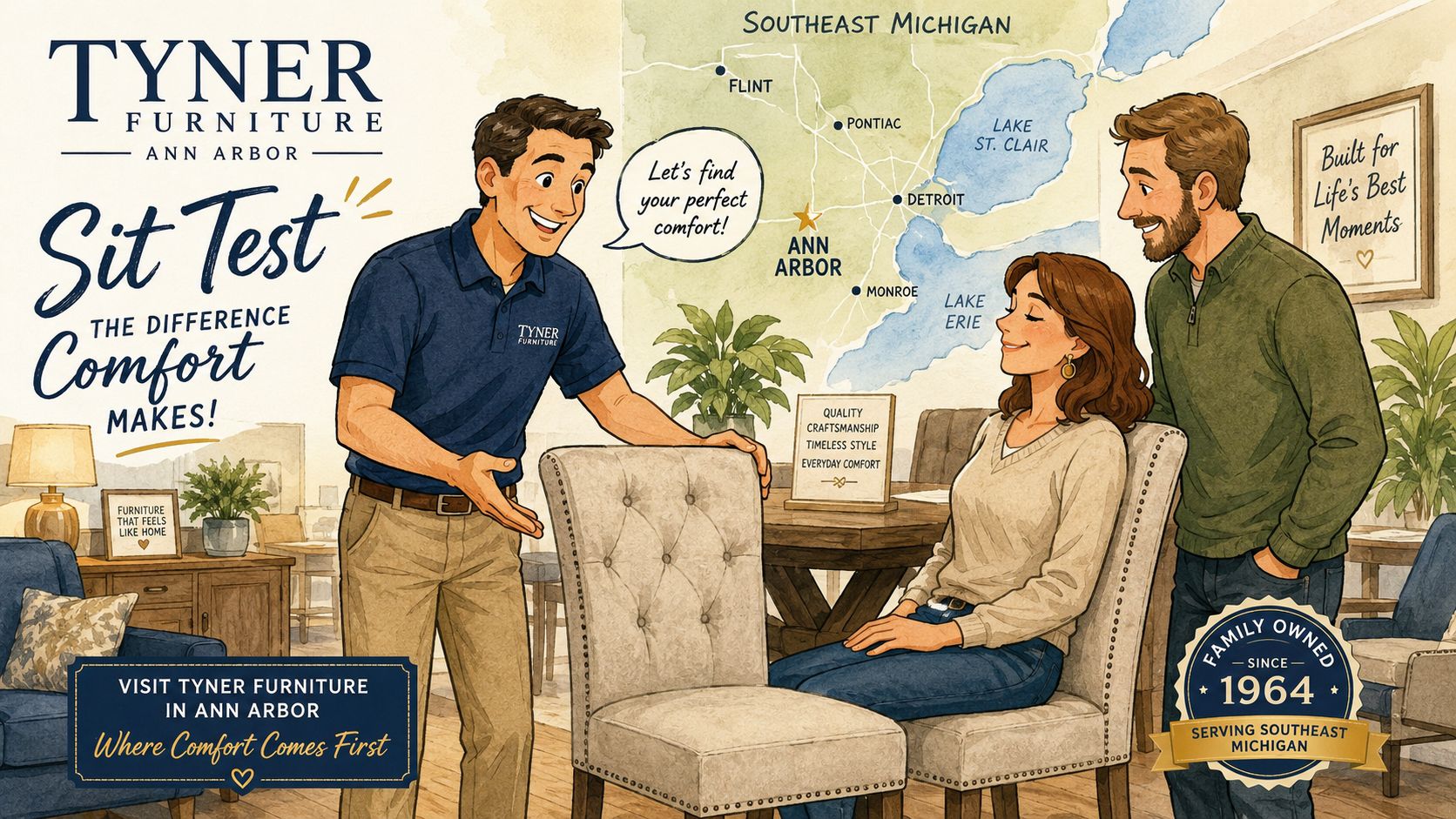
A showroom visit in Ann Arbor gives buyers a chance to do the work that screens can't do well:
- Compare woods directly: Cherry, oak, and maple each read differently in person.
- Test comfort thoroughly: Seat pitch, back support, and arm clearance become obvious fast.
- Review finish samples under real light: Color choices often shift outside studio photography.
- Ask practical questions: Delivery, special orders, and room fit are easier to solve face to face.
For Southeast Michigan households, local shopping also shortens the distance between decision and support. If a question comes up later, there's a real place to return to and a knowledgeable team to talk with.
Trust is part of the value
Longevity in business matters for the same reason longevity in furniture matters. It suggests consistency, accountability, and a local legacy built over time. A family furniture business founded in 1957 has usually helped multiple generations furnish dining rooms, bedrooms, family rooms, home offices, and outdoor spaces. That history tends to produce better guidance because it's grounded in what holds up in real homes, not just what looks appealing for the season.
For shoppers pairing chairs with a new table, American made dining tables is a useful next stop. The best dining rooms aren't assembled by accident. They're composed with proportion, comfort, and craftsmanship working together.
For shoppers ready to compare american made dining chairs in person, Tyner Furniture offers the advantage of local guidance in Ann Arbor, a long-standing Southeast Michigan presence since 1957, and a South State St. showroom where a proper sit test still matters. Browse online Quick Specs for special orders, or visit the showroom to explore bespoke Canadel dining options, hand-crafted solid wood selections, ergonomic comfort insights influenced by Stressless standards, Special Financing, and a Low Price Promise that makes long-term value easier to bring home.