White Glove Delivery Cost Explained for Furniture Buyers


White-glove delivery for furniture typically runs roughly $100–$400 per shipment, with most standard jobs landing near $150–$250, and the price is driven by labor and access, not mileage. The practical question is whether that fee covers everything needed to get the furniture safely into its intended room.
A household may have already chosen a dining table, compared wood finishes, and cleared space for its arrival. Then someone notices the narrow entryway, the stair landing, or the distance between the driveway and the dining room. For an heirloom purchase, those details deserve as much attention as the finish sample.
White glove delivery cost is better understood as a protection fee than a shipping surcharge. It pays for the handling between the truck and the finished room, where a carefully chosen piece can otherwise become a difficult moving problem.
What White Glove Delivery Actually Means
A large crate arrives outside an older Ann Arbor home. Inside sits a solid-wood dining table intended for an upstairs room, but the entrance opens onto a narrow hallway and a staircase with a tight turn. If the contracted service ends at the driveway, the homeowner still has to solve the hardest part.
That's the distinction worth understanding before checkout. Curbside delivery gets furniture to the property; white-glove service addresses the in-home work. Basic inside delivery occupies the middle ground, but the written description must establish exactly where the crew stops.
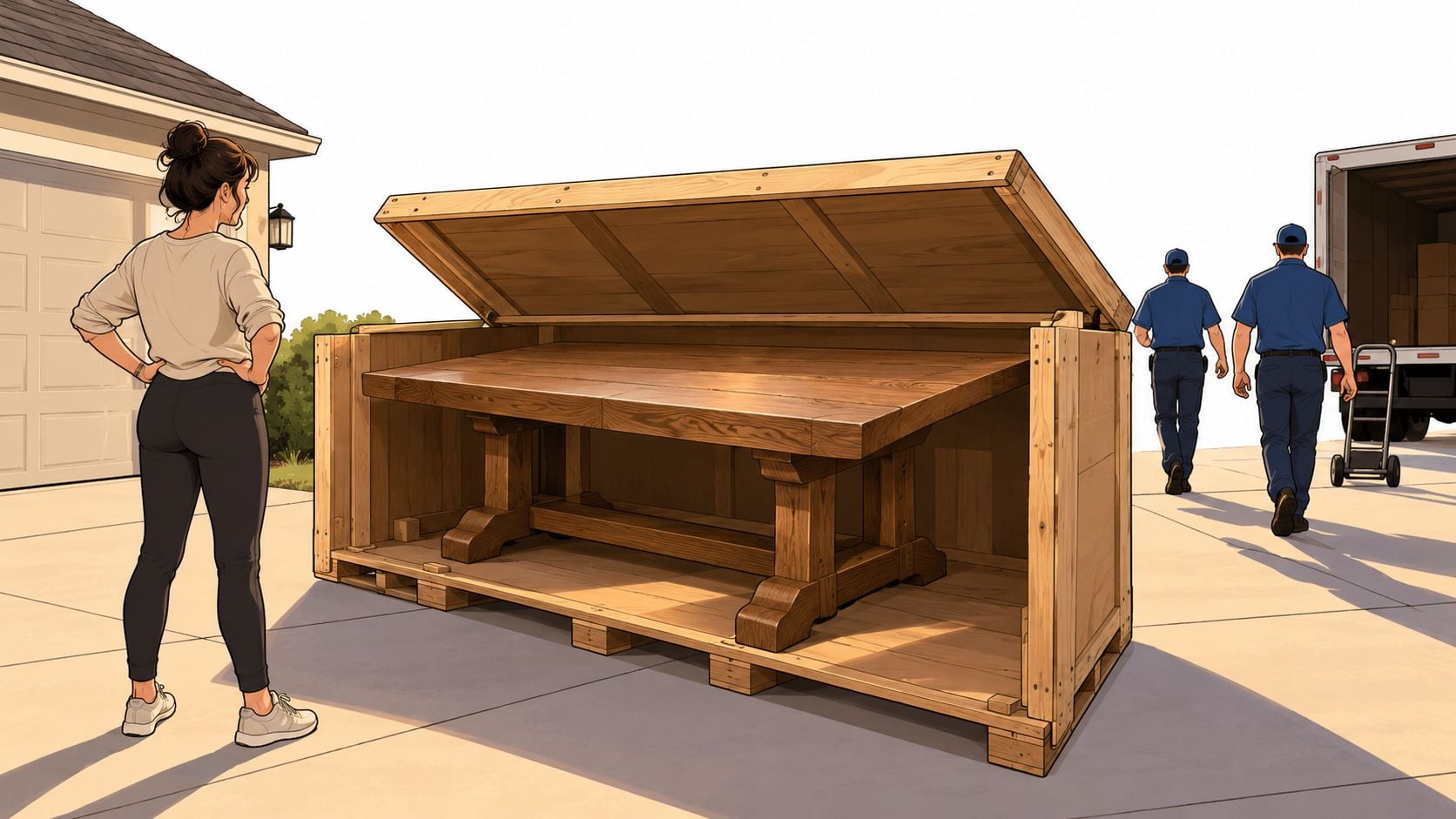
The destination matters more than the label
White-glove delivery extends beyond curbside drop-off to include room-of-choice placement, unpacking, assembly, installation, inspection, and packaging removal, which explains its position as a premium last-mile delivery service. Nevertheless, shoppers shouldn't treat the label as a complete contract. The quote needs to identify which tasks apply to the actual purchase.
For a dining table, that might mean carrying components into the dining room and assembling the base there. For custom upholstery, it might mean placing sections in their intended configuration rather than leaving wrapped components near the entrance.
- Curbside delivery: The household retains responsibility for the route from the drop-off point to the finished room.
- Inside delivery: The quote should name the stopping point, rather than relying on the word “inside.”
- White-glove delivery: The service description should identify the handling, setup, cleanup, and acceptance work included.
Craftsmanship changes the stakes
Tyner's Amish hand-crafted bedroom and dining pieces emphasize solid hardwood construction and traditional joinery, including dovetailing and mortise-and-tenon. Against mass-produced alternatives, the useful comparison is material integrity and construction, not whether both pieces look similar in a photograph.
The weight of solid cherry wood and the smoothness of a finished table edge make that distinction tangible. Those same qualities call for deliberate handling, particularly when a piece must pass through an awkward doorway.
For shoppers comparing product listings, the guide to reading furniture descriptions with confidence helps connect construction details with purchasing decisions. A higher delivery fee makes sense when it purchases a clearly defined, controlled arrival experience for furniture that's heavy, delicate, or made to order.
Six Services Hidden Inside the White Glove Fee
A delivery invoice may show a single charge, but a well-specified appointment contains several separate jobs. The household should compare those jobs, not just the total.
The distinction also matters outside furniture shopping. For families coordinating an in-home equipment arrival, DME Superstore's medical equipment delivery options offer a relevant resource to consult while identifying the help required at the destination. Furniture shoppers should take the same practical approach: determine what must happen after unloading.

The work that makes furniture ready to use
- Room-of-choice placement: The agreement names the destination room and intended position. A recliner left in the foyer isn't equivalent to one placed beside the reading lamp.
- Careful unpacking: Wrapping should be removed without dragging cutting tools across leather, upholstery, or finished wood. The important question isn't the name of the blade; it's whether the crew uses a controlled method that protects the surface beneath.
- On-site assembly: The quote identifies the required work, such as attaching a table base or connecting sectional components. “Assembly included” shouldn't leave the household guessing about the actual piece.
The work that finishes the appointment
Packaging removal means the household doesn't inherit a hallway filled with cardboard, foam, and wrapping. It should be distinguished from removal of existing furniture, which needs its own agreement.
Final inspection gives the recipient an opportunity to examine exposed surfaces, connections, and moving components. A scratch on a cherry tabletop or a torn leather panel deserves documentation, not an assumption that someone will address it later.
Property protection should also be discussed explicitly. Protective runners, blankets, and a planned carrying route are sensible requirements to confirm, rather than benefits to assume every service includes.
Pro tip: A useful quote describes the completed appointment, not merely the arrival of the truck.
For made-to-order upholstery and heirloom case goods, this vocabulary makes comparison much clearer. A lower invoice may represent less work, while a higher invoice may include services the household needs. Neither price is meaningful until the scope is visible.
What Drives the White Glove Delivery Cost
The largest variables are the furniture's handling requirements and the route into the home. Neutral logistics guidance identifies dimensions, weight, crew requirements, liftgates, stairs, narrow openings, long carries, assembly, scheduling, removal, and terminal distance as principal white-glove cost drivers, with specialized service approximately $150–$500 or more per shipment.
Distance still matters. It doesn't explain the entire bill. A nearby upper-floor Ann Arbor apartment can require more handling than a farther suburban home with straightforward ground-floor access.

White Glove Delivery Cost Drivers and Typical Price Impact
The published benchmarks below place basic inside delivery at $100–$200, stair additions at $25–$75 per flight, and full service with complex assembly at $250–$400 or more, according to delivery service pricing guidance.
| Cost Driver | Typical Price Impact | Notes |
|---|---|---|
| Basic inside handling | $100–$200 service benchmark | Not equivalent to a complete white-glove appointment |
| Stairs | $25–$75 per flight | Confirm how the carrier counts flights and landings |
| Complex assembly | $250–$400 or more for full service | This is a service range, not an assembly-only surcharge |
| Large dimensions or substantial weight | Quote-specific | May change crew and equipment requirements |
| Narrow turns and long carries | Quote-specific | Describe the whole route before accepting the price |
| Delivery distance | Quote-specific | Ask where the delivery route originates |
| Appointment restrictions and removal | Quote-specific | Identify scheduling and disposal requirements separately |
Separate transport from the in-home work
A large armoire and a boxed chair shouldn't be treated as equivalent because they travel to the same address. The armoire may require additional handling, a more complicated route, and careful positioning once inside.
For an early transportation comparison, the Endless Storage shipping calculator is a resource to consult. Any planning estimate still needs a separate check against the required in-home services and access conditions.
The most useful quote separates base transportation, room placement, assembly, difficult-access labor, and removal. Where no published fixed surcharge applies, the retailer should provide a job-specific amount rather than implying that every obstacle has a universal price.
Tipping is a separate planning question, not a substitute for defining the service. Tyner's white-glove delivery tipping guide addresses that topic without confusing the contracted delivery fee with discretionary appreciation.
Ann Arbor and Southeast Michigan Access Realities
National price ranges can't describe the staircase in a particular Ann Arbor home. A household's actual route may include an entry vestibule, a radiator beside a doorway, or a landing that looks generous until a long cabinet reaches it.
The right approach is to describe the route as a sequence of obstacles. Room dimensions alone aren't enough; the furniture must reach the room before its layout matters.
Different homes create different handling problems
An older two-story colonial might offer plenty of bedroom space but a narrow stairwell. The relevant issue is stair geometry, especially the landing and clearance above the turn. A photograph from each end of the staircase can help staff understand what a floor-plan sketch misses.
A downtown condo presents a different problem. The elevator may accommodate the furniture, but building management may require a reservation, a designated loading area, or permission to use a particular entrance. The household should confirm those requirements before a delivery appointment is scheduled.
In a ranch home, the entrance may be easy while the destination family room sits far from the driveway. That's a long-carry question, not a stair question. A suburban home with a curved entry staircase may instead require attention to turning clearance and the shape of the piece.
An access checklist worth completing
- Parking and unloading: Identify where the truck can stop and whether the route crosses steps, slopes, or landscaping.
- Openings: Record usable doorway and hallway clearance, including trim and protruding hardware.
- Stair turns: Capture landings, overhead clearance, handrails, and changes in direction.
- Elevator arrangements: Confirm interior dimensions, door openings, booking rules, and permitted delivery hours.
- Final placement: Clear the destination and identify the intended furniture orientation.
The furniture measuring guide provides a useful starting point for gathering those details. Measurements and route photographs can then be brought to the South State St. showroom for a practical discussion.
An access condition disclosed before quoting is a planning problem. The same condition discovered at the door can become a billing dispute.
Honest Southeast Michigan pricing should reflect the home as it is. A household shouldn't have to choose between an unrealistic initial quote and an unexpected delivery-day addition.
Matching the Service Tier to the Purchase
Not every purchase needs the most extensive handling package. A small accessory and a bespoke dining table create different obligations, even when both belong in the same room.
The sensible choice is the least extensive tier that fully completes the required job. That's different from choosing the lowest advertised price and hoping the crew fills the gaps.
Compare the outcome rather than the tier name
| Service Tier | Appropriate Purchase Situation | What Must Be Confirmed |
|---|---|---|
| Room-of-choice placement | A manageable chair or accessory with straightforward access | Exact destination, unpacking expectations, and cleanup |
| Placement plus assembly | A bedroom grouping or sectional needing setup | Named assembly tasks and the completed configuration |
| Complex-access service | A substantial armoire or dining table facing difficult access | Route approval, equipment, extra handling, and exclusions |
For a single chair, placement may be the essential service. For a bedroom suite, assembly and component positioning can be central to the purchase. For an imposing solid-wood cabinet, the access plan may matter more than any setup work.
Shoppers should also ask whether hoisting, additional flights, storage, and old-furniture removal fall outside the chosen tier. A broad service name shouldn't be interpreted as permission to perform every possible installation or moving task.
Customization makes the specification more important
At Tyner, in-stock is just the beginning. Canadel offers bespoke dining choices, while Stressless brings ergonomic seating options into the selection process. Fabrics, finishes, sizing, and configurations allow the purchase to suit the household rather than forcing the household to accommodate a showroom example.
Those choices should inform the delivery discussion. A sectional's selected configuration, for example, belongs in the order documentation and the placement plan, not only in the interior design conversation.
- Prioritize the difficult task: Identify whether carrying, assembly, or access is the main challenge.
- Confirm the exclusions: Establish who handles any work outside the selected tier.
- Document the finish line: Describe how the room should look when the appointment ends.
The guide to the furniture buying journey helps place these decisions alongside selection and ordering. The heavier or more customized the purchase, the less room there should be for unwritten assumptions.
The Risk Question Most Delivery Articles Never Ask
A competitive delivery quote isn't automatically good value. The more important question is what happens if the furniture arrives damaged, cannot pass through the approved route, or requires another appointment.
Public complaint records include reports of damaged or missing goods and dissatisfaction with claims handling; the delivery complaints and policy discussion also highlights the risk of attempted-delivery and return-to-warehouse charges when access is inadequate, the recipient is unavailable, or the location is inaccessible. Those examples aren't grounds for distrusting every carrier, but they are grounds for reading the terms.
Questions that belong before booking
- Inspection before acceptance: May the recipient inspect the furniture before signing, and how should an exception be recorded?
- Concealed damage: What reporting method and deadline apply when damage becomes visible after unpacking?
- Repair or replacement: Who evaluates the issue, and which remedies are available?
- Failed access: Who pays if the furniture cannot fit despite measurements submitted before delivery?
- Redelivery and storage: Which circumstances trigger another charge?
- Responsibility for the claim: Does the household contact the retailer, the carrier, or both?
A protection fee isn't an insurance policy
Careful handling and written remedies serve different purposes. The first addresses how the crew performs the job; the second addresses what happens if something goes wrong. A household needs both, particularly for an heirloom piece chosen around a specific wood, finish, or family use.
The most useful written delivery promise identifies an accountable contact and explains the next step. Vague reassurance about taking care of problems isn't a substitute for a reporting process.
Practical rule: The stronger quote explains both successful delivery and unsuccessful delivery.
Property condition deserves attention too. Pre-arrival photographs can establish existing marks, while the guide to protecting floors from furniture supports planning for the piece after placement.
The final decision should consider the total exposure, not only the appointment charge. A modest saving loses its appeal when the household inherits uncertain return transport, unclear claims responsibility, or another bill before the furniture can be used.
How Tyner Delivers White Glove Service With Local Care
Tyner's local legacy began in 1957, and its South State St. showroom gives Southeast Michigan households a place to discuss selection and delivery together. The range extends from the Home Office to Outdoor Spaces, so the handling plan should match the particular purchase rather than a generic shopping category.
The showroom also makes materials easier to evaluate. The buttery feel of top-grain leather, the proportions of a Stressless recliner, and the finish of an Amish bedroom piece offer information that photographs alone can't supply.
Plan the complete investment at ordering
Domestic made-to-order furniture commonly requires 8–16 weeks, while sectionals and complex configurations often take 12–16 weeks, according to custom furniture lead-time guidance. Delivery planning should therefore begin when the order is placed, not after production is complete.
- Clarify the total: Request a written furniture-and-delivery breakdown based on the submitted access information.
- Discuss Special Financing: Subject to credit approval, financing can spread the purchase across monthly payments; applicable terms still deserve careful review.
- Review the Low Price Promise: Competitive product value and a properly specified delivery appointment should be considered together.
Cost-per-year is a useful purchasing lens: consider the complete investment against the period the household expects to use the piece. It's a way to think about value, not a guaranteed lifespan calculation.
Durability, craftsmanship, and repair-minded ownership also support a sustainable approach to furnishing without requiring an unsupported environmental claim. A piece selected for long service deserves an arrival plan that respects the same intention.
Tyner offers made-to-order Canadel dining, ergonomic Stressless seating, and Amish solid-wood furniture, with delivery planning considered alongside the purchase. Households can visit Tyner Furniture at the Ann Arbor South State St. showroom for a Stressless sit test and bring access measurements for a delivery discussion, or browse the online Quick Specs for special orders. Furniture chosen to become an heirloom deserves handling that matches the care invested in choosing it.