Solid Cherry Wood Furniture Guide: What to Know


What makes a cherry table an heirloom rather than just a table with a cherry-colored finish? The answer lies beneath the surface, in the species, the way the boards respond to indoor conditions, and the joinery holding each component together. Shoppers in Ann Arbor and across Southeast Michigan often compare a beautiful showroom finish with a lower-priced mass-produced alternative, but appearance alone can't reveal material integrity.
Solid cherry wood furniture deserves a closer look because its value develops over time. The color changes, the wood moves with the seasons, and carefully built joints can keep serving a household long after a surface-only piece has lost its appeal. Since 1957, Tyner Furniture has helped local households evaluate those differences across dining rooms, bedrooms, home offices, living spaces, and outdoor areas.
Why Solid Cherry Wood Furniture Is a Timeless Choice
A family gathers around a dining table after years of ordinary meals and important celebrations. The tabletop carries small signs of life, while the cherry itself has developed a deeper, warmer tone. It doesn't look frozen in the condition it had on delivery. It looks settled into the home.
That transformation begins with the species. Black cherry, Prunus serotina, is the principal cherry species used for commercial lumber in North America, and its natural range extends across much of eastern North America. The USDA describes the wood as medium-density, firm, strong, fine-textured, and uniform, qualities that help explain its use in solid dining furniture, cabinetry, case goods, and bedroom pieces. The USDA Forest Products Laboratory's cherry wood profile also notes that freshly milled cherry typically appears light pink to reddish brown before exposure to light deepens it toward a richer reddish brown.

A color that becomes part of the story
Cherry's fine texture gives it a smooth, composed appearance. Its grain generally supports both traditional and transitional interiors without competing with the room, while its natural color brings warmth without relying entirely on a heavy stain.
That color evolution can surprise buyers. A new cherry table may not match an older cherry cabinet perfectly on the day it arrives, because the two pieces may be at different stages of light exposure. Over time, the newer piece can develop a more coordinated tone, although direct sunlight and objects left in one position can create uneven areas.
Practical rule: A cherry finish should be judged as a living color, not as a fixed paint sample.
The distinction between solid cherry and a cherry-colored engineered surface also matters. A veneer can present an attractive appearance, but a solid hardwood top offers the weight, tactile depth, and repair potential associated with substantial lumber. Buyers exploring American-made construction can review American-made solid wood furniture to see how material and construction choices shape the ownership experience.
For a relaxed room direction, shoppers may also find useful visual context in cozy rustic styles at SouthShore Fine. Cherry doesn't have to look formal. Its refined grain can work with simple textiles, natural textures, and comfortable spaces.
The most useful way to think about cherry is as an heirloom material. It offers beauty at delivery, but its deeper value appears through years of use, careful care, and the craftsmanship that lets a dining table, dresser, or home office piece remain relevant as a household changes.
Understanding the Physical Properties of Cherry Wood
Cherry's appeal isn't limited to color. Its physical properties give furniture makers a practical balance between workability and everyday resilience. The USDA reports an oven-dry specific gravity of approximately 0.53 and a Janka hardness of about 950 lbf for black cherry. Those figures place it in a useful middle ground, firm enough to resist ordinary household dents better than many softwoods, yet workable enough for shaped edges, fine joinery, and detailed furniture components. The USDA wood reference for black cherry supports this combination of density, strength, and workability.
Why stability matters in a dining room
Properly dried cherry is described as stable under normal indoor changes in temperature and relative humidity, but stability doesn't mean that the wood stays dimensionally frozen. Wood exchanges moisture with the surrounding air. Movement occurs primarily across the grain, while lengthwise movement is comparatively small.
Published cherry shrinkage values are approximately 3.7% radial and 7.1% tangential, producing a tangential-to-radial ratio near 1.9. USDA-derived coefficients summarized in the supporting research estimate about 0.31% tangential and 0.16% radial dimensional change per percentage-point change in moisture content. In a simplified example, a 12-inch flatsawn component exposed to roughly a 6-point moisture swing could change width by approximately 0.22 inch. The Forest Service research on cherry shrinkage and hardness emphasizes that actual movement depends on grain orientation, board cut, moisture history, and restraint.
That explains why a quality solid cherry table needs movement-tolerant construction. A wide top may use elongated fastener holes, floating panels, or other methods that let the boards expand and contract without splitting or forcing joints apart.
What homeowners should expect
A dry heated winter can make a tabletop contract across its width, while humid summer conditions can encourage expansion. Small seasonal fit changes in drawers, doors, or table components aren't automatically signs of poor workmanship.
The strongest protection comes from properly dried stock, acclimation before assembly, balanced finishing on all faces and edges, and indoor conditions that avoid sharp swings. Shoppers can explore North American hardwoods to compare how species differ, but the construction details remain just as important as the species label.
Cherry vs. Other Hardwoods, Oak, and Maple
Cherry makes the most sense when its strengths match the room and the household's priorities. Oak, maple, and cherry can all produce durable furniture, but they create different visual and tactile experiences.
| Wood | Visual character | Typical design impression | Practical consideration |
|---|---|---|---|
| Cherry | Fine, relatively uniform grain with a tone that deepens | Warm, refined, and quietly formal | Color evolves with light exposure |
| Oak | More prominent grain and visible patterning | Grounded, traditional, and expressive | The grain can become the room's strongest visual feature |
| Maple | Lighter appearance and cleaner grain | Crisp, bright, and adaptable | Often chosen when a lighter foundation is preferred |
Cherry's appeal comes from the combination of restrained grain and changing color. Oak tends to announce its grain more clearly, which suits shoppers who want visible texture and a sturdy, traditional presence. Maple offers a lighter starting point and a clean surface for a range of interior design directions. Neither alternative is automatically better. The right choice depends on whether the room needs warmth, contrast, visual texture, or a lighter backdrop.
Finish and color should guide the decision
Cherry can be finished to emphasize its natural warmth rather than conceal it. Its color progression also means that a room planned around cherry should allow for change. A new piece might look lighter than an established cherry interior at first, then become richer as it receives ambient light.
Oak and maple can also accept finishes, but a stain can't reproduce cherry's particular combination of grain, undertone, and gradual deepening. Buyers comparing samples should ask whether they're looking at the actual species or a color designation. “Cherry finish” may describe a tone rather than the wood itself.
Black cherry's supply story adds another layer. The species has a broad biological range, but high-quality commercial concentrations have historically been centered more narrowly in the northern Allegheny and adjacent plateau regions. It maintains a growth advantage over associated species for approximately 60–80 years in mixed stands, a fact documented by the USDA Forest Service black cherry silvics profile. That doesn't indicate immediate scarcity, but it reinforces the value of responsible sourcing and long service life.
A wood species should be selected for the room's light, the household's habits, and the desired aging pattern, not just for the name on a finish card.
For a Southeast Michigan home, cherry can bridge traditional architecture and more contemporary interiors. Its warmth works with natural fabrics and darker accents, while its smooth grain keeps a space from feeling visually crowded. Oak may suit a room that needs stronger texture, and maple may suit one that benefits from brightness. The comparison becomes clearer when shoppers handle full-size pieces rather than relying on small online swatches.
How to Evaluate Quality, Joinery and Construction
Two pieces can both carry a “solid wood” label and still differ substantially in service life. The deciding evidence often appears inside a drawer, beneath a tabletop, or where a leg meets a frame.
Start with the joints
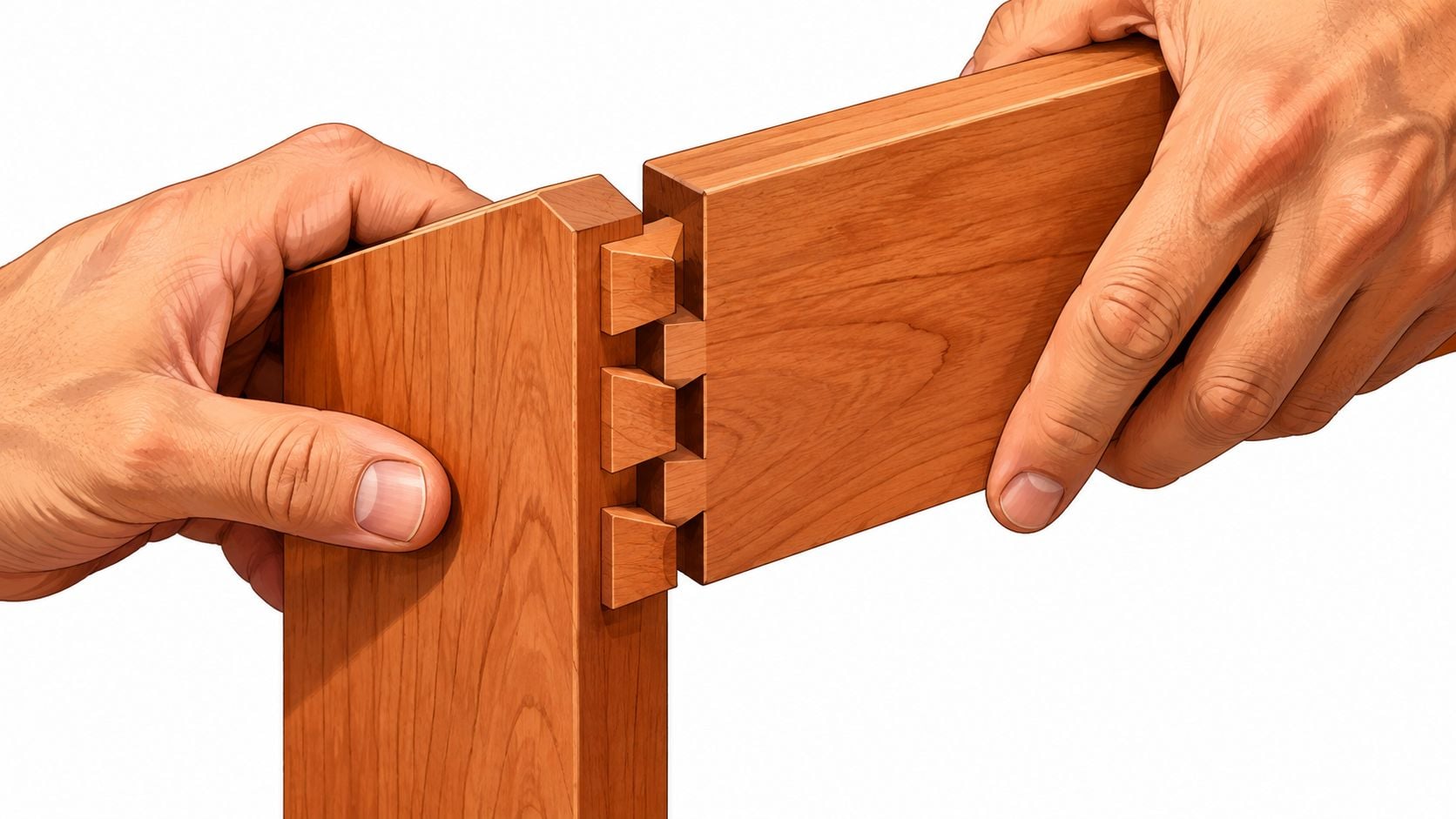
A mortise-and-tenon joint places one shaped component into a matching opening in another. A dovetail uses interlocking pins and tails, especially useful in drawer boxes and case construction. These methods create mechanical structure before glue completes the connection.
Independent joint testing found that a traditional mortise-and-tenon joint, with the tenon cheek and shoulder cut from the same stock, withstood more than 26 kilonewtons of applied load before elastic failure. A common No. 20 biscuit joint handled just over 12 kilonewtons, roughly half as much. The comparative furniture-joint study provides useful context for why joinery deserves more attention than a polished exterior.
The figures don't mean every furniture joint will experience those loads in a home. They do show why traditional construction can offer a stronger foundation than relying on a small inserted biscuit or hardware alone.
Use a showroom inspection routine
A shopper doesn't need to be a cabinetmaker to notice meaningful differences.
- Open every drawer. Look for dovetails, solid-feeling drawer components, even gaps, and a smooth close rather than rattling or flexing.
- Inspect the underside. Tabletop attachment should allow cross-grain movement rather than rigidly trapping a wide solid panel.
- Examine the corners. A frame that meets cleanly and feels rigid often reveals more than a decorative front.
- Run a hand across the finish. The surface should feel consistent along the top, edge, and corners.
- Ask what is solid. Confirm whether the top, legs, drawer fronts, backs, and drawer bottoms use solid lumber or engineered components.
A careful shopper can also ask how screws and fasteners supplement the primary joinery. A reference on PoziDriv screws for wood can help explain why fastener design matters, but screws shouldn't be treated as a substitute for sound wood-to-wood construction.
Separate appearance from material integrity
Cherry veneer can be useful in appropriate applications, but it isn't the same as solid cherry throughout. Veneer may offer grain stability and efficient use of lumber, while solid wood provides a different experience of weight, edge treatment, repairability, and long-term material depth.
For dining and bedroom furniture, Amish hand-crafted construction deserves close inspection because the joinery, not just the stain, defines the piece. Information about mortise-and-tenon construction can help shoppers recognize the purpose of the joint and ask more precise questions.
Inspection advice: The most revealing parts of a piece are often the ones a camera doesn't emphasize, the drawer box, the underside, the back edge, and the connection between rails and legs.
Dovetail geometry also matters. Research on dovetail-connected furniture boxes found that the ratio between hole depth and slope height affected compression and tensile strength. At a ratio of 75%, the tested box achieved its highest strength, while 50% produced the lowest strength and more severe damage under loading. The result is a useful reminder that “dovetail” alone doesn't describe every construction detail. Proportion, glue surface, stock quality, and fit all contribute to performance.
Caring for Your Cherry Furniture, Finishes and Maintenance
Cherry furniture rewards consistent care rather than complicated routines. Dust with a soft cloth, protect surfaces from standing moisture, and use coasters or mats beneath items that could leave rings or concentrated heat.
A finish slows moisture exchange, but it doesn't eliminate wood movement. It also can't prevent light from changing cherry's tone. Independent wood-aging research summarized in the available guidance reports that roughly 80% of cherry's color change may occur during the first 6–12 months of light exposure, while oxidation and continued exposure deepen the tone for several years. The cherry color-change guidance also notes that sunlight is a major driver and that American cherry showed comparatively good photostability among tested woods.
Plan for color instead of fighting it
Buyers matching existing cabinetry should photograph the room in daylight, request a finish sample, and ask whether the proposed finish is oil-based or water-based. A showroom sample, a delivered piece, and an older table may all represent different stages of the same color journey.
During the initial period, placing a new piece away from intense direct sun can reduce uneven exposure. Rugs, lamps, centerpieces, and decorative objects can create shadow areas if they remain stationary, so tabletop objects should be rotated periodically.
The most useful planning question isn't whether cherry will change. It will. The better question is whether the room can welcome the richer future tone.
Keep maintenance gentle and construction respected
Avoid abrasive cleaners and aggressive polishing products unless the furniture maker specifically approves them. For a scratch or dent, a repair professional should evaluate the finish and the depth of the damage before any touch-up, especially on a made-to-order or hand-crafted piece.
Customers considering a new table can compare tabletop finishes and discuss how sheen, color, and protection affect daily use. A finish should support the wood's character, not hide it under unnecessary color.
Cherry's evolving color isn't a maintenance defect. It's part of the design, and it should be considered alongside rugs, walls, lighting, and existing case goods.
Consistent indoor conditions also matter. Seasonal movement is normal, but sharp swings, direct heat, or prolonged sun can increase stress. Proper care preserves both the finish and the story the furniture develops through use.
Why Choose Tyner Furniture for Your Cherry Pieces
What should a good furniture store help you understand before you commit to solid cherry? The answer goes beyond stain cards and room dimensions. A useful retailer should be able to explain what the wood is, how the piece is joined, what can be customized, how the finish will live in your home, and what delivery and service will look like after the sale.
Tyner Furniture has served Southeast Michigan since 1957, with an Ann Arbor showroom on South State St. Its selection includes Home Office, living spaces, entertainment areas, mattresses and sleep systems, and Outdoor Spaces, which helps shoppers coordinate rooms that need to work together instead of buying each piece in isolation.
Customization starts beyond the showroom floor
A showroom sample is only the starting point. For many households, the better question is whether a piece can be adjusted to the room, the traffic pattern, and the way the family actually uses it.
Made-to-order options can help with finish, dimensions, configuration, fabrics, and upholstery details. That matters with cherry because proportion and construction affect more than appearance. The right table size changes how a room moves. The right finish helps new cherry sit more naturally beside older wood tones that may already have deepened with age.
Shoppers ready to compare layouts in person can browse cherry dining room sets to see configuration and finish options side by side. That kind of comparison is hard to judge on a screen, especially when chair spacing, table shape, and visual weight all affect comfort.
Good guidance also helps people ask smarter questions. Does the extension system feel sturdy when opened and closed? Do drawers move cleanly? Do the joints look built for years of seasonal movement, or just for the sales floor? Those are the details that separate a solid cherry purchase from a piece that only photographs well.
Value includes service life and purchase flexibility
Value of solid cherry usually shows up over time. Well-made solid wood furniture is often kept and used for decades, while lower-cost alternatives made with particleboard or MDF are more often treated as shorter-term purchases. The lifecycle comparison for solid-wood furniture offers a general framework for thinking about service life, but any individual piece will still depend on its joinery, finish, daily use, and the indoor conditions around it.
That is why an in-person evaluation matters. Weight alone is not proof of quality, but it can tell you something. So can drawer movement, door alignment, surface depth, and how firmly a chair feels under a shifting seated load. Joinery works like the skeleton of the piece. If that structure is weak, attractive wood and finish choices cannot compensate for it for long.
Financing can lower the immediate barrier, but the promotion terms deserve careful review. A deferred-interest offer is different from a true interest-free loan. On a $2,400 purchase under a 12-month deferred-interest plan, paying roughly $200 per month would be necessary to clear the principal before the deadline, excluding taxes and fees. Buyers should confirm the promotional length, required minimum payments, APR afterward, and whether unpaid interest is retroactive. This furniture financing guide explains the distinction.
Tyner's Low Price Promise is another factor to weigh, but the showroom may be even more useful for many buyers. Ann Arbor and Southeast Michigan shoppers can test comfort, inspect finish depth, and feel the steadiness of solid cherry in person. A sit test often answers questions that a product photo cannot.