Top Grain Leather vs Bonded Leather: A Buyer’s Guide

A shopper stands in front of two sofas, running a hand across each arm. One surface feels supple and warm, with a softness that invites a second touch. The other looks smooth and tidy, but the feel is cooler and more uniform. That small moment often decides whether a furniture purchase becomes a long-term investment or a temporary solution.
For many households in Ann Arbor and across Southeast Michigan, leather shopping gets confusing fast. Labels sound similar. Price tags vary widely. And consumers aren't trying to become leather experts. They want a sofa, recliner, or dining chair that looks good now and still makes sense years from now.
That's where the key question sits. In top grain leather vs bonded leather, the better choice usually isn't about finding a winner in every situation. It's about understanding what kind of ownership experience fits the home, the budget, and the timeline. Since 1957, local shoppers have leaned on careful guidance to make that decision with more confidence, whether they're furnishing a living room, home office, dining space, bedroom, or even planning for outdoor spaces and coordinated interiors.
Table of Contents
- The Leather Decision in Your Living Room
- Understanding Top-Grain Leather The Hallmark of Quality
- Defining Bonded Leather A Manufactured Alternative
- A Head-to-Head Comparison for Your Home
- The Environmental Choice Longevity as Sustainability
- Choosing the Right Leather for Your Lifestyle
- Your Invitation to the Ann Arbor Showroom
The Leather Decision in Your Living Room
Leather isn't just a color or a finish. It changes how furniture feels, how it ages, and how often a household may need to replace it. That's why top grain leather vs bonded leather matters so much on pieces people use every day, especially sofas, recliners, sectionals, and dining seating.
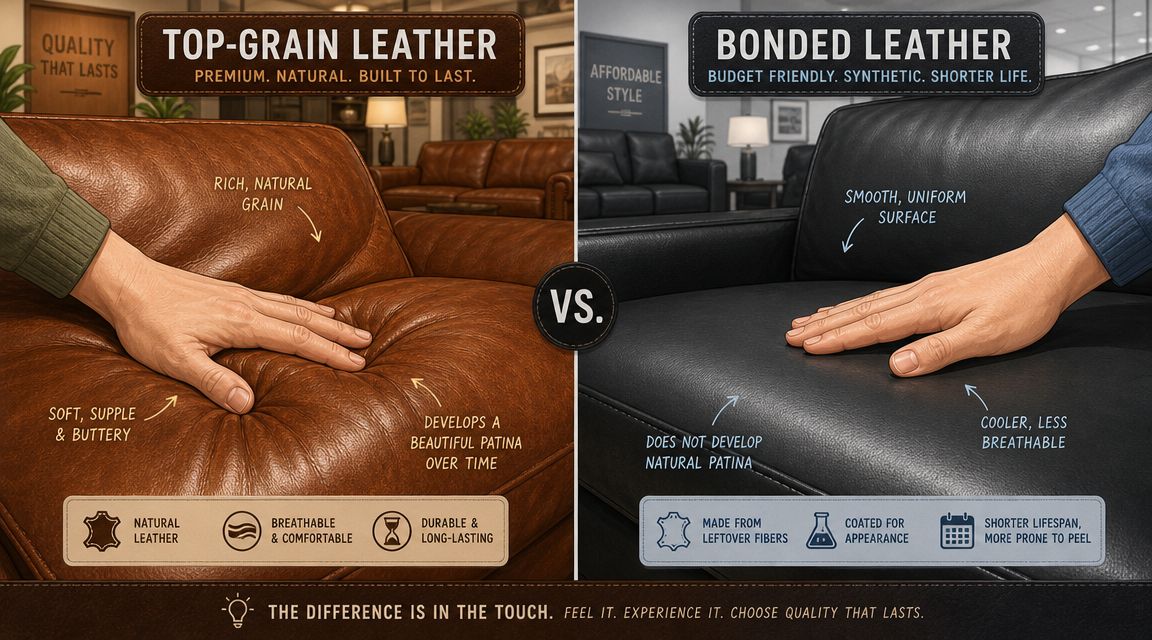
The confusion usually starts with the word “leather.” Both materials may carry that word, but they aren't made the same way and they don't perform the same way. One is a higher-grade cut from the hide. The other is a reconstituted material made from leftovers and binders. For a shopper trying to balance comfort, craftsmanship, and value, that distinction changes everything.
A practical way to think about the choice is this:
- Investment seating: Furniture meant for the main living room, daily family use, or a forever-home purchase usually calls for a material that can support years of regular use.
- Temporary seating: Furniture bought mainly to fill a room quickly or meet a short-term need may prioritize a lower upfront price over longevity.
- Design alignment: Premium upholstery belongs best on frames with equal staying power, especially when the goal is heirloom quality rather than quick replacement.
Practical rule: The more often a seat gets used, the more material quality matters.
This is the same mindset careful furniture shoppers already use in other parts of the home. In dining and bedroom furniture, solid wood with hand-crafted joinery is judged differently than mass-produced veneer pieces. Upholstery deserves that same level of attention. A sofa isn't just purchased. It's lived on.
For shoppers comparing options on South State St. in Ann Arbor, the smartest first step isn't asking which piece costs less today. It's asking which one will still feel like a good value after years of use.
Understanding Top-Grain Leather The Hallmark of Quality
What top-grain actually means
Top-grain leather comes from the top layer of the hide and is sanded or buffed to create a more uniform finish. That construction is one reason it's treated as a premium upholstery material, while bonded leather is a composite that may contain as little as 10% to 20% real leather, making it a fraction of the price, as described in this overview of leather types.
That definition helps clear up one of the biggest misunderstandings in furniture shopping. Top-grain isn't a marketing nickname. It describes where the material comes from on the hide and how it's refined. It's still real leather, with natural character beneath a more consistent surface.
For a homeowner, that usually translates into a few noticeable traits:
- Smoother appearance: Sanding and buffing help create a more even surface.
- Natural substance: It still begins as the top layer of the hide, not as scraps pressed together.
- Premium feel: Many shoppers recognize it immediately by touch. It often feels softer, richer, and less plasticky than lower-grade alternatives.
How it feels in everyday use
Top-grain leather often appeals to people who want furniture to feel substantial without looking overly rustic. It has a polished look that works well in many interiors, from tailored urban condos to larger family homes in Southeast Michigan. On a recliner, it can feel refined and ergonomic. On a sectional, it can anchor the entire room.
That sensory difference matters. Upholstery is one of the few furniture materials that people interact with using sight, touch, and movement every day. The hand feel, the slight give when seated, and the way the surface responds over time all influence whether a piece still feels satisfying after the excitement of delivery has passed.
A good leather seat shouldn't only look finished in the showroom. It should still feel right on a quiet Tuesday night years later.
For readers who want a broader primer on upholstery choices before narrowing the field, this guide to upholstery materials offers useful background. Those exploring leather goods and finishes more broadly may also find it helpful to browse CITYSHEEP's vegetabla tanned range, especially to better understand how different tanning approaches influence texture and appearance.
In made-to-order seating, top-grain leather also opens the door to a more bespoke result. That matters on pieces designed around comfort and longevity, such as ergonomic recliners, custom sofas, or statement chairs chosen to stay with a home through multiple design updates.
Defining Bonded Leather A Manufactured Alternative
How bonded leather is made
Bonded leather is best understood as an engineered upholstery material. It isn't a natural cut of hide. It's made by taking shredded leather fibers or scraps, mixing them with polyurethane or other synthetic binders, and pressing that mixture onto a backing material.
That manufacturing method explains why bonded leather can look leather-like at first glance while behaving differently over time. The surface may appear neat and consistent, and for some buyers that first impression is enough. But underneath, the material is a composite rather than a full leather layer.
A simple comparison helps. Bonded leather relates to top grain in much the same way particle board relates to solid wood. Both can fill a function. Both can look acceptable at first. But their structure tells a very different story about repairability, wear, and long-term value.
Why the label causes confusion
The word “leather” in the name leads many shoppers to assume bonded leather is another grade of leather. It isn't. It sits in a different category because of how it's made. That's why confusion often shows up after the purchase, when expectations were based on the name rather than the composition.
For practical buying decisions, bonded leather is usually associated with these characteristics:
- Lower entry price: Its composite construction makes it less expensive to produce.
- More uniform surface: It can look clean and consistent out of the box.
- Different aging pattern: It doesn't wear like top-grain leather because it doesn't have the same structure.
Shoppers who want to compare upholstery categories before deciding on a sofa or recliner can review Tyner Furniture's leather feature page. It helps place bonded leather in the larger conversation about comfort, appearance, and long-term ownership.
A careful buyer doesn't need to dismiss bonded leather with harsh language. It helps to name it accurately. For someone furnishing a room on a short horizon, it may serve a purpose. For someone hoping to create an heirloom-feeling interior, it usually won't behave like the materials found in hand-crafted, made-to-order furniture.
A Head-to-Head Comparison for Your Home
Top-Grain vs. Bonded Leather At a Glance
| Attribute | Top-Grain Leather | Bonded Leather |
|---|---|---|
| Composition | Cut from the top layer of the hide, then sanded or buffed for a uniform finish | Composite made from shredded leather fibers or scraps mixed with binders and pressed onto a backing |
| Price position | Higher upfront investment | Often priced at roughly one-quarter to one-fifth the price of top-grain products, as noted in the earlier source |
| Feel | More natural, supple, and substantial | More uniform, often cooler and less yielding |
| Aging | Wears with character and is associated with long-term use | Commonly associated with peeling, cracking, flaking, or separating |
| Best use | High-use sofas, recliners, dining chairs, and long-term furniture purchases | Shorter-term furnishing needs or lower-commitment applications |
Cost per year matters more than sticker price
Most shoppers first notice the upfront difference. Bonded leather often looks attractive because the opening price is lower. But furniture value isn't measured well by the first receipt alone. It's measured by how many good years a piece gives the household.
That's why cost per year is a better lens than sticker price.
A sofa that looks affordable but needs replacement much sooner can become the more expensive choice in practice. A higher-quality sofa that stays comfortable and presentable far longer often delivers better value over the life of the piece. This is especially true in busy family rooms, primary seating areas, and recliners used every evening.
The smartest furniture budget asks, “How long will this serve the home well?” not only, “What does it cost today?”
How each material behaves in a real home
Durability changes the whole equation. Bonded leather furniture is widely described as lasting about 3 to 5 years before significant wear like peeling and cracking appears, while top-grain leather is made from the stronger part of the hide and is known for withstanding decades of everyday use, according to this explanation of the durability gap.
That difference matters most in ordinary routines:
- Family movie nights: Repeated sitting in the same spot puts stress on cushions, armrests, and headrests.
- Pet households: Nails, friction, and constant movement reveal material weaknesses quickly.
- Dining seating: Chairs see frequent sliding, shifting, and body contact, so surface integrity matters.
- Home offices: A desk chair may get used daily for hours, which means wear shows up fast if the upholstery is only skin-deep.
Top-grain leather tends to make more sense wherever people regularly sit in the same place. It's also a stronger partner for better frames and better construction. A thoughtfully built sofa or recliner deserves upholstery that can keep pace with the frame beneath it.
For shoppers comparing leather benches, banquettes, or dining seating, this leather dining bench page gives a practical example of how upholstery choices influence both look and use.
There's also a design factor that often gets overlooked. Bonded leather usually starts with a very uniform appearance, which some buyers like at first. But uniformity doesn't guarantee graceful aging. Top-grain leather often retains a more authentic depth and presence over time, which is why it pairs well with interiors built around craftsmanship, solid materials, and lasting comfort.
A household deciding between the two should ask four direct questions:
- Is this piece for daily use or occasional use?
- Does the room need longevity or just a quick visual solution?
- Will replacing the piece in a few years feel acceptable or frustrating?
- Does the frame and design deserve premium upholstery?
Those questions usually lead to a clearer answer than price alone.
The Environmental Choice Longevity as Sustainability
The greener choice is often the longer-lasting one
Sustainability in furniture isn't only about what a material includes. It's also about how long the finished piece remains useful. A product that needs replacement sooner creates a repeat cycle of manufacturing, shipping, disposal, and repurchasing.
That's why longevity often becomes the more responsible lens. If a material is known for a shorter service life and visible breakdown, a lower upfront commitment may also mean more waste over time. By contrast, a durable upholstered piece that stays in the home for many years avoids part of that replacement cycle.
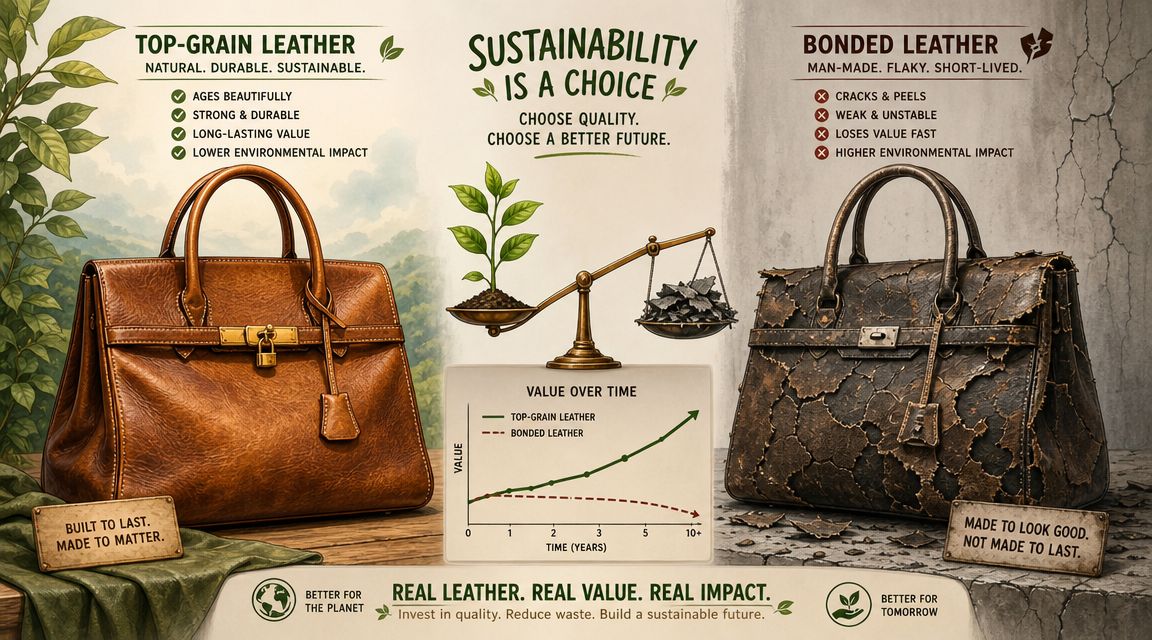
This idea often surprises shoppers because bonded leather sounds resourceful on the surface. It uses leftover leather content. But if the resulting furniture is treated more like a temporary solution, the sustainability story gets weaker. For many homes, the most sustainable purchase is the one that doesn't need to be made again soon.
This idea applies beyond upholstery
The same logic shows up across the home. In dining rooms and bedrooms, solid wood furniture with lasting joinery usually outperforms mass-produced alternatives over the long haul. Shoppers who are already thinking about heirloom quality in wood furniture can see that same philosophy in upholstery decisions too. This guide to choosing hardwood for longevity and style connects those ideas well.
A room built with durable materials also tends to feel calmer and more intentional. Instead of replacing major pieces every few years, homeowners can update around them with rugs, lighting, art, or accent textiles. That kind of interior design planning is often more sustainable, more cost-conscious over time, and easier to live with.
For buyers in Southeast Michigan who care about sustainable choices, the best question may be simple. Which piece is more likely to stay useful, comfortable, and wanted for the long run?
Choosing the Right Leather for Your Lifestyle

Best fit for active households
A busy household usually answers the top grain leather vs bonded leather question quickly. If children sprawl across the cushions, pets circle for the warmest spot, or a sectional serves as the center of daily life, top-grain leather is generally the more sensible investment.
It also suits specialty seating where long-term comfort matters. An ergonomic recliner, for example, shouldn't pair advanced support with upholstery that may become the weak point. The same is true for dining chairs that see nightly use or home office seating that supports work routines throughout the week.
Shoppers often benefit from thinking room by room:
- Main living room: Top-grain leather usually aligns better with high traffic and long ownership.
- Home office: A refined leather chair can support both comfort and polished interior design.
- Dining room: Upholstery should match the durability expectations of the table and frame.
- Primary reading chair or recliner: Premium comfort deserves premium covering.
Where bonded leather may tempt buyers
Bonded leather can look appealing when a buyer is focused on immediate budget relief or furnishing a low-use space quickly. That temptation is understandable. But in many cases, a quality fabric ends up being the better temporary or lower-commitment solution because it can offer comfort and value without pretending to be something it isn't.
That distinction matters in guest spaces and occasional-use rooms. If the goal isn't a leather investment, a well-chosen textile may be the more honest fit.
For many buyers, the real comparison isn't top-grain leather versus bonded leather. It's top-grain leather versus a good fabric, depending on how the room will be used.
Customization changes the decision
Customization often shifts the conversation from “What's on the floor today?” to “What will fit the home for years?” That's where made-to-order furniture has a clear advantage. In-stock is only the beginning. A shopper may want a different leather color, a new configuration, a specific seat depth, or a better fit for an open-concept room.
This is especially useful with collections that emphasize personalization. Canadel offers broad flexibility in dining finishes and configurations. Stressless gives shoppers ergonomic sizing and comfort-driven tailoring. That kind of bespoke planning helps the material choice make more sense because the furniture is being selected as a long-term part of the home, not as a quick fill-in.
Tyner Furniture offers made-to-order upholstery options, including top-grain leather selections for living room and recliner seating, alongside customizable dining and solid wood pieces. For buyers trying to align upholstery, scale, and finish with the rest of the home, that type of selection can make a long-term decision easier to get right.
Your Invitation to the Ann Arbor Showroom
Reading about leather helps. Touching it helps more.
A shopper standing in the showroom can feel the difference between a uniform manufactured surface and the richer hand of top-grain leather within seconds. That kind of sit test matters because furniture is physical in a way most purchases aren't. Comfort, resilience, texture, and support all register faster in person than they ever will on a screen.
The South State St. showroom gives Ann Arbor and Southeast Michigan shoppers a chance to compare upholstery while also seeing how materials relate across the home. A leather sofa may sit near hand-crafted Amish dining or bedroom furniture, where solid cherry, maple, or oak and traditional joinery reinforce the same lesson. Lasting value usually starts with honest materials and careful construction.
Since 1957, that local legacy has mattered. Good guidance lowers the pressure and raises the confidence. It also makes higher-end pieces more approachable through available Special Financing and a Low Price Promise, which can help households invest in craftsmanship without feeling forced into a rushed decision.
For directions, questions, or help planning a visit, shoppers can contact the Ann Arbor showroom. Bringing room measurements, photos, and finish samples often makes the visit even more productive.
For anyone weighing top grain leather vs bonded leather, the most useful next step is to test the materials in person, compare how they feel, and review made-to-order Quick Specs with a design-minded team. Explore Tyner Furniture online or visit the Ann Arbor showroom for a sit test that turns a furniture purchase into a long-term plan.