Is White Glove Delivery Worth It? a Buyer’s Guide


What does “white glove” buy, beyond getting a sofa through the front door? For a homeowner in Ann Arbor or elsewhere in Southeast Michigan, the answer depends on the furniture's value, the route into the room, and the work included in the written service scope. A made-to-order sectional, an Amish solid-cherry dining table, and a small side chair don't carry the same delivery risk.
The label alone isn't enough. A careful buyer compares the delivery premium with the value of craftsmanship, damage prevention, homeowner labor, and a clean first installation. That matters even more when the piece is an heirloom intended for a forever home, not a temporary purchase.
Why the White Glove Question Deserves a Better Answer
"Is white glove delivery worth it?" is too broad a question to answer well. The sharper version is: What will the delivery crew do, what risks will they assume, and what would the homeowner have to handle without them?
"White glove" is not a universal service standard. One provider brings furniture into the room, unpacks it, assembles it, removes the packaging, and inspects the piece. Another stops at the threshold, or excludes assembly despite charging for the upgraded service. Some buyers pay for white-glove service and discover at the door that assembly was never part of the scope, which is why the written estimate matters more than the label.
That gap between the label and the actual work is where buyers get frustrated. A customer expects a finished room and receives a boxed item in an entryway. The result is an awkward scramble involving friends, rented equipment, floor protection, packaging disposal, and the risk of damaging an expensive piece before it has even been used.
The furniture changes the calculation
A delivery upgrade makes more sense for furniture that is heavy, fragile, oversized, difficult to assemble, or costly to replace. Custom upholstery may involve a long replacement cycle. Solid-wood dining furniture can be difficult to maneuver without marking walls or floors. A coordinated room package may require several pieces to be positioned and leveled together.
Tyner Furniture has served Southeast Michigan since 1957, and that local legacy sets a reasonable standard for the buying conversation. Customers should receive clear answers before the truck arrives, not a vague promise attached to a checkout label. Furniture is a high-consideration purchase because its comfort, dimensions, finish, and lifecycle all matter, as explained in this guide to why furniture purchases are high-consideration decisions.
Practical rule: If the written scope doesn't say what happens inside the home, assume the service stops earlier than expected.
The right decision is therefore not "premium delivery or no premium delivery." It is whether the service transfers enough practical risk to justify its fee. For a buttery leather recliner or the weight of solid cherry wood, that answer can be very different from the answer for a compact, easily handled accent piece.
What White Glove Delivery Includes
The name on the invoice matters less than the work the crew performs. A buyer paying for furniture that will stay in the home for years should know exactly how much handling, setup, and cleanup is included.
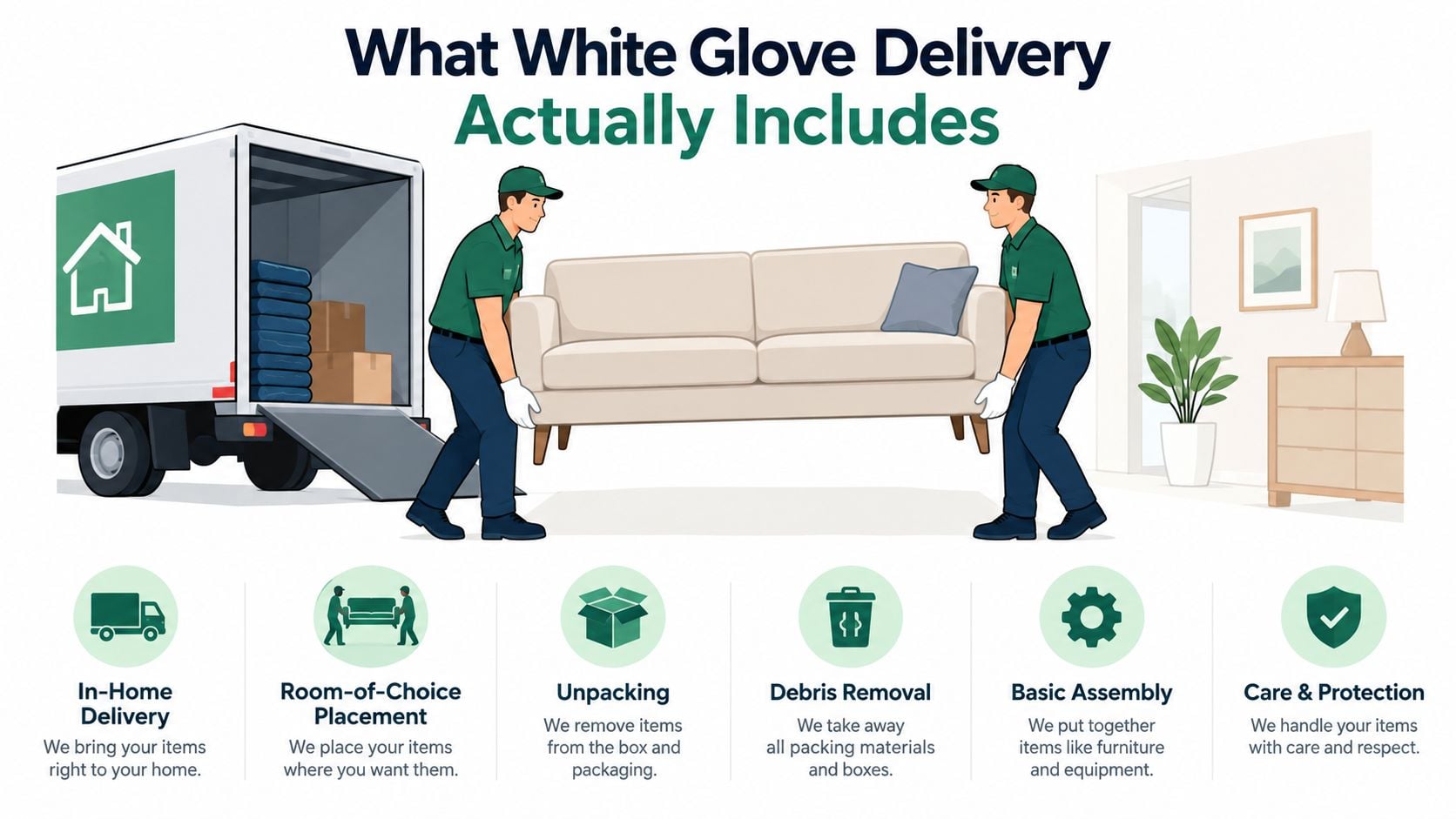
Threshold delivery
Threshold service usually means the furniture reaches the first practical indoor spot, such as a foyer, garage, lobby, or building entrance. After that, the homeowner still handles moving the piece to its final room, opening cartons, assembly, and disposal of packing materials.
That can work for a light chair or a simple item with a clear first-floor path. It makes far less sense for a bulky piece, a tight hallway, or anything that needs two people just to get it through the door.
Room-of-choice delivery
Room-of-choice service takes the furniture farther inside, usually to the room the customer names. Ask whether the crew will handle stairs, tight turns, unpacking, and placement in the exact spot you want.
The phrase does not automatically include assembly. It may also leave out moving existing furniture, wall mounting, removing an old piece, connecting powered furniture, or handling awkward access. If any of that is included, it belongs in writing.
Full white-glove service
Full service usually bundles several tasks into one visit:
- In-home placement: The crew carries the furniture to the designated room and sets it where it belongs.
- Unpacking: Cartons, wrapping, and protective materials come off the piece.
- Assembly: Legs, table parts, bed pieces, or sectional sections are assembled when the scope says so.
- Leveling and setup: The crew adjusts the piece when that work is included.
- Packaging removal: Cardboard, foam, plastic, and other delivery debris leave with the crew.
- Protection: Blankets, plastic protection, and careful handling help protect upholstery, floors, and walls.
Consumer Reports reported that white-glove pricing commonly ranged from $60 to $400, with variation based on distance, order value, and furniture size (Consumer Reports furniture delivery guidance). The number only helps if the buyer knows what labor it buys.
Some tasks still sit outside the base scope. Wall mounting, old-furniture removal, unusual stair handling, electrical work, and hookup of powered recliners often cost extra. A buyer should also confirm whether the crew stops if the piece cannot fit safely through a doorway.
For Southeast Michigan shoppers, the Tyner Furniture delivery information is a practical place to start that conversation. The question is simple: What gets completed before the crew leaves?
Comparing White Glove to Standard Delivery
Which delivery choice makes sense for the piece you are buying, and for how long you expect to keep it? That is the question for Southeast Michigan homeowners weighing white glove against standard delivery.
Standard delivery can be fine for a sturdy, replaceable item that is easy to move and simple to assemble. It puts more of the work on the buyer, and that is where the difference shows up. The useful comparison is who carries the item, who protects the home, who completes setup, and who deals with the fallout if something goes wrong.
The risk matters more with expensive or hard-to-replace furniture. Consumer reports on delivery problems found that 6% of in-store furniture purchases and 10% of online purchases arrived damaged or with missing parts (Consumer Reports furniture delivery guidance). That does not mean every order needs white glove service. It does mean the service decision should match the furniture's value, complexity, and expected lifespan.
Service tiers compared
| Service Element | Threshold Delivery | Room-of-Choice | Full White Glove |
|---|---|---|---|
| Entry point | First suitable indoor area | Selected room, if access permits | Selected room with planned in-home handling |
| Floor and wall protection | May be limited or unspecified | Confirm in writing | Commonly included when stated |
| Unpacking | Usually homeowner responsibility | May be separate | Commonly included when stated |
| Assembly | Usually excluded | Varies by item and provider | Included only when written into the scope |
| Debris removal | Usually excluded | May be separate | Commonly included when stated |
| Stairs and tight access | Often excluded or restricted | Must be confirmed | Must be assessed and confirmed |
| Inspection | Customer handles most inspection | Customer should inspect with crew | Crew and customer can inspect before completion |
| Existing furniture removal | Usually excluded | Usually excluded | Separate service unless expressly included |
For a homeowner furnishing an older Ann Arbor house, the room itself is not the whole job. Door trim, stair turns, railings, elevators, narrow halls, and porch approaches can change the route. The furniture measurement guide helps buyers check the path before delivery day rather than finding out beside the truck.
Who should handle the move?
Threshold delivery works for a manageable piece, a clear route, and a homeowner who is willing to handle unpacking and setup. Room-of-choice is the middle ground when the furniture needs to reach a specific room but does not require much assembly or tricky handling. Full service earns its keep when the piece is heavy, fragile, custom, or difficult to replace.
Tyner buyers in Southeast Michigan should judge the delivery against the furniture's value and lifecycle, not the label on the invoice. A custom dining table, heirloom cabinet, or high-end sectional deserves a different standard than a basic accent chair. If the piece is meant to last, protect it from the start.
For households coordinating a move rather than a single furniture delivery, the Melbourne relocation help from House Moving Melbourne shows why access details, handling responsibilities, and the exact service boundary need to be set before moving day. The same rule applies here. A delivery crew can only protect the home and complete the work that was agreed on.
Buyers should compare the actual tasks. A lower fee can turn into poor value if you end up arranging extra labor, dealing with packaging, or fixing a placement problem on your own.
What Premium Delivery Actually Costs
White-glove delivery looks expensive when it is reduced to one line on an invoice. The better way to judge it is to separate the fee from the work it buys and the problems it prevents.
Typical charges for premium delivery vary by piece and by service level. Reported standalone fees often run from $79 to $249 per piece, while broader inside-delivery estimates place the surcharge around $75 to $350 per delivery. Full-service delivery is often quoted around $150 to $400, and room-of-choice service is often around $100 to $200 (white-glove delivery pricing examples, white-glove delivery cost guidance).
The quote can also change with the size of the shipment. A published fee schedule in that cost guidance starts at $140 for a base shipment, rises to $210 for two pieces, reaches $280 for three pieces, and lists $324 for four or more pieces. That is why a coordinated installation often makes more sense than paying separate handling charges for each item.
The break-even question
The homeowner is not just paying to avoid lifting. The fee may cover labor, unpacking, assembly, placement, cleanup, specialized handling for bulky furniture, and less risk to floors, walls, and trim.
A damaged solid-cherry dining table carries a very different cost from a scratched accent table. A Stressless recliner that has to be carried up a difficult staircase creates a different physical risk from a compact chair. A made-to-order upholstery piece is harder to replace quickly because its fabric, dimensions, and configuration were chosen for the home.
The sensible calculation is simple. Compare the premium against the value of homeowner labor, equipment, injury risk, packaging disposal, and the delay that comes with damage or a bad placement. For buyers spreading out the cost of a long-lived purchase, furniture financing options can help with the purchase itself, but the delivery fee still deserves its own decision.
Tyner buyers in Southeast Michigan should judge that fee against the furniture's value and lifecycle. A custom dining table, heirloom cabinet, or high-end sectional deserves a different standard than a basic accent chair. If the piece is built to stay in the house for years, protect it from the first trip through the door.
The delivery fee is fair when it costs less than the work and risk the homeowner would otherwise carry.
Scenarios Where the Premium Pays Off
A fee becomes easier to judge when attached to a real room, a real route, and a real piece of furniture. Southeast Michigan homes offer plenty of those complications, from narrow bungalow entries to second-floor bedrooms and coordinated open-plan spaces.
The 2024 Florida International University study provides a useful behavioral signal. In a choice-based experiment with 221 current or potential online shoppers, white-glove service accounted for 63% of measured delivery preference, compared with 25% for the delivery window and 12% for delivery speed (Florida International University study summary). Participants also valued receiving the item on the promised date or during the promised period more than receiving it as quickly as possible.
A sectional in a 1920s bungalow
A large sectional may need to clear a narrow doorway, turn through a short hall, and avoid marking painted walls or hardwood floors. Threshold delivery leaves the most difficult work with the homeowner. Full service is the clear choice when the crew must protect the route, coordinate multiple sections, and place the configuration correctly.
A lighter room-of-choice option may be enough if the sectional arrives in manageable pieces and the retailer confirms that placement is included. The key is not the sectional's showroom appearance. It's the packaged dimensions and the tightest point in the route.
An Amish solid-cherry dining table
An Amish hand-crafted table deserves more than a casual drop. Solid North American hardwood has a different material integrity from mass-produced alternatives, and joinery such as dovetailing or mortise-and-tenon construction reflects the furniture's heirloom purpose.
White-glove service makes sense when the table is heavy, the finish is difficult to repair, or a replacement would interrupt a made-to-order purchase for a long period. The cost should be weighed against protecting the weight of solid cherry wood, the finish, and the surrounding home.
A coordinated Stressless seating package
A room with several recliners or powered seating pieces creates more setup work than a single chair. Customers should confirm whether connection, placement, leveling, and testing are included. If the pieces need to work together in a specific arrangement, full service is preferable to a threshold drop.
Stressless also brings an ergonomic consideration. Small, medium, and large sizing affects comfort, so the delivery crew should place the seating where the household can evaluate movement and clearance rather than leaving cartons in an entryway.
A made-to-order Canadel dining set
Canadel allows customers to choose finishes, fabrics, configurations, leg styles, table edges, and other details. That customization edge means a damaged or incorrectly handled piece may be harder to replace than a generic in-stock item.
Room-of-choice service may be enough for an easy route and a simple table. Full white glove is the better decision when the set includes multiple chairs, a large table, protective packaging, and a finish that needs careful inspection. Tyner's custom upholstery services also illustrate why the delivery decision should follow the furniture's level of personalization.

A second-floor bedroom suite
A bedroom suite arriving during a move-in window creates a practical deadline. The pieces need to reach the right room, packaging needs to leave, and assembly can't become an unexpected evening project. Full service is usually justified when stairs, narrow halls, or several coordinated pieces are involved.
The same logic applies across Tyner's range, from the Home Office to Outdoor Spaces. The more a household is creating a complete interior design plan rather than buying an isolated piece, the more valuable coordinated placement becomes.
The Pre-Delivery Checklist That Protects the Investment
Want to protect a piece you expect to keep for years, not just get it through the front door? Handle the delivery details before the truck is on the way. That is the difference between a routine setup and a claim fight over a custom bed, a solid-wood dining table, or a sofa built for a specific room.
Get the service scope in writing and keep it with the order paperwork. For higher-value furniture, that written scope matters as much as the delivery date because it defines who does what inside your home.
Questions to settle before the truck arrives
- Placement: Is room-of-choice placement included?
- Assembly: Does the crew assemble the specific item, or only carry it inside?
- Protection: Are floors, walls, upholstery, and doorways protected?
- Access: Are stairs, narrow entries, elevators, and long carries covered?
- Setup: Does the service include leveling, sectional connection, or powered-furniture connection?
- Cleanup: Will the crew remove cartons, foam, plastic, and other packaging?
- Exceptions: Are wall mounting, old-furniture removal, or an item that doesn't fit excluded?
Clear the route before arrival. Move lamps, rugs, accent tables, and fragile décor out of the way so the crew has a clean path and there is no argument later about what they bumped or scratched. If delivery is landing in the middle of a move, a separate move-out cleaning checklist for renters can help keep the rest of the transition organized.
Inspect the furniture while the crew is still there. Photograph corners, legs, upholstery, wood surfaces, hardware, and even the packaging if it shows impact or crushing. If you see damage or a setup problem, write it on the delivery receipt before signing whenever possible.
Claim rules vary by seller and service agreement. Some require notice within 48 hours. Others expect damage to be reported at delivery. Confirm that claim window in writing before delivery day, and ask who handles installation-related damage if assembly is included.
Local follow-up also matters. When a made-to-order piece needs adjustment or service, reaching the same delivery or store team is usually far better than getting pushed into a generic freight claim process.
When White Glove Is Worth It and When to Skip It
White-glove delivery is worth paying for when the furniture is heavy, fragile, made-to-order, difficult to access, or expensive to replace. Forever-home nestbuilders investing in heirloom solid wood, households furnishing a coordinated room, buyers facing tight stairs or narrow entries, and homeowners working against a move-in schedule usually benefit most.
Skipping it is reasonable for a small side chair, a light occasional table, or an easily assembled bookshelf with a clear first-floor route. In those cases, the homeowner may not be buying enough risk reduction to justify the premium.
Sustainability deserves a practical reading. White glove can support a lower-waste lifecycle when careful handling prevents damage, replacement, and repeat delivery trips. It can work against that goal when routes are poorly planned or failed deliveries create extra travel. DHL's February 2025 announcement of 21 electric vehicles for bulky-goods last-mile delivery estimated that each vehicle could save about 20.4 metric tons of CO2e and 6,400 liters of diesel annually compared with a comparable combustion vehicle (DHL electric bulky-goods delivery announcement). That doesn't make every provider sustainable, but it shows why routing, fleet choice, packaging, and delivery success all matter.
Tyner Furniture offers made-to-order upholstery, Canadel customization, Stressless ergonomic seating, Amish hand-crafted solid wood, Special Financing, and a Low Price Promise, with selections extending from Home Office to Outdoor Spaces. Visit Tyner Furniture in the Ann Arbor area for a proper sit test and a clear delivery conversation, or browse the online Quick Specs when planning a special order.