What Is Amish Furniture and Why It Lasts


A dining table looks beautiful online, but the details feel uncertain in person. Is “solid wood” describing the entire piece or only a thin surface? Will the drawers still fit after a Southeast Michigan winter? Can the finish be renewed when a busy household leaves its mark? Furniture shopping becomes tiring when every product promises quality without explaining how that quality is built.
The question what is Amish furniture deserves a more useful answer than “furniture made by the Amish.” It describes a workshop tradition shaped by skilled woodworking, made-to-order production, regional manufacturing networks, and an ownership philosophy centered on durability, repairability, and long-term value. For a homeowner furnishing a forever home, those details matter more than a label alone.
Defining the Amish Woodworking Tradition
A shopper comparing bedroom sets may see solid wood, hardwood, hand-crafted, and artisan used across several product descriptions. Those terms don't always describe the same construction. One retailer may offer a piece with a genuine wood veneer over a manufactured core, while another offers a made-to-order frame built from solid cherry, oak, or maple. The surface may look similar at first, but the way the furniture is built determines how it ages, moves, and can be repaired.
Amish furniture is best understood as part of a broader cultural and economic transition, not as one standardized religious style. Amish communities originated in Europe during the late seventeenth century. Approximately 500 Amish immigrants settled in Pennsylvania between 1727 and 1790, followed by a migration of about 3,000 people to Ohio, New York, Indiana, and Illinois between 1815 and 1865. Historically, agriculture supported many Amish households, but growing populations made farmland scarcer and more expensive. The U.S. Forest Service describes furniture manufacturing as an emerging nonfarm sector that helped communities remain economically competitive, particularly in Ohio. This history of Amish furniture production helps explain why the category is both cultural and industrial.
More than a prescribed look
There isn't one official Amish silhouette. A dining table may have a clean Shaker influence, a traditional trestle base, or a more contemporary profile. The defining qualities are usually found in the production setting, the woodworking skill, and the relationship between the maker and the finished piece.
Small workshops can focus on details that anonymous, high-volume production often standardizes. A customer may select a wood species, stain, edge profile, hardware, dimensions, or configuration. That made-to-order process makes Amish furniture bespoke without requiring an ornate appearance.
The scale of the communities also supports regional specialization. In 2020, the estimated North American Amish population was 350,665, up from approximately 177,885 in 2000, an increase of 97 percent, according to research from the U.S. Forest Service. About 62.5 percent lived in Ohio, Pennsylvania, and Indiana, regions strongly associated with Amish settlements and woodworking enterprises. The same source records growth in Amish church districts from 200 in 1951 to 2,915 in 2022, providing context for the communities that sustain these craft economies.
Practical rule: The Amish label should start a quality conversation, not end it. Ask about the wood, joinery, finish, moisture control, and repair options for the specific piece.
For Southeast Michigan buyers, that distinction makes furniture shopping more manageable. Amish furniture generally means workshop-built construction rather than anonymous factory output, but standards still vary among makers and retailers. A careful buyer evaluates the actual specifications, then considers whether the piece can serve as an heirloom through moves, renovations, and changing household needs.
The Science of Solid Wood Integrity
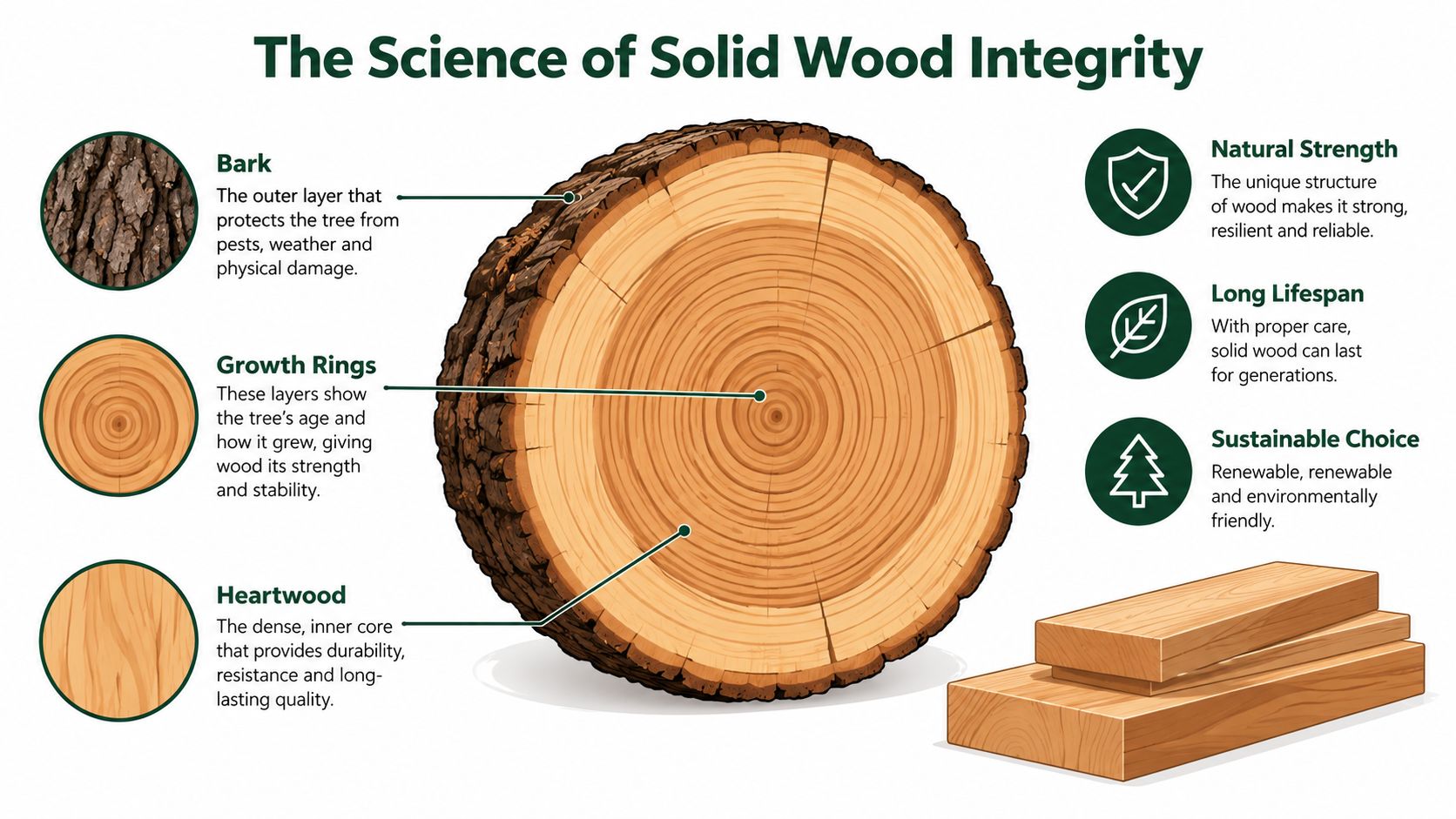
Solid wood has a character that manufactured panels can't fully reproduce. A cherry tabletop develops depth as light moves across its grain. Oak has an open, tactile structure, while maple feels comparatively smooth and close-grained. That weight of solid cherry wood or the clean warmth of maple can be felt in a showroom, but material integrity also depends on moisture control and engineering.
Wood is hygroscopic, which means it gains and loses moisture as surrounding humidity changes. Most movement occurs across the grain. A broad tabletop or cabinet panel therefore needs room to expand and contract. If a builder traps that panel rigidly, the wood can place stress on fasteners, joints, and finish surfaces.
Moisture content affects everyday performance
The USDA Forest Products Laboratory recommends drying interior hardwood lumber to approximately 6–8% moisture content. The USDA guidance on wood moisture and interior furniture provides a practical benchmark because properly dried and acclimated lumber is less likely to undergo disruptive dimensional change inside a climate-controlled home.
That matters in ordinary moments. A drawer that once glided smoothly may bind if the wood absorbs moisture. A cabinet door may close unevenly if its panel moves without an appropriate construction allowance. Correct kiln drying doesn't stop wood from responding to the seasons. It helps the maker begin with material better suited to the indoor environment.
Wide surfaces need movement-aware attachment methods, such as appropriate fasteners or elongated holes that let the top move without splitting or pulling against the base. The same principle applies to cabinet panels and doors. “Solid wood” is therefore not a complete quality specification. It should be paired with questions about species, kiln drying, acclimation, and panel attachment.
A buyer's inspection list
At a showroom serving Ann Arbor and surrounding communities, shoppers can ask:
- Wood species: Is the piece built from cherry, oak, maple, or another material, and where does solid wood end and veneer begin?
- Moisture preparation: Does the maker kiln-dry and acclimate the lumber for interior use?
- Movement planning: Can tabletops and panels expand and contract without stressing the frame?
- Finish care: What cleaning, humidity, and refinishing guidance applies to the selected finish?
The comparison between solid wood and engineered wood becomes more useful when it focuses on the purpose of each material. Engineered panels can have appropriate applications, while solid hardwood can offer repairability and refinishing potential. The right choice depends on construction, use, and expectations, not on a slogan.
Traditional Joinery Versus Mass Production
A chair can appear sturdy while hiding a weak connection beneath its finish. The structural question is whether the frame transfers force through a broad, accurately fitted wood-to-wood joint or depends mainly on small connectors, adhesive, or hardware. Traditional joinery earns attention because it gives the furniture's frame a mechanical foundation.
A mortise-and-tenon joint uses a projecting tenon cut on one component and a matching mortise, or cavity, in another. The broad contact area helps the joint resist racking, twisting, and repeated loading. In dining tables, chairs, and beds, this method is especially relevant at legs, rails, posts, and stretchers. The mortise-and-tenon construction guide shows why the joint is more meaningful than calling a piece solid wood.
Drawers use a different but equally recognizable approach. A dovetail interlocks the drawer sides and resists being pulled apart. Greater dovetail density and more available glue surface can improve load resistance, although accurate machining, grain direction, adhesive quality, and moisture control still matter.
What comparative testing reveals
Joinery can be evaluated with force-resistance data rather than vague claims. In comparative furniture-joint testing, a traditional mortise-and-tenon configuration with the tenon's cheeks and shoulder cut from the same stock resisted more than 26 kN before elastic failure, while a common #20 biscuit joint resisted just over 12 kN. The results appear in the comparative joint testing research.
| Joint Type | Force Resistance (kN) |
|---|---|
| Mortise-and-tenon, cheeks and shoulder from the same stock | More than 26 |
| Common #20 biscuit joint | Just over 12 |
The same research reports another frame-reliability comparison. Mortise-and-tenon joints averaged approximately 204 N·m of moment capacity, compared with about 154 N·m for dowel joints. Those figures don't guarantee that every chair or table will perform identically. Joint size, fit, wood quality, grain orientation, adhesive, and moisture conditions all influence the result.
A practical inspection checklist
Buyers evaluating a dining set or bedroom case good can look for visible and documented details:
- Dining tables: Ask how the top attaches to the base and whether the design permits seasonal movement.
- Chairs: Ask whether stretchers use pinned mortise-and-tenon joints and inspect how rails meet legs.
- Drawers: Check whether boxes use through or half-blind dovetails, then open and close each drawer slowly.
- Case goods: Look for accurate alignment, clean transitions, substantial backs, and hardware that can be replaced.
Mass production isn't automatically synonymous with failure, and traditional joinery isn't a substitute for careful workmanship. The meaningful comparison is construction-specific. A buyer should choose the piece whose materials and joints match the demands of daily use.
Evaluating True Sustainability and Repairability
A solid-wood table arriving at a forever home carries more than a material story. Its environmental effect also depends on how it is made, shipped, maintained, and used throughout its life. A 2023 life-cycle study of wood chairs found that durability alone did not guarantee a lower environmental footprint. A 2025 assessment of 25 furniture products found that heavier products generally created greater environmental impacts, with pre-production accounting for an average of 76% of total impact. The life-cycle research on wood furniture supports a careful buying question: will this piece deliver enough useful service to justify the resources invested in it?
The strongest sustainability case for Amish furniture comes from long service and continued use. A well-made piece that remains useful for decades, can be repaired, and avoids replacement may serve a household more efficiently than furniture sent to disposal after a short period. Material intensity still deserves attention, so ask about wood sourcing, finish chemistry, shipping distance, and expected service life. A piece earns the description sustainable wood furniture through responsible materials, thoughtful construction, long use, and realistic repair support, as explained in this guide to sustainable wood furniture.
The ownership test
Repairability turns craftsmanship into a practical ownership benefit. A dining table may be refinished after years of family use. A drawer may receive new hardware, while a chair may be reglued or restored instead of discarded. These options depend on the actual construction and on whether qualified repair or refinishing support remains available.
Recent consumer research found that 70% of people try to repair, sell, or donate broken or unwanted furniture, while a 2025 comparative study reported that consumers perform roughly 60–80% of clothing and furniture repairs. The consumer insights research on repair and reuse also examines repair, refurbishment, reuse, and design for disassembly as ways to extend product life. It recognizes that complex construction can increase manufacturing energy and emissions.
A sustainable furniture decision includes the years after delivery. The piece should remain useful, serviceable, and adaptable as the household changes.
Questions for a forever-home purchase
Before ordering, buyers can ask:
- Refinishing: Can the finish be renewed locally, and what care will preserve it?
- Adaptability: Can a dining table be resized, moved to another room, or repurposed?
- Components: Are drawers, hinges, glides, doors, and hardware replaceable?
- Transfer: Would the dimensions and style remain useful after a move or renovation?
This framework treats craftsmanship as part of an environmental decision, not as proof by itself. For Southeast Michigan homeowners, sustainable value means responsible materials, careful construction, long use, and practical support when a repair becomes necessary.
The Cost-Per-Year Investment Model
The checkout price tells only part of the story. A furniture buyer also pays through maintenance, replacement, moving, and the disruption of finding a suitable replacement when a piece fails. The cost-per-year model makes those tradeoffs easier to see.
The calculation is straightforward:
Initial purchase price plus maintenance, divided by expected lifespan, equals approximate annual cost.
A comparison cited from a 2019 Journal of Cleaner Production study reports average usable lifespans of approximately 25–50 years for solid-wood furniture, compared with 5–15 years for particleboard and MDF alternatives. One example places a $2,697 solid-maple set lasting 50 years at about $54 per year. An $800 MDF set lasting seven years works out to about $114 per year and would require multiple replacements over a 30-year period. These figures appear in this solid-wood bedroom furniture cost comparison.
Those examples aren't promises for every table, bed, or dresser. They demonstrate why a higher initial price can represent a different ownership model. An heirloom piece may cost more today, but it can continue serving a household through moves, changing rooms, and generations.
A simple comparison for everyday furniture
Another cost-per-year example compares a $350 solid-wood TV stand lasting 10 years, or $35 per year, with a $150 particleboard version lasting two years, or $75 per year. The same source estimates roughly 8–12 years of service for solid wood with doweled joinery, compared with about 2–3 years for particleboard using cam-lock construction. This cost-per-year furniture framework is a useful starting point, not a guarantee.
A buyer can apply the model to a bedroom set, dining table, or home office desk by asking:
- Expected life: How long should the piece remain structurally useful?
- Maintenance: Can the surface be cared for and renewed?
- Repair: Can individual parts be fixed instead of replacing the whole piece?
- Use value: Will the design continue fitting the household's interior design needs?
A custom order can also reduce the cost of a poor fit. Selecting the right dimensions, wood, finish, and configuration at the beginning may prevent a premature replacement after a renovation or move. Tyner Furniture offers special financing options subject to credit approval, along with a Low Price Promise, which can help qualified buyers plan for higher-quality furniture without treating the initial price as the only measure of affordability.
The better question isn't whether Amish furniture costs more at checkout. It's whether the piece delivers enough years of comfort, service, repairability, and daily use to justify the investment.
Designing Your Space with Custom Orders
Custom furniture works best when the household starts with practical needs rather than a color alone. A dining room may need an extension table that supports regular family meals and occasional gatherings. A bedroom may need storage that fits an older home's proportions. A home office may require an ergonomic chair, a correctly scaled desk, and cable management that won't interfere with daily work.
The in-stock selection is just the beginning. A made-to-order program can allow shoppers to choose wood species, stain, dimensions, hardware, upholstery, and configuration. Canadel offers bespoke dining combinations, while Stressless provides ergonomic seating choices with custom sizing in Small, Medium, and Large. Upholstery orders can also include premium fabrics and the buttery feel of top-grain leather.
A practical custom-order sequence
Measure the room first. Record wall lengths, door openings, stair access, traffic paths, and the space needed to pull out chairs or recline comfortably.
Define the daily use. A table for quiet breakfasts has different priorities from one used for large meals, schoolwork, and holiday hosting. A sofa or recliner should support posture, relaxation, and the household's preferred seating positions.
Choose material and finish together. Cherry, oak, and maple each present grain and color differently. A stain should complement flooring, cabinetry, and natural light rather than being selected from a small screen image.
Review the construction details. Ask about drawer joinery, tabletop attachment, movement allowance, finish maintenance, and future repair options.
Confirm delivery and care. Made-to-order furniture deserves a plan for access, placement, humidity, cleaning, and refinishing decisions.
A room layout guide can help organize clearances before a custom piece is ordered. This practical living room layout guide offers a useful reference for placing seating, tables, and circulation paths without relying on guesswork.
Tyner Furniture, founded in 1957, serves Southeast Michigan from its Ann Arbor showroom on South State St. The selection extends beyond Amish dining and bedroom furniture to Home Office, living spaces, mattresses and sleep systems, entertainment areas, and Outdoor Spaces. That breadth helps households coordinate an entire home while still choosing different levels of customization for each room.
Showroom habit: A sit test reveals details that photographs cannot, including seat support, recliner movement, tabletop scale, drawer feel, and the difference between a visually attractive finish and one that feels right in the room.
For shoppers ready to plan a made-to-order piece, the custom-order starting guide can help organize measurements, preferences, and questions before a showroom visit. Special financing and the Low Price Promise may also make a long-term investment easier to evaluate within a household budget.
Tyner Furniture offers hand-crafted Amish solid wood furniture alongside customizable Canadel dining, Stressless ergonomic seating, and furnishings for every room from Home Office to Outdoor Spaces. Visit Tyner Furniture in Ann Arbor for a personal sit test and guidance on finishes, dimensions, and construction, or browse the online Quick Specs when planning a special order.