Custom Upholstered Armchair: How to Order One That Lasts


A custom upholstered armchair is an investment in longevity, not just appearance, and the right piece can serve a household for generations when it has a solid frame and properly specified foam. Foam for everyday residential seating commonly starts around 1.8–2.5 lb/ft³ with 28–35 ILD, while heavier-use seating may call for approximately 2.5–3.0 lb/ft³ and 35–45 ILD. Specialty Fabrics Review explains why both density and firmness matter.
A shopper can spend an afternoon comparing silhouettes, fabrics, and leg finishes, then discover after delivery that the chair is too deep, the seat edge presses behind the knees, or the cushion already feels tired. That frustration is familiar in furniture shopping, especially when a catalog shows only the outside of the chair. A true made-to-order process gives the buyer control over the details that determine whether the chair becomes a comfortable heirloom or a long-term liability.
Since 1957, Tyner Furniture has served Ann Arbor and Southeast Michigan with a local legacy built around furniture for the whole home, from the Home Office to Outdoor Spaces. In-stock is just the beginning. Custom finishes, fabrics, and configurations, including Canadel and Stressless options, allow a chair to be selected for the room, the body, and the way the household actually lives.
Finding Your Perfect Custom Upholstered Armchair
A showroom can feel like a menu written in a foreign language. One armchair has a generous seat, another has a graceful curved back, and a third has buttery top-grain leather that feels wonderful beneath the hand. Yet the visible details don't answer the important questions. Will the chair fit beside the bookcase? Will the seat support the user without forcing a slouch? Can the covering be maintained when the family, pets, or daily routine put it to work?
A custom upholstered armchair changes that conversation. Instead of accepting the dimensions and materials attached to an in-stock model, the shopper can begin with the intended use, then select the scale, cushion feel, fabric or leather, finish, and configuration. A reading chair may need a supportive back and a softer arm profile, while a conversation chair may benefit from a more upright posture and a smaller footprint.
Practical rule: A chair should be judged by the way it supports a person after several quiet minutes, not by its appearance during the first glance.
The tradition behind this approach is older than modern showroom merchandising. The Metropolitan Museum of Art identifies an upholstered armchair attributed to Adam Hains as an example of the late Louis XVI fauteuil en cabriolet style. French émigré upholsterers and cabinetmakers who arrived in Philadelphia and New York during the 1790s helped transfer French furniture techniques to American craftsmen and wealthy patrons, establishing a custom upholstery heritage that continues today. The Metropolitan Museum of Art documents this history and the chair's tailored construction.
Control the details that affect daily life
A practical custom order usually begins with four decisions:
- Purpose: Decide whether the chair is for reading, conversation, napping, occasional seating, or daily use.
- Scale: Measure the room, doorway, nearby tables, and circulation path before choosing a generous lounge profile.
- Comfort: Test the cushion, back angle, arm height, and seat depth with the actual user.
- Covering: Match fabric or leather to sunlight, pets, children, cleaning habits, and desired tactile character.
Tyner's guide to getting started with a custom order can help organize those choices before a showroom appointment. The best result is not just a chair that looks bespoke. It is a chair whose structure, ergonomics, and finish make sense together, so the investment remains useful as the room and household evolve.
Measuring for a Perfect Fit and Comfort
Visual proportion can mislead. A deep, low armchair may look inviting in a photograph but leave a shorter sitter with unsupported feet and a rounded back. Ergonomic fitting starts with the person, not the catalog image.
Use the body as the measuring guide
An anthropometric workflow should record the intended user's:
- Popliteal height: The distance from the floor to the underside of the knee, which helps determine seat height.
- Buttock to popliteal length: A guide to usable seat depth, so the cushion supports the thighs without pressing behind the knees.
- Hip breadth: The minimum usable seat width, measured with room for normal clothing and movement.
- Seated shoulder height: A reference for backrest height and the amount of upper-body support required.
The actual compressed cushion changes the fit. Frame dimensions alone aren't enough, because foam thickness, suspension, upholstery tension, and the sitter's weight alter the final seat height and depth. Measurements should be checked with the intended cushion installed, not only on an exposed frame or specification sheet.
Published ergonomic research identifies seat height and depth as important constraints, with one study reporting an ideal seat height of 33 cm and depth of 36 cm for a specific user population. The same research found that reclining the seat pan backward by up to 5° can improve sitting comfort, although that angle may make standing harder for older users. The ergonomic study provides the supporting measurements and trade-offs.
Test the chair under real conditions
A showroom sit test should last 10–15 minutes, using a firm temporary cushion when a custom cushion isn't yet available. The sitter should check that:
- Both feet rest fully on the floor.
- The knees remain approximately 90°–105°.
- The seat edge doesn't press behind the knees.
- The lower back remains supported without constant muscular effort.
- The arms rest naturally rather than lifting the shoulders.
- Standing up doesn't require a forward lurch or twisting motion.
Footwear matters, particularly for a chair used in everyday clothing rather than barefoot testing. A mixed household may need a loose back cushion or adjustable lumbar support instead of one fixed dimension intended to suit everyone.
A deep lounge chair isn't automatically more comfortable. If the user can't reach the backrest while keeping the feet grounded, the chair may encourage slouching. Tyner's furniture measuring guide offers a useful starting point for recording room and doorway dimensions before the sit test. The final decision should still be made with the actual person and cushion together.
Inside the Frame and Cushion Construction
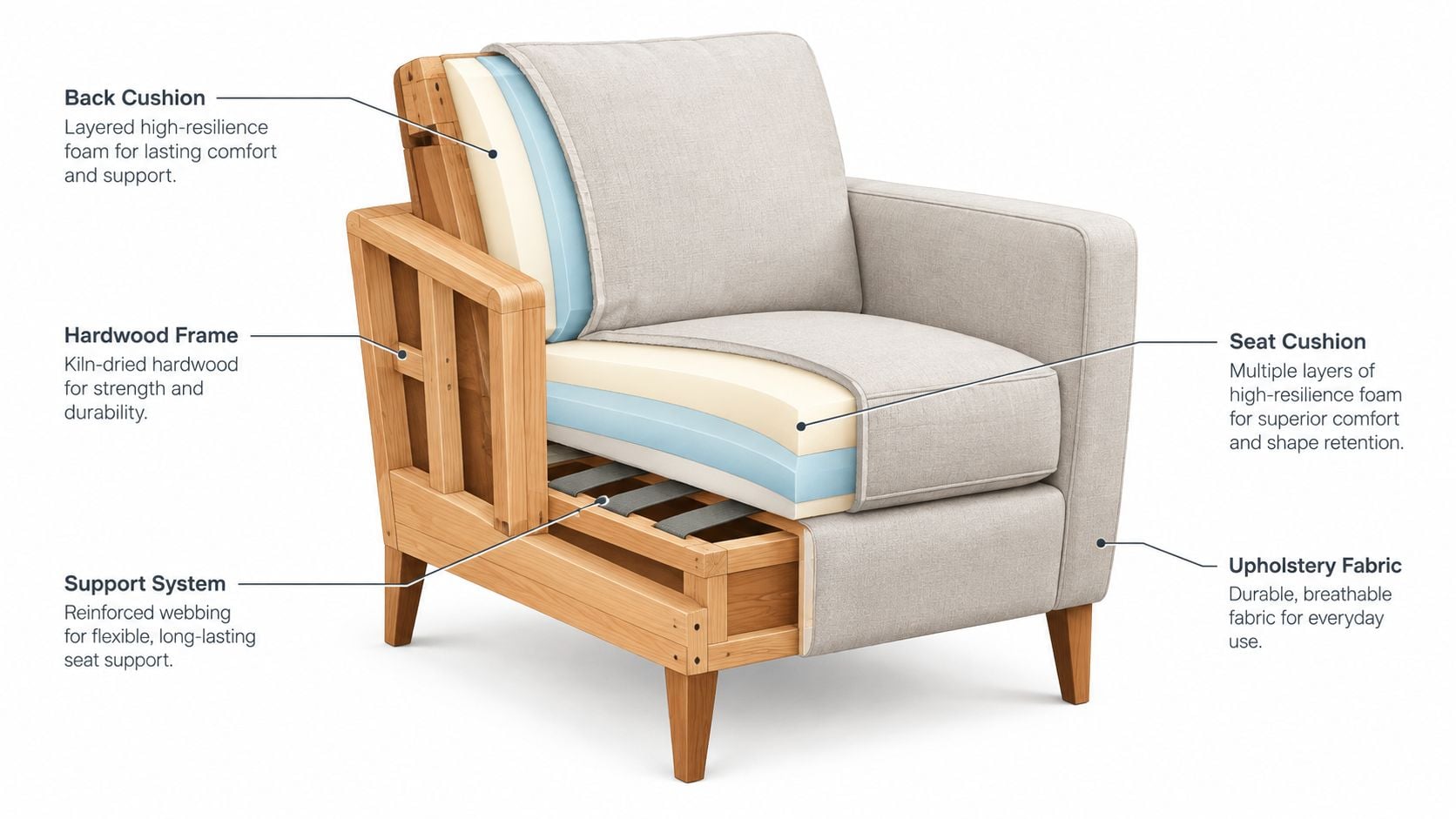
The fabric is the part everyone sees, but the frame carries the repeated load. A person sits, leans, shifts sideways, reaches forward, and rises from the chair. Those forces travel through the rails, legs, corner blocks, joints, suspension, and cushion support. A beautiful cover can't compensate for a frame that flexes or loosens under ordinary use.
Ask how the frame is joined
Solid wood is meaningful only when the maker uses it intelligently. The species, grain direction, rail design, corner reinforcement, and joinery all affect structural reliability. Mortise-and-tenon construction creates a substantial mechanical connection between components rather than relying only on adhesive or fasteners. Research into furniture frames found that mortise-and-tenon joints had the highest measured moment capacity among the tested joint types and a reported reliability of 99.99%. The furniture-frame study explains the reliability measurement.
That figure isn't a guarantee for every armchair, because construction details and testing conditions vary. It does give shoppers a concrete reason to ask what lies beneath the upholstery. A frame should feel stable when the sitter shifts naturally, and a knowledgeable specialist should be able to explain how the load-bearing parts connect.
Amish hand-crafted furniture follows the same principle of material integrity. In bedroom and dining furniture especially, solid North American hardwoods such as cherry, oak, and maple offer a more substantial foundation than mass-produced alternatives built around thin surface treatments. The weight of solid cherry beneath the hand, or the clear grain of oak at a rail, should be considered alongside the joinery rather than treated as decoration alone.
Specify the cushion as a system
“High-density foam” isn't a complete specification. The order should identify:
- Density: Stated in lb/ft³, indicating the foam's material mass and offering a useful durability reference.
- ILD or IFD: The force required to compress the foam by 25%, describing firmness rather than density.
- Thickness: Enough material is needed to prevent bottoming out under the intended load.
- Recovery: The cushion should return to shape after repeated loading.
- Construction: A wrapped foam core, properly tensioned suspension, and a removable cover make future service more practical.
A residential starting point of 1.8–2.5 lb/ft³ and 28–35 ILD may suit many uses, while heavier-use seating may justify 2.5–3.0 lb/ft³ and 35–45 ILD, subject to comfort testing. High firmness alone doesn't prove durability. Low-density foam can feel firm at first and still develop a pancake-like profile, while excessive ILD can create a hard edge.
Removable covers also deserve attention. Anyone handling a serviceable cushion can benefit from these practical tips for fitting cushion zips from More Sewing, particularly when planning future upholstery work. Tyner's custom upholstery cushion information can help shoppers ask how a cushion may be refreshed rather than replacing the whole chair.
Choosing Durable Fabrics and Leather Options
Covering selection is where interior design meets household behavior. A textured performance textile can bring warmth and pattern to a room, while top-grain leather offers a smooth, substantial surface and a buttery feel that changes with use. Neither material is universally superior. The right choice depends on spills, sunlight, pets, children, sitting frequency, and how much maintenance the household will perform.
Compare the covering with the routine
| Material | Durability and maintenance | Best for |
|---|---|---|
| Performance textile | Often designed to simplify spill response, but cleaning limits and approved products vary by construction | Active households that want fabric color and texture |
| Natural woven textile | Offers varied hand, pattern, and visual depth, with durability shaped by fiber, weave, and care instructions | Rooms where tactile character and design flexibility matter |
| Top-grain leather | Smooth, durable-looking, and capable of developing character, but requires manufacturer-approved cleaning and conditioning | Readers, conversational seating, and households that appreciate a rich material presence |
| Removable or replaceable cover | Makes future service more practical, although replacement work still depends on the chair's construction | Buyers planning for long-term maintenance |
A household with pets may prefer a tightly woven, serviceable textile or a leather selected with scratching and cleaning in mind. A family with young children may value a covering with clear cleaning instructions more than a delicate texture. Sunlight can affect both fabric and leather, so the chair's position matters as much as the sample held in the showroom.
The specification should include the cleaning code, permitted products, resistance to light exposure, seam construction, and whether the cushion cover can be removed. A high abrasion rating by itself doesn't explain how the material behaves around claws, food, oils, or repeated local wear.
Choose for service, not replacement
Furniture disposal happens at substantial scale. A sustainability review cites the U.S. Environmental Protection Agency estimate that approximately 9 million tons of furniture are discarded in the United States each year. The review discusses disposal, lifecycle impact, and the environmental importance of durable construction.pdf).
That figure doesn't prove every custom chair has a lower footprint. It does support a practical principle: a durable frame, replaceable covering, and repair-friendly cushion can preserve the material and manufacturing investment already inside the chair. Synthetic textiles can also be difficult to separate and recycle after use, so keeping a well-made chair in service longer may matter more than choosing a covering based only on its first impression.
Tyner's upholstery materials guide can help organize the fabric-versus-leather discussion. The final selection should feel good under the hand, suit the room's light, and remain realistic for the household's cleaning habits.
Navigating Custom Pricing and Financing
A custom upholstered armchair can carry a higher initial price because the buyer is paying for more than a visible silhouette. The total includes frame construction, joinery, suspension, foam, labor, fabric or leather, and the ability to specify details that an in-stock model fixes in advance. Comparing only the ticket price can hide the cost of replacing a chair that loses comfort or usefulness early.
Cost-per-year offers a better lens. A chair with a durable frame, serviceable cushion, and covering matched to its use may remain valuable through room changes and upholstery updates. A lower initial price can become less attractive when the chair can't be repaired, the foam collapses, or the dimensions never suited the user.
Read the financing mechanism carefully
Special Financing can make a made-to-order purchase easier to plan, but the exact terms matter. Consumer-finance guidance distinguishes ordinary 0% APR promotions, where interest is waived during the promotional period, from deferred-interest plans, where interest may accumulate and then be charged retroactively if the balance isn't paid by the deadline. Minimum payments still apply, and missed payments can lead to fees or loss of the promotion. This financing guidance explains the questions shoppers should ask.
Before signing, confirm:
- Promotional period: How long the stated offer lasts.
- Payment schedule: What payment is required each month.
- Post-promotion APR: Which rate applies to any remaining balance.
- Interest mechanism: Whether unpaid interest is waived or charged retroactively.
- Eligibility: Whether the promotion applies to special orders and custom upholstery.
Tyner's furniture financing information can be reviewed alongside the written terms. A Low Price Promise also helps frame the purchase around competitive value rather than an inflated starting figure. Financing should support a carefully chosen chair, not encourage a buyer to exceed a manageable household budget.
Maintaining Your Heirloom-Quality Armchair
A custom chair needs ordinary care, not precious treatment. The first habit is even use. Rotate reversible cushions when the construction allows it, fluff loose back cushions, and redistribute the fill before one sitting position creates a permanent hollow.
Vacuum dust from seams and crevices with a suitable upholstery attachment. Blot spills rather than rubbing them deeper into the textile, and follow the manufacturer's cleaning code instead of reaching for a household product that may alter the color or finish. Keep leather away from harsh sunlight where practical, and use only the conditioner approved for that leather's surface.
Watch the small changes
A developing squeak, slight rocking motion, exposed seam, or cushion that no longer recovers deserves attention early. A professional can assess whether a joint needs tightening, a suspension element needs service, or a worn panel can be replaced before damage spreads.
Maintenance note: Repairing a cover or refreshing a cushion preserves more of the chair than waiting until the frame and upholstery have both deteriorated.
Keep the original fabric information, leather care instructions, and order specifications with household records. Those details help a future upholsterer match the material, understand the cushion build, and preserve the chair's character when the room eventually changes.
Bringing It All Together in Your Home
The finished chair should make the room feel more settled, not merely more decorated. A reading corner becomes useful when the seat height lets both feet rest comfortably, the depth supports the thighs, and the back meets the sitter without forcing a posture. A living room chair earns its place when the frame feels solid, the cushion recovers, and the covering suits the way people actually gather.
Technical specifications support that emotional result. Joinery provides confidence beneath the fabric. Foam density and ILD help define the balance between initial softness and lasting support. A measured ergonomic fit prevents the beautiful chair from becoming the one nobody uses. The covering adds the final sensory layer, whether that means the grain and buttery feel of top-grain leather or the textured weight of a carefully selected textile.
A home can also be finished through small, useful contrasts. A custom upholstered armchair paired with a soft throw creates a place that invites lingering, and guidance on styling with boutique cashmere throws can help refine that layered look without overwhelming the chair's form. The aim isn't to hide the craftsmanship. It's to make the chair feel naturally at home.
For Ann Arbor and Southeast Michigan households, the most reliable final test happens in person. Visit the South State St. showroom with room measurements, footwear similar to everyday use, and the people who will sit in the chair. A proper sit test can reveal what a screen can't, including whether the arms, depth, cushion, and back angle work together.
Tyner Furniture offers made-to-order upholstery, fabric and top-grain leather selections, and configurable options through brands including Canadel and Stressless, alongside furniture for the Home Office through Outdoor Spaces. Visit Tyner Furniture in the Ann Arbor showroom for a sit test, or browse the online Quick Specs when planning a special order.