Durable Furniture for Pets: An Ann Arbor Buyer’s Guide

A lot of pet owners in Ann Arbor reach the same point. The sofa still looks fine from across the room, but up close there's flattened seat foam, a scratched arm, fur tucked into the weave, and one corner that has become the dog's landing pad. Replacing it again feels wasteful. Covering it with something bulky feels like giving up on the room.
That's where the conversation around durable furniture for pets needs to change. The question isn't only which fabric hides fur. It's whether the piece is built well enough, finished well enough, and customized well enough to live beautifully with animals for years. For households across Southeast Michigan, that means looking past quick fixes and paying attention to structure, upholstery, and long-term value.
Since 1957, shoppers have turned to a local legacy of furniture guidance that treats a purchase as an investment, not a rushed transaction. That perspective matters whether someone is furnishing a living room, a dining room, a bedroom, a Home Office, or even Outdoor Spaces. A pet-friendly home doesn't have to look utilitarian. It can still feel calm, well-designed, and connected to good interior design.
Table of Contents
- Why Investing in Quality Pet-Friendly Furniture Matters
- Choosing the Right Armor Pet-Friendly Fabrics and Leathers
- The Unseen Strength Solid Wood and Heirloom Construction
- Real-Life Solutions for Your Ann Arbor Home
- Keeping Your Investment Beautiful Cleaning and Pro-Tips
- Begin Your Pet-Friendly Journey at Tyner Furniture
Why Investing in Quality Pet-Friendly Furniture Matters
Pet owners often blame themselves when furniture wears out quickly. In many cases, the bigger issue is that the piece was never built for repeated impact, daily lounging, shifting weight, and constant cleaning. A dog jumping onto the same cushion every evening tests a frame and seat differently than a showroom visit ever will.
A smarter way to judge a purchase is cost-per-year. A lower ticket price can look appealing until the piece starts sagging, the fabric pills, or the finish gives up under regular use. A higher-quality sofa, chair, or dining set may ask for more up front, but if it stays comfortable, attractive, and structurally sound for much longer, the value picture changes.
The broader market points in the same direction. The global pet furniture market is projected to reach USD 3.7 billion in 2026, with North America holding about 38% of the market, reflecting how strongly pet owners are choosing durable, high-quality furnishings as they increasingly treat pets as family (pet furniture market projection).
The investment mindset that saves frustration
A useful shopping filter is to ask three plain questions before falling in love with a silhouette:
- Will it hold shape: Cushion resilience matters more than a soft first sit.
- Will it stay attractive: The room should still feel designed, not surrendered to protective layers.
- Will it age with dignity: Wear should look like use, not failure.
Practical rule: If a piece only works when it's covered up, it probably wasn't the right piece to begin with.
That's especially important for families trying to create a polished, pet-friendly home in Ann Arbor without turning the living room into a holding area for muddy paws and mismatched blankets. Good furniture doesn't ask the homeowner to choose between pets and beauty. It asks for better materials and better craftsmanship.
Choosing the Right Armor Pet-Friendly Fabrics and Leathers
The first thing most shoppers touch is the fabric, and that's exactly where confusion starts. “Pet-friendly” can sound like a vague label unless someone understands what to check. The key spec is abrasion resistance.
Why the upholstery spec matters

For heavy-duty residential use, the 2026 benchmark for pet-resistant fabric is a minimum double rub count of 50,000, and tightly woven performance microfiber stands out because its dense surface resists hair embedding and scratching while often cleaning up with a vacuum or damp cloth (pet-resistant fabric benchmark and microfiber guidance).
That number helps shoppers compare materials that may look similar on a swatch card. A loose, textured weave can feel cozy in a showroom, but it may grab claws and hold onto fur. A tighter weave usually gives less for claws to catch, and it tends to release hair more easily during routine cleaning.
For anyone sorting through upholstery options, this guide to sofa upholstery fabrics for everyday use gives a helpful way to think about surface texture, cleanability, and wear before making a custom order.
Leather, microfiber, and the look of a lived-in home
Performance microfiber earns attention because it's practical, but leather still deserves a place in the conversation. The appeal isn't only maintenance. It's sensory. Good top-grain leather has that buttery feel people notice the moment they sit down, and over time it can develop character instead of looking tired.
A simple comparison helps:
| Material | What pets test most | What homeowners usually notice |
|---|---|---|
| Performance microfiber | Claw friction, fur buildup, spot cleaning | Smooth texture, easier hair removal, soft hand |
| Top-grain leather | Surface scratches, repeated contact points | Wipeable surface, rich feel, evolving patina |
| Loosely woven fabric | Snagging, embedded hair | Faster visible wear in favorite pet spots |
That doesn't mean one material wins in every home. A house with an active dog that sheds heavily may lean toward a dense microfiber. A quieter room with a reclining chair may benefit from leather, especially when the owner wants an elevated look and straightforward wipe-down care.
The bigger advantage is customization. In-stock is just the beginning. Many strong upholstery programs offer hundreds of fabric and leather choices, which means a shopper doesn't have to settle for the one durable option that clashes with the room. A bespoke piece can support pets, complement interior design, and still feel personal rather than generic.
- For busy seating areas: Dense, smooth fabrics tend to simplify vacuuming.
- For statement seating: Top-grain leather can bring warmth and visual depth.
- For sustainable priorities: Recycled performance options can offer durability with a lighter environmental footprint.
- For allergy-sensitive homes: Looking for recognized textile certifications can support cleaner material choices.
A swatch should be judged with the hand and the eye. If it feels delicate or looks like it will trap every hair, daily life will prove it right.
The Unseen Strength Solid Wood and Heirloom Construction
Upholstery gets attention because it's visible. The structure underneath decides whether a piece becomes an heirloom or a headache. That matters even more in homes where pets launch, lean, pace, and nap in the same spots every day.
What holds up under real pet weight
A large dog doesn't use furniture gently. Repeated jumping puts force on corners, rails, seat decks, and joints. That's why durable furniture for pets can't stop at stain resistance. It needs real structural integrity.
In dining rooms and bedrooms, the difference is often easiest to feel by hand. The weight of solid cherry wood or maple is noticeably different from a lighter mass-produced alternative. One feels grounded. The other can feel hollow, even before years of use expose the weakness.
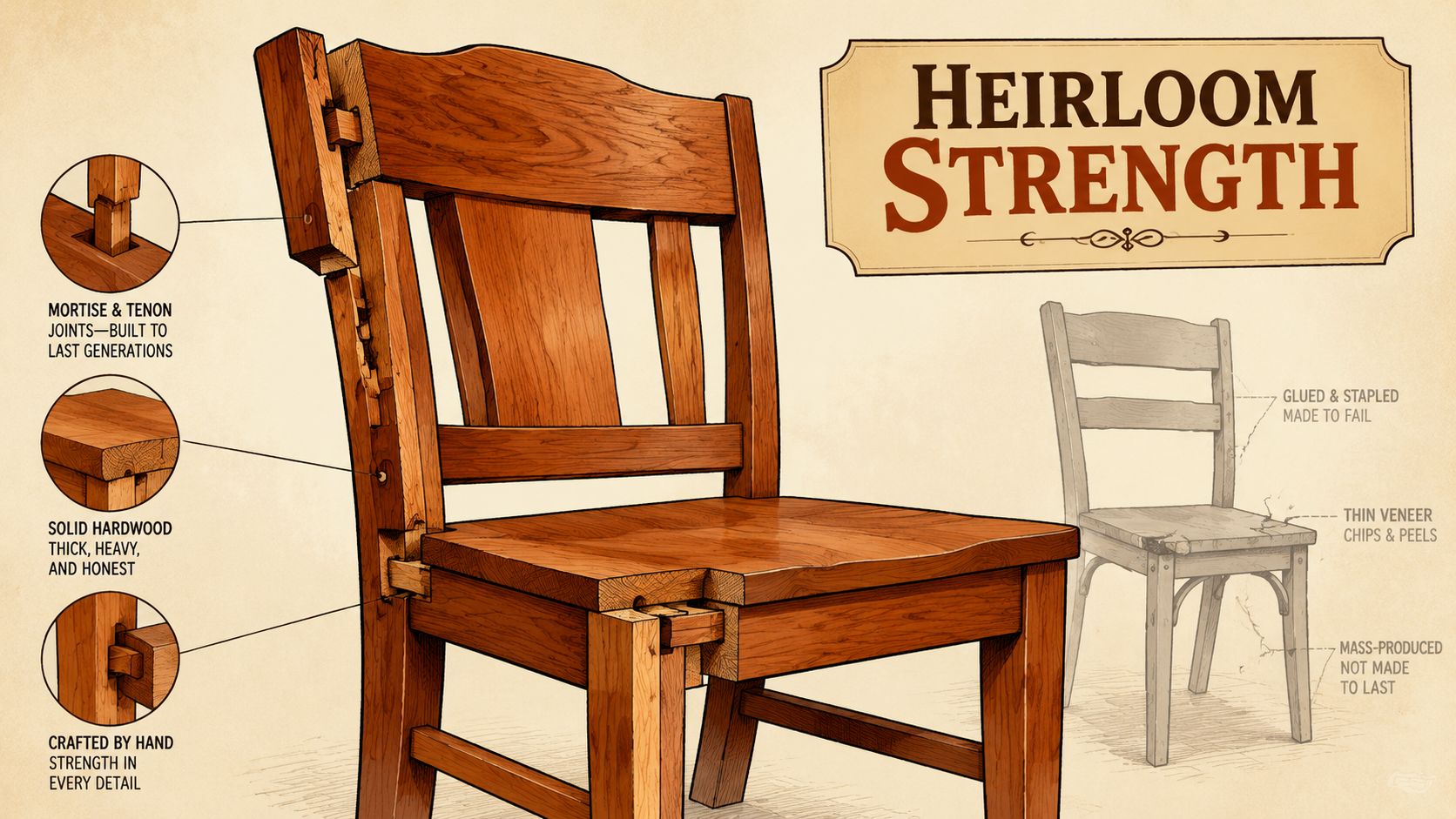
For shoppers comparing construction methods, American-made solid wood furniture is worth studying because it highlights what's supporting the top, the seat, and the long-term load.
Why hand-crafted joinery changes the outcome
Amish furniture joinery relies on interlocking wood pieces with dovetail and mortise-and-tenon joints, creating a bond significantly stronger than nails or screws. That construction helps furniture withstand stress and serve as a functional legacy, outperforming mass-produced alternatives in structural integrity (Amish joinery and structural integrity).
That statement sounds technical until it's translated into daily life. A dovetail joint locks together. A mortise-and-tenon joint fits one wood member into another in a way that resists loosening under stress. For a pet owner, that means less wobble, less shifting, and less chance that a favorite bench, bed, or dining chair starts failing at its stress points.
A side-by-side view makes the difference clearer:
Mass-produced construction
Often depends more heavily on hardware and shortcuts
May feel acceptable at first
Can loosen where repeated force hits the frame
Hand-crafted solid wood construction
Relies on the wood-to-wood connection itself
Handles repeated use with more confidence
Fits the idea of a local legacy and long-term home investment
Furniture for pet households should be judged like a staircase, not a decoration. It needs to carry weight, absorb motion, and stay reliable.
Made-to-order solid wood becomes especially useful. A shopper can choose species, stain, and finish to suit the room, while also gaining the strength that comes from better material integrity. That balance of beauty and durability is hard to get from pieces designed mainly for a quick sale.
Real-Life Solutions for Your Ann Arbor Home
Theory helps, but most households need room-by-room answers. A pet-friendly home in Southeast Michigan usually isn't dealing with one problem. It's managing a dog that naps against the recliner, a cat that circles the dining chairs, and a bedroom bench that becomes a launch point.
Living room comfort that still looks refined

A living room often benefits from an Ergonomic recliner sized correctly for the person who uses it most. Stressless offers custom sizing in Small, Medium, and Large, which matters because a chair that fits the body well tends to get used properly and wear more evenly. Add a durable leather or dense woven upholstery, and the room stays comfortable for people without becoming an invitation to visual clutter.
For older pets that struggle to reach a favorite chair or bed without slipping, a thoughtfully placed step system can aid older dog mobility and reduce the hard jumping that wears both joints and furniture.
One practical option many Ann Arbor shoppers consider is Amish solid wood furniture, especially when the goal is to pair a custom upholstered seating area with nearby case pieces that can stand up to daily traffic.
Dining and bedroom pieces that don't feel precious
Dining rooms often suffer from a different kind of wear. Claws scrape around chair legs. Water bowls get carried in from another room. Pets curl up under the table, which means the finish needs to handle everyday contact without making the owner anxious.
Customization matters here. Canadel offers thousands of combinations for dining sets, including leg styles, table edges, and scratch-resistant finishes, moving well beyond what's available in-stock and allowing a bespoke result (Canadel customization programs). That flexibility helps a household choose a table shape that fits traffic flow, a finish that better hides daily use, and chairs that feel coordinated rather than overly formal.
A simple room-by-room framework can help:
- Living room: Recliners and sofas benefit from ergonomic sizing, durable upholstery, and stable frames.
- Dining room: Solid wood tables and chairs with customized finishes are easier to live with than fragile surface treatments.
- Bedroom: Hand-crafted bed frames, nightstands, and benches hold up better when pets jump up and down routinely.
- Home Office and beyond: The same logic extends to desks, occasional chairs, and coordinated pieces throughout the house.
Tyner Furniture naturally fits into the conversation. Its assortment spans living, dining, bedroom, Home Office, and Outdoor Spaces, with made-to-order programs that let shoppers move beyond in-stock pieces and tailor the result to their home.
Keeping Your Investment Beautiful Cleaning and Pro-Tips
Even well-built furniture needs the right care. The good news is that high-quality materials are usually easier to maintain because they were designed to recover, resist, and clean up better in the first place.
Simple care for fabric, leather, and wood
Expert-engineered pet-friendly furniture uses high-density 2.5-lb foam and reinforced suspension to prevent sagging and frame fatigue from pet impacts, helping it hold structural integrity for years, unlike standard furniture that can show degradation within months.
That construction advantage changes maintenance. When cushions recover properly and the suspension does its job, cleaning becomes routine care instead of an attempt to disguise early failure.
A straightforward cleaning rhythm works well:
- For microfiber: Vacuum with an upholstery attachment, paying attention to seams and the front edge of seats where fur gathers.
- For top-grain leather: Wipe away surface dust with a soft cloth and use an appropriate conditioner on schedule so the hide stays supple.
- For solid wood: Dust regularly, blot spills quickly, and preserve the finish rather than soaking the surface.
For wood care habits that help prevent everyday marks, this guide to protecting wood furniture from scratches and stains is a useful companion.
Pro-Tips for daily life with pets
Some of the best protective habits don't involve covering the furniture at all.
Keep the “favorite pet spot” intentional. A handsome throw in one chosen corner often works better than wrapping the entire sofa.
Pro-Tips
- Use a designated perch: If a dog always chooses the left cushion, place a washable accent throw there that suits the room.
- Redirect scratching: Put scratching posts where the pet already likes to linger, not in an unused corner.
- Trim at the source: Regular nail care reduces micro-scratches on leather, wood, and fabric.
- Rotate wear zones: Turn loose cushions and vary seating patterns so one area doesn't take all the pressure.
- Clean quickly, not aggressively: Blot first. Rubbing harder usually spreads the problem.
For households trying to decide whether to refinish a beloved older piece or retire it, Meliusly's article on restoring old furniture offers practical perspective on when refurbishment makes sense.
Begin Your Pet-Friendly Journey at Tyner Furniture
The strongest pet-friendly rooms don't look defensive. They look intentional. The chair fits the body. The fabric fits the household. The dining table fits the traffic pattern. The wood finish fits the rest of the home.
A better standard than the throw-over cover
That shift matters because many people are tired of living under protective layers. Data shows 68% of pet owners avoid traditional furniture covers due to poor style, and interest is growing in scratch-resistant luxury, with attention focused on high-end finishes and top-grain leathers that resist damage without visible protective layers (pet owner preference for inherently durable materials).
That lines up with what many homeowners want in Ann Arbor and across Southeast Michigan. They don't want a room that looks like it's waiting for company before the main furniture comes out. They want durable furniture for pets that still feels warm, well-designed, and settled every day of the week.
For anyone still fighting the never-ending battle with upholstery cleanup, Pet Magasin's pet hair advice can be a handy read alongside better furniture selection.
How to shop with confidence in Southeast Michigan
Good shopping becomes easier when the process is narrowed to a few grounded priorities:
- Choose inherent durability over add-on protection. Materials and construction should carry the burden.
- Use customization well. In-stock is a starting point, not the limit. Canadel and Stressless make it possible to tune finish, size, leather, fabric, and configuration.
- Favor hand-crafted, solid wood where structure matters most. Bedroom and dining pieces benefit from real joinery and material integrity.
- Think in years, not weekends. Cost-per-year gives a clearer picture than sticker price alone.
- Make the purchase manageable. Special Financing and a Low Price Promise can reduce hesitation around a lasting investment.
For upholstery shoppers who want to browse possibilities before visiting, custom furniture upholstery options make it easier to compare materials and imagine a bespoke result.
Since 1957, the South State St. showroom has served as a community resource for people who want furniture that feels good, looks right, and lasts. That matters when the home includes pets, kids, guests, work-from-home routines, and the ordinary mess of real life. The right piece shouldn't need apology, and it shouldn't need hiding.
For anyone ready to make a more confident choice, Tyner Furniture offers a practical next step. Visit the Ann Arbor showroom on South State St. for a sit test and feel the difference in cushion support, leather texture, and the weight of solid wood in person, or browse the online Quick Specs to explore special-order options in bespoke fabrics, finishes, and configurations.