Full Bed Trundles: A Smart Guest Room Investment for 2026


Hosting guests in a room that's supposed to do three jobs at once gets old fast. A spare bedroom, a home office, and a catch-all storage zone can't all stay useful if the bed dominates the floor, yet nobody wants to send family or adult visitors to a flimsy sleep solution that feels like an afterthought.
That's where full bed trundles earn their keep. They give a room a real second sleep surface without surrendering the whole footprint, and when they're built well, they fit the way a proper guest room should fit, cleanly, and for the long haul. The old version of the idea goes back to the 16th century and stayed common into the early 19th century, when low rollaway beds helped households manage space, labor, and sleeping hierarchy in a very practical way (Britannica).
Rethinking the Guest Room with Full Bed Trundles
A homeowner in Ann Arbor might not need a permanent guest suite. What they need is a room that works on ordinary Tuesdays, then still feels generous when a parent, cousin, or long-stay friend arrives. A full-size trundle makes more sense than a tiny rollaway when adults are involved, because a full sleeping surface gives the guest room real credibility instead of a kid-only compromise.
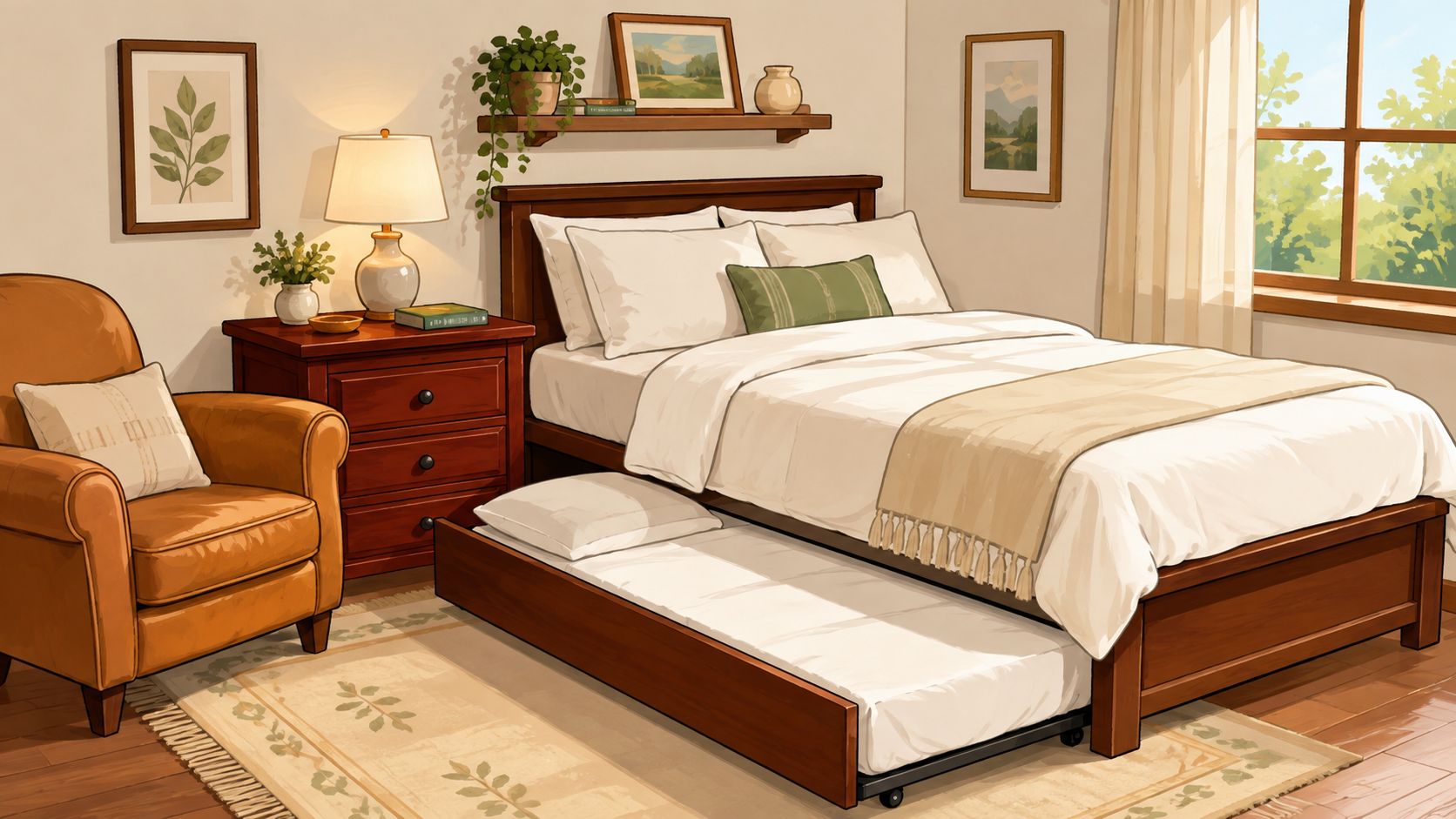
A guest room should work like a room, not a storage closet
The best guest rooms in Southeast Michigan don't look overfurnished. They look intentional. A solid bed with a trundle lets the room stay open day to day, then convert into a proper sleep space without dragging in extra temporary pieces that crowd the walkway or make the room feel improvised.
That is the practical appeal of the trundle concept as a whole, and it's why the form has lasted for centuries. Britannica notes that historic trundles were low beds on casters or wheels, often pushed under larger beds for servants or secondary sleepers, with oak common in the frame and leather or canvas straps supporting the mattress rather than a modern box spring (Britannica). The point wasn't novelty. It was efficiency, and that part still holds up.
For a homeowner weighing guest comfort against square footage, the question is simple. Does the room need a bed that sits there all year, or a bed that waits until it's needed? A well-built full bed trundle answers the second question without making the room feel like a spare closet with sheets.
Practical rule: If the room has to do double duty, the bed should disappear cleanly when it's not in use. That's the standard, not the bonus.
For a related layout approach, this spare-bedroom planning guide gives a useful sense of how a guest room can stay calm and functional without wasting floor space. The right trundle plays into that same logic. It keeps the room flexible, but it still respects comfort, craftsmanship, and the way people live.
Why the full size matters
A full trundle is a better adult guest solution than a smaller pull-out because it gives the sleeper more usable room. The lower bed is still close to the floor, so it isn't a perfect substitute for a standard-height guest bed, but it's far more accommodating than a cramped twin when the guest is staying more than one night.
Woodstock Furniture's trundle bed buying advice is worth a careful read for anyone comparing configurations, especially if the room also has to function as a home office or family space. The bigger lesson is the same across good guest-room planning. Buy for the way the room is used most of the year, not for the rare weekend when it's full.
Mastering Dimensions and Mattress Clearances
A trundle works only when the room is measured as a working system, not as a pair of stacked beds. The mattress size matters, but the open path, the clearance above the lower unit, and the way the frame slides in and out matter just as much. If the geometry is wrong, the trundle starts sticking, the frame takes unnecessary wear, and the guest room becomes frustrating to use.
The numbers that actually control fit
A full-size trundle is generally built around a mattress measuring about 54 inches wide by 75 inches long (Designing Idea). That footprint still has to live inside the under-bed cavity, so the box dimensions and mattress thickness have to match the frame with care. A representative full platform bed with trundle lists a 74.76 in × 53.82 in × 11.61 in trundle box and a 14 in platform height, and the matching guidance points to at least 10.5 in of under-clearance while keeping the mattress no thicker than 6.5 to 7 in so the lower bed does not interfere with the upper structure.
| Measurement Type | Standard Dimension | Planning Note |
|---|---|---|
| Mattress size | 54 in × 75 in | Confirms the full footprint of the lower sleeper |
| Trundle box example | 74.76 in × 53.82 in × 11.61 in | Shows how tightly the lower bed is boxed in |
| Under-clearance | 10.5 in minimum | The bed must clear the upper structure cleanly |
| Mattress thickness | 6.5 to 7 in recommended | Too much height causes binding and closure problems |
Those figures are not decorative. They tell you whether the lower bed will roll freely, sit level, and tuck away without scraping the main frame. A buyer can find a solid reference point in Home Depot, which shows how a real full trundle package handles box size, under-clearance, and mattress thickness in one build.
The open room matters more than the closed room
Stored dimensions are only half the story. A full trundle setup can require an open footprint of about 92 in × 75 in, which means roughly 8 feet of clear width when both beds are in use. That is the test that matters. If the lower bed opens into a door swing, closet access, or the path to the bathroom, the room stops functioning the moment guests arrive.
Measure the rollout lane, not just the empty rectangle. A rug edge, a floor transition, or a dresser leg can stop a trundle from rolling smoothly even when the room looks wide enough on paper.
Use a tape measure, then mark the open bed position on the floor with painter's tape. Walk the path around it, open the closet, and check the door swing with the trundle fully extended. If circulation feels tight in that mockup, the room is too small for a full-size pullout, no matter how good the bed looks in the showroom.
For a disciplined process, this measuring guide gives a practical way to check furniture before you order. With trundles, that habit protects the frame, avoids returns, and keeps the guest room useful instead of awkward.
The Solid Wood Advantage for Lasting Durability
A weak trundle reveals itself fast. It flexes under load, the wheels catch, and the frame feels light enough for a short stay, not a home that expects years of use. That is the wrong build for a guest room that needs to do real work.
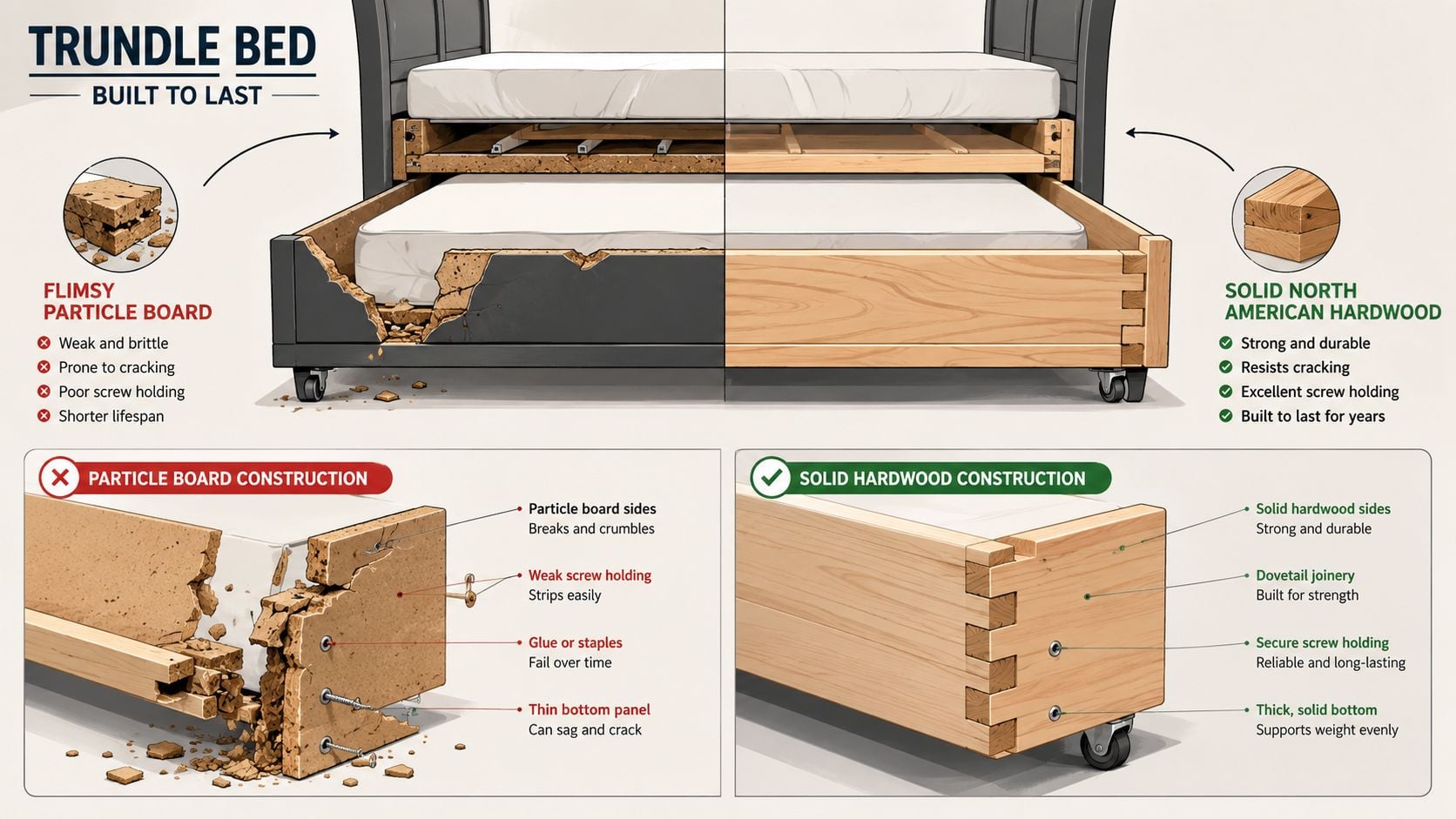
Why the frame should be built like a real piece of furniture
A good full trundle has to carry concentrated weight while it moves. Strong builds use a center support bar, four casters, and a denser slat layout so the load is spread across the frame instead of hanging on a few weak points. One full-size trundle package includes 10 wood slats, 4 casters, and a center support bar on the lower unit, while another full-bed system lists a main-bed capacity of 400 lb with plywood slats, a metal support bar, and metal-on-metal bolt connections. Those details matter because they control how the bed carries stress every time it is rolled out and tucked back in.
The logic is straightforward. More support means less bending in the rails and slats, especially on a bed that gets moved often. Thin panels and loose hardware can look acceptable on delivery day, then start breaking down long before a properly built wood frame would show the same wear.
Material matters just as much. Tyner Furniture's solid wood versus engineered wood guide explains the difference plainly. Solid wood has more mass, a different feel under load, and better staying power than veneer-based shortcuts. In a guest bed, that shows up in how the frame tracks, how the joints hold, and how the finish ages.
What good craftsmanship looks like in the showroom
Some details stand out right away. Solid wood has deeper grain, more variation, and more weight at the joints. The rest shows up in the rails and supports, where a trundle built from real hardwood keeps its shape and moves with more confidence.
A trundle should roll like furniture, not like a storage cart. If the motion feels crude, the construction usually is too.
Hand-crafted joinery, solid materials, and a steady support system earn their keep here. A trundle meant for a long-term home should behave like an heirloom guest bed, not a disposable convenience. The lower bed takes the most punishment in the frame, so cheaping out there is false economy.
Measuring Your Room for Deployment and Storage
A full bed trundle has two working states, and both matter. In the parked position, it needs to sit cleanly under the main bed without blocking drawers, closet doors, or the path into the room. In the deployed position, it has to clear the furniture around it without turning the bedroom into a squeeze.
Start with the stored layout
Measure the room as it lives every day, with the trundle tucked away. Include the main frame, the mattress, and the space that nearby pieces need to function, not just the space they occupy on paper. A dresser drawer that cannot open fully is a bad layout, even if the bed itself technically fits.
Door swing comes first. A bedroom door, closet door, or nearby cabinet can interfere with the pull-out path long before the trundle reaches its final position. If the room relies on a tight turning angle, measure that movement carefully. A bed that forces a door to stay shut is a poor guest-room solution.
Check what the floor surface does
The floor itself changes how the trundle behaves. Thick carpet can slow the casters, make the pull-out motion uneven, and leave the lower bed feeling heavier than it should. A low-pile surface moves more cleanly, while a plush one often needs more clearance and a more deliberate hand.
Raised thresholds and uneven transitions create the same kind of trouble. A trundle that rolls smoothly across hardwood can catch hard at the edge of a rug or doorway trim. That kind of friction matters in real use, because a guest bed should roll out without a struggle every time it is needed.
Leave room for the wood itself
Wood is not static. Solid wood pieces can shift a little with changes in humidity, so the fit should never be so tight that seasonal movement turns into rubbing or scraping. Give the frame breathing room around walls, trim, and adjacent furniture.
That extra margin also protects the finish. A trundle that barely clears the bedside table in one season can start to scuff when the air changes and the wood settles differently. The better plan is to allow enough room for the frame to move naturally, then keep the room useful in both warm and dry weather.
A narrow fit looks efficient on move-in day and troublesome after that.
Confirm the guest path
The room should still let someone enter, sleep, and leave without feeling boxed in. Check the path from the doorway to the bed, then from the bed to the bathroom or hall. If the trundle changes that route into a sideways shuffle, the setup is too tight for regular use.
Long-term thinking beats a quick fit. A trundle in a guest room should behave like a proper bed arrangement, not a temporary obstacle course. If it only works when every surrounding piece is pushed to its limit, the room is carrying too much furniture for the bed to function well.
Evaluating Cost-Per-Year and Customization Value
A smart furniture buyer stops asking, “What does it cost?” and starts asking, “What does it cost per year of useful life?” That question changes the whole conversation around full bed trundles, because the right piece can serve as guest bed, spare-room anchor, and long-term investment instead of a short-lived fix.
Why made-to-order beats settling for whatever is in stock
In-stock is only the starting point. The better purchase is often the one that can be configured to the room, the finish, and the rest of the home's interior design. That matters because a guest bed should not look borrowed from somewhere else. It should belong in the room, the same way a dining table or recliner belongs in the house when it's properly chosen.
Tyner Furniture's showroom model reflects that kind of flexibility. The store has served Southeast Michigan since 1957, and it keeps a broad mix that reaches beyond bedrooms into Home Office and Outdoor Spaces, so the same household can coordinate more than one room without starting over each time. That wider selection matters for homeowners building a cohesive house, not just buying one item.
The value is in the details shoppers can choose. A made-to-order trundle can be customized in finish, configuration, and overall look so it works with the rest of the home instead of fighting it. That's a better long-term decision than replacing a hollow frame every few years because the first one started to sag or look tired.
The long view is the honest one
A quality trundle has a higher upfront commitment, but the cost-per-year logic usually favors the sturdier piece. Strong materials, better joinery, and a finish that ages well all reduce the urge to replace the bed early. That's especially true in a guest room, where the piece may not be used every night, but it still needs to stay ready for years.
There's another advantage worth naming. Heirloom-quality furniture supports the rest of the home's rhythm. It doesn't demand attention every season, and it doesn't look dated the moment the room changes around it. That steadiness is the opposite of throwaway furnishing, and it's a better fit for homeowners who want to buy once and buy well.
Selecting the Right Mattress and Maintaining Your Trundle
The mattress makes or breaks the guest experience. A strong frame with the wrong mattress still feels wrong, and a proper mattress on a poor frame won't save the setup. For a trundle, the mattress has to balance comfort, thickness, and clearance without fighting the bed's mechanical limits.
Keep the mattress low and supportive
Most trundles are made for a low-profile mattress, with common guidance placing the thickness limit around 6 to 8 inches. That range is there for a reason. If the mattress is too thick, the trundle may not close smoothly or may scrape the underside of the main bed when rolled away.
For shoppers choosing a guest-room mattress, this guide to the right guest room mattress is a useful starting point for thinking about support, comfort, and profile together. The key is to match the mattress to the actual trundle, not just to the general idea of a full bed.
Keep the mechanism clean and the wood protected
The moving parts need attention. Casters should stay aligned, and the rollout lane should stay clear of grit, loose rug fibers, and clutter that can make the lower bed drag. That kind of maintenance is minor, but it protects the movement that makes the bed useful in the first place.
Wood care matters too. Solid finishes need occasional attention so the surface doesn't dry out or lose its depth. A trundle that's kept clean and properly finished looks better longer, and the frame is less likely to show the kind of wear that turns a guest room into a visual afterthought.
Good maintenance is quiet. If the trundle rolls easily, closes fully, and the finish still looks rich, the bed is doing its job without asking for attention.
For a more complete overview of mattress selection, Tyner Furniture's mattress guide gives a helpful framework for matching comfort to room use. A trundle guest bed does best when the mattress is chosen as carefully as the frame.
Your Local Showroom and Financing Options
A trundle is easier to buy when someone can see the build, feel the movement, and judge the finish in person. That's why a local showroom still matters, especially for buyers in Ann Arbor who want to compare solid wood construction, test the rollout action, and look at the piece in the same lighting it will live under at home.
Tyner Furniture's Ann Arbor showroom on South State St. gives Southeast Michigan shoppers a place to do exactly that. It's been part of the local scene since 1957, and that kind of longevity matters when the goal is a local legacy purchase instead of a quick fix. A shopper can also use financing options to make a better-built bed more approachable without compromising on the material standard.
Why the showroom visit pays off
A photo can show shape, but it can't show the weight of solid cherry wood, the feel of a finish, or the way a trundle tracks under pressure. A showroom visit gives the buyer a sit test, a look at joinery, and a chance to compare stain depth and material integrity with a real hand on the piece. That's the practical difference between guessing and buying with confidence.
It also helps that Tyner Furniture's assortment reaches across the home, from bedroom pieces to Home Office and Outdoor Spaces. That breadth makes it easier to coordinate a trundle with the rest of the house, especially for buyers building a room around existing furniture rather than starting from scratch.
The Low Price Promise and special financing make the purchase easier to manage, but the bigger value is the combination of guidance, craftsmanship, and local accountability. For a bed meant to serve guests for years, that combination beats a one-size-fits-all warehouse approach every time.
Visit the Ann Arbor showroom on South State St. to do a sit test, compare solid wood trundle options, and talk through the right size for your guest room. If a made-to-order solution makes more sense for the room, Tyner Furniture also makes it easy to browse quick specs for special orders, then move forward with confidence on a trundle that fits your home for the long term.