High End Executive Desks: Your 2026 Investment Guide

A lot of people start shopping for a desk at the exact moment they're tired of working around one.
The dining table isn't cutting it anymore. The builder-grade office desk feels light, noisy, and undersized. The room itself may be ready for something more settled, something that reflects a serious career, supports long workdays, and still looks right years from now. That's when high end executive desks move from a nice idea to a practical decision.
For homeowners and professionals around Ann Arbor and Southeast Michigan, this purchase can feel bigger than expected. It isn't just about picking a finish and calling for delivery. It's about choosing a workspace centerpiece that has to perform every day, fit the room correctly, support posture, hold technology, and age well. That's why furniture tends to be a high-consideration purchase in the first place, especially when the piece is meant to stay with a home for the long haul. A helpful perspective appears in this look at why furniture purchases are high consideration decisions.
A forever desk should be judged less by sticker shock and more by cost per year. A hand-crafted desk with durable materials, proper joinery, and a layout that still works a decade from now often delivers more value than a series of replacements. In a community that has trusted local guidance since 1957, that mindset still matters.
Table of Contents
- An Introduction to Your Legacy Workspace
- What Truly Defines a High-End Executive Desk
- Choosing the Right Size and Style for Your Office
- Essential Ergonomics and Integrated Features
- The Bespoke Advantage of Hand-Crafted Desks
- Budgeting for an Heirloom Investment
- Your Next Step Toward a Legacy Workspace
An Introduction to Your Legacy Workspace
A high-end executive desk earns its place by solving several problems at once. It anchors the room, supports concentration, and gives daily work a sense of permanence. That matters whether the office sits in a historic Ann Arbor home with tight architectural details or in a newer Southeast Michigan build with a clean, open plan.
The term heirloom gets used loosely, but it has a clear meaning in furniture. It describes a piece that's built to last through years of use and still deserves repair, refinishing, or relocation instead of replacement. A desk can't reach that standard on looks alone. It has to start with honest materials, thoughtful engineering, and craftsmanship that remains sound long after trends fade.
Practical rule: If a desk is being evaluated only on appearance, half the decision is missing.
The good news is that the shopping process becomes much easier once the decision shifts from “What's fashionable?” to “What will still work beautifully years from now?” That change in mindset helps buyers ignore a lot of noise. It also leads to better questions about wood construction, ergonomic range, storage behavior, cable control, finish quality, and whether the desk fits the room.
That's the right way to approach high end executive desks. They're not impulse purchases. They're workspace investments that should feel reassuring every morning, from the first drawer pull to the weight of the writing surface under a laptop, a legal pad, or a stack of contracts.
What Truly Defines a High-End Executive Desk
The easiest mistake in this category is assuming “high-end” means decorative. It doesn't. In furniture, quality reveals itself in what the desk is made from, how it's joined, how it feels under load, and how well it handles years of ordinary use.
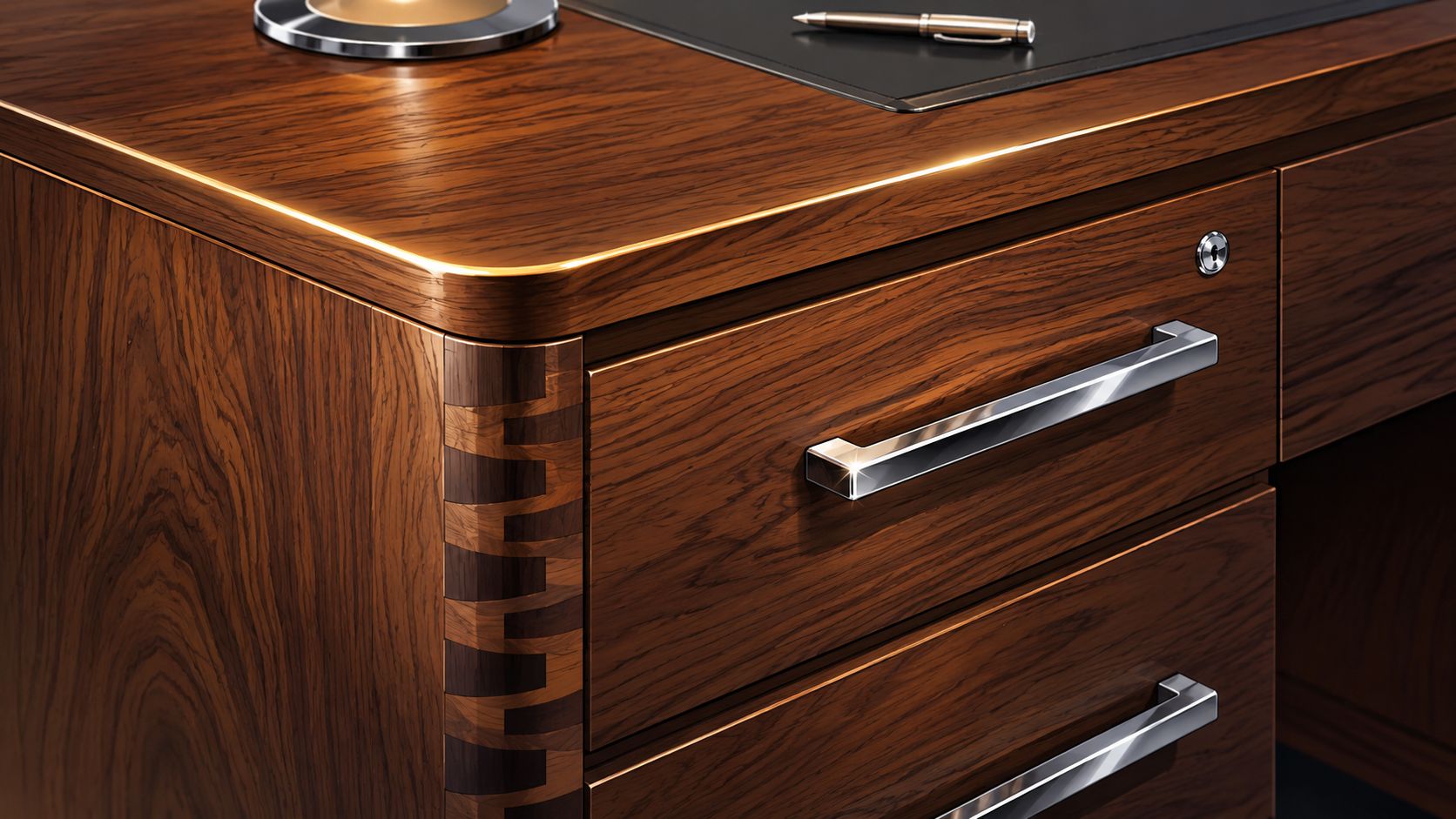
The structural standard is clear. The structural integrity of high-end executive desks is determined by the use of solid North American hardwoods such as mahogany, oak, and walnut, along with time-honored joinery techniques like mortise-and-tenon and dovetailing, which outperform mass-produced veneer alternatives. That's the standard behind well-built luxury office desk options.
Material integrity shows up fast
Solid hardwood has a different presence from thin veneer over composite material. The weight is more substantial. The grain has depth instead of a printed uniformity. A cherry or oak top doesn't feel hollow when a hand rests on it, and the visual character changes with the light instead of looking flat from every angle.
For a buyer evaluating a desk in person, these are the first clues worth noticing:
- Edge thickness: A solid top usually looks and feels convincing at the edge, not just on the face.
- Surface character: Real wood grain varies naturally. Repetition tends to signal a manufactured surface.
- Mass and steadiness: A desk with proper material integrity stays composed when drawers open, monitors shift, or elbows lean into the front edge.
A premium desk market exists because people keep looking for pieces that communicate professionalism and last. The global high-end executive desk market reached about USD 20 billion in 2023 and is projected to reach USD 30 billion by 2032, with a 4.5% CAGR, according to office desk market data.
The details that separate heirloom from ordinary
Joinery matters because furniture fails at stress points, not in showroom photographs. Dovetailed drawers hold together under repeated use. Mortise-and-tenon connections resist loosening over time. These methods don't just sound traditional. They create the difference between a desk that stays square and one that starts shifting, creaking, or racking.
The other dividing line is what the desk includes as standard, not as decoration.
| Feature | What works | What doesn't |
|---|---|---|
| Drawer action | Smooth, controlled travel | Rattling or abrupt stops |
| Storage security | Locking compartments for sensitive papers | Open storage for everything |
| Finish quality | Durable, hand-applied feel that protects the wood | Thin surface that shows wear quickly |
| Air quality consideration | Low-emission certifications such as GREENGUARD Gold where applicable | Strong off-gassing in enclosed offices |
A high-end desk should feel quieter than an ordinary one. Better joinery, steadier drawer slides, and denser materials reduce the little disruptions that make daily work feel cheaper than it should.
That's why craftsmanship isn't an abstract talking point. It's what turns a desk into a local legacy piece instead of another item on a replacement cycle.
Choosing the Right Size and Style for Your Office
The right desk should command the room without swallowing it. That balance is especially important in Ann Arbor, where offices can vary wildly. One home may have a converted study with trim details and a narrow doorway. Another may have a broad bonus room with enough space for a more architectural setup.
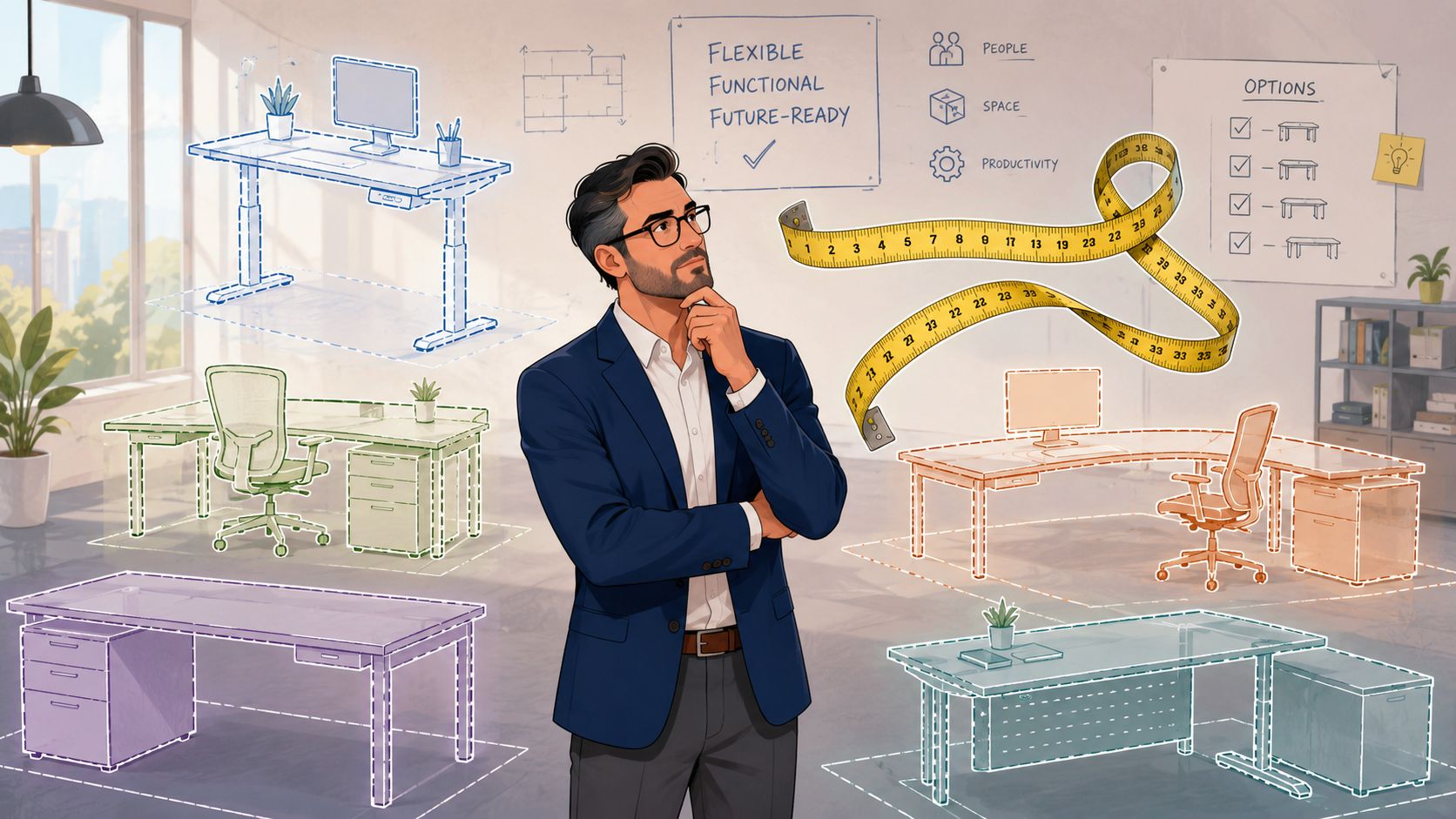
A practical starting point is this: industry standards indicate that high-end executive desks typically feature widths ranging from 60 to 72 inches and depths spanning 30 to 36 inches, creating the kind of generous work surface needed for multiple monitors and complex paperwork, as outlined in this guide on what defines an executive desk. Before choosing a silhouette, it helps to review the room with a reliable furniture measuring guide.
Start with room scale
A desk can be beautiful and still be wrong for the room. The most common sizing issue isn't buying too small. It's buying a desk that leaves no breathing room around the chair and walking path.
Keep these spacing ideas in mind:
- Desk footprint: A larger executive desk needs visual and physical space around it, or it loses its authority and starts feeling crowded.
- Chair clearance: Better layouts allow at least 36 inches behind the chair for comfortable egress.
- Monitor distance: Depth matters because screens should sit at a comfortable viewing distance, not at the very edge of the work zone.
A deep desk often feels better in daily use than a wider but shallow one. It creates room for papers, keyboard placement, a task lamp, and monitor positioning without forcing everything into one visual plane.
Match the desk shape to the way work happens
Shape should follow workflow, not trend. Different forms solve different problems.
- Rectangular desks suit focused work, cleaner sight lines, and rooms where circulation matters.
- L-shaped desks help separate computer work from writing, reviewing, or meeting space.
- U-shaped desks create a command-center feel, but they need a room that can carry the footprint gracefully.
Style matters too, but the strongest rooms usually avoid extremes. Traditional desks in dark hardwood can look grounded and formal. Transitional designs bridge classic joinery with lighter profiles. Modern executive desks can feel crisp and architectural, especially when paired with the right chair and lighting.
The desk should fit both the office and the person using it. A powerful piece in the wrong room feels awkward. A properly scaled one feels settled on day one.
This is also where visual texture matters. In a showroom, buyers often respond first to color. In real homes, proportion and finish tend to matter longer. The weight of solid cherry wood, the softness of a matte finish, and the relationship between the desk and surrounding casegoods usually decide whether the room still feels right years later.
Essential Ergonomics and Integrated Features
A desk can be hand-crafted and still fail the workday if it doesn't support the body. High end executive desks should do both. They should look composed and behave intelligently.
Movement is part of the design
The strongest ergonomic development in this category is the sit-stand desk with a powerful dual-motor base and memory presets. Research indicates that the optimal dynamic range for sit-stand systems is 25.5 inches to 51 inches of vertical adjustment, allowing users to maintain a neutral posture and transition more often, which improves blood flow and reduces spinal compression, according to BIFMA ergonomic guidance.
That range matters because office users aren't built to one standard height. A quality desk should adapt to the person, not force the person to adapt to the desk.
Three features deserve close attention:
- Dual-motor operation: Especially important when the desk supports heavier equipment loads.
- Memory presets: Helpful because they remove friction from the sit-stand routine.
- Anti-collision protection: A smart safeguard for the desk, nearby seating, and anything stored below.
Integrated features that earn their keep
Premium features should reduce distraction, not add gadgets. The most useful integrated details tend to be the least flashy.
- Cable management: Well-placed grommets and accessible trays keep power cords from pooling underfoot or dragging across the surface.
- Storage design: Soft-close drawers and locking compartments support both quiet operation and document security.
- Electrical safety: Commercial-grade models may also carry electrical and mechanical safety validation such as UL 962.
An executive desk should also work with the chair, not against it. That's where the broader home office plan matters. Seating, monitor height, task lighting, and desktop depth all contribute to comfort. For buyers building a more complete workspace, a resource on multifunctional home office furniture helps connect those pieces.
The customization edge matters here too. In-stock is only the beginning. A room often performs better when the desk, seating, and surrounding storage are chosen as a system. That same design thinking appears in bespoke programs such as Canadel for customized configurations and Stressless for ergonomic seating, including size-specific options in Small, Medium, and Large that support a more personal fit. It reflects a broader view of furniture selection, from the Home Office to Outdoor Spaces, with comfort and interior design treated as connected decisions rather than isolated purchases.
The Bespoke Advantage of Hand-Crafted Desks
Customization changes the whole buying process because it shifts the question from “What's available?” to “What belongs in this room?” That's a major difference. The best executive offices rarely look assembled from leftovers. They look considered.
A made-to-order desk gives the buyer control over the variables that matter most. Wood species, stain depth, hardware feel, storage arrangement, and even subtle dimensional decisions can all shape how the finished piece lives in the space.
Made-to-order changes the whole decision
Amish hand-crafted furniture built from solid North American hardwoods utilizes traditional joinery techniques like dovetailing and mortise-and-tenon, which significantly outperform mass-produced alternatives in structural integrity and longevity, ensuring the furniture serves as a functional legacy, as shown in this overview of Amish furniture craftsmanship.
That matters because a desk doesn't sit alone. It has to relate to flooring, trim color, wall tone, shelving, and the overall interior design language of the home. A bespoke approach makes those relationships easier to solve.
A buyer choosing a hand-crafted desk should think through these factors:
- Wood personality: Cherry brings warmth, oak offers visible grain, and maple often reads cleaner and lighter.
- Finish intent: A stain should support the room, not overpower it.
- Storage habits: Some professionals need enclosed organization. Others want a cleaner writing face and fewer built-ins.
This same made-to-order mindset appears in other rooms of the home. Canadel, for example, offers thousands of customization combinations in dining, from leg styles and edges to finishes and distress levels. That reinforces an important truth. In-stock is just the beginning.
Customization has to serve the room
The best customization isn't endless. It's disciplined. Every choice should improve fit, usability, and long-term satisfaction.
Good bespoke furniture doesn't feel customized for the sake of being different. It feels resolved.
That principle applies beyond desks. Homeowners planning coordinated built-ins, cabinetry, or storage often benefit from seeing how other custom projects are evaluated. This wardrobe guide for home improvement is a useful example because it shows how thoughtful measurements, finish choices, and room context shape a successful built-in result.
For buyers exploring hand-crafted, sustainable, solid wood office furniture, custom Amish furniture options offer one path toward a desk that feels less like a product and more like a permanent fixture of the home. That's the heart of heirloom buying. The desk isn't meant to get by. It's meant to belong.
Budgeting for an Heirloom Investment
Price matters. It just shouldn't be the only lens.
A better way to budget for high end executive desks is to ask how long the piece is expected to serve, how well it will age, and whether it's likely to be replaced because of failure, poor fit, or changing needs. A desk that remains structurally sound, visually relevant, and comfortable to use can justify a higher upfront investment because the cost per year often improves over time.
How to evaluate cost per year in person
The most useful budgeting exercise often happens in the showroom, not on a spreadsheet. A buyer can learn a lot from touch and motion.
Check these things in person at the South State St. showroom in Ann Arbor:
- Run a hand along the top: The surface should feel substantial and well finished, not plasticky or hollow.
- Open every drawer: Look for smooth travel, quiet closure, and stable alignment.
- Sit at the desk: Notice whether the depth supports a natural reach and whether the scale feels commanding or excessive.
- Inspect inside surfaces: Well-made furniture usually looks cared for even in the places guests won't see.
The sensory part matters. Buyers notice the weight of solid wood, the clean sound of quality hardware, and the difference between a surface that merely looks polished and one that feels durable. That physical test often clarifies value faster than a long product description ever could.
Making the purchase easier to manage
Financing can be practical when it supports a long-term decision instead of encouraging a rushed one. Tyner Furniture offers special financing programs that include promotional no-interest periods, enabling customers to spread the cost of high-end custom orders over manageable monthly payments, as described in its special financing information. Paired with a Low Price Promise, that helps make an heirloom purchase more approachable without reducing the decision to a short-term bargain hunt.
That can be especially helpful when the office project is part of a larger household change, such as a move, renovation, or room conversion. For readers trying to map the practical side of business moves and workspace planning, this UK office relocation costs guide offers a useful budgeting framework, even if the location differs.
Since 1957, the local value in this kind of guidance has been simple. Help people buy better, not faster. That's still the right approach when a desk is meant to serve as an investment, not a placeholder.
Your Next Step Toward a Legacy Workspace

A great executive desk should do more than fill floor space. It should support serious work, hold its structure, suit the room, and still feel right after the novelty wears off. That's the ultimate test of a legacy workspace.
The strongest choices usually share the same traits. They rely on durable materials. They fit the office instead of dominating it. They account for ergonomics and integrated storage. And when customization is handled well, they reflect the owner's work habits and interior design priorities without feeling trendy.
There's also a practical side to ownership after the desk is built and delivered. Large, heirloom-quality furniture deserves careful handling when a room is renovated or a home is reconfigured. For anyone thinking ahead about protection during a future move, this safe antique moving guide offers useful perspective on handling substantial wood furniture with care.
The final step should be tactile. Visit the South State St. showroom in Ann Arbor. Test the drawer glide. Study the grain. Notice the weight of the wood and the way the finish catches the light. If the office plan includes seating, perform a proper sit test and compare how the chair and desk work together. If the project is still taking shape, browse Quick Specs online and narrow the field before making the trip.
That kind of deliberate shopping has served Southeast Michigan well for generations. It respects the fact that some pieces aren't bought for now. They're chosen for the long haul.
For a closer look at high end executive desks, visit Tyner Furniture in Ann Arbor for a sit test, or browse the online Quick Specs for special orders and made-to-order inspiration before heading to the showroom.