Leather Swivel Chairs: Expert Style & Comfort


A lot of shoppers reach the same point. The sofa is in place, the coffee table works, the room is almost there, but one chair is still missing. It needs to feel comfortable at the end of a long day, look polished from every angle, and earn its spot for years instead of one season. That's where leather swivel chairs often enter the conversation.
The challenge is that this category can get confusing fast. Leather quality varies. Seat dimensions matter more than many people expect. A swivel base can improve how a room works, or create traffic problems if the scale is off. For homeowners and renters across Ann Arbor and Southeast Michigan, the better purchase usually isn't the trendiest chair. It's the one that balances craftsmanship, fit, and long-term value.
Since 1957, Tyner Furniture has been part of that conversation in the local community. That long view matters. An heirloom purchase isn't about chasing novelty. It's about choosing materials and construction that still feel right years down the road, whether the chair ends up in a living room, reading corner, bedroom sitting area, or home office.
Table of Contents
- Your Guide to Finding the Perfect Leather Swivel Chair
- Decoding Leather The Language of Durability and Feel
- Beyond the Spin Understanding Swivel and Ergonomics
- Finding the Perfect Fit Sizing and Room Placement
- Styling Your Swivel with Amish Solid Wood Furniture
- Caring for Your Investment Maintenance and Longevity
- Making It Yours Customization and Purchasing in Ann Arbor
Your Guide to Finding the Perfect Leather Swivel Chair
A leather swivel chair has to do more than look handsome in a showroom. It has to support the way a room lives. In a family room, that may mean turning toward conversation and then back toward a window. In a reading corner, it may mean soft support without the oversized bulk that can make a room feel crowded. In a home office, it may mean a cleaner silhouette than a task chair without giving up everyday comfort.
That's why the best way to shop is to think in layers, not labels. Start with use. Then evaluate leather quality, seat comfort, room placement, and how the chair will relate to the rest of the furniture. A chair that feels impressive for five minutes can disappoint after an hour. A chair that fits the body and the room tends to last in both style and function.
For readers comparing silhouettes, this overview of modern swivel chairs for living room layouts can help narrow the field before visiting a showroom.
The purchase gets easier with a simple filter
A useful decision framework looks like this:
- First ask about purpose. Reading, TV viewing, conversation, and desk use each call for a different seat depth, back feel, and arm position.
- Then judge materials. The leather, cushion fill, and frame determine how the chair will age.
- Finally test scale. A beautiful chair that overpowers the room won't feel like value for long.
Practical rule: The right chair should feel calm and obvious in the space, not like a compromise that has to be justified.
Shoppers often focus on price first because it feels concrete. Long-term value is usually a better lens. A well-made leather swivel chair can become part of the home's rhythm for years, especially when it's paired thoughtfully with other lasting pieces from the home office to the living room, bedroom, and even coordinated outdoor spaces.
Decoding Leather The Language of Durability and Feel
A leather swivel chair can fool you at first glance. Under showroom lighting, many look rich and inviting. The actual difference shows up later, after winter heat dries the air, after a favorite seat gets used every evening, and after the chair has to hold its own beside a solid cherry or oak piece that will still be in the family years from now.
That is why leather deserves a slower look.
What shoppers are really buying
Shoppers are not only buying color or softness. They are buying the way the surface will age, how the seat will feel after repeated use, and whether the chair will still look at home next to enduring furniture. In a room with Amish solid-wood tables, bookcases, or bedroom pieces, weak leather stands out quickly. Good leather settles in. Poor leather gives up.
On a better swivel chair, the materials work together like parts of the same recipe. Top-grain or full-grain leather provides the touch and visual depth. A resilient cushion helps the seat keep its shape. A well-built frame supports years of sitting, turning, and standing. No single part carries the whole chair.
For readers comparing upholstery labels, this guide to top-grain leather vs bonded leather explains what those terms usually mean in everyday use.
Leather Type Comparison
| Leather Type | Key Characteristic | Best For |
|---|---|---|
| Full-grain leather | Natural surface character and strong long-term aging potential | Buyers seeking the most organic look and heirloom appeal |
| Top-grain leather | Refined surface, premium feel, and broad everyday versatility | Living rooms, reading chairs, and shoppers balancing elegance with practicality |
| Bonded leather | Lower-tier material with a different long-term wear profile | Shorter-term use or budget-driven purchases |
The chart helps, but leather selection is more like choosing hardwood than choosing paint. Species matters. Cut matters. Finish matters. Two oak tables can age very differently depending on how they were built, and leather works much the same way.
Why finish matters over time
Finish changes both feel and aging. A heavily corrected or heavily coated leather can look uniform at first, but it often has less of the natural variation that gives leather its warmth. More natural leathers usually show grain, soften with use, and develop patina in a way many long-term owners value.
That aging process can confuse shoppers because "marks" are not always defects. On quality leather, small variations in grain and color are often part of the material itself. They are signs that the hide began as a natural material, not a printed imitation. In the right room, especially one grounded by handcrafted wood furniture, that character usually reads as honest and lasting rather than imperfect.
Cost-per-year is often the clearer way to judge value. A better leather chair may cost more upfront, yet it usually gives back more in comfort, appearance, and longevity. Instead of peeling or looking tired early, it tends to gain softness and visual depth through use.
A good leather chair should look more settled with age, not more disposable.
At Tyner Furniture in Ann Arbor, that point matters because many shoppers are furnishing for the long haul. They are pairing a leather swivel chair with Amish dining pieces, a solid-wood desk, or a carefully chosen bedroom suite. In that setting, the right leather does more than match the room. It earns its place in it, especially when customization options such as Stressless help fit the chair to the person who will live with it for years.
Beyond the Spin Understanding Swivel and Ergonomics
A leather swivel chair usually proves itself in a quiet moment. You sit down with a book, turn toward the conversation, then pivot back toward the window without scraping the floor or shifting the whole chair by hand. When the engineering is right, that movement feels natural. When it is wrong, even a handsome chair starts to feel busy and awkward.
The swivel function is only one part of comfort. The mechanism under the seat, the pitch of the back, the height of the arms, and the way the cushion supports your hips all have to work together. A well-made chair feels settled and controlled, almost like a door on good hinges. It moves easily, but it never feels loose.
The mechanism under the chair matters
Better swivel chairs rotate with a steady, grounded feel. There should be no wobble, no shaky return to center, and no sense that the chair is fighting the person using it. That depends on strong base hardware and a frame built to handle years of repeated turning, sitting, and standing.
In a living room, that motion adds up quickly. A chair may turn toward guests, the fireplace, the television, or a nearby reading lamp several times in a single evening. Families often underestimate how often a swivel chair gets used in small spaces and multi-use rooms. That is one reason stylish small home solutions often work best when the seating can change direction without forcing a full room rearrangement.
For shoppers comparing comfort across different chair styles, these ergonomic seating solutions give a useful foundation.
Ergonomics begins with measurable fit
Ergonomics sounds clinical, but the idea is simple. The chair should let your body rest in a balanced position instead of asking your muscles to keep correcting it.
Fit starts with a few practical dimensions. Seat height affects whether your feet rest comfortably on the floor. Seat depth determines whether your lower back can stay supported while your thighs are properly supported too. Arm height matters more than many shoppers expect, because arms that sit too high can lift the shoulders, while arms that sit too low leave the upper body without support.
Shoppers often blame “comfort” when the issue is fit.
That confusion happens every day on a showroom floor. Someone sits in a chair for thirty seconds and says it feels too firm, too deep, or too upright. Often the chair is not poorly made. It is sized for a different body. A good fit should feel easy almost immediately, like a well-cut coat that settles into place instead of needing constant adjustment.
A few checkpoints help clarify what your body is telling you:
- Seat width affects how evenly weight is supported and whether the chair feels relaxed or restrictive.
- Seat depth affects whether you can use the back support without pressure building behind the knees.
- Arm height affects shoulder tension and forearm support during reading or conversation.
- Back angle affects whether the chair encourages rest or pushes the body too far forward.
At Tyner Furniture in Ann Arbor, that fit question often becomes more important because the chair is rarely standing alone. It may be paired with an Amish end table, a solid-wood desk, or a handcrafted bookcase that is expected to stay in the home for decades. In that setting, a leather swivel chair should do more than spin. It should feel right year after year and look at home beside furniture built with the same long-view mindset.
Custom options help here. Stressless, for example, offers sizing and comfort choices that can better match the person who will use the chair every day. That kind of personalization is worth serious attention if you are buying for long-term comfort rather than a quick style update. An heirloom-minded purchase should suit the body as carefully as it suits the room.
Finding the Perfect Fit Sizing and Room Placement
A leather swivel chair can solve a common Ann Arbor room problem. You want one seat that can face the sofa during conversation, turn toward the window in the afternoon, and still sit comfortably beside a solid-wood end table without the room feeling crowded. That only works if you plan for motion before you bring the chair home.
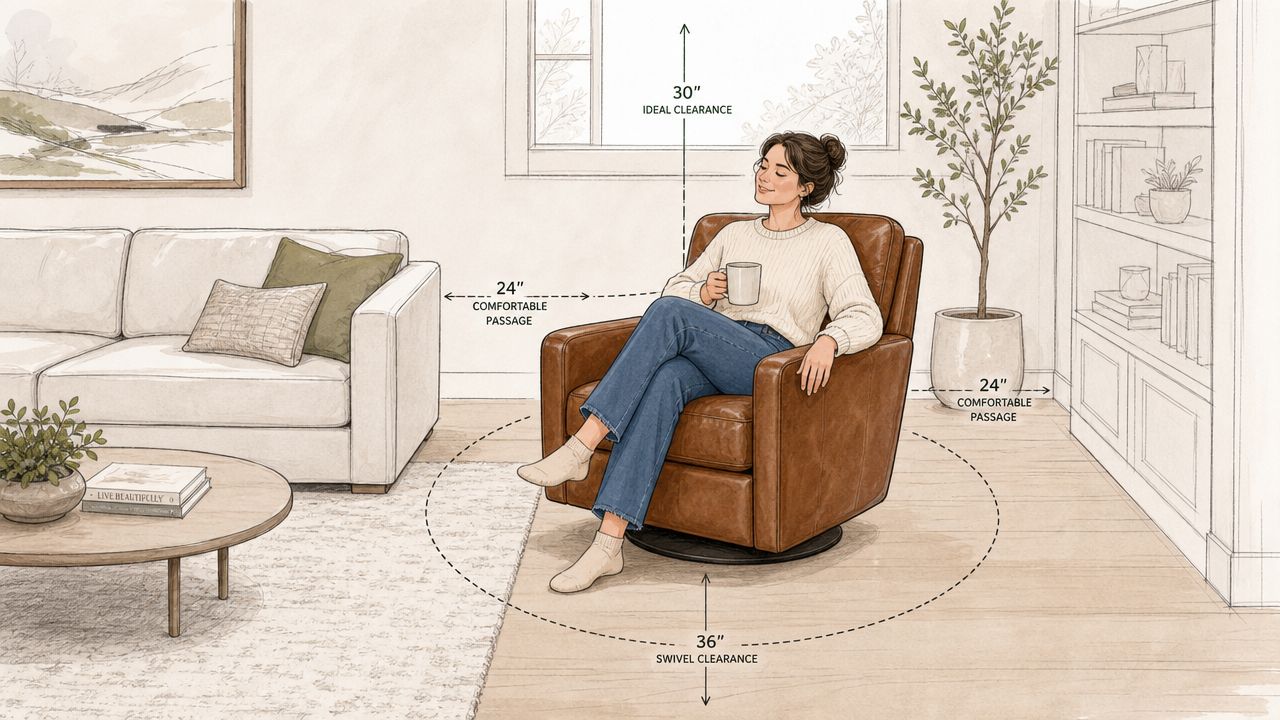
The biggest measuring mistake is treating a swivel chair like a fixed accent chair. A fixed chair claims one patch of floor. A swivel chair uses an orbit around that patch, much like a door needs swing space to work properly. If you measure only the base, the chair may technically fit and still feel awkward every day.
Plan for the chair and the space it uses
Start with the footprint, then measure the chair in use.
A practical way to do that:
- Measure the base area. This tells you whether the chair can physically sit in the intended spot.
- Add full turning room. The arms, back, and occupant need space to rotate without bumping a wall or clipping a wood table corner.
- Preserve walking paths. Family traffic should pass the chair easily, even when it is turned at an angle.
- Check nearby furniture height. This matters in rooms with Amish side tables, desks, or bookcases, where proportions are usually more substantial and permanent than trend-driven pieces.
- Test the view from the chair. A good swivel placement should let the sitter shift between conversation, reading light, and television without dragging furniture around.
For a careful setup before delivery day, Tyner's guide on how to measure furniture gives a clear process for mapping doorways, room dimensions, and placement.
Where placement usually works best
In many homes, the smartest position is at the edge of the seating group. That gives the chair freedom to turn inward for guests and outward for quieter moments. In an open floor plan, it can also soften the line between the living area and a dining space, which is helpful when the room needs one piece to do more than one job.
Small rooms benefit from this flexibility most. Homeowners looking for stylish small home solutions often focus on storage or scale, but motion matters too. A chair that turns cleanly can reduce the need for extra seating pieces because one well-placed seat serves multiple directions.
At Tyner Furniture, placement often gets discussed alongside the pieces already in the room. A leather swivel chair beside Amish solid wood should feel intentional, not squeezed in as an afterthought. If the chair has enough breathing room, the pairing looks settled and collected, the way heirloom furniture should.
The goal is simple. Choose a chair with the right physical size, then give it the space to behave like a swivel chair. That is what makes the feature useful for years instead of merely interesting on the sales floor.
Styling Your Swivel with Amish Solid Wood Furniture
A leather swivel chair doesn't have to feel separate from traditional furnishings. In fact, some of the richest rooms come from that contrast. Supple leather introduces motion and softness. Hand-crafted solid wood brings weight, grain, and permanence.
Leather and wood already have a design history
This pairing has deep roots. A surviving example in the U.S. Senate collection is a leather-upholstered mahogany swivel chair designed by cabinetmaker Thomas D. Wadelton (1861–1931) and custom-made by S. Karpen and Bros., showing that leather was already being paired with premium hardwoods in refined furniture by the late nineteenth and early twentieth centuries, as described in this history of swivel chairs and notable American examples.
That historical note matters because it clears up a common misconception. Leather swivel chairs aren't just modern casual pieces. They can sit comfortably in rooms built around heirloom values.
How to build a room that feels collected
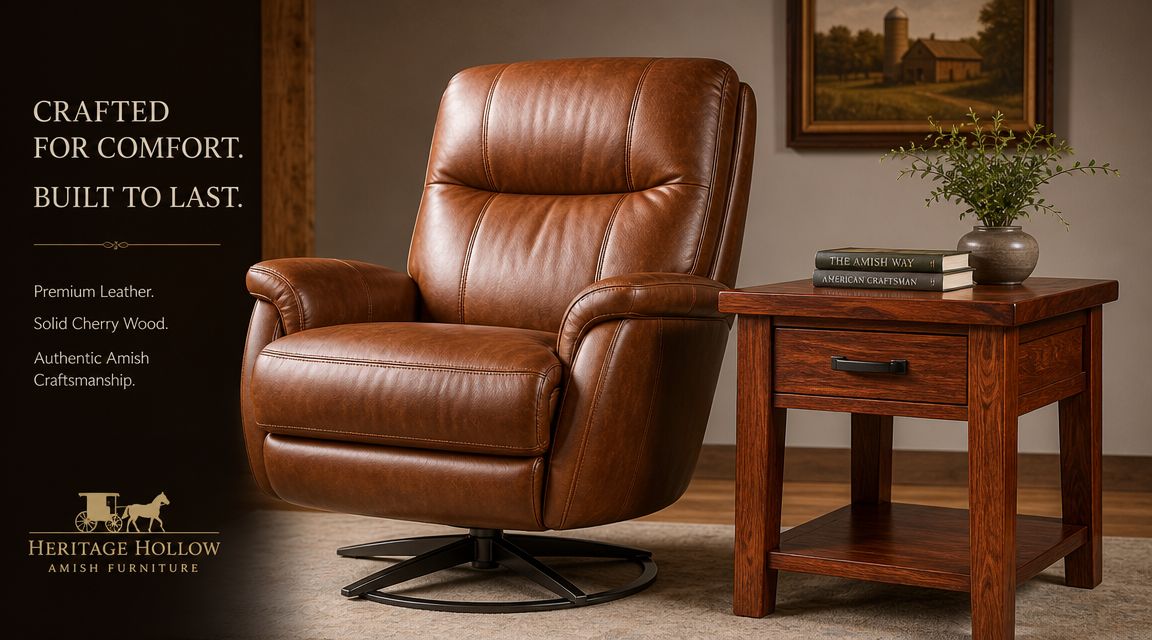
The easiest way to make the pairing work is to focus on shared warmth instead of matched style. A rich brown leather seat can echo the depth of cherry wood. A darker leather can ground the lively grain of oak. A smoother leather surface can balance the tactile character of hand-finished wood.
For readers exploring hand-crafted case goods and tables, this collection of Amish solid wood furniture shows how wood species and finish choices can support that layered look.
A few combinations tend to feel especially natural:
- Cherry with warm leather. This creates a welcoming, settled look with visual richness.
- Oak with refined leather. The grain brings structure, while the leather softens the effect.
- Maple with lighter interiors. This pairing can keep a room feeling bright while still substantial.
Mass-produced veneer furniture often misses this harmony because the material doesn't have the same depth or integrity. Hand-crafted solid wood, especially when built with time-honored joinery such as dovetailing and mortise-and-tenon, gives the room a sense of honesty. The weight feels real. The edges feel finished. The piece belongs beside leather that will age, not beside upholstery meant to be replaced quickly.
A well-composed room might place a leather swivel chair beside a solid cherry end table, opposite a wood media console, with dining pieces from Canadel carrying the finish story into the next space. That's where bespoke design starts to feel natural rather than staged.
Caring for Your Investment Maintenance and Longevity
A leather swivel chair often shows its age the way a good pair of boots does. The story can be handsome and settled, or dry, scuffed, and tired. The difference usually comes down to ordinary habits at home.
That matters even more when the chair is meant to live beside Amish solid-wood furniture for decades, not just fill a corner for a few years. At Tyner Furniture, we often tell Ann Arbor families that maintenance is part of the purchase, much like oiling a wood cutting board or waxing a treasured dining table. Good materials age well. They still need steady care.
Simple care protects comfort and appearance
Leather needs a clean surface, balanced moisture, and protection from harsh conditions. The cushion and swivel mechanism need even use and a clear base area so the chair keeps its shape and motion. Care is really about helping all the parts age at a similar pace.
That is how a chair keeps its inviting hand and refined look.
A fine leather swivel chair should soften with use, not slump prematurely or develop avoidable wear in one favorite spot. If one person always sits on the same edge, if grit stays on the seat, or if afternoon sun hits the same arm every day, the chair will tell that story. Over time, those little patterns become visible.
A chair becomes heirloom quality through sound construction and the care it receives after delivery.
A practical routine for busy households
The best care routine is simple enough to repeat without much thought.
- Dust with a soft, dry cloth. Fine grit acts like sandpaper over time, especially on the seat, arms, and headrest.
- Blot spills right away. Press gently instead of rubbing so moisture and residue do not spread further into the leather.
- Use leather conditioner sparingly. Too little care can dry the hide. Too much product can leave buildup. Follow the maker's instructions.
- Vary where people sit when possible. Even rotation helps the cushion and leather wear more evenly.
- Keep the chair away from direct heat and strong sun. Leather ages best in a steady indoor environment.
The swivel base deserves its own quick check now and then. Dust, pet hair, and small bits of debris can gather around the mechanism and affect how smoothly the chair turns. If the chair sits on a rug, make sure the surface allows stable rotation rather than catching or tilting the base.
In Southeast Michigan, winter air indoors can feel especially dry. Leather may feel a bit firmer in those months, much like solid wood can react to seasonal humidity changes. That is one reason a thoughtful pairing of leather seating and Amish solid-wood pieces makes sense. Both reward owners who pay attention to the home environment and treat furnishings as long-term possessions.
Done well, maintenance is not fussy. It is stewardship. A few minutes of regular care help a leather swivel chair keep the comfort, shape, and character that made it worth bringing into the room in the first place.
Making It Yours Customization and Purchasing in Ann Arbor
A leather swivel chair is far easier to love when it fits the room's scale, the household's habits, and the surrounding materials. That's where customization changes the decision. The chair on a showroom floor may show the silhouette, but it doesn't always represent the final result a homeowner wants.
Customization changes the outcome
Made-to-order programs let shoppers move beyond settling for the nearest option. Leather color, surface character, cushion feel, and wood accents can all change how a chair lives in a room. Stressless sizing adds another layer by helping shoppers choose a fit that better matches the body, not just the floor plan. Canadel does something similar in dining spaces, where finish selection can help a leather chair feel connected to nearby solid-wood furniture instead of visually isolated.
Tyner Furniture offers customizable seating options, including leather swivel styles, through its Ann Arbor showroom and online browsing tools. That's useful for shoppers who want to compare in-stock inspiration with special-order possibilities without losing the guidance piece of the process.

A thoughtful purchase should feel manageable
Good furniture can be a significant investment, but the buying process shouldn't feel out of reach. Special Financing can help spread the purchase into manageable payments for qualified buyers, and a Low Price Promise can reduce some of the hesitation that often comes with buying higher-end furniture for the long term.
A helpful buying checklist looks like this:
- Test the sit first. Seat depth, arm height, and back support matter more in person than on paper.
- Bring room details. Photos, measurements, and nearby wood tones speed up better decisions.
- Ask about custom paths. The right leather or finish may not be the one shown on the floor.
- Think beyond one room. A chair should relate to the wider home, from living areas to home office settings and beyond.
Ann Arbor shoppers often find that a South State St. showroom visit settles questions quickly. The eye can judge proportion online. The body decides comfort in person.
A thoughtful next step is to visit Tyner Furniture for a sit test in the Ann Arbor showroom or browse the online Quick Specs for special-order options. Since 1957, the store has helped Southeast Michigan households furnish spaces with lasting value, from the home office and living room to dining rooms, bedrooms, and outdoor spaces.