Ergonomic Seating Solutions for Your Ann Arbor Home

The discomfort is most palpable after a full day. Your shoulders are up, your lower back is tired, and the chair that seemed fine in the showroom or on a product page suddenly feels like the wrong long-term partner for your home. That discomfort doesn't only show up in a home office. It follows people into reading corners, living rooms, breakfast nooks, and anywhere else they spend real time sitting.
For many households in Ann Arbor and across Southeast Michigan, the challenge isn't finding a chair. It's finding seating that supports how you live. Work calls at the desk. A quiet hour in a recliner. Family time on the sofa. That's where ergonomic seating solutions become useful. They help you match the seat to the person, the room, and the task, instead of asking your body to adapt to furniture that was never designed for you.
Table of Contents
- What Are Ergonomic Seating Solutions
- The True Value of Investing in Ergonomic Comfort
- Comparing Ergonomic Solutions for Every Room
- How to Select and Measure for Your Perfect Fit
- The Tyner Furniture Customization Advantage
- Begin Your Journey to a More Comfortable Home
What Are Ergonomic Seating Solutions
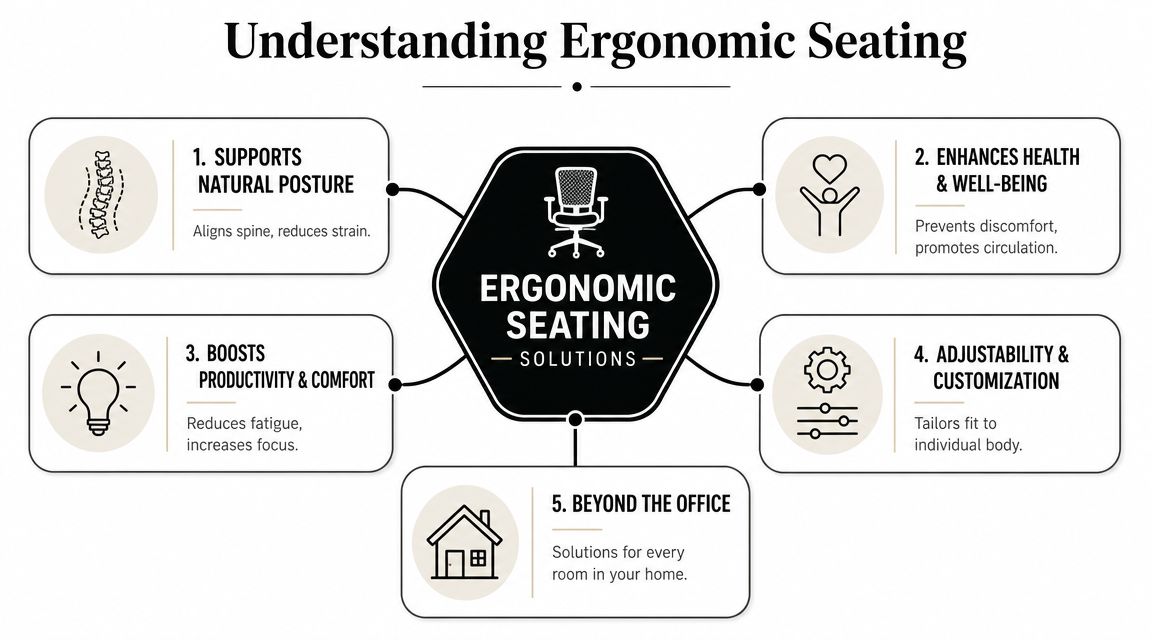
Ergonomic seating solutions are not one specific product category. They're a way of designing seating so it works with the human body instead of against it. That applies to desk chairs, recliners, dining chairs, reading chairs, and even task-specific seating used in mixed-use home spaces.
A simple way to think about it is this. A well-made ergonomic chair should fit more like a bespoke suit than an off-the-rack jacket. If the proportions are wrong, you feel it quickly. Your body shifts, compensates, braces, and eventually gets tired.
Ergonomic means fit, not hype
People often hear “ergonomic” and think of a black office chair with lots of levers. That's part of the story, but not the whole thing. The fundamental principle is support through fit, adjustability, and posture control.
An ergonomic seat helps you maintain a more natural sitting position for the activity you're doing. For computer work, that usually means support that keeps you from sliding forward or collapsing into a rounded posture. For lounging, it means the chair supports you without locking you into one strained position for too long.
If you're researching task seating in more detail, a practical overview of ergonomic mesh desk chairs can help you understand how breathable backs, support structure, and adjustability work together in everyday use.
Practical rule: If a chair feels good for five minutes but asks your body to “make it work” after half an hour, it isn't functioning ergonomically for you.
What proper fit looks like
The clearest guidance comes from measurable fit points. According to the U.S. General Services Administration's seating guide, seat depth should leave about a 2-inch gap between the front of the seat and the back of your calves, and the backrest should fit the natural curve of your lower back. That's useful because it turns a fuzzy idea like “supportive” into something you can check.
A good ergonomic seat usually supports these basics:
- Seat height: Your feet should rest comfortably while your legs aren't compressed by the seat edge.
- Seat depth: You should be able to sit fully back without the front edge pressing behind the knees.
- Back support: The chair should meet your lower back where your body needs support, not where the frame happens to stop.
- Arm support: Armrests should help your shoulders relax rather than push them upward.
For many people, posture gets confusing because they think “sit straight” means rigid. It doesn't. Good seating should let you feel supported, not frozen. If you want a practical next step, this guide on how to improve posture while sitting pairs well with any furniture search because it helps you notice whether the problem is your habits, your setup, or the chair itself.
The True Value of Investing in Ergonomic Comfort
The easiest mistake in furniture shopping is judging a seat by first impression alone. Plushness wins that contest all the time. Long-term comfort doesn't.
Why this belongs in the investment category
The demand behind ergonomic seating isn't small or specialized. Grand View Research estimated the global ergonomic chair market at USD 9.80 billion in 2022 and projected it to reach USD 16.88 billion by 2030, a sign that this is now a major furniture category rather than a niche office add-on (ergonomic chair market outlook).
That growth makes sense when you look at how people use their homes now. One chair often has to carry a lot of responsibility. It may support work, reading, screen time, conversation, or recovery after a long day. When a seat handles daily life that often, cost-per-year becomes a more helpful way to think than sticker price alone.
A durable, hand-crafted piece with stronger materials, better internal support, and thoughtful design usually asks for more upfront. But if it serves you well for years, keeps its structure, and still feels good after the novelty wears off, the value looks very different. That's especially true in a forever home, a first serious apartment, or any room you use every single day.
Comfort changes how a home feels to live in
Good ergonomic comfort isn't only about avoiding aches. It can change how long you can focus, how rested you feel after sitting, and whether a room invites you in or wears you out. People often notice this in simple ways. They get through a work session with less fidgeting. They stand up from a recliner without that “stuck” feeling. They stop piling throw pillows on a sofa just to make it usable.
Here's a useful way to compare furniture value:
| Seating choice | Short-term impression | Long-term question |
|---|---|---|
| Deep, soft seating | Feels cozy right away | Does it still support you after extended sitting? |
| Adjustable task chair | May feel firmer at first | Can you tune it to your body and task? |
| Well-built recliner | Feels supportive and relaxing | Does the support still hold as the years pass? |
Buying furniture is a high-consideration decision because you don't live with the purchase for a weekend. You live with it for years.
That's why a slower buying process often leads to a better result. If you're weighing options carefully, this article on why furniture purchases are high-consideration decisions captures that reality well. The right seat isn't just a room upgrade. It's a daily-use investment in comfort, concentration, and durability.
Comparing Ergonomic Solutions for Every Room
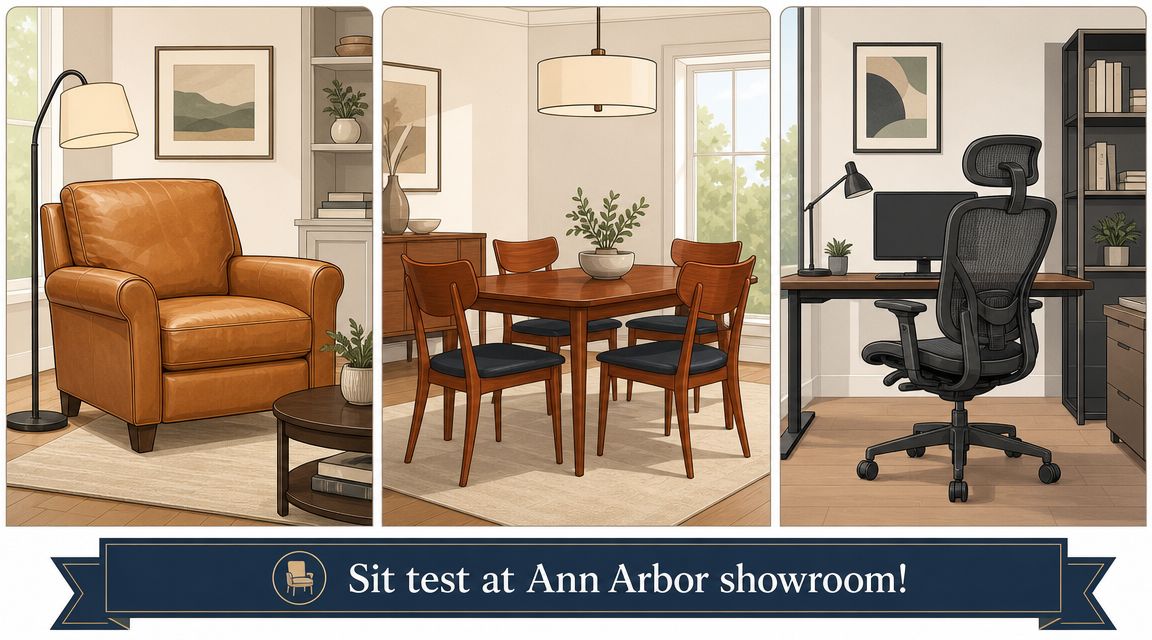
While the focus for ergonomic seating often begins with the home office, these solutions belong throughout the entire house. The chair you work in needs one kind of support. The recliner you read in needs another. The sofa where the family gathers has its own job entirely.
According to the Canadian Centre for Occupational Health and Safety, a chair only becomes ergonomic when it matches the user's body dimensions, workstation, and tasks. That's the key comparison standard for every room. Not “Which chair is ergonomic?” but “Which chair is ergonomic for this person, in this setting, for this purpose?”
For focused work
Task seating is built for repeat use and posture control. In a home office, that usually means you want adjustability, a supportive back, and a seat that lets you sit fully back without pressure behind the knees. The sensation should feel stable and alert, not overstuffed.
A strong task chair usually works best for:
- Computer work: Support that helps you stay centered and avoid slumping forward
- Long desk sessions: Adjustments that let different users fine-tune the fit
- Shared workspaces: Flexible settings for more than one household member
If your room also needs a softer look, some shoppers in Southeast Michigan balance a task chair with an upholstered accent option, such as a fabric swivel chair, for nearby reading or conversation space.
For living room recovery
Recliners raise a different question. You don't want a seat that only feels cushioned. You want one that supports relaxation without dropping your body into a shape that's hard to maintain comfortably. This is where the feel of the materials matters. The buttery feel of top-grain leather, the way a headrest meets you, the support under the thighs, and how easily the chair follows your movement all affect the experience.
A recliner makes sense when you want:
- Reading comfort: Neck and back support without stacking extra pillows
- Evening unwinding: A position that feels restorative rather than collapsing
- A long-term comfort piece: A chair you'll use often enough to justify better engineering and upholstery
Some households need support that goes beyond conventional living room furniture. For readers helping a family member with more advanced comfort or mobility needs, resources like home medical beds Pinellas County can be helpful for understanding adjacent support options in the broader home-health category.
A recliner should help your body let go. It shouldn't force your pelvis, shoulders, or neck to negotiate for a comfortable position.
For shared everyday seating
Sofas and dining chairs often get overlooked in ergonomic conversations because they don't look technical. But family seating matters because people use it for long stretches. Streaming, conversation, casual laptop time, meals, and reading all happen there.
Here's a simple side-by-side view:
| Room | Best seating type | What to look for |
|---|---|---|
| Home office | Adjustable task chair | Fit, posture support, movement |
| Reading corner | Supportive recliner or swivel chair | Back support, neck comfort, easy repositioning |
| Living room | Supportive sofa or sectional | Seat depth, upright comfort, durable cushioning |
| Dining area | Well-proportioned dining chair | Stable support, usable posture through a full meal |
One practical example is Tyner Furniture, which offers seating across the home office, living room, dining room, bedroom, and even outdoor spaces, so shoppers can compare different support styles in one place rather than trying to guess from isolated product photos. That broader view matters because many ergonomic problems come from mismatching the seat to the room's real use.
How to Select and Measure for Your Perfect Fit
A good ergonomic purchase usually comes from a simple process. Not a lucky guess. Not a dramatic sale weekend decision. Just a few checks done in the right order.
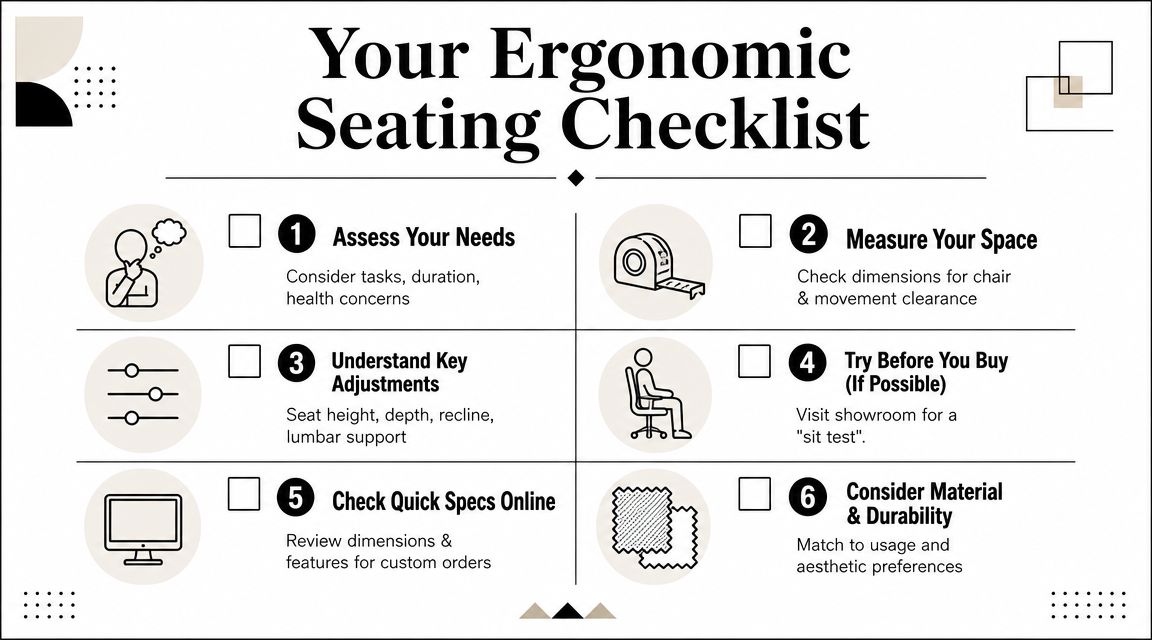
Start with the job the chair needs to do
Before you measure anything, ask what the seat is for. The answer changes the criteria.
If you'll use it mainly for work, you'll care more about adjustability, upright support, and how the chair behaves over a long session. If it's for the living room, the question shifts toward supported relaxation, ease of getting in and out, and whether the cushion keeps you positioned well instead of swallowing you. If it's for a mixed-use room, you may need a compromise between task support and residential warmth.
The comfort trap catches people here. A very soft seat can feel pleasant at first touch, but that isn't the same thing as long-term ergonomic support. Guidance on ergonomic seating highlights an important tradeoff: plush cushioning may feel good immediately, while better long-term support often comes from features that encourage posture variation and reduce continuous loading rather than maximizing softness alone.
Measure your body and your room
You don't need special tools. A tape measure and a little honesty about how you sit will take you far.
Start with your body:
- Check seated depth needs. Sit back in a current chair and see whether you can place your back against the backrest without the front edge pressing into the back of your knees.
- Notice foot placement. If your feet dangle or you tuck them under constantly, the seat height may be wrong.
- Pay attention to arm position. If your shoulders creep upward, the arm support may be too high or too far apart.
Then check your space:
- Walking clearance: Make sure the chair can move, swivel, or recline without blocking normal pathways.
- Visual scale: A big chair can fit dimensionally and still dominate a small room.
- Use pattern: Leave enough room for side tables, lamps, or footrests where they'll be used.
For room planning, this guide on how to measure furniture is a practical place to start, especially if you're trying to avoid the common mistake of buying a piece that fits through the door but not the life of the room.
Use the sit test to catch what specs miss
Specifications matter. They just don't tell the full story. A sit test does.
When you try a chair in person, stay in it long enough to notice the details. Does the lumbar area meet your lower back naturally? Do you feel perched on top of the cushion or supported within it? Can you relax your shoulders? If it reclines, does the motion feel smooth and balanced?
Use this showroom checklist:
- Sit all the way back: If you can't, the depth or back shape may be wrong.
- Stay still for a minute: Discomfort often shows up after the first pleasant impression fades.
- Change posture: A useful chair should support more than one position.
- Stand up slowly: Notice whether the seat helped or hindered your body.
The best seat often doesn't announce itself with softness. It reveals itself when your body stops negotiating.
Materials belong in the decision too. Leather, performance fabric, denser support foams, and stronger internal construction each affect how a chair feels over time. That's where craftsmanship enters the conversation. The right ergonomic fit paired with durable build quality is what turns a good purchase into a long-term one.
The Tyner Furniture Customization Advantage
Customization matters because ergonomic comfort is personal. Two people can sit in the same chair and have completely different experiences. One feels supported. The other feels pressure behind the knees, strain in the neck, or too much depth through the seat.
Customization matters because bodies and homes differ
That's one reason alternative seating has become more relevant. The Canadian Centre for Occupational Health and Safety notes that options such as kneeling chairs, saddle chairs, and other alternatives are designed to support different postures. The lesson isn't that everyone needs an unusual chair. It's that a single generic “comfortable chair” doesn't solve every problem.
A high-service showroom can help translate that into real choices:
- Made-to-order upholstery: Fabrics and leathers can be selected for feel, durability, and room style
- Size-based fit: Some recliner programs offer different sizes so the support lands where it should
- Room coordination: Seating can be matched to dining, bedroom, home office, and outdoor spaces for a more coherent home
- Design flexibility: Finish, texture, and silhouette can be customized instead of accepted as-is
For shoppers who want to understand the process before visiting in person, this guide to getting started with custom order is useful. It shows how made-to-order furniture moves beyond “what's on the floor today.”
Craftsmanship supports long-term value
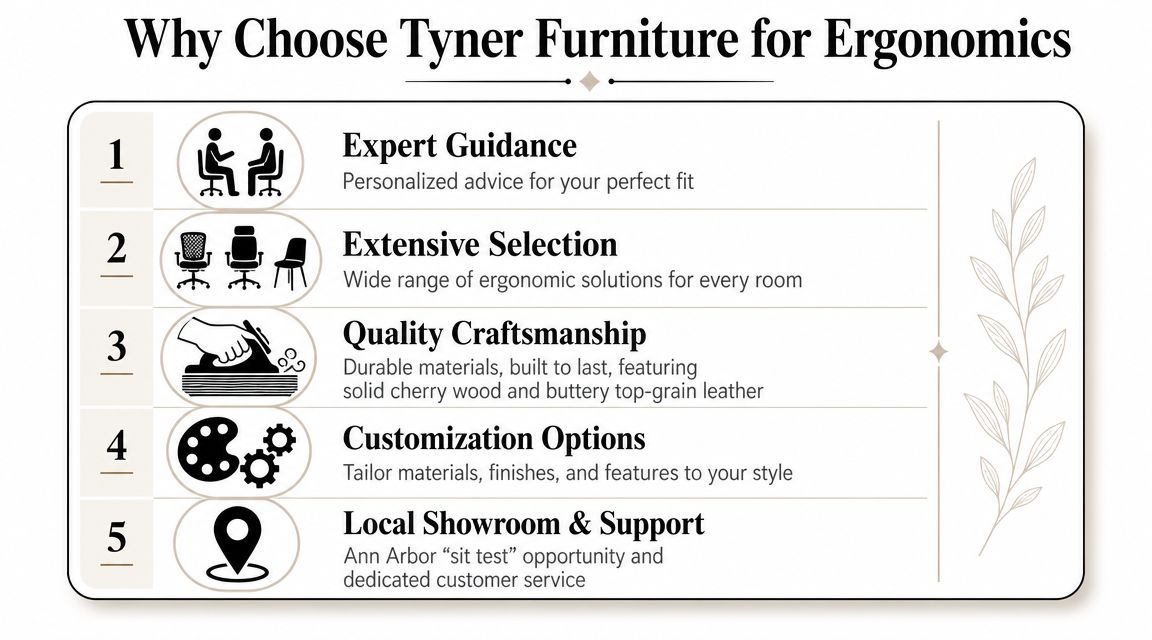
A seat can fit well on day one and still disappoint if the materials break down too quickly. That's why workmanship belongs in any ergonomic discussion. Support depends on what's inside the furniture as much as what you can see from the outside.
In a showroom with a local legacy dating back to 1957, that conversation often includes more than upholstery. It includes joinery, frame integrity, durable cushioning, the weight of solid cherry wood in hand-crafted dining and bedroom pieces, and whether a made-to-order program such as Canadel or Stressless lets you tailor the piece to your body and room. In-stock is only the beginning.
A custom choice isn't about making furniture feel fancy. It's about reducing the compromises you'd otherwise have to live with every day.
Special Financing and a Low Price Promise also lower the barrier for households that want to buy for the long term instead of replacing furniture repeatedly. For many Southeast Michigan shoppers, that makes an ergonomic investment more practical without changing the goal: buy once, choose carefully, and enjoy the piece for years.
Begin Your Journey to a More Comfortable Home
The right seating changes more than one corner of the house. It changes how your body feels during work, how you unwind in the evening, and how confidently you invest in pieces you expect to keep. That's the appeal of ergonomic seating solutions. They bring together comfort, support, craftsmanship, and a better fit for daily life.
If you're furnishing a home in Ann Arbor or anywhere in Southeast Michigan, it helps to slow down and choose seating with intention. Look for support that matches the room's purpose. Pay attention to measurement, posture, and how the chair feels after the first few minutes. Consider whether customization, better materials, and hand-crafted durability will serve you better over time than a quick purchase ever could.
A local showroom experience still matters for this category. You can feel the difference between soft and supportive. You can compare a task chair to a recliner, or a structured dining chair to a deep lounge seat. You can test fabrics, notice scale, and decide what belongs in your home.
Since 1957, Tyner has been part of that process for families building more comfortable homes, one thoughtful piece at a time.
Visit Tyner Furniture to start your search in the way that works best for you. If you're ready to feel the difference in person, stop by the South State St. showroom in Ann Arbor for a sit test. If you'd rather begin from home, browse the online Quick Specs and made-to-order options to compare dimensions, materials, and customization choices before your visit.