Top Grain Leather Sectional Sofa: A Buyer’s Guide


The sectional looks right on the screen: warm caramel leather, a generous chaise, and enough room for everyone to settle in. Then the questions begin. Does top-grain mean the whole sofa is leather? Will the cushions stay supportive? Can the largest section make the turn from the hallway?
A top grain leather sectional sofa is best judged as a long-term investment, not just an upholstery choice. For an Ann Arbor household, the strongest purchase combines comfortable proportions, a suitable finish, serviceable construction, and a delivery plan that works before the order is placed.
Top-Grain Leather Compared With Other Grades
Two sectionals can sit side by side in a showroom, both tagged "genuine leather," and age completely differently over the following decade. The grade explains much of that gap, because each layer of the hide performs differently once it becomes a sofa. Since a sectional may stay in a home for many years, the grade also shapes whether worn panels can be conditioned and repaired or whether the upholstery has to be replaced.
Leather grades compared for a sectional sofa
| Grade | Surface | Durability | Look Over Time | Best For |
|---|---|---|---|---|
| Full-grain | Natural grain left intact | Highest of the leather grades | Develops patina and shows natural character | Buyers wanting the most authentic hide |
| Top-grain | Upper layer sanded or buffed for uniformity | Hard-wearing, slightly below full-grain | Even appearance with fewer visible marks | Family rooms wanting a refined, consistent look |
| Corrected or split leather | Surface corrected, embossed, or split from the lower hide | Finish quality and hide thickness govern performance | Uniform, often with more coating | Buyers prioritizing a lower entry price |
| Bonded leather | Shredded leather fibers bonded to a backing | Lowest of the leather options | Can peel or crack with use | Light-use spaces, not long-term ownership |
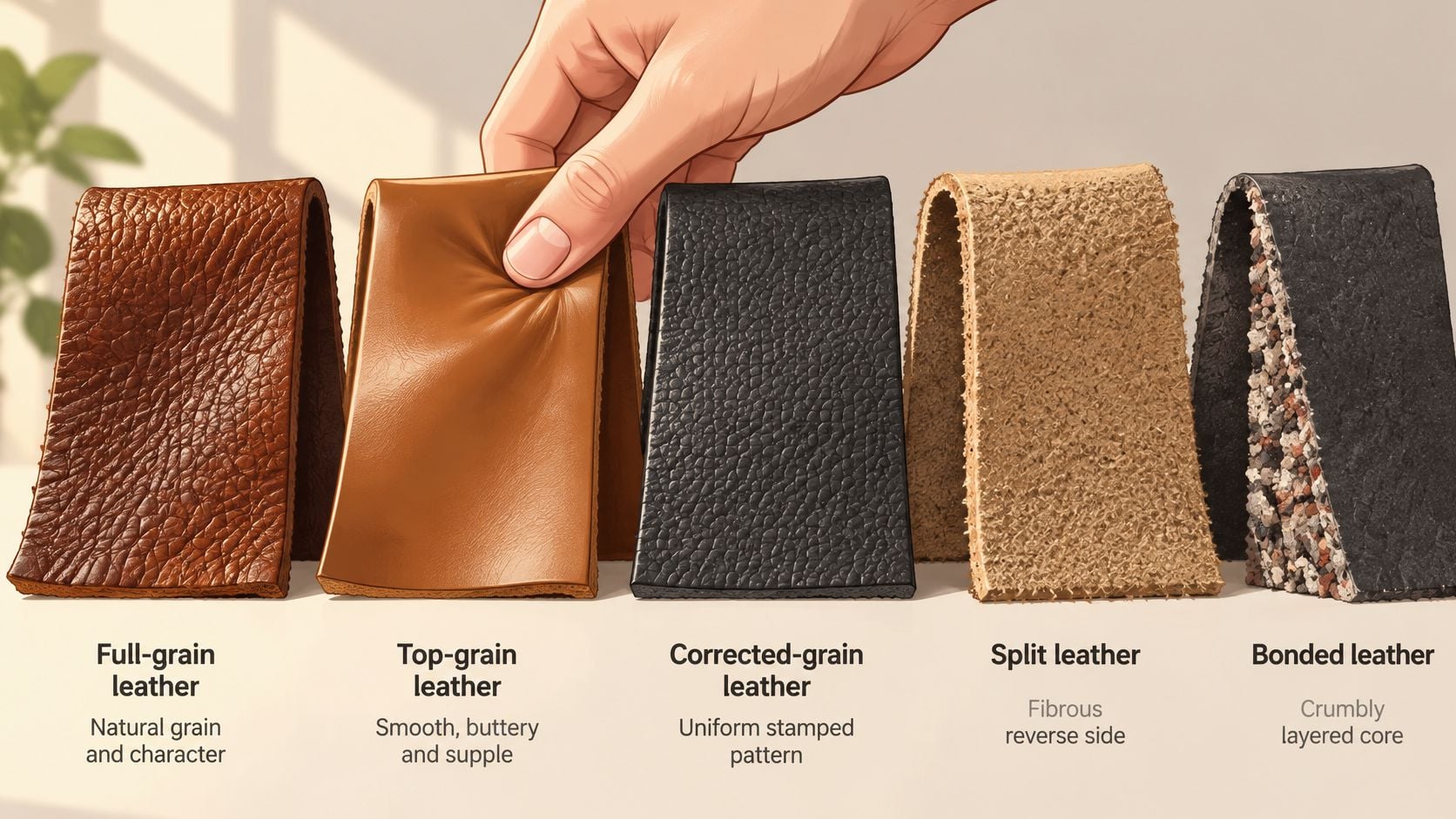
Top-grain is real hide, and the label does not guarantee a specific grade of genuine leather. It comes from the upper layer of the hide, sanded or buffed to create a more consistent surface, while full-grain keeps the surface intact and generally retains greater durability.
Across a large sectional, that difference becomes visible. Full-grain can display fine pores, scars, and variation in grain; top-grain generally offers a smoother, buttery feel with fewer obvious irregularities. A household that wants the leather to record its own history tends to prefer full-grain. A busy family room, where a predictable surface hides everyday wear more gracefully, often suits top-grain better.
What the label doesn't promise
The categories aren't perfectly separate. Corrected grain describes surface processing, so top-grain leather can also be corrected; split leather comes from a different layer. A retailer should identify the actual material rather than treating those terms as interchangeable.
Top-grain also isn't a standardized promise of softness, thickness, or stain protection. Rub ’n Restore's leather identification guide explains why processing and finish still matter when evaluating the material. Tyner's top-grain versus bonded leather guide offers a focused comparison for shoppers sorting through similar-looking labels.
Texture deserves its own comparison, too. For households coordinating upholstery and bedding, SouthShore Fine Linens' explanation of breathable fabrics for deep-pocket sheets provides useful context about material feel, although bedding performance shouldn't be used to predict leather performance.
Before comparing colors, shoppers benefit from clear answers to these questions:
- Leather coverage: Does every seating surface use the same leather, or are some panels leather-match materials?
- Finish system: Is the leather aniline, semi-aniline, or protected?
- Thickness: What leather thickness does the manufacturer specify?
Tyner Furniture's Custom Order option includes top-grain leathers for sectionals, so shoppers can compare samples side by side at the Ann Arbor showroom before committing to a configuration.
Finish Systems That Decide How Your Sofa Ages
Two sectionals can carry the same top-grain label and behave like completely different purchases five years in. The difference usually sits in the finish, the surface treatment applied after tanning, and that thin layer decides whether a spilled drink wipes away or becomes a permanent watermark.
Leather industry references group finishes into families that trade feel for protection. Natural aniline surfaces keep the hide's original grain open and soft, while corrected and protected leathers carry a polymer coating that improves resistance to routine soiling and simplifies cleaning. The finish system often tells a household more about daily ownership than the grade name alone. A protected finish works like a light rain shell over clothing: the leather underneath keeps its character, while the coating takes the abuse.
Leather finish systems compared
| Finish | Surface Feel | Patina | Stain and UV Tolerance | Upkeep |
|---|---|---|---|---|
| Aniline | Softest, most natural | Develops rich patina over time | Most vulnerable to spills and sun | Careful placement and manufacturer-directed conditioning |
| Semi-aniline | Natural with light protection | Moderate patina | Better stain resistance; sun protection still needed | Periodic conditioning when approved |
| Pigmented or protected | Uniform and slightly less natural | Minimal patina | Best resistance to routine soiling; not immune to UV | Wipe clean with the approved cleaner |
Matching the finish to the household
A protected finish generally makes the most sense in a busy family room where children snack, pets climb aboard, and several people compete for the same favorite seat. Its even sheen and consistent color keep the sectional looking tidy, and that forgiveness matters financially. A surface that shrugs off an accident costs nothing extra that year. A surface that records every accident eventually asks for professional attention.
Aniline suits a different expectation. A shopper who enjoys softened color, natural variation, and visible signs of use may welcome patina rather than read each change as a flaw. That choice means accepting real exposure to spills, scratches, and fading, and budgeting the care to match.
Semi-aniline sits between those preferences. Its lighter protection can retain a natural look without asking the household to accept the full vulnerability of an open aniline surface. Actual samples remain important because manufacturers' finishes don't all feel alike.
Practical rule: A household should choose the finish for its busiest ordinary day, not for the room immediately after cleaning.
Distinguishing character from damage
Patina isn't the same as a broken finish. Gentle changes in shade and softness can be desirable, while an exposed patch, deep cut, or failing coating deserves evaluation rather than a shrug. This distinction carries a repairability question: routine surface wear on a protected finish often responds to approved cleaning and conditioning, while a coating that has cracked or peeled moves the conversation toward professional restoration. Those are different levels of expense, and both belong in the long-term cost picture for the sofa.
When judging samples, view them upright and flat, with light falling across the surface. A protected leather tends to show a more even reflection, while a natural finish reveals subtler shifts in grain and color. Either way, center the decision on the seat cushions and arm fronts. Those surfaces absorb repeated flexing, skin oils, and friction every day, so their behavior matters far more than the pristine back panel in a showroom photograph.
Construction Checks That Separate Quality From Looks
A sectional's leather gets judged in seconds. Its frame, joints, and suspension decide whether the piece still feels solid after years of daily use, so the parts you cannot see deserve the closest attention.
The frame specification should identify solid hardwood, engineered wood, or a combination, followed by the joint and reinforcement methods. Material names alone say little. A carefully described combination tells a shopper more than a vague premium-wood label.
Craftsmanship beneath the upholstery
Tyner's Amish hand-crafted solid wood furniture provides a useful benchmark for material integrity. Solid North American cherry, oak, and maple, paired with time-honored joinery, offer a different ownership proposition from mass-produced alternatives that rely primarily on surface appearance.
The Utah State University Extension furniture guide explains mortise-and-tenon and dowel joints and identifies dovetail construction as a familiar sign of quality drawer construction. Those details don't mean every sofa needs drawer-style joinery. They show why the smart question is how a structure is connected, since the covering hides the workmanship.
That same logic carries to upholstery. The heft of solid cherry is easy to feel in a table; on a sectional, the equivalent investigation concerns frame rigidity, reinforced connections, and stable attachment of the arms and back.
Construction specs worth recording
- Frame material and joints: The specification should identify the material, connection method, and reinforcement.
- Cushion system: Foam density, cushion removability, and replacement options should be documented. Density and firmness aren't interchangeable.
- Suspension: The support system beneath the cushions should be identified, including how repairs are handled.
- Seams: Arm fronts, seat edges, and chaise corners deserve close inspection for even stitching and reinforcement.
- Attachment points: Arms, backs, modular connectors, and moving mechanisms should feel secure.
- Warranty coverage: Written terms should separate frame, cushion, mechanism, and upholstery protection.
A more useful showroom inspection
Run the sectional through ordinary movements: sit upright, lean against an arm, shift toward the seat edge, and stand again. Each move loads a different joint. Clicking, sway, or uneven support deserves an explanation before purchase, and a mechanism that already resists or rattles will only loosen with use.
Showroom Pro-Tip: Weight is a weak signal of quality on its own. A better question is how replacement cushions, connectors, and mechanism parts are ordered, since a sectional with serviceable components costs less to keep over its lifetime.
Tyner's guide to high-end sectional sofas can help organize those comparisons. An heirloom-minded investment rewards shoppers who evaluate leather and construction together, because premium upholstery over a weak foundation still means an early replacement.
Sizing and Layouts to Measure Before You Order
A sectional works like a parked car: the body can fit the space while the doors still cannot open. Circulation, seated comfort, delivery access, and room for future service all deserve a tape-measure check before a made-to-order configuration becomes fixed.
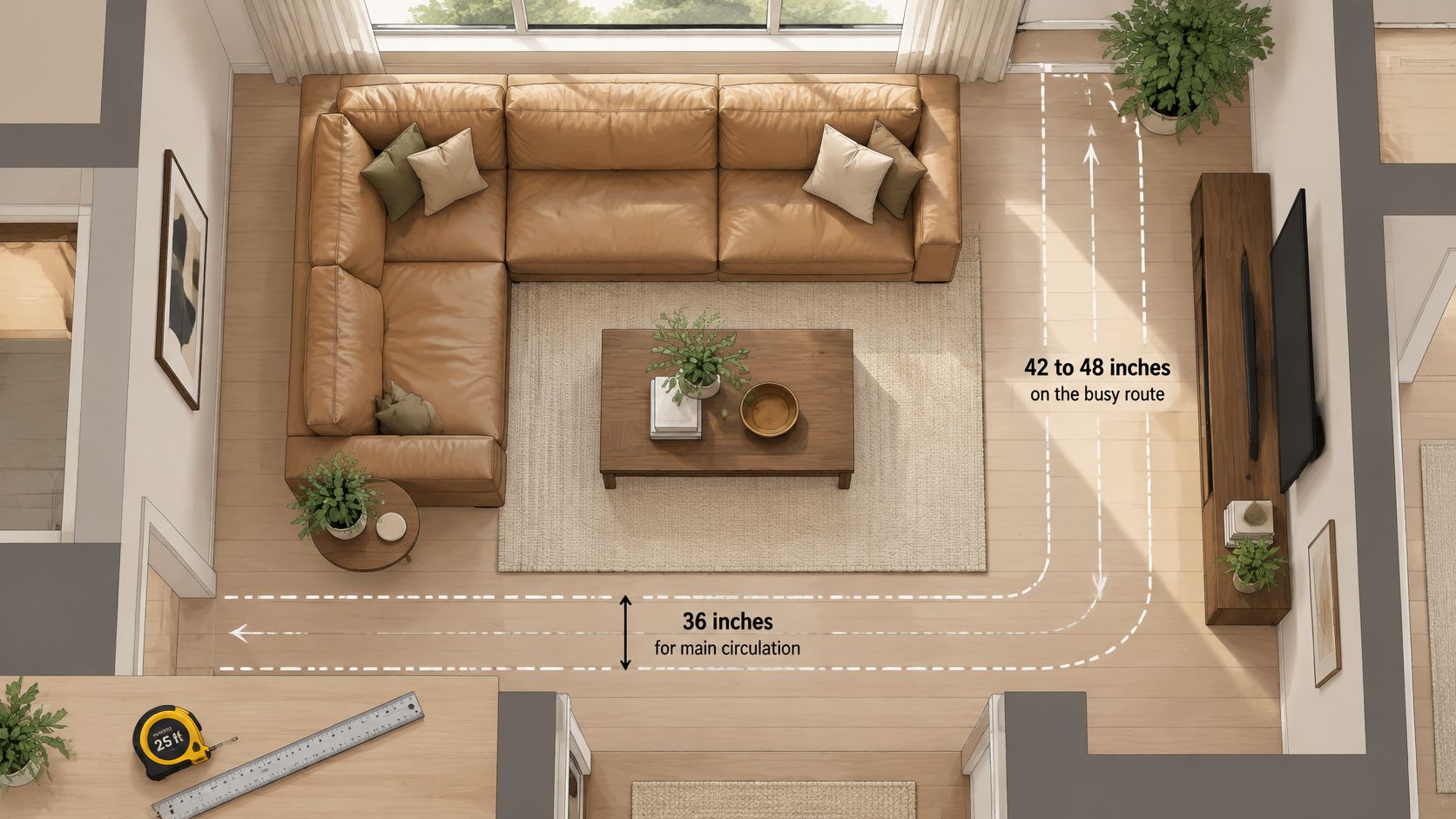
Use these typical planning references as a starting point rather than as accessibility rules: about 36 inches for primary circulation, about 42 to 48 inches for higher-traffic routes, and seat heights around 16.5 to 19 inches. Body proportions, mobility equipment, doorways, and the household's normal traffic pattern can push those needs higher.
Sizing checks for a sectional sofa
| Check | Reference Value | Why It Matters |
|---|---|---|
| Primary walkway clearance | About 36 inches | Keeps everyday movement comfortable |
| High-traffic route clearance | About 42 to 48 inches | Allows passing and moving furniture |
| Seat height | About 16.5 to 19 inches | Can ease sitting down and standing up |
| Seat depth and back angle | Test each seat in the showroom | Comfort changes with body proportions |
| Chaise projection | Measure cushions and arms, not the frame alone | Adds footprint beyond the listed seat line |
| Delivery route | Doors, halls, stairs, and turns | Confirms components can reach their intended location |
Treat the table as a measuring prompt, not a promise. A household using a walker may want wider lanes, while a tight entry may decide the configuration before style enters the conversation.
Choosing a usable configuration
A left-facing or right-facing chaise can preserve a walkway or block it. Retailer diagrams should settle orientation, since “right” can be described from different viewing positions; Tyner's right-chaise sectional guide helps shoppers evaluate that layout on paper before ordering.
Modular pieces can support future rearrangement, but not every modular collection permits every combination. A U-shape may serve a large gathering space well while creating an awkward enclosure in a smaller living room. Leave breathing room for recliner extension, connector access, and the day a mechanism, cushion, or panel needs service.
Comfort deserves the same scrutiny. A deep, soft seat may feel luxurious during a brief lounge yet make upright conversation or standing more difficult. Older adults, people with back discomfort, children, and mixed-height households may prioritize a firmer seat and accessible height.
A pre-order measurement protocol
- Record every component. Width, depth, and height should come from the actual configuration specification, not a photograph.
- Include projections. Cushion overhangs, arms, recliner extension, and chaise depth belong on the room sketch.
- Trace the delivery route. Door openings, hall widths, stair landings, ceiling restrictions, and turns all matter. Component dimensions and permitted disassembly should be confirmed.
- Mark circulation. Painter's tape can outline the sectional footprint while the household walks its normal routes.
- Identify fixed features. Reversible chaises, movable modules, and fixed upholstered corners offer different levels of future flexibility.
Each seat should be tested, not just the inviting chaise. Feet, back support, arm height, and the effort needed to stand reveal more than overall dimensions.
The final design step includes a coordinated white-glove installation managed by Tyner's dedicated team, placing every major furniture piece, mattress, accessory, and final styling detail. Planning placement with the team before delivery helps turn a measured layout into a workable room.
Customizing Your Sectional Beyond the Showroom Floor
In-stock is just the beginning. A showroom arrangement demonstrates possibilities, but it doesn't have to determine the final color, upholstery, or configuration.
Tyner's Custom Order option allows shoppers to move beyond the floor selection. Upholstery options include hundreds of premium fabrics and top-grain leathers for sofas, sectionals, and recliners, giving a room more flexibility than choosing whichever display model happens to be available.
Bespoke choices with a practical purpose
Customization works best when every decision solves something. A quieter leather color might complement patterned curtains; a different arm profile might preserve seating space; a chaise arrangement might keep the route to the kitchen open.
Tyner's custom-made sectional sofa guide provides a starting point for those choices. The online shop's Customizable filter helps narrow the selection, alongside feature filters such as Power Headrest, Lumbar, Massage, Power Reclining, Glider, Swivel, Rocking, Storage, and Cupholders.
The living-room range includes sofas, reclining furniture, sectionals, loveseats, chairs, recliners, lift chairs, and sleeper sofas. Those categories help households consider whether one large sectional or a coordinated mix better serves the room.
Ergonomic fit and coordinated interior design
As a premier Stressless dealer, Tyner offers Small, Medium, and Large sizing for personalized ergonomic seating. The brand's active-release approach supports a body-focused comparison, though the best choice remains the seat that fits the individual rather than the size name alone.
Canadel demonstrates the same made-to-order thinking in dining furniture. Thousands of combinations across leg styles, table edges, finishes, and distress levels allow a dining area to coordinate with the living room without requiring identical furniture.
- Finish continuity: Related wood undertones can connect adjacent rooms without making every surface match.
- Fabric and leather balance: A textured fabric chair can soften the visual weight of a leather sectional.
- Configuration discipline: Bespoke ordering should preserve movement and comfort rather than add every available feature.
For example, a family room with a long wall might use a chaise sectional along the main seating area and a Stressless recliner near the open end. Leather and fabric samples could echo an existing wood cabinet, while a complementary Canadel finish connects the dining area.
That approach treats interior design as problem-solving, not decoration alone. An Ann Arbor sit test lets the household compare the intended seating positions before committing to a custom order.
Care Routine That Protects Top-Grain Leather
Leather care routine for a sectional sofa
| Task | How Often | Method |
|---|---|---|
| Dust and vacuum seams | Weekly | Soft brush attachment to remove grit that abrades the finish |
| Wipe spills | Immediately | Blot with a dry cloth without rubbing |
| Surface cleaning | Every one to three months, adjusted to use and manufacturer guidance | Manufacturer-approved pH-neutral cleaner, tested on an inconspicuous area first |
| Conditioning | As the manufacturer directs | Product approved for the finish; aniline may need closer attention |
| Sun and heat check | Ongoing | Keep out of direct sun and away from heating vents |
This schedule is a practical starting routine, not permission to apply products more often than the leather manufacturer allows. A protected finish may need a different treatment from aniline, and more conditioner isn't automatically better.
The IICRC upholstery-cleaning draft standard recommends controlling cleaning chemistry and application, beginning with pH-neutral solutions. An approved product and restrained application matter more than a bottle's general leather-safe claim.
Gentle care at the contact points
Grit collects in seams and along cushion edges. A soft brush attachment removes those particles without dragging them across the surface; the attachment itself should be clean and free of sharp edges.
Spills call for blotting rather than scrubbing. A dry, absorbent cloth can lift liquid while avoiding unnecessary friction, and a stain that remains should be assessed before additional cleaner is applied.
Arm fronts and seat edges deserve particular attention because they receive regular contact from hands, clothing, and skin oils. Cleaner should first be tested on a concealed area and allowed to dry fully so changes in color, sheen, or feel become apparent.
Gentle, finish-specific care is safer than aggressive cleaning followed by an attempt to restore the surface.
Understanding abrasion claims
A large abrasion figure isn't a service-life guarantee. Leather testing needs an identified method, tested finish, and failure endpoint; fabric abrasion results shouldn't be treated as interchangeable with leather results.
Laboratory testing also doesn't reproduce every household condition. Cushion compression, seams, sunlight, body oils, and cleaning products affect how the finished sectional performs.
Tyner's guide to protecting leather furniture helps organize ongoing maintenance. A follow-up inspection after the sofa has settled into regular use should focus on dry-feeling areas, changing sheen, and manufacturer guidance about whether conditioning is appropriate.
Calculating Cost Per Year Across Repairs and Financing
Cost per year equals the purchase price, financing charges, care costs, and repairs, divided by the years of use. It isn't a prediction of lifespan. It's a way to compare ownership scenarios.
For a clearly hypothetical example, a $3,600 sectional kept for 12 years costs $300 per year before care or financing. Adding a hypothetical $200 cosmetic repair produces a total of $3,800, or approximately $317 per year. These figures illustrate the arithmetic, not a product price or promised repair cost.
Repairability changes the investment
A 2025 circular-design study on repair motivations examines why owners repair or discard furniture and other goods. Its useful implication for sectional shopping is practical: access to service, parts, skills, and perceived value deserves attention before damage occurs.
Repair discussions become clearer when separated by the kind of problem:
- Cosmetic wear: A professional may be able to soften minor scuffs or improve localized color loss. A perfect match shouldn't be assumed, especially after surrounding leather has aged.
- Replaceable components: Seat foam, cushion inserts, suspension, connectors, and mechanisms may be serviceable when the construction allows access and parts remain available.
- Structural failure: A damaged frame or inaccessible attachment can make restoration complicated even when the leather remains attractive.
Removable cushions aren't automatically replaceable as complete units. Owners need to know whether covers, inserts, hardware, and labor are available separately, along with warranty exclusions and leather-matching limitations.
After one year, Tyner Furniture has a minimum $69.00 charge for an in-home service call. That minimum belongs in an ownership budget, with the scope and any additional repair charges clarified before service.
A sustainable purchase is one a household can realistically keep using. Premium leather alone doesn't establish low lifetime cost if the supporting components can't be repaired economically.
Financing without an unpleasant surprise
Special Financing is available with approved credit, and the Low Price Promise supports value comparisons. Neither replaces a careful reading of the credit agreement.
The Consumer Financial Protection Bureau's explanation of deferred-interest promotions warns that interest may be waived only when the promotional balance is paid in full by the deadline; otherwise, accrued interest can be charged retroactively from the purchase date.
The safer payoff plan divides the full promotional balance by the available payment months, then targets completion before the final deadline. A buffer month reduces dependence on last-minute processing.
Before signing, the household should confirm the exact payoff date, post-promotion APR, payment allocation rules, and whether the offer is true zero-interest financing or deferred interest. The affordable monthly payment is the one that completes the plan, not merely the minimum printed on the statement.
Schedule Your Sit Test in Ann Arbor
A useful showroom visit starts with a shortlist. Use the online shop filters before the appointment to narrow seating by features such as Power Reclining, Power Headrest, Lumbar, Massage, Swivel, Storage, Cupholders, and Customizable. The Custom Order option can then be discussed around the room's measurements and upholstery samples instead of starting from zero.
The Ann Arbor showroom lets shoppers test what a product photo cannot show. Sit in the ordinary seats, stretch out on the chaise, and run any recliner through its motion. Check whether the arm supports a relaxed shoulder and whether the seat depth suits each regular user. Long-term seating should continue to feel supportive after several minutes.
A short bring-list
- Room information: A measured sketch, photographs of the intended space, and delivery-route notes covering doorways, hallways, stairs, and final placement.
- Material references: Existing wood, fabric, paint, or leather samples that need to work with the new seating.
- Purchase questions: Notes about the Low Price Promise, Special Financing with approved credit, Custom Order details, and the written specifications needed before ordering.
Every household member who regularly uses the room benefits from joining the sit test. The chaise and any recliner module deserve attention alongside the ordinary seats, and arm height should be evaluated against the person using it.
Before deciding, return to the earlier leather checklist and use it to guide the final questions. Ask that the upholstery selection, module arrangement, feature choices, and delivery notes be written clearly; a model or color name alone can leave room for confusion.
A local legacy of whole-home guidance
Founded in 1957, Tyner Furniture has served Southeast Michigan with a selection spanning Living Room, Bedroom, Dining Room, Entertainment, Home Office, Mattresses, Outdoor, and Amish Furniture. That breadth can help coordinate a sectional with other rooms without requiring every style to match.
A showroom sit test is also where appearance meets ownership. Comfort, repair potential, order details, and the delivery path all affect whether the sectional will remain practical in daily use. Patient comparison helps a family balance those factors before making a long-term purchase.
Tyner Furniture offers top-grain leather upholstery, custom-order options, and guidance on seating configurations. Households ready to compare comfort and fit can visit Tyner Furniture, use the online filters to narrow feature choices, and plan a sit test at the Ann Arbor showroom.