Leather Sofa with Fabric Cushions: Is It Right for You?

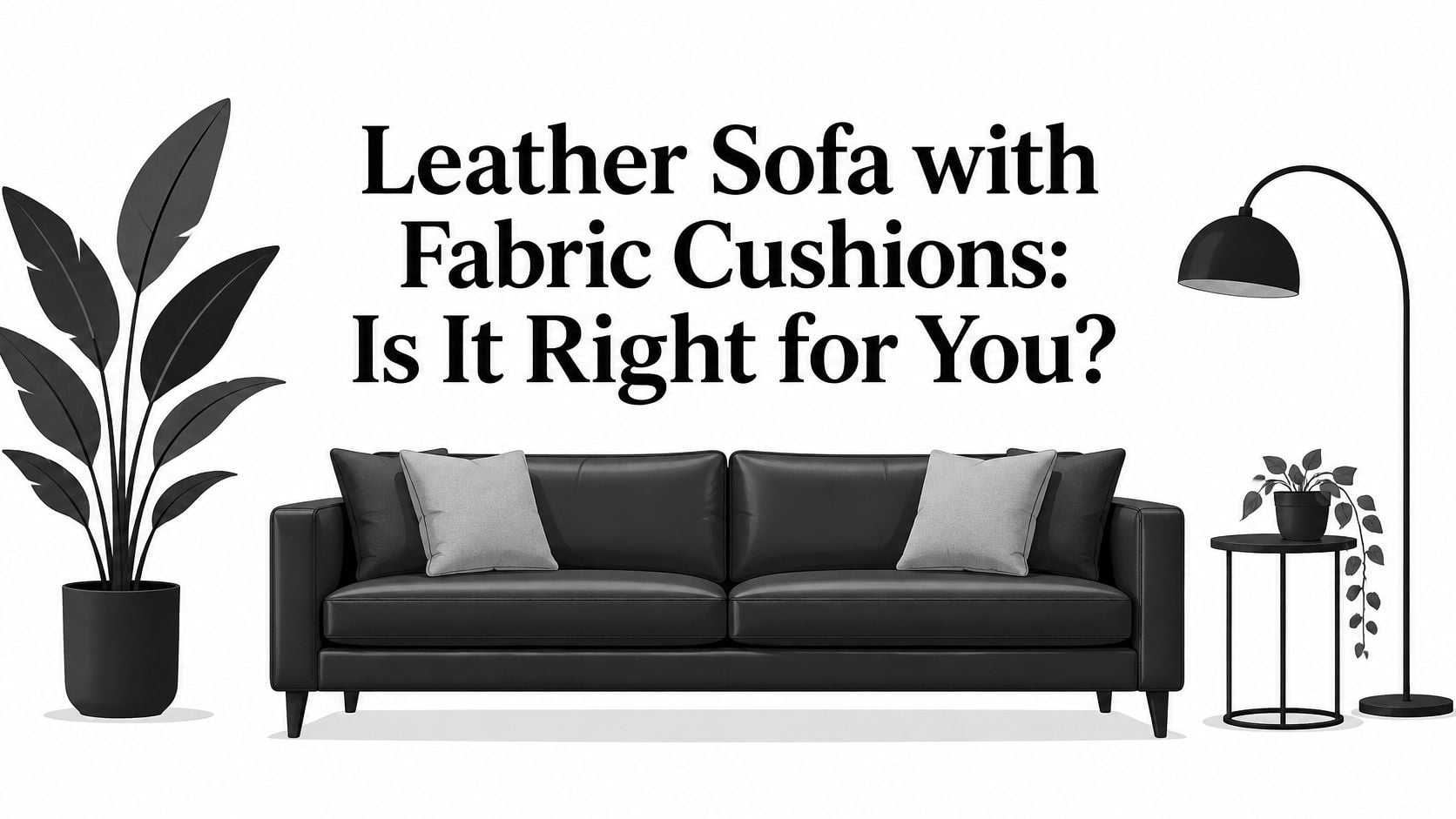
A Saturday afternoon in Ann Arbor often starts the same way. Someone sets a mug on the arm, a kid drops crackers in the seat, and the household wants a sofa that still looks composed on Sunday. Leather promises a wipe and a finished edge. Fabric promises a softer place to sit for hours. A leather sofa with fabric cushions is the piece that tries to do both, and the choice only pays off when each material is cared for on its own terms.
What a Leather Sofa with Fabric Cushions Really Is
On South State St., a shopper sits down and the first thing that gives is the seat. Fabric yields under the hand. The arms and outer sides stay firm, with the buttery feel of top-grain leather and a clean line that doesn't slump when someone leans. That split is the whole idea.
Think of a blazer. The shell holds the shape and takes the brushing, the bag strap, and the weather. The lining is what the body rests against, and it can be replaced when it wears. A leather sofa with fabric cushions works the same way. Leather covers the frame, arms, and outer sides. Fabric covers the seat and back cushions, where people lounge.
Each material earns its place.
- Structure and a finished look: Leather gives the body a substantial edge and a surface that wipes clean after a drink or a paw.
- Hand, color, and updates: Fabric brings a softer hand, a wide range of color and pattern, and cushion covers that can be replaced or refreshed without rebuilding the sofa.
The pairing isn't a compromise between two minor options. A Mordor Intelligence market analysis found that fabric held 59.33% of upholstered-furniture material share in 2025, while leather was forecast to grow at 5.53% a year through 2031. The hybrid keeps both of those categories in one piece instead of forcing a single finish.

Families with children, homes with pets, and anyone who sits on the sofa every evening in Ann Arbor and Southeast Michigan tend to land here. They want leather where hands, elbows, and spills hit the outside, and fabric where the body rests. Tyner Furniture has furnished local homes since 1957, long enough that this local legacy is about pieces meant to stay, not pieces meant to be swapped out next season. The useful questions are which surfaces are leather, how the materials trade off, and how each zone should be cleaned.
Which Parts Are Leather and Which Are Fabric
Leather sits where the sofa needs structure and handling. Fabric sits where comfort and the cleaning routine matter most. A leather-looking sofa isn't always leather on every face, and the underside of a cushion is often fabric on purpose.
| Surface | Usual material | Main reason | What to check |
|---|---|---|---|
| Seat cushion top | Fabric, removable or fixed | Softer hand and wider color choice | Cleaning code and abrasion rating |
| Seat cushion underside | Fabric with anti-slip backing | Reduces sliding and lets trapped air escape | Backing present and secure |
| Back cushions | Fabric | Comfort and easier replacement | Zipper access and reversibility |
| Inner seat and back frame | Hardwood or engineered frame | Structural support under load | Joinery and suspension attachment |
| Arms | Top-grain or corrected-grain leather | Handles daily contact and wipes clean | Grain type and sun exposure |
| Outer sides and back panel | Leather | Structured, finished edge | Straight seams under load |
| Zipper panels and welts | Fabric or leather | Access to the cushion core | Zippers run straight and open fully |
A fully leather-wrapped cushion can act like a small air bladder. Air stays trapped, and the cushion slides on a leather deck. A fabric bottom with a secure anti-slip backing lets air out and keeps the seat from creeping forward. That detail is engineering, not a shortcut.
Grades a buyer will actually meet
- Full-grain: The outer hide, with natural marking. It feels substantial and can develop a patina rather than a uniform shine.
- Top-grain: Sanded and finished for a smoother hand. It still wears well on arms if the finish is cared for.
- Corrected-grain: More heavily finished to hide scars. It can look even, and it often shows up where contact is lighter.
- Bonded leather: Fibers bonded with a coating. It can mimic hide on a lower-wear panel, and it isn't the same investment as a full hide on the arms.
Corrected-grain or bonded material on a back panel doesn't automatically make the sofa a poor buy. It does mean the label "leather" needs a map. A clear upholstery materials guide helps separate hide from textile before color samples take over the conversation.
Ask three things before leaving the floor: Which surfaces are leather, which are fabric, and are the cushions reversible or removable?
Those answers set the cost-per-year more than the swatch does. A reversible, removable cushion can be turned and later re-covered. A fixed cushion with no zipper locks the household into the original insert.
Hybrid Compared with All-Leather and All-Fabric Sofas
Three sofas can sit in one room and ask for three different owners. An all-leather piece suits a household that wipes a surface and moves on. An all-fabric piece suits one that treats a spot the same afternoon, before it sets. A hybrid asks for both habits, each on its own surface, and that split is the whole point.
Over a decade, the routine follows the fabric rather than the hide. Cloth stains, leather scuffs, and only one of those disappears with a quick wipe.
Buy the hybrid if hands, paws, and juice cups land on the arms and back while legs and movie nights land on the seat. Buy all-leather if the room is formal and the seating is brief. Buy all-fabric if you want one textile to run uninterrupted across the frame and you are willing to clean all of it.
| Criteria | Hybrid (leather frame, fabric cushions) | All-leather | All-fabric |
|---|---|---|---|
| Look and structure | Structured leather exterior with softer cushion texture | Uniform, substantial leather finish | Softer, textile-led look |
| Spill handling on the frame | Leather wipes clean; cushions need spot treatment | Wipes clean across surfaces | Spot treatment needed on every surface |
| Seat comfort and hand | Soft fabric seat and back | Firmer, cooler feel on the seat | Softest hand |
| Color and pattern range | Wide on cushions, narrower on frame | Limited to hide colors | Widest range |
| Replacing worn covers | Often possible on cushions alone | Usually a professional job | Often possible on cushions or the full piece |
What the hybrid does well
- A structured exterior: Arms and sides keep a clean line while the seat stays soft.
- A seat people use: Fabric on the seat and back feels warmer under the hand than hide.
- Color where it shows: Cushions can carry navy, olive, or a small pattern while the frame stays quiet.
- Service over decades: Covers can be replaced and cores re-cored, which spreads an heirloom price across years of sitting instead of one season of newness.
Where it asks more of the owner
- Two routines: Leather and fabric do not share one cleaner, so the supply shelf doubles.
- Two decisions: The frame and the cushion are chosen separately, and the cushion cover is usually the one a household revisits first.
- Construction can hide: Mixed surfaces do not fix a weak frame or a sagging suspension.
- Upfront cost: A leather body costs more than a basic fabric sofa, and the premium only makes sense when the piece is built to be serviced.
Families with pets and children often want arms they can wipe and seats they can live on. Buyers who like a textile look but not fabric on the frame get that split here. A side-by-side reading of leather versus fabric upholstery sorts those trade-offs before a made-to-order choice, because the two materials wear in different ways and on different timetables.
In-stock upholstery is a starting point rather than the ceiling. Most Tyner pieces can be customized to personal style and comfort, and Stressless options are available, so cushion feel and seat depth can follow how the household really sits. A deeper seat suits lounging. A slightly firmer, more supportive sit suits reading and conversation. Either way, a well-built hybrid with cushions that can be renewed is priced across years of use.
Pro-Tip: Sit on the leather arm and the fabric seat in the same visit. The difference in temperature and give is the decision, not the photograph.
Cushion Foam and Serviceability Specs to Request
Ask for the foam density before the cover color. The core decides whether the seat still has height after years of evenings, and the fabric only hides what the foam does.
The Polyurethane Foam Association reports that seating foams at or above 1.8 lb/ft³ (about 29 kg/m³) perform better under repeated compression than lower-density foams, and a practical residential target for a hybrid seat runs a step above that baseline, at roughly 2.0–2.5 lb/ft³ (32–40 kg/m³) of high-resilience foam. Density is the amount of material packed into the block. More material usually means the cells hold their shape longer, which is why the upper half of that range earns its cost in a seat someone uses every night.
ILD or IFD is the firmness rating, and it is chosen separately from density. A household that wants a supportive sit and a deeper seat can pick a higher ILD without dropping the density. Judge firmness by how the core recovers, not by first touch. Sit for ten minutes, stand up, and watch whether the cushion climbs back to its crown or stays dented.
The pancake trap
A low-density cushion with a high ILD can feel supportive on day one. The cells are stiff, so the sit reads as "good" in the showroom. Under daily weight those cells collapse, the seat loses height, and the profile flattens into the frame. A denser high-resilience core may feel a touch softer at first and still hold its shape five years in. That is the trade you are making when you compare two cushions side by side.
What to ask for, and what to ask about later
- Foam density, in writing: ask for the number and the foam type together, so "high-density" cannot stand in for a figure.
- ILD or IFD matched to seat depth: a deep lounge seat and a shallow reading seat want different firmness even at the same density.
- An insert that unzips: this is the serviceability question. A zippered case lets the core be swapped without reupholstering the leather frame or arms.
- Who handles a re-core: ask whether cushions travel back with the sofa or separately, because the answer shapes how a repair gets scheduled years from now.
Heavier daily use, sleeping on the sofa, or a very deep seat all raise the compression load. Those households should stay at the upper end of the density range and confirm the suspension is attached to the frame rather than resting inside it. Details on custom upholstery cushions let you compare cores before the order is cut.
At Tyner Furniture, items with easily transported components, such as unattached cushions or pillows, must be returned by the customer to the service department for service. Ask how that handoff works before the sofa is ordered, so a re-core years later isn't a surprise.
Caring for Each Material Zone and Spills
Coffee tips across the seat, runs into the welt, and stops against the leather arm. One gesture, two maintenance zones. The hide wants a wipe and an occasional conditioning. The cloth cushion takes the abrasion, carries the cleaning code, and sets the weekly rhythm for the whole sofa. That split is the practical reason fabric cushions, not the leather, usually drive what a hybrid costs you to own each year.
Abrasion ratings give you a first filter. Contract upholstery standards commonly set minimums near 15,000 Wyzenbeek double rubs or 20,000 Martindale cycles, and those thresholds are worth asking for by number rather than accepting "durable" as an answer. What happens after the purchase matters just as much: seam construction, soil, cleaner chemistry, cushion movement and sunlight decide how long a cover lasts. On the leather side, conditioning every six to twelve months keeps the finish supple and the color even.
| Zone | Routine care | How often | Avoid |
|---|---|---|---|
| Leather frame and arms | Dust, then wipe with a soft damp cloth and a pH-balanced leather product | Weekly wipe; condition every 6 to 12 months | Alcohol-heavy cleaners, degreasers, abrasive pads |
| Fabric seat and back cushions | Vacuum or brush the surface; follow the fabric cleaning code | Weekly vacuum; fluff monthly and rotate reversible cushions on a set day | Water on fabrics coded vacuum-only |
| Cushion seams and crevices | Brush out dry soil and crumbs | Weekly | Stiff brushes that fray seams |
| Zippers and welts | Vacuum lint and check that the zipper runs straight | Monthly | Forcing a stuck zipper |
| Sun-exposed sides and cushions | Rotate placement or use window coverings | Seasonal review | Prolonged direct sun on one area |
What to request with the fabric
- Test method and result: Wyzenbeek or Martindale, with the actual number.
- Fiber content: Tight weaves shed soil better than loose, fuzzy faces.
- Cleaning code: Water-based, solvent-based, either, or vacuum-only.
- Lightfastness: So a south window doesn't fade one cushion and leave the leather looking newer.
Leather resists water without stopping it. Liquid that sits can enter a seam, stain the hide, or stiffen it, which is why the first minute matters more than the first product. A cleaning code names a compatible method, and that is the whole of what it tells you: which products may touch the cloth. How stain-resistant the weave is comes down to fiber, finish and weave tightness, and the code says nothing about whether a cover can survive a washing machine.
When one spill crosses both materials
- Blot at once with a clean white cloth. Press, don't rub. Rubbing drives liquid into hide and fiber.
- Trace the path. A splash rarely stays on the arm. It runs onto the cushion, the welt, the zipper, or a seam.
- Read the fabric code before any product comes out. Vacuum-only cloth gets no water.
- Match the product to the surface. A pH-balanced leather cleaner stays on the hide. The fabric gets only what its code allows.
- Test in a hidden spot and let it dry before judging the color.
- Keep leather conditioner, bleach, abrasive pads, and household sprays off both zones. Conditioner on fabric leaves a dark ring. Solvent on the wrong hide dries the finish.
- If the mark remains, or there is no code, ask the store for a written spot-cleaning protocol or call a cleaner who will treat each material separately.
The same logic shows up in commercial rooms. Teams focused on safeguarding assets in high-traffic hotels treat stain protection as a planned system, with a routine and a trained responder, rather than a panic wipe after guests leave. A living room with kids and pets deserves that same split between prevention and the right cleaner. Guidance on how to protect leather furniture covers the hide. The cushions still need their own vacuum, their own rotation, and the code that matches their weave.
Styling a Room Around a Hybrid Sofa
A hybrid looks chosen when the leather and the cloth share a color story. Left alone, cognac arms and a random gray seat can read as two sofas pushed together.
Three pairings hold up in real rooms.
- Relaxed: A warm cognac or parchment leather frame with cream or oatmeal cushions. Wood floors and a low, solid table keep it from feeling pale.
- Refined: Charcoal or espresso leather with navy or olive cushions. The dark frame does the architecture. The cloth does the color.
- One pattern: A neutral leather frame and a single patterned cushion set that also appears on an accent chair. One pattern is enough.
Repeat that cushion color once more in the room, in a throw or a pillow on a nearby chair. The eye then treats the fabric as part of the interior design, not as a different sofa.
Wood, scale, and light
A solid cherry or oak coffee table grounds the leather's warmth. Mortise-and-tenon or dovetailed joinery, the kind used in hand-crafted Amish hardwood, has a weight and a grain that veneer doesn't fake. That grain plays against the fabric's texture instead of competing with it. Leave a clear path around the sofa, use a rug that reaches the front legs, and set lamp shades near seat height so the light falls on faces rather than on the ceiling.
A plant in the corner softens a dark leather edge without adding another upholstered shape. Notes on how to style indoor plants in small spaces are useful when the sofa already claims most of the floor. Pieces chosen as coordinated living room furniture should share leg style and seat height so the hybrid doesn't sit apart from the chairs.
Leather's warm tone shifts under lamps. Take swatches home and look at them in morning light and again after dark before the order is placed.
A sit test still matters. A cushion that looks balanced on a rack can look deeper, and slightly darker, once someone is in it.
Confirm the Details and Book a Sit Test
The final ten minutes of a sofa decision tend to get rushed. The leather is chosen, the fabric is chosen, the price is agreed, and everyone wants to be done. The questions worth asking at that moment are the ones that decide how the piece behaves in year six.
Ask about the cushion first, because it is the part you will either live with or replace. What foam density goes into the seat core, what ILD or IFD rating does it carry, and do the covers come off so the core can be swapped later? Then narrow the leather. Which faces are hide and which are fabric, and is the hide full-grain, top-grain, or corrected? Ask for the fabric's cleaning code and the abrasion test method behind its rating. One more question saves a headache later: how do unattached cushions get back to the service department, since Tyner Furniture asks customers to bring items with easily transported parts, cushions and pillows among them, in themselves rather than sending the whole frame.
Read the financing line before signing
Special financing, subject to credit approval, can spread a made-to-order piece across manageable payments, and the terms deserve the same attention as the foam. As The Health Money explains in its breakdown of deferred-interest store cards, a "no interest" offer is often deferred interest: the interest accrues during the promotional period and is waived only if the full balance is cleared by the deadline. Miss the date and the waived interest can return in a lump, which is why a long promotional window is not automatically the safer one.
A few questions settle it before you sign. Does the paperwork say 0% APR or "no interest if paid in full"? What is the exact end date, and does a partial payment in the final month protect you or not? How are payments applied, and would a late payment on an unrelated account end the promotion? What monthly amount clears the balance inside the window? Write the answers next to the end date. Tyner's Low Price Promise addresses what you pay for the furniture, and the interest mechanics run on a separate clock.
Then the visit. The Ann Arbor showroom is where the leather and the fabric sit side by side, and where you can press a seat cushion after standing up to see how quickly it recovers. Tyner Furniture has served Southeast Michigan since 1957, and the sit test is where that history either shows up under you or it doesn't. Most pieces can be customized to a customer's style and comfort, including Stressless recliners sized small, medium, or large, so bring the room's dimensions and a photo of the rug with you.
Tyner Furniture builds made-to-order seating for Ann Arbor and Southeast Michigan households that want a leather frame and fabric cushions specified for real daily use, from foam density to cleaning codes. The showroom is the place for a sit test, and a custom order can be reviewed with a consultant before a finish is locked in. Visit Tyner Furniture to compare materials in person and plan a piece meant to be kept.