Top Grain Leather Armchair Guide for Ann Arbor Buyers


A shopper finds a handsome leather chair online, checks the color, and notices the words top-grain leather beside the price. Another chair carries the same label but looks smoother, feels firmer, and costs considerably more. Furniture shopping can become overwhelming when a familiar description doesn't explain those differences.
For Ann Arbor households, a top grain leather armchair can be a worthwhile long-term investment, but the label is only a starting point. The useful questions concern the surface finish, the frame beneath the upholstery, and the care the chair will receive in its everyday setting.
Top-Grain Leather Compared With Other Armchair Leathers
Top-grain leather comes from the upper portion of an animal hide and is typically sanded or buffed to remove rigid surface fibers, creating a thinner, more flexible material with a more uniform appearance than full-grain leather. The FAO overview of hides, skins, and leather provides the material context for understanding leather upholstery, including bovine leather's use in furniture.
The important distinction is between where the material comes from and how the finished chair performs. A hide classification doesn't describe the stitching, cushion support, protective coating, or frame.
Armchair leather types compared
The durability descriptions below are broad shopping categories, not standardized ratings or promises of service life.
| Leather type | Surface | Feel and aging | Everyday durability | Best fit |
|---|---|---|---|---|
| Full-grain | Untouched outer surface | Natural markings, develops patina | Highest potential with suitable finishing and care | Buyers seeking an heirloom chair |
| Top-grain | Sanded or buffed for an even look | Thinner, soft and flexible | High with suitable construction and care | Most armchair buyers wanting durable comfort |
| Corrected split | Lower layer, coated to hide flaws | Uniform look, less breathable | Moderate, with coating integrity important | Value-minded buyers wanting a consistent finish |
| Bonded | Shredded leather fibers bonded with polymer | Stiffer surface, can peel with wear | Low | Light, occasional use |
| Bicast | Split base with polyurethane skin | Smooth, may crack over time | Low to moderate | Lower-traffic rooms |
| Faux leather | Synthetic material, no hide | Consistent look, can crack or peel | Product-specific, verify coating and test results | Buyers wanting a vinyl-style finish |
Full-grain appeals to shoppers who welcome natural markings and a developing patina. It generally occupies the premium end of leather selection, although a finished chair's price also reflects its frame, cushioning, tailoring, and mechanism.
Top-grain is a common premium armchair choice because it balances a supple feel with a more even appearance. It shouldn't be confused with a perfectly uniform product category. A lightly finished hide and a heavily protected hide can both carry the label while feeling quite different.
Read beyond the material name
Corrected split leather uses the lower hide layer rather than the outer grain layer. Its coating supplies much of the visible appearance, so shoppers should pay particular attention to surface condition and warranty coverage.
Bonded and bicast materials require another distinction. Bonded leather combines leather fibers with a binder, while bicast uses a split-leather base beneath a polyurethane surface. Neither description means the chair has the same upholstery structure as top-grain leather.
Faux leather contains no animal hide. It can offer a consistent decorative finish, but its performance must be assessed as a synthetic upholstery product rather than inferred from leather terminology.
A broader guide to upholstery materials helps shoppers compare leather with other seating options. The best choice starts with a practical preference: natural character, visual consistency, or easier everyday maintenance.
Finish Types That Decide Stain Resistance and Care
A guest sets a glass of iced tea on the arm of a top-grain leather chair. One chair takes a pale ring. Another, labeled the same way, wipes clean. Top-grain names the outer layer of the hide. It does not grade the finish sitting on that layer, and the finish is what a hand feels and what a spill meets.
Surface correction, coating thickness, coverage across the chair, and the warranty language around cracking or peeling separate a handsome sample from a chair that fits a busy room. Under showroom lighting, a lightly finished hide can look richer than a coated one. After one dinner, that same hide may hold a water ring the coated version never shows.
Armchair finish types and what they mean for daily use
| Finish type | Surface appearance | Stain resistance | Care demands | Best for |
|---|---|---|---|---|
| Aniline | Dye only, natural markings visible | Lowest | Gentle cleaning and finish-approved conditioning when specified | Low-traffic rooms and buyers wanting the most natural look |
| Semi-aniline | Light protective topcoat, some markings remain | Moderate | Routine gentle care | Families wanting natural feel with added protection |
| Pigmented or protected | Coated, uniform color | Highest among these categories | Simple wipe-down routine with compatible products | Households with children, pets or frequent spills |
Aniline is dye worked into the hide, with little or no topcoat. Markings, pores, and color shifts stay visible. It suits a reading chair, where natural texture matters more than keeping every panel unchanged. A drink left on the arm, or oil from a hand, reaches the hide quickly, so spills need prompt, gentle attention and only conditioners the finish allows.
Semi-aniline sits in the middle. A light protective coat leaves some grain and markings visible while slowing ordinary stains. It fits a living room that is used most evenings and still should look like leather, not a uniform shell.
Pigmented, or protected, leather carries a heavier coating and a more even color. It is the practical start for frequent entertaining, children, or pets. The coating can still scratch, and it still needs cleaners made for that finish. What it changes is daily handling: a prompt wipe is usually enough for ordinary spills.
A heavier coat works like a clear jacket over the hide. You gain forgiveness and give up some breathability and the soft, uneven feel of bare grain. A thinner coat keeps that character and asks for more care around moisture, heat, and household cleaners.
Questions that clarify the purchase
Ask for the upholstery specification, not only the leather name:
- Finish category: Is the selected leather aniline, semi-aniline, or pigmented/protected?
- Coverage: Do the seat, arms, back, and sides use the same leather and finish?
- Surface treatment: Has the hide been embossed or heavily corrected?
- Warranty language: What coverage applies if the finish cracks, peels, or delaminates?
Match the finish to the room's traffic: a reading chair suits aniline, a family room suits semi-aniline or protected leather. Protected top-grain can be the better fit where drinks, kids, and pets are daily guests. A less-corrected hide can be more satisfying where the sitter wants visible aging and will treat the surface gently.
Frame Construction and Cost-Per-Year Value
A $3,000 chair kept for 15 years costs $200 per year. A $1,200 chair replaced after four years costs $300 per year. Those are arithmetic examples, not prices or lifespan promises for any particular product. They show why the frame under the leather belongs in the same conversation as the hide you can see.
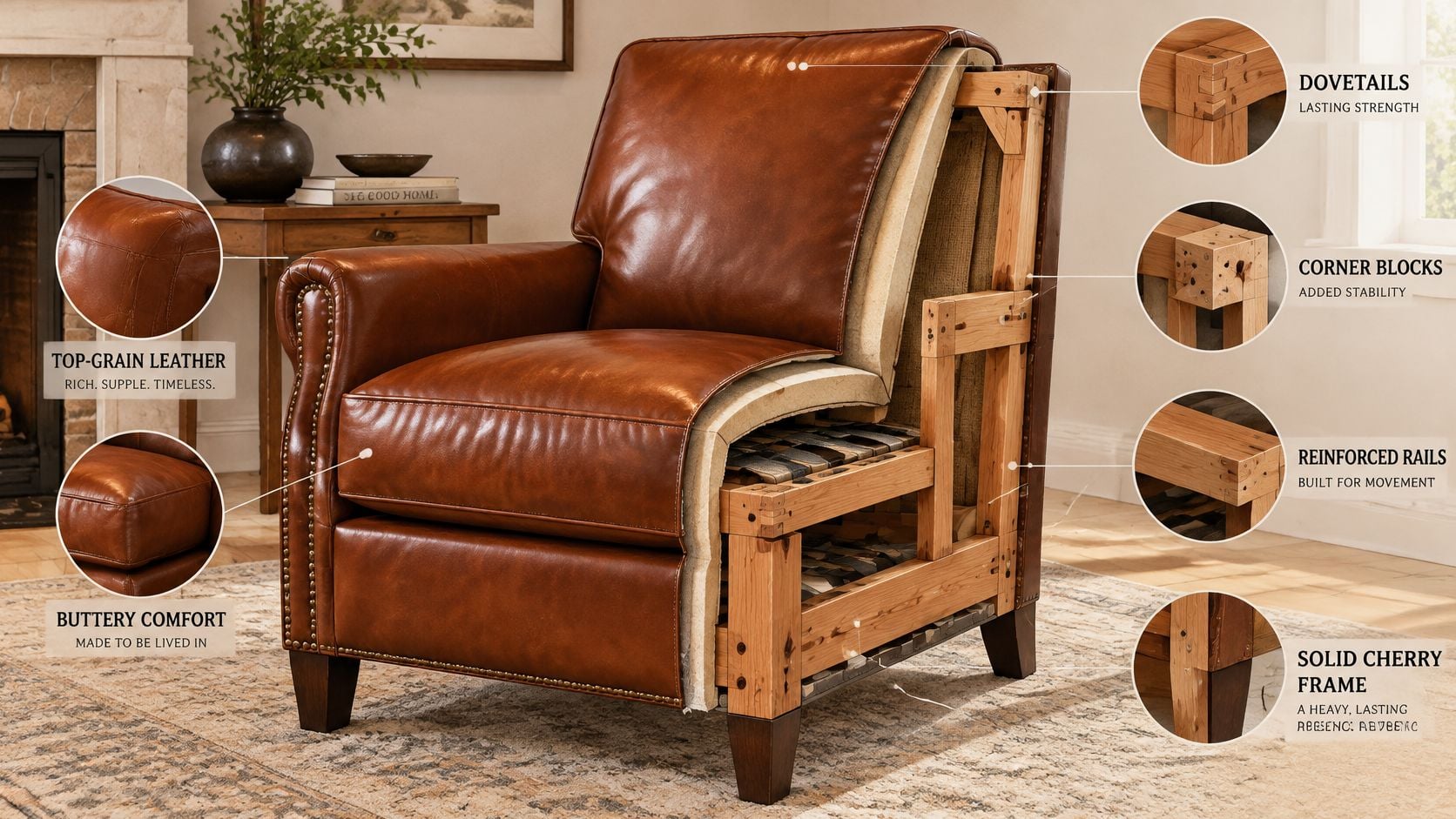
The leather takes the wear you notice. The frame takes every sit, lean, and shift. A handsome surface cannot make up for joints that loosen or a seat assembly that loses support.
The cutaway below illustrates the relationship between upholstery and the supporting structure.
Match the joint to its job
A dovetail is the right joint for a drawer. A mortise-and-tenon belongs in a chair frame. The WoodWiki explanation of dovetail joinery separates those jobs: dovetails resist pull-apart forces in drawers and carcasses, while mortise-and-tenon joints resist racking in structural frames.
Comparative testing summarized in the furniture and joinery guide found mortise-and-tenon joints used in chair rails and similar structural components withstood more than 26 kN before elastic failure. That result describes the tested joints, not a load rating for every finished chair.
A closer look at mortise-and-tenon construction shows how that joint fits chair rails and other load-bearing connections. The tenon seats in a matching pocket, the way a peg sits in a hole, so the rail is less free to twist out of square.
Before you compare two quotes, pin down the frame itself. Is it solid hardwood, an engineered assembly, or a combination? How are the principal joints under the arms and seat rails secured? What does the frame warranty cover if a joint loosens?
Engineered materials can suit the chair when the complete assembly has sound material, joint design, and evidence of durability. Tyner Furniture sells Amish furniture that is hand-crafted from solid wood and fully customizable. In dining and bedroom furniture, that solid-wood construction offers a clear contrast with mass-produced alternatives whose appearance may conceal different core materials and assembly methods.
Calculate value over ownership
Pro-Tip for comparing quotes: Divide each purchase price by a realistic ownership period, then consider likely maintenance, repair options, and warranty coverage. A longer assumed lifespan should have supporting construction details, not just an heirloom label.
Craftsmanship earns its cost when comfort, repairability, and daily usefulness keep the chair in service. Fifteen years in the same room means you skip the second purchase a four-year chair would force.
Specs and Tests to Request Before You Buy
Ask for the tear-strength result for the seat and arm leather before you compare prices. Top-grain names the layer of the hide. It does not report how that leather behaves once it is cut, finished, and fitted to a chair.
A useful sheet separates those properties. EN ISO 3377-1 covers tear strength. EN ISO 4045 covers leather pH, which relates to aging and how stable a finish stays. EN ISO 5402-1 covers dry-flex endurance under repeated bending. EN ISO 11640 covers colorfastness. ASTM D7255 covers abrasion on a rotary platform. For the whole chair, ISO 7173 asks a different question: structural strength and durability of the seating, not leather performance by itself.
Leather and seating tests to request
| Test or standard | What it measures | What to request from the seller |
|---|---|---|
| EN ISO 3377-1 | Tear strength of the leather | Test result for the seat and arm leather |
| EN ISO 4045 | Leather pH, relevant to aging and finish stability | Confirmed pH value and cleaner compatibility |
| EN ISO 5402-1 | Dry-flex endurance under repeated bending | Flex-test result for the upholstery |
| EN ISO 11640 | Colorfastness | Colorfastness rating for the chosen color |
| ASTM D7255 | Abrasion under a rotary-platform test | Visible-damage or mass-change results, read as one factor only |
| ISO 7173 | Strength and durability of the seating structure | Evidence that the complete armchair was tested, not just the leather |
Request the written result for the leather and finish on the chair you are ordering. An unsupported claim that the upholstery is exceptionally durable does not replace that result.
Match the numbers to the chair in front of you
An abrasion figure describes damage or material change under one test method. It leaves seam fatigue, flex cracking, frame strength, and cushion life unanswered. A high abrasion number should not close the purchase on its own.
The sample in the report has to be the sample you will receive. A result from another leather collection, or from the same hide with a different finish, describes a different product.
The specification request should include:
- Leather thickness: Obtain the stated upholstery thickness rather than judging it by touch.
- Exact finish: Record the finish category and selected leather identification.
- Cleaning compatibility: Obtain the recommended cleaner and any restrictions on conditioning.
- Complete-chair evidence: Separate upholstery documentation from frame and seating tests.
Written-specification Pro-Tip: Request the specification sheet before placing the order. Compare competing chairs with the same questions, so one quote is not a full test sheet while the other is only a brochure line.
The sofa and chair buying checklist adds a practical whole-piece perspective. At the Ann Arbor showroom, Tyner Furniture can walk through the sheet that is available for the chair, so documented results stay distinct from features that still need manufacturer confirmation.
Care Routine and Room Conditions That Extend Life
A simple, finish-compatible routine does most of the maintenance work. The goal isn't to keep adding products, but to remove soil gently without soaking the upholstery or disturbing its protective surface.
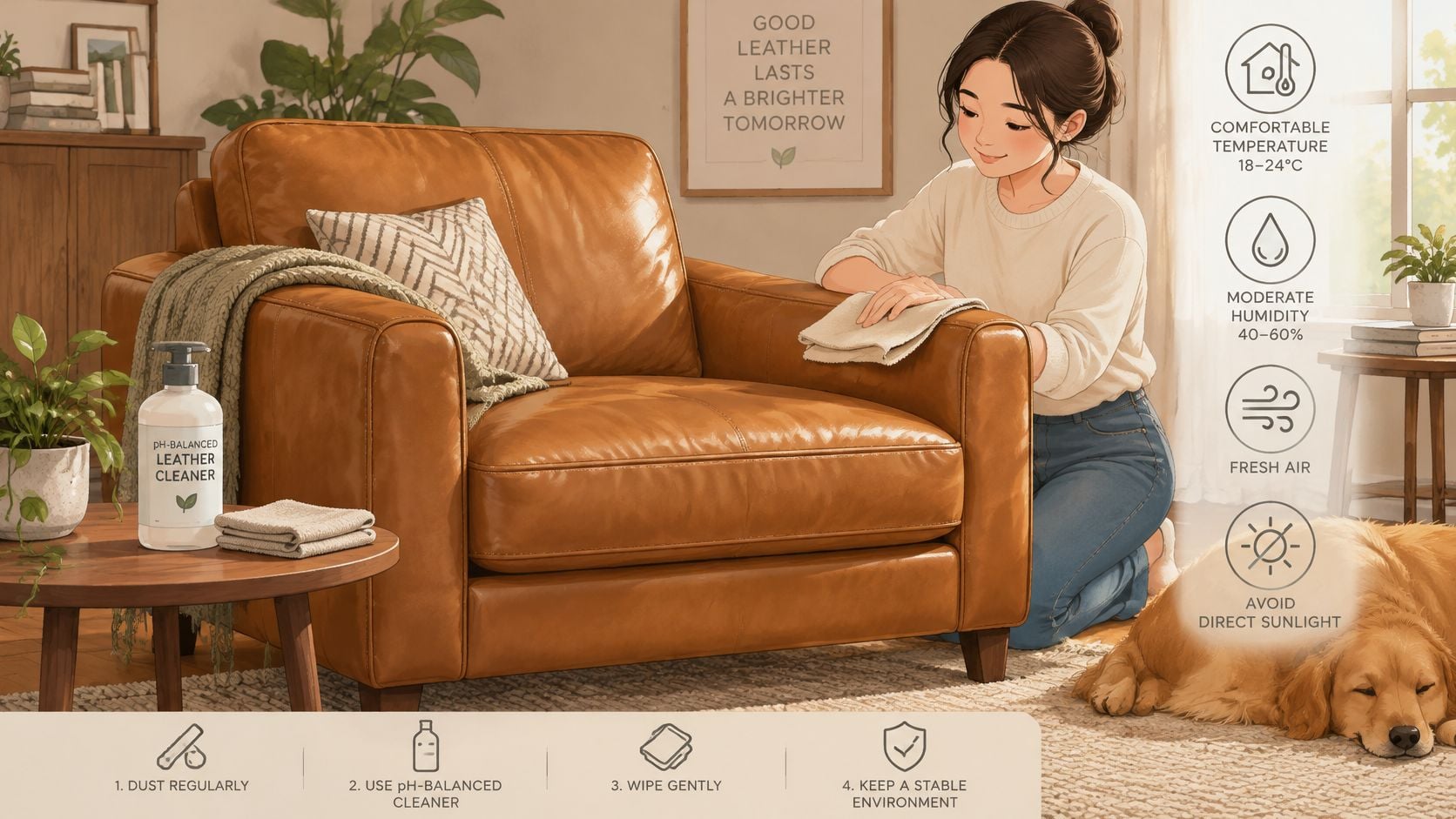
A soft cloth and a controlled application are the starting point.
A careful cleaning sequence
- Remove dry dust with a soft cloth. Lift loose particles before introducing cleaner so grit isn't rubbed across the finish. A gentle pass along seams catches debris that gathers at cushion edges.
- Apply a compatible pH-balanced leather cleaner to a cloth. Direct spraying can wet one spot too heavily and leave uneven marks. Check compatibility on an inconspicuous area first.
- Wipe gently in small sections. Controlled coverage makes it easier to clean evenly. Scrubbing harder isn't a safe substitute for the correct product.
- Remove residue with a clean, lightly damp cloth. The cloth should feel barely moist, not wet. Excess water can collect around seams and panel edges.
- Allow natural drying. Keep the chair out of use until the surface has dried. A heater or hair dryer can cause concentrated, uneven drying.
- Condition only when the finish calls for it. Use a conditioner specifically approved for that upholstery. Some protected finishes don't need a separate conditioning product.
Strong solvents, alcohol-heavy cleaners, degreasers, abrasive pads, and prolonged direct heat should stay away from the chair. A household cleaner that works on a nearby table may be unsuitable for leather.
Watch the room as well as the surface
Inspect the seat front, arm caps, headrest, and seams for localized wear. Changes in these contact areas can reveal a problem while attention is still straightforward.
Keep the chair away from direct sun, heaters, and concentrated vent airflow. Damp conditions encourage mold, while very dry air and uneven drying can contribute to stiffness, clouding, or cracking.
The BIFMA standards overview provides context for whole-chair durability assessment, including the structural seating standard named in the purchasing checklist. Good maintenance supports the upholstery, but it can't replace a sound seating structure.
For a room-wide maintenance plan, Interiors by DeX's discussion of materials that resist swelling and rust offers useful context for nearby furnishings. Those materials require their own care methods, rather than a shared all-purpose spray.
The leather furniture protection guide can help households organize a consistent routine.
Seasonal-care Pro-Tip: Set a quarterly calendar reminder to inspect contact areas, check nearby heat and light exposure, and review the approved care products. Inspection doesn't mean conditioning on a fixed schedule.
Comfort, Sizing and Style That Suit Top-Grain Leather
The first sit tells you the leather's give under the forearm. The second, longer sit shows whether the cushion holds its shape. The surface warms with body contact, and the way posture meets that cushion is easier to judge than it was in the first minute.
A close view shows the texture that a small online swatch can miss.
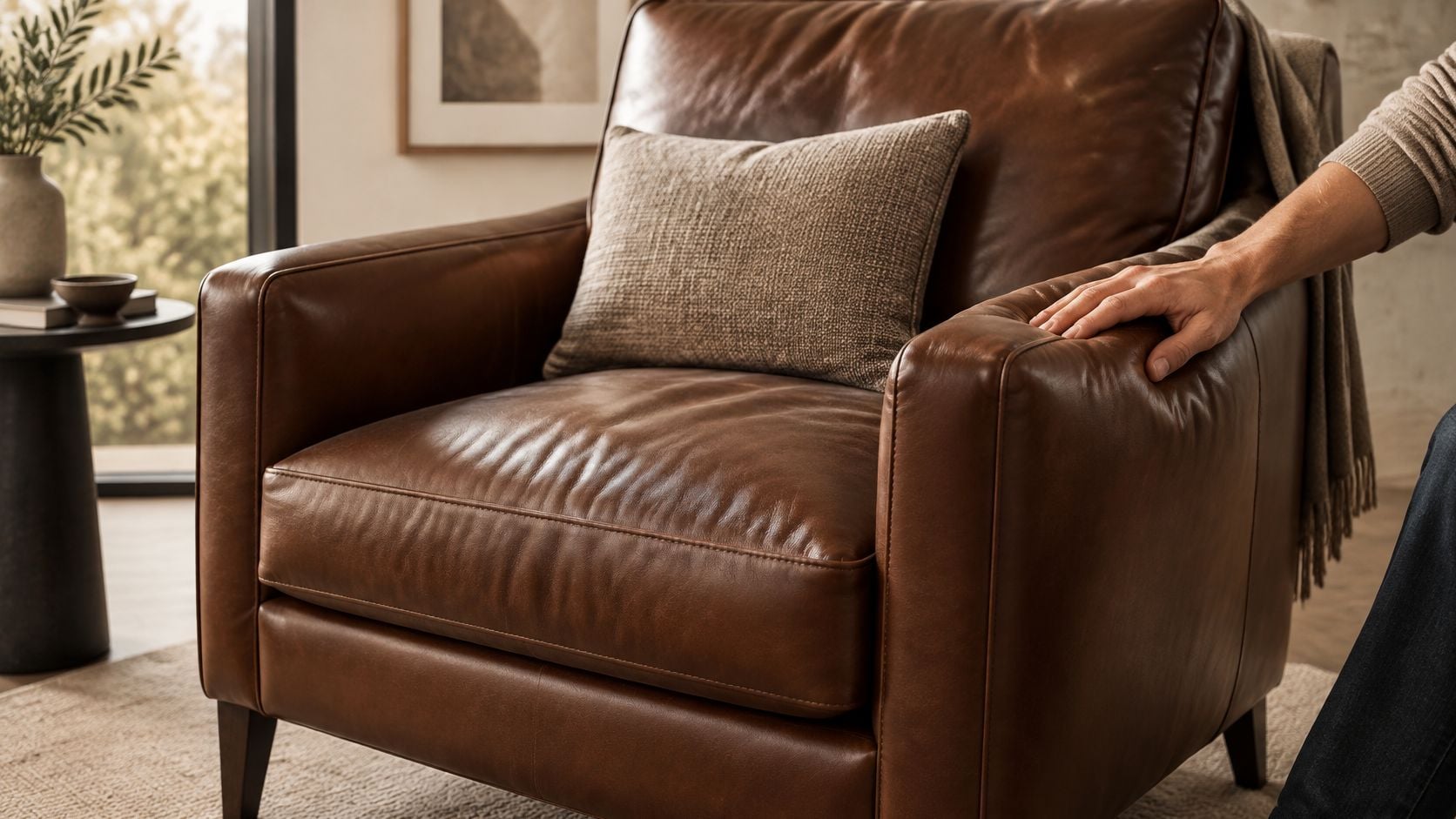
The Wirecutter leather-buying advice explains that lightly corrected top-grain can retain natural markings, with the finish influencing both appearance and maintenance. On a curved armchair, flexible upholstery can follow the back, arms, and cushions, and normal creasing remains part of upholstered seating.
Fit the person before fitting the corner
An evening reading chair can look generous and still miss the body that will use it. Seat depth works like a shoe that is a size too long: the sitter slides forward to plant the feet, and the backrest stops supporting the spine.
A seat about 22 inches deep against a thigh closer to 17 inches, measured from the back of the knee to where the back should meet the cushion, leaves a gap the body closes by scooting forward. Feet should rest flat without pressure behind the knees, so seat height has to match leg length after the cushion compresses, not the empty chair. Width should allow a small shift while the armrests stay easy to reach. Forearms rest without lifting the shoulders. Where the chair reclines or swivels, the open floor around it has to fit that motion, not only the chair's footprint.
Shoppers sorting posture questions can start with ergonomic seating solutions matched to body and chair. Ergonomic fit is that match: proportions against seat angles, cushion firmness, and arm placement.
A sit test should last long enough for initial softness to stop being the only impression. Measure the chair against the person who will use it, and note the activity that chair is meant to support.
Choose color in the room's light
Pale leather shows some stains and scuffs sooner. Dark leather can make light dust or pet hair stand out. Samples seen in the room beat the guess that every darker finish hides wear.
A warm brown top-grain chair beside a honey-oak bookcase and a cream linen pillow reads as one family of tones. A cool gray wall behind that group keeps the leather from looking muddy. In a farmhouse scheme, personalized signs for farmhouse living rooms can add a personal note without forcing the chair, the wood, and the textiles into one matched set.
The same hide shifts with the hour. Check the shortlisted color where the chair will sit, once in morning light and once late in the day, before the palette is settled.
Test Your Choice at the Ann Arbor Showroom
A chair can feel right for the first minute and still be the wrong buy. Top-grain names the part of the hide. It does not grade the finish, the frame, or the care you will give it later. Those three decide how the armchair ages, and the Ann Arbor showroom is where you can check them before the label does the deciding.
Tyner Furniture has served Southeast Michigan since 1957, with time for an unhurried comparison instead of a decision made from a photograph. Tell the person helping you whether the chair is for reading, conversation, television, or a laptop. Each job loads the seat differently.
Check finish and frame before you fall for the hide
Work through the shortlist with a specification sheet in hand. A protected top-grain surface and a more open aniline surface can share one grade name and still age on different clocks. Ask which finish you are touching, what a spill or a pen is likely to do, and which wiping method the maker expects. Put that answer beside the care sheet and the warranty before you leave the floor.
Then test the structure the leather is hiding. Press the arms, sit back, and ask how the joints are built. Joinery that stays tight is what keeps the chair from loosening while the hide still looks respectable. A soft sit today is only a bargain if the frame holds that shape for years.
If the model reclines, swivels, or lifts, run the motion once and watch whether the leather pulls at the arms or the back. Before the visit, the shop's feature filters can narrow the field by power reclining, swivel, massage, USB, and similar options, so the floor time is a comparison rather than a search.
Fit the chair to the rooms around it
Most pieces can be customized to a customer's personal style and comfort. The Custom Order option allows made-to-order fabrics, finishes, and configurations, but only inside what that collection offers. Review those limits on the sheet, not from memory. Stressless can enter the conversation when support is the priority, and Canadel when a dining set has to live beside the chair.
Selection also runs through living room, bedroom, dining room, entertainment, home office, mattresses, and outdoor furniture. That range makes it easier to plan the next room without treating the leather chair as a one-off.
Special financing, subject to credit approval, and the Low Price Promise can steady the budget. The fair comparison is still comfort, finish, construction, and the years you expect to keep the chair, not the first price alone.
Tyner Furniture offers customizable seating and guidance on the finishes, construction, and fit that matter when choosing a top grain leather armchair. Visit Tyner Furniture at the Ann Arbor showroom for a sit test and a staff walkthrough of the specification sheet, or use the shop's feature filters to begin a special order.