Curved Sectional Leather: How to Plan the Fit


The common advice says a bigger sofa means more seating. A curved sectional leather piece breaks that rule. Its arc turns people toward each other, softens a room, and can look generous in a photo, yet the same arc shortens the straight run where a person stretches out to watch a movie or nap. Shoppers in Ann Arbor and across Southeast Michigan get better results by counting usable seats, traffic paths, and television sightlines first, then choosing hide, finish, and color. A curve is a room plan before it's a style.
When a Curved Leather Sectional Fits
Most photos hide the trade-off. For example, in a living room near 14 by 16 feet, an arc spanning 100 to 120 inches can look like five seats while offering only three comfortable, forward-facing places. The end seats angle inward, knees point toward the center table, and nobody gets a long, flat stretch. That's a win for talk and a loss for straight-on lounging.
Coverage in Elle Decor's 2026 curved furniture trend report notes growing demand for curved forms, with buyers weighing flexibility, permanence, comfort, and practicality at the same time. Demand doesn't answer the seating question. A household still has to decide whether face-to-face conversation matters more than a screen, a nap, or a wall-hugging layout.
Start With the Room's Main Job
Conversation rooms reward a curve because the arc puts faces, not shoulders, toward each other. Floating pieces in open plans also work well, since the rounded back looks finished from the kitchen or entry and defines a zone without a wall. A bay window, a round fireplace surround, or other curved architecture gives the sectional something to echo, so the shape reads as intentional rather than forced.
A curve performs poorly in other settings. Rooms under about 12 feet wide lose their walkway to the deepest part of the arc. A primary television room puts people on the horns of the curve at an angle to a centered screen, and leather placed opposite a south window reflects glare while strong sun works on the finish. A door swing or radiator landing inside the radius can defeat a layout that cleared every wall on paper.
Which layout fits the way the room is used
| Room job | Better layout | Usable seating | Clearance to hold |
|---|---|---|---|
| Conversation-centered room | Fixed or gentle curve | Most people face inward; fewer straight lounging seats | 14 to 18 in from seat edge to center table |
| Open-plan floating layout | Curve as a sculptural anchor | Defines a zone without a wall | 36 in main walk; 18 in minimum behind |
| Bay, fireplace, or curved architecture | Curve that echoes the feature | Seats follow the focal point | Keep the arc off the hearth and trim |
| Primary TV room | L or straight sofa with chaise | Straight sightlines to the screen | 36 in main walk |
| Narrow room under 12 ft wide | Straight sofa, not a curve | Depth eats the walkway | 30 in side path |
| Household that naps or stretches out | L with a chaise | Long flat run | A tight arc has no straight nap length |
Circle One Row First
That single choice sets every later decision. A conversation row leads to a fixed or gentle curve and a round table. A television row leads to straighter seating, even if a curved back looks softer in the showroom. A nap row protects the long chaise run that no tight radius can replace.
Practical rule: Count seats by where a person's back, hips, and knees actually land, not by cushion seams or overall width.
Households that skip this step often buy visual softness and discover the cost later, in a sore neck at the end seat or a daily squeeze past the deepest point of the arc. The right curved sectional leather layout earns its footprint on an ordinary Tuesday, not only when guests arrive.
How to Measure Clearance and Traffic
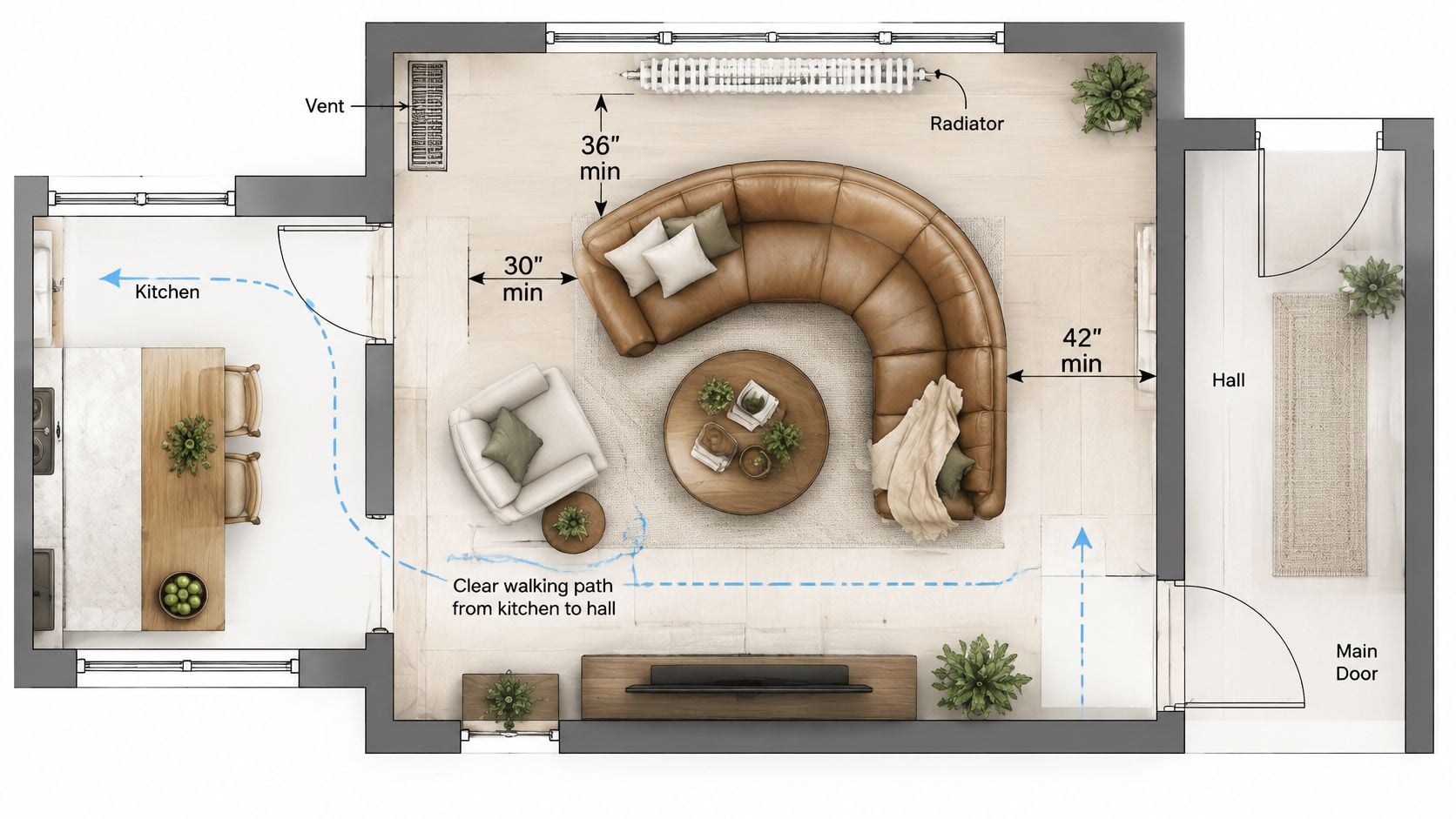
Measuring starts with the layout circled for the room's main job, not with every sofa on a website. A curved back occupies space differently from a rectangle, so overall width and depth alone won't show where shoulders, shins, and door casings land. Tape on the floor tells the truth faster than a tape measure held against one wall.
Seven Steps in Order
- Sketch the fixed features: Mark doors and their swings, radiators, vents, outlets, and the daily path from kitchen to hall. Southeast Michigan ranches and colonials often force a tight turn around a peninsula, and that's exactly where a curve steals inches.
- Measure at two heights: Record length and width at the baseboard, then again at about 30 inches high. Older plaster walls bow, so a back that clears the floor line can still rub higher up.
- Tape the outside radius: Use the maker's overall width and depth to mark the full outline with painter's tape, not just the front edge. The back sweep is the part most sketches miss.
- Walk the taped path loaded: Carry a laundry basket or a serving tray along the main route. Shoulders brushing the tape mean the 36-inch main aisle is already gone.
- Sit on the arc: Place dining chairs where seats will fall and check knee room, end-seat views of the television, and where afternoon sun lands. A seat that looks fine standing up can feel angled and bright once occupied.
- Set the inside and behind gaps: Leave 14 to 18 inches inside the curve for a round table, close enough for a mug but not a shin. Keep at least 18 inches behind a floating piece so the back doesn't crowd the path.
- Photograph and note the room: Shoot the tape from the doorway and record ceiling height and any sloping wall. A curved back that looks fine in a straight-on photo can clip a door casing the tape already revealed.
What the Tape Catches Early
Tape exposes conflicts that dimensions on a product page can't. A heat register under the deepest part of the arc will bake the leather and block airflow. A floor outlet needed for a lamp can end up trapped under the frame. A reclining or sleeper function, if planned, needs its open footprint taped too, since footrests and beds move into the same space the coffee table wants.
Delivery deserves the same treatment. Door openings, stair turns, and hallway corners should be measured against component sizes, because a fixed crescent travels differently from separate wedges. The step-by-step method in Tyner Furniture's guide to measuring furniture before ordering helps households record those numbers in a consistent order.
Photos of the taped floor belong in the showroom visit. They let a sit test use the actual radius, the actual door swing, and the actual sun exposure, instead of a guess made beside a floor sample. Good interior design at home is mostly this kind of plain verification, done before a made-to-order order locks the dimensions in.
Leather Grades That Hold a Curve
Grade sets how long the hide lasts. Treat it as a buying rule.
Full-grain leather keeps the outer hide with its natural marks, and it generally wears and breathes the longest. Top-grain leather also comes from the outer hide but is sanded or corrected for a more even face, which helps color match across the wide panels a curve needs. The buttery feel of top-grain leather is real, yet hand feel alone won't tell you how a finish handles sun, body oils, and seams.
The finish decides much of what happens after year three. Semi-aniline adds a light protective coat over a softer, more natural look. Pigmented or protected leather carries an opaque finish that resists stains from kids and pets better, at the cost of a less supple hand. Bonded leather is scraps bound with polyurethane, and it's the category most likely to peel where a curved arm or seam stays under tension.
Leather grades for a curved sectional
| Grade | What it is | Typical life in a home | On a curve | Main risk |
|---|---|---|---|---|
| Full-grain | Outer hide, natural marks kept | Often 15 to 25 years or more with care | Breathes; patina shows on arms and radii | Sun fade and scratches stay visible |
| Top-grain | Outer hide, sanded or corrected | Long, close to full-grain when well made | More even color across large panels | Less natural texture |
| Semi-aniline | Aniline with a light protective finish | Mid to long if oils and sun are managed | Softer hand with some protection | Still marks at high-touch seams |
| Pigmented or protected | Opaque finish coat | Strong stain resistance for daily family use | Best for kids, pets, and tight arms | Can feel less supple; a weak finish may crack |
| Bonded | Leather scraps plus polyurethane | Often about 3 to 6 years of daily use | Looks convincing when new | Peeling at seams and stretched radii |
Life ranges summarized from Homeia's furniture material comparison of leather and fabric, which draws on a 2024 Dutch government research report.
Read those spans as estimates rather than warranties. Sun, daily use, body oils, and care shift any single piece up or down, which is why two sofas cut from the same grade can age differently in the same house. On a curve, the budget earns its keep at the arms and the seat fronts, where hands and denim land every day, and along the outside back that faces the room.
Questions That Protect the Investment
On a curve, confirm that every contact surface, arms and outside back included, uses the same genuine leather. Ask for finish type, cleaning method, and expectations about sunlight and body oils in writing before ordering. A south-facing Ann Arbor window fades aniline faster than a pigmented hide, so placement and finish belong in the same conversation.
Cleaning follows the finish. Protected and pigmented hides generally tolerate a damp cloth and a manufacturer-approved cleaner, while aniline needs gentler care and shows spills sooner. Households weighing long-term care can read about protecting leather sofas with specialist cleaning as part of a realistic maintenance plan, since a cracked seam on a radius is harder to repair than one on a flat cushion.
A large swatch, viewed under showroom light and window light, reveals color shift that a small sample hides. Tyner Furniture's explainer on top-grain leather compared with bonded leather gives shoppers plain language for checking labels. Cost-per-year favors the hide that stays sound longest, and that's where durability turns a leather purchase into an heirloom decision instead of a short cycle of replacement. A more sustainable choice starts with honest service life, repairability, and care.
Fixed Curves versus Modular Pieces
A curved sectional can look like one continuous sweep and still be built two very different ways. A fixed crescent is built as one frame with one radius. Its overall width tells you less than its inner radius, seat count, and how much straight run remains for stretching out. A larger-looking arc often seats fewer people straight-on than an L because the seats turn toward each other instead of lining up toward a screen. That is the trade: better face-to-face talk, less straight-on capacity.
A modular wedge arc works like dining chairs pushed into a curve. The angled pieces can be reset straighter, split around a different room, or extended if matching pieces remain available. That flexibility suits households that move or remodel. In leather, though, seams between wedges show more than a single upholstered frame, and a person can end up perched on a junction if seat positions are not counted carefully.
Fixed, modular, and straight alternatives
| Build | How it sits | Best when | Weakness |
|---|---|---|---|
| Fixed crescent | One radius; most seats angled inward | Conversation, floating rooms, layouts that will not change | Cannot be straightened; limited straight run for reclining or stretching out |
| Modular wedge arc | Angled pieces that can be reset or split | Households that move, remodel, or rearrange | Seams read more clearly in leather; a junction can become a perch if seats are not counted |
| Curved sofa plus ottoman | Center more square; ends softened | Mixed conversation and television | Not one continuous sectional; ottoman adds a loose piece |
| L with chaise | Long flat lounging run | Naps and straight TV sightlines | Blocks corners and traffic; less face-to-face than a crescent |
Depth, Seams, and Motion Features
Seat depth should be measured at the cushion, from the front edge to the back, with a tape. Then sit with shoes off and feet where they normally land. A deeper seat helps taller sitters and leaves shorter legs reaching, so the number matters less than the fit. Shared arms, wedge junctions, and corner cushions decide whether a nominal seat is a real seat.
A fixed curve is a commitment to one room arrangement. Modular pieces cost some visual calm and buy back options. Power recline, heat, and massage fit more easily on straighter modules than on a tight continuous radius. Shoppers should not assume a curved showroom piece can take every motion feature, or that cords and mechanisms will clear the taped outline. Tyner Furniture's guide to sectional buying basics and configurations helps separate layout terms from functions, since a sectional can be curved in outline and modular in construction at the same time.
Price Against Service Life
Sticker prices mislead when service lives differ, and the quote for a curve is tied to its build. Tyner Furniture's Custom Order section lets a buyer price the exact configuration rather than a floor model. The useful arithmetic is the quoted price divided by the years you expect to use the piece. A lower sticker on a shape that fights traffic is value lost every day; a made-to-order curve that fits the room has a longer useful life to spread its cost across. Check frame material, suspension, and whether the radius on the order matches the taped floor before comparing two quotes.
Style the Leather with Wood and Fabric
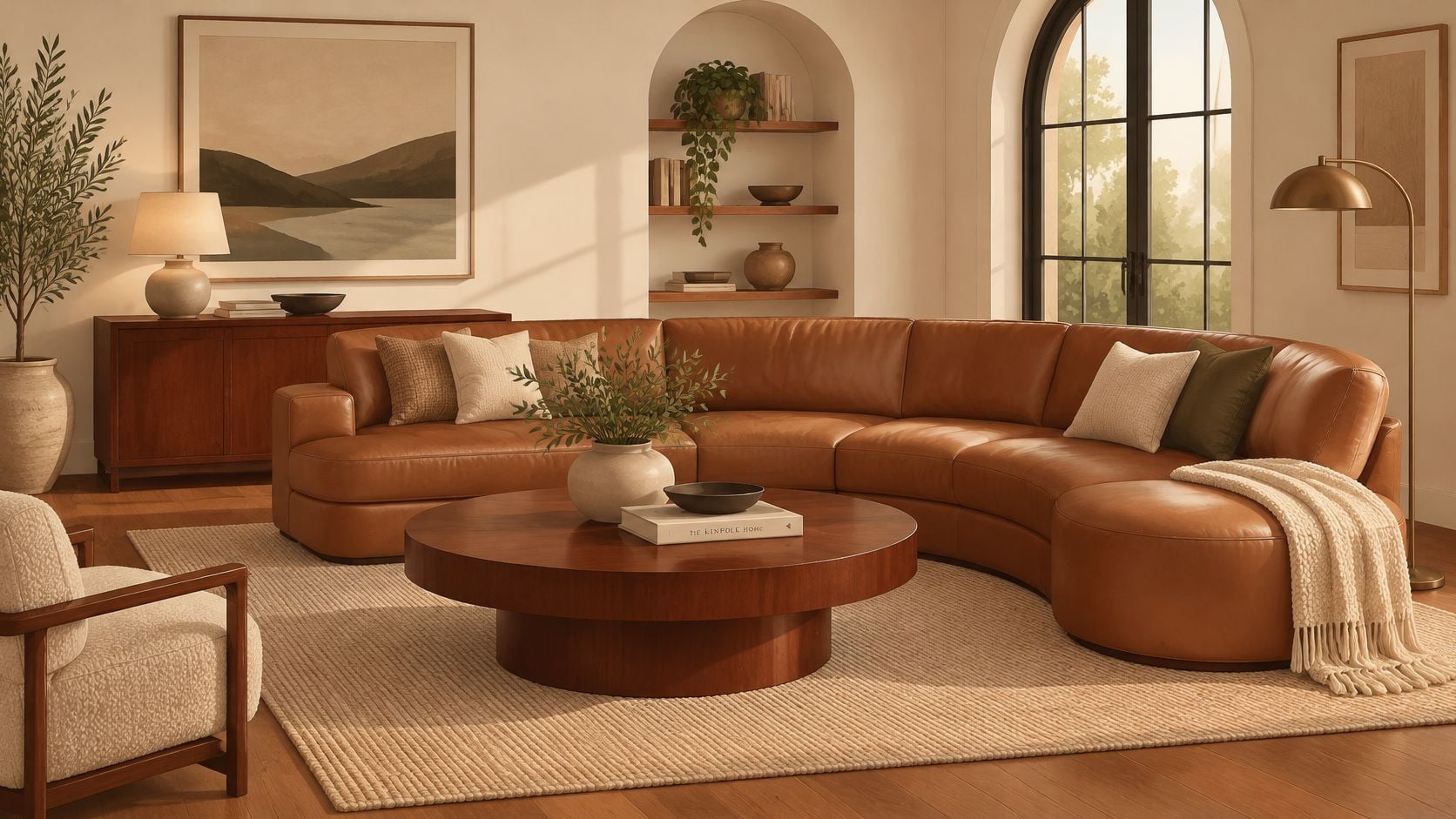
Say a household places a cognac arc in an open-plan room with a fireplace on one side and dining space behind. The leather already supplies movement, sheen, and a strong silhouette, so neighboring pieces should stay calm. Solid wood, one textured fabric, and a round table usually do more for the room than additional pattern or shine.
Wood That Can Stand Beside Leather
Hand-crafted Amish solid wood suits a heavy sectional because the piece has real visual and physical weight. The weight of solid cherry wood in a coffee or end table keeps it from disappearing beside broad leather arms, and dovetail or mortise-and-tenon joinery signals construction meant to stay tight. Material integrity matters more than a stain name, especially next to an heirloom seating purchase.
Color pairings stay simple. Cherry warms cognac and caramel hides and deepens the room's evening feel. White oak or maple keeps black or greige leather from turning gloomy and reflects more of Michigan's winter light. A round or oval coffee table follows the inside of the arc, so shins miss corners and every seat can reach the surface at a similar distance.
One Fabric, One Extra Chair
A single accent fabric is enough. A lumbar pillow or throw in a textured weave softens the leather's smooth face without starting a pattern contest. Two competing prints make the curve look busy, while one quiet textile lets the arc remain the anchor.
An ergonomic Stressless chair in a nearby corner adds sized comfort in small, medium, or large without another bulky sofa back. On the dining side of an open plan, Canadel made-to-order legs, edges, and finishes can echo the wood tone without copying the sectional. Ideas for coordinated living room furniture arrangements help households keep those relationships proportional.
Pro tip: View the leather swatch, wood sample, and pillow fabric together in late-day sun, since south-facing Ann Arbor rooms shift warm hides toward orange and cool grays toward blue.
A buttery top-grain hide beside cool gray walls usually wants warmer wood. A pigmented black hide wants oak and one lighter textile so the room keeps contrast. In both cases, restraint protects the curve. The sectional is the sculptural piece, and solid wood joinery plus one calm fabric give it neighbors with enough substance to belong there.
Order the Sectional after a Sit Test
A showroom visit works best with evidence in hand: taped-room photos, the circled layout row, door and stair measurements, and a chosen leather grade. At the Ann Arbor showroom, shoppers can sit the closest curve, test the end seats as well as the center, and check whether feet, knees, and lower back settle naturally. Five quiet minutes in a seat reveal more than a quick perch.
Count usable seats while you are there. A generous-looking arc often seats fewer people straight-on than a same-width L, because the ends angle inward and the middle carries the conversation. Sit the two ends and the center in turn, then ask how many people can face each other without turning their shoulders.
In-Stock Is the Starting Point
Floor samples show construction and sit. They don't have to fix the final radius, depth, or finish. Most Tyner Furniture pieces can be customized to a customer's personal style and comfort, and the website has a Custom Order section for special orders. That's the practical edge of a local legacy retailer serving Southeast Michigan since 1957: configuration, leather, and finish can be adjusted to fit the room.
The same visit can solve neighboring pieces. Tyner Furniture sells outdoor furniture, including outdoor sets, sectionals, sofas, loveseats, tables and chairs, so a covered porch can echo the living room's wood tone. Stressless seating and Canadel dining sit in the same showroom, and Canadel bespoke styles can be combined in thousands of custom combinations. Shoppers comparing seat construction can use guidance on what to look for in a new sofa or chair to check support, cushions, and frame questions in order. A calm sit test keeps a high-cost, made-to-order decision grounded in bodies and inches.
Read Financing Terms Plainly
Tyner Furniture offers special financing with approved credit, and the Low Price Promise supports competitive value on an heirloom build. Promotional language still deserves careful reading. A deferred-interest explainer from The Health Money reports that roughly one in five deferred-interest promotional balances incurred retroactive interest, and that on promotions lasting 25 to 35 months, added interest could approach 50% of the original purchase price.
That risk comes from one distinction. Under deferred interest, interest can accrue during the promotion and is waived only if the full promotional balance is paid by the deadline; a remaining balance may trigger interest back to the purchase date. Before counting on any offer, shoppers should confirm:
- Offer type: Interest-free or deferred interest
- Promotional term: Exact payoff deadline, not just monthly payment
- Rate after promotion: The annual percentage rate once the term ends
- Minimum payment: Whether paying only the minimum clears the balance in time
Monthly comfort shouldn't hide total cost. Weighed against cost-per-year over a long-lived hide, a clear payoff plan protects the value of the purchase. Households that bring measurements, sit every seat, verify the leather grade, and read financing terms in full can order a curved leather sectional with confidence.
Visit Tyner Furniture to plan a sit test at the Ann Arbor showroom, where measurements and taped-room photos can be matched to radius, depth, leather grade, and finish. Households can compare Stressless and Canadel companion pieces and choose a made-to-order curved sectional built for years of daily use.