Custom Upholstered Recliners: A 2026 Order Guide


A recliner can feel wonderfully soft during a quick showroom visit, then leave its owner straining to stand or shifting around to find support. The better order is simple: check body fit and safe standing first, then choose the upholstery, mechanism, and finish that suit the home.
For Southeast Michigan households, a made-to-order chair is a chance to get more than a preferred color. The right size, supportive construction, and fabric or leather that fits daily life can make a custom upholstered recliner a lasting investment, with value measured in comfort over years rather than by the ticket price alone.
Measure for a Stressless Fit First
Before comparing softness or features, take five checks in street clothes, seated on a firm chair with shoes off. These measurements help narrow the size, but a sit test still decides whether the chair fits in real use.
| Body measure | How to take it | What it sets | Fail sign |
|---|---|---|---|
| Seated hip width | Measure the widest point across the hips and thighs while seated. | Seat width between the arms. | Hips or thighs feel pinched by the arms. |
| Popliteal height | Measure from the floor to the crease behind the knee, shoes off. | Seat height. | Feet dangle or heels lift off the floor. |
| Buttock-to-knee length | Measure from the back of the seated body to the back of the knee. | Seat depth. | Pressure builds behind the knees, or a gap remains at the lower back. |
| Seated shoulder height | Measure from the compressed seat to the top of the shoulder. | Back height and headrest position. | The head falls back in TV or full recline. |
| Egress | Try standing with the chair arms from upright and partial recline. | Seat firmness and mechanism. | Rising is slow, unsteady, or requires help. |
Use height as a starting clue
Stressless sizing at Tyner uses Small, Medium, and Large. As a starting point, Small often fits people up to about 5 feet 4 inches, Medium about 5 feet 4 inches to 6 feet, and Large about 6 feet and taller. Height alone doesn't settle the choice: torso and thigh length can point to a different size, so the person who'll use the chair needs to test it.
Practical rule: A chair that feels plush for ten minutes isn't necessarily a good fit. Check foot contact, knee pressure, head support, and the ability to stand before deciding that softness feels comfortable.
Test the chair upright, in its TV position, and fully reclined. In each position, notice whether the lumbar area, head, and arms stay supported, and whether the controls remain reachable. The ergonomic chair-selection study recommends assessing dimensions, posture, support, and independent entry and exit rather than relying on showroom comfort alone. It also found that low seats, rearward tilt, deeper recline, and more compressible seats made standing slower and more difficult for older participants.
For an older sitter or anyone with limited strength or balance, stable arms and a higher, firmer seat deserve priority over a deep sink-in feel. If rising feels uncertain from upright or partial recline, change the size or configuration before placing an order.
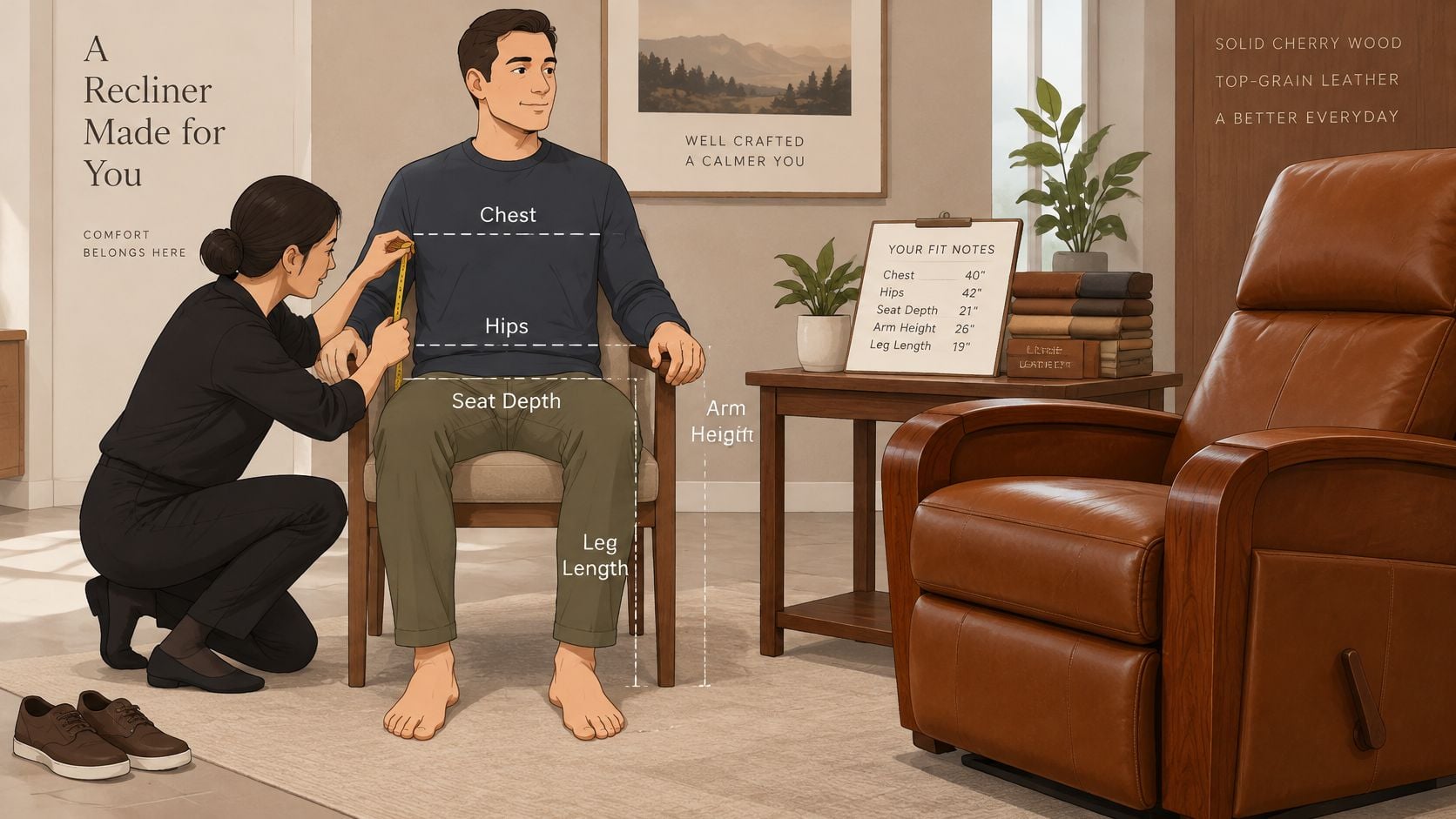
Keep the result practical: write down the size, the feel in all three positions, and whether standing was independent. The Stressless recliner dimensions guide can help organize the sizing questions before a visit.
How to Place the Custom Order
Once the chair size is settled, make the order around the person, the room, and the way the chair will be used. A written spec sheet keeps decisions clear and makes it easier to compare options without choosing upholstery in a hurry.
Name the main sitter and the chair's job. Decide whether it's for evening television, reading, or a nap beside a living-room window. A chair used for long reading sessions may call for different head support and arm positioning than one used mainly for short rests.
Sketch the footprint. Record the chair width, wall distance, and the walkway needed when the footrest is extended. A wall-close mechanism needs less space behind the chair than a traditional recline that travels backward, but both need clear space in front.
Choose manual or power operation. Match the mechanism to the sitter's hand strength and reach. A power control should be easy to operate without twisting, and its position should work from a fully reclined posture.
Specify the frame and seat support. Ask what the frame is made from and how the seat is supported. A kiln-dried hardwood or reinforced frame, with the suspension type specified by the maker, gives the shopper concrete details to compare. Choose a seat that supports the body instead of a cushion that feels pleasant at first but compresses too easily.
Match cushioning and adjustments to long sessions. High-resiliency foam or a pocketed seat can be worth considering for extended use. Note whether the headrest and lumbar support adjust, and make sure those settings work for the primary sitter rather than merely adding features to the spec.
Shortlist upholstery after checking household needs. Put one bespoke fabric and one top-grain leather option on the written ticket. Compare their feel, care instructions, and suitability for the chair's moving parts before settling on a color.
Confirm the order terms. Ask for the current made-to-order lead-time window, what delivery and setup include, and how Special Financing applies to the chosen build. Keep those answers alongside the chair dimensions and upholstery details.
Pro-Tip: Before choosing a power build, confirm that the control sits on the sitter's dominant side and can be reached from full recline without leaning or twisting.
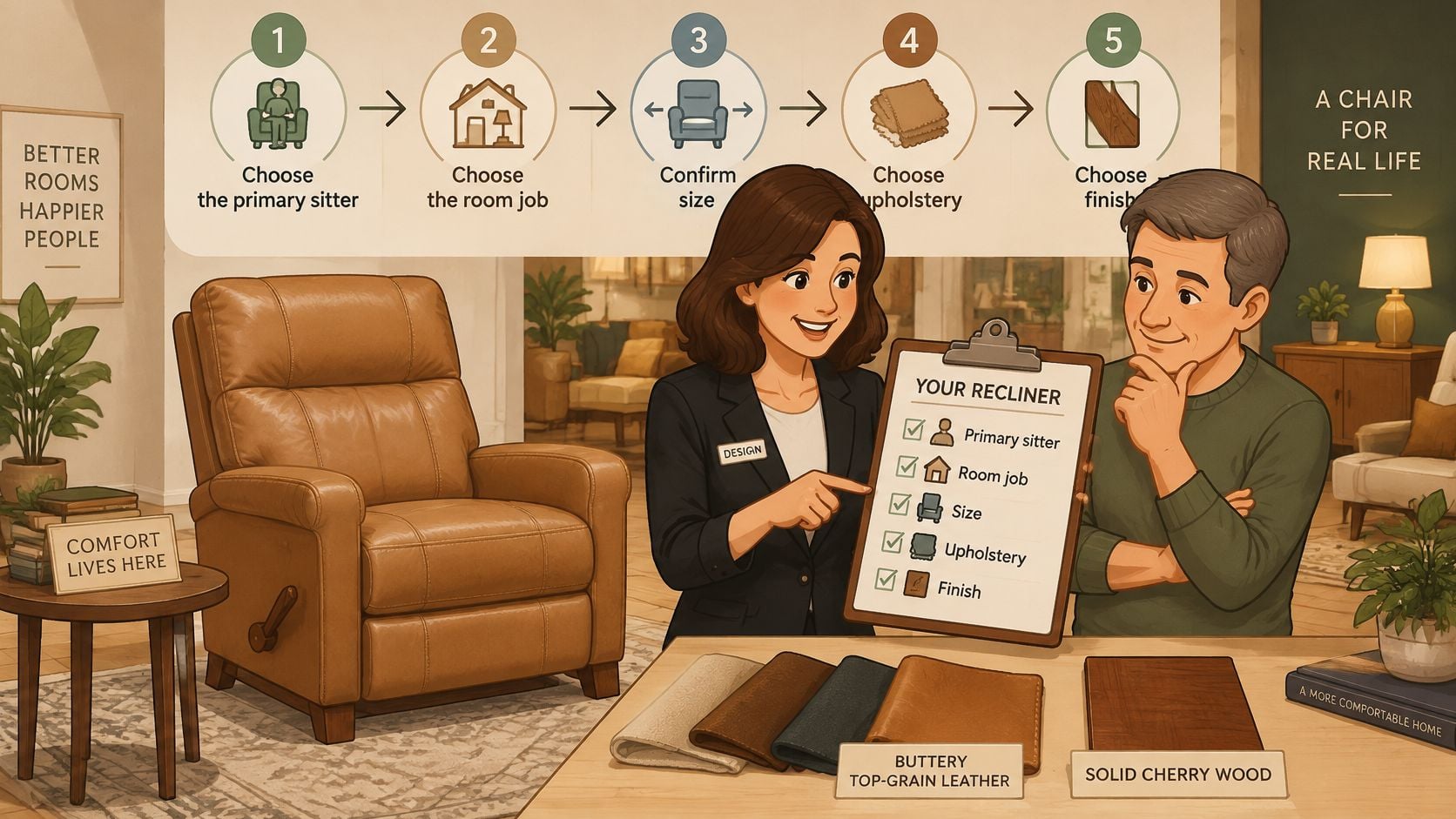
A special order works best when the shopper can review the whole build at once: size, mechanism, cushion, upholstery, and room clearance. The custom-order starting guide offers a place to begin; the final choices should still be written down for the specific chair.
Choose Fabric or Top-Grain Leather
Start with the household, not the swatch. An occasional guest chair, a daily family recliner, and a seat shared with pets face different kinds of wear. Use abrasion ratings as a screening tool, then weigh cleanability, seams, and the places where the recliner moves.
| Upholstery | Use it when | Screening standard | Daily care | Trade-off |
|---|---|---|---|---|
| Light-use decorative fabric | The chair is for occasional guests. | About 15,000 Wyzenbeek double rubs or 20,000 Martindale cycles. | Clean gently according to the fabric code. | A weak choice for pets, children, or all-day TV use. |
| Tightly woven fabric | The chair gets daily family use. | About 30,000 Wyzenbeek double rubs or 40,000 Martindale cycles. | Vacuum, then follow the cleaning code. | Flat tests miss wear at seams, arms, and moving parts. |
| Solution-dyed performance textile | Spills, pets, or strong sunlight are concerns. | Still look for a moderate-to-heavy-use rating. | Blot spills and avoid harsh solvents. | Easy-clean doesn't mean long-lasting. |
| Top-grain leather | The chair is a daily, heirloom-minded purchase. | Judge the hide and finish, not a double-rub number. | Wipe and condition as the maker directs. | Natural marks and patina are part of its character; it isn't stain-proof. |
| Heavily finished leather | A more uniform, wipeable appearance matters. | Finish quality matters more than an unusually high rub count. | Wipe with a damp cloth. | It can feel less natural and may crack if neglected. |
Read the rating in context
The ACT abrasion guidance gives approximately 15,000 Wyzenbeek double rubs or 20,000 Martindale cycles as private or light-use benchmarks, and approximately 30,000 Wyzenbeek double rubs or 40,000 Martindale cycles for heavier-duty applications. Those are separate test methods, not interchangeable units, so compare fabrics only on the method each one reports.
A very high number isn't a service-life guarantee. ACT cautions that results above 100,000 Wyzenbeek double rubs haven't been shown to reliably indicate longer fabric life. The upholstery materials guide can help narrow the material choices, but the order should also account for the weave, backing, seams, snagging, pilling, and edge wear.
An abrasion test doesn't reproduce every point of contact on a recliner. Arms, headrests, footrest hinges, and repeated friction near moving parts can wear differently from a flat test sample.
For pets or children, rank snag resistance and cleanability alongside the rating. A performance cloth may handle spills better than a delicate weave, but harsh cleaners can damage adhesives or fillings, leave rings, or make soil return sooner. “Easy-clean” isn't the same as indestructible.
Before ordering, ask about warranty exclusions, request a spare swatch, confirm the recommended professional-cleaning interval, and check whether the mill approves the fabric for a moving mechanism. Put the spare swatch where afternoon sun reaches the living-room window; showroom lighting on South State Street won't be identical to the light at home.
Plan Delivery, Lead Time and Financing
A custom chair needs a delivery plan as carefully as it needs an upholstery choice. Confirm the written lead-time window after the specifications are set, and ask what could delay the order, such as a special leather, a power component, or a custom fabric. Keep the existing chair in place until the new one arrives so a schedule shift doesn't leave the room without a usable seat.
Measure the route, not just the room
Before delivery day, check the doorway width, stair turns, and the tightest corner between the entry and the chair's final spot. Measure the space where the recliner will sit and the walkway around it, too. A made-to-order chair is built to the selected specifications, so it's sensible to resolve access questions before production rather than assume it can be exchanged like a floor sample.
Ask what the delivery quote includes. Confirm whether the crew will uncarton the chair, place it in the room, and remove packaging. Tyner's local white-glove delivery service details can help clarify the delivery questions to settle before confirming an order.
Compare value by the years of use
A ticket price says what the chair costs now, not what each year of use costs. A straightforward calculation divides the purchase price by the number of years the chair is expected to serve. Durability, repairability, daily comfort, and whether the chair continues to fit the sitter all affect that estimate.
Illustrative example, not a Tyner price: A $1,500 chair used most evenings for 15 years costs about $100 a year. A $900 chair that wears out in 4 years costs $225 a year. The lower starting price doesn't necessarily make the second option the better value.
This is why craftsmanship and fit belong in the cost conversation. A supportive seat, a frame suited to repeated use, and upholstery matched to the household may justify a higher initial outlay if the chair remains comfortable and serviceable longer. The goal isn't to buy the most expensive build; it's to choose a chair whose expected use makes sense for the money.
Treat financing as a deadline to plan around
Special Financing, subject to credit approval, can be considered for showroom pieces and custom orders. Promotional periods commonly run 6, 12, 18, or 24 months, and some offers extend to 60 months. The furniture financing guidance explains why shoppers should check the account terms rather than assume “no interest” means the balance can be carried indefinitely without cost.
Before signing, confirm the promotional end date, how the required monthly payment is calculated, the regular APR after the promotion, late-payment rules, and whether the offer covers custom orders. Calculate a personal payoff date that comes before the promotional deadline, leaving room for a payment to post late or for a household expense to interrupt the plan.
For a plain-language explanation of borrowing with set payments, the NextStopLoans guide to installment borrowing can help shoppers understand how repayment schedules work. It's a general learning resource, not a replacement for reading the specific financing agreement.
Use the Low Price Promise as a value check, then compare the full written quote, expected years of use, and planned payoff date. Financing can spread a purchase across payments, but it shouldn't decide whether the chair fits the body or the budget.
Book the Ann Arbor Sit Test
A custom order is easier to judge when the person who'll use the chair can sit in it. At the Ann Arbor showroom on South State Street, shoppers can repeat the fit check in upright, TV, and full recline, then compare shortlisted fabric and top-grain leather by hand. The buttery feel of leather and the texture of a woven fabric are details that a screen can't fully convey.
Tyner Furniture has served Southeast Michigan since 1957, guiding households through furniture choices that include ergonomic recliners and made-to-order upholstery. A written spec can capture the chair's size, mechanism, cushion, selected material, and current lead time so the order reflects the decisions that matter in the home.
The local legacy reaches beyond the living room, from the Home Office to Outdoor Spaces. Canadel customization offers made-to-order options for the dining room, and hand-crafted Amish furniture gives shoppers a solid-wood choice for pieces where material integrity and joinery matter. For questions about recliner support before a visit, the back-support recliner guide provides another starting point.
If a showroom visit has to wait, online Quick Specs can help start a special order. Before paying a deposit, use three checks: standing is steady, the feet stay supported, and the upholstery suits the way the household lives. If any check fails, change the size or material before financing and production, not after the chair has been built.
Visit Tyner Furniture on South State Street for a recliner sit test, or start with online Quick Specs for a made-to-order option. Bring the sitter's measurements and room notes so the conversation can focus on fit, materials, and long-term value.