Customer Order Process at Tyner: A Step-by-Step Guide

The sofa looks right online, but the fabric sample looks different beside the living-room curtains. The dining table fits the room on paper, yet the stair turn hasn't been measured. Then comes the deposit, along with a question that deserves a clear answer: what happens if something changes?
A good customer order process makes those decisions visible before money and manufacturing commitments lock them in. For an Ann Arbor household choosing made-to-order furniture, the priority isn't placing an order. It's getting the right configuration, a workable payment plan, and a piece that belongs in the home for years.
Seven Stages of a Custom Order at Tyner
A custom order moves through seven stages, from setting the brief to requesting service. Each stage has a decision and an approval point. The table gives you a clear view of where details need to be settled.
| Stage | Decision you make | What you receive | Sign-off point |
|---|---|---|---|
| Consultation and vision | Lifestyle, style goals and room needs | Creative direction, material palette, initial layouts | Agree on the brief |
| Materials and finishes | Upholstery, wood species, stain, configuration | Swatches and configuration options | Approve swatches and finish |
| Measurement and sizing | Dimensions, recliner size, delivery access | Specification with measurements and quote | Sign the written specification |
| Deposit and timeline | Minimum deposit and financing choice | Itemized price and estimated arrival | Pay deposit and accept lead-time estimate |
| Production | Whether to proceed with the approved order | Factory status information, as available | Confirm any proposed changes and their price and timing |
| Delivery | Delivery arrangements and room placement | Furniture brought to the home | Inspect and accept delivery |
| Aftercare | Whether service is needed | Support for a product question or service request | Contact support for service |
Late changes often begin with an unclear specification. A measurement, configuration, or finish that remains undecided can affect the order after other choices have been approved. Keep one written specification as the reference for dimensions, selected options, pricing, and sign-offs.
APQC's perfect-order definition includes taking an order correctly, delivering it on time, and invoicing accurately. A custom order also depends on matching the approved finish and configuration, so the paperwork and product details need to agree.
For households coordinating furniture with broader interior design work, Sumana Kumar's project timeline explained offers a companion perspective on project sequencing.
Tyner Furniture has served Southeast Michigan since 1957. Clear decisions at each sign-off point help keep the order aligned with the approved specification.
Start With a Consultation That Sets Your Brief
A sofa that looks right in a photo may still be awkward for someone who has trouble standing, or too large for the room. Start the consultation with the people who will use the furniture, the room it must fit, and any existing pieces that need to stay.
Customers can request a design consultation online or stop by the showroom. Sales associates can also help place an order during operating hours.

Turn preferences into working requirements
Tyner's Vision & Customization stage explores lifestyle, aesthetic goals, and functional needs, then develops creative direction, material palettes, and initial spatial layouts. Bring room dimensions, photos of the walls and windows near the furniture, seating needs, and details of pieces that must coexist with the purchase.
Before the meeting, clarify who uses the space, how long they sit, and what support they need. A conversation chair and an evening reading chair may call for different comfort choices. Also describe how far the design can depart from the display model, such as changing the cover or configuration.
For households planning furniture alongside kitchen improvements, kitchen planning for Cherry Hill homeowners offers a related perspective on setting project requirements.
Pro-Tip: Bring fabric, flooring, and wood samples from home. Compare them together under the room's usual lighting before settling on a color.
A showroom visit lets you assess details a photograph cannot show, such as pressure against a sofa arm, support beneath the thighs, or the feel of a tabletop. A good written brief ends with must-haves, nice-to-haves, and deal-breakers.
Pick Materials, Finishes and Configurations
In-stock is just the beginning. Canadel's bespoke dining options combine leg styles, table edges, finishes, and distress levels into thousands of configurations. The practical trade-off is straightforward: more choice creates a better opportunity for fit, but every selected option needs a place on the quotation.
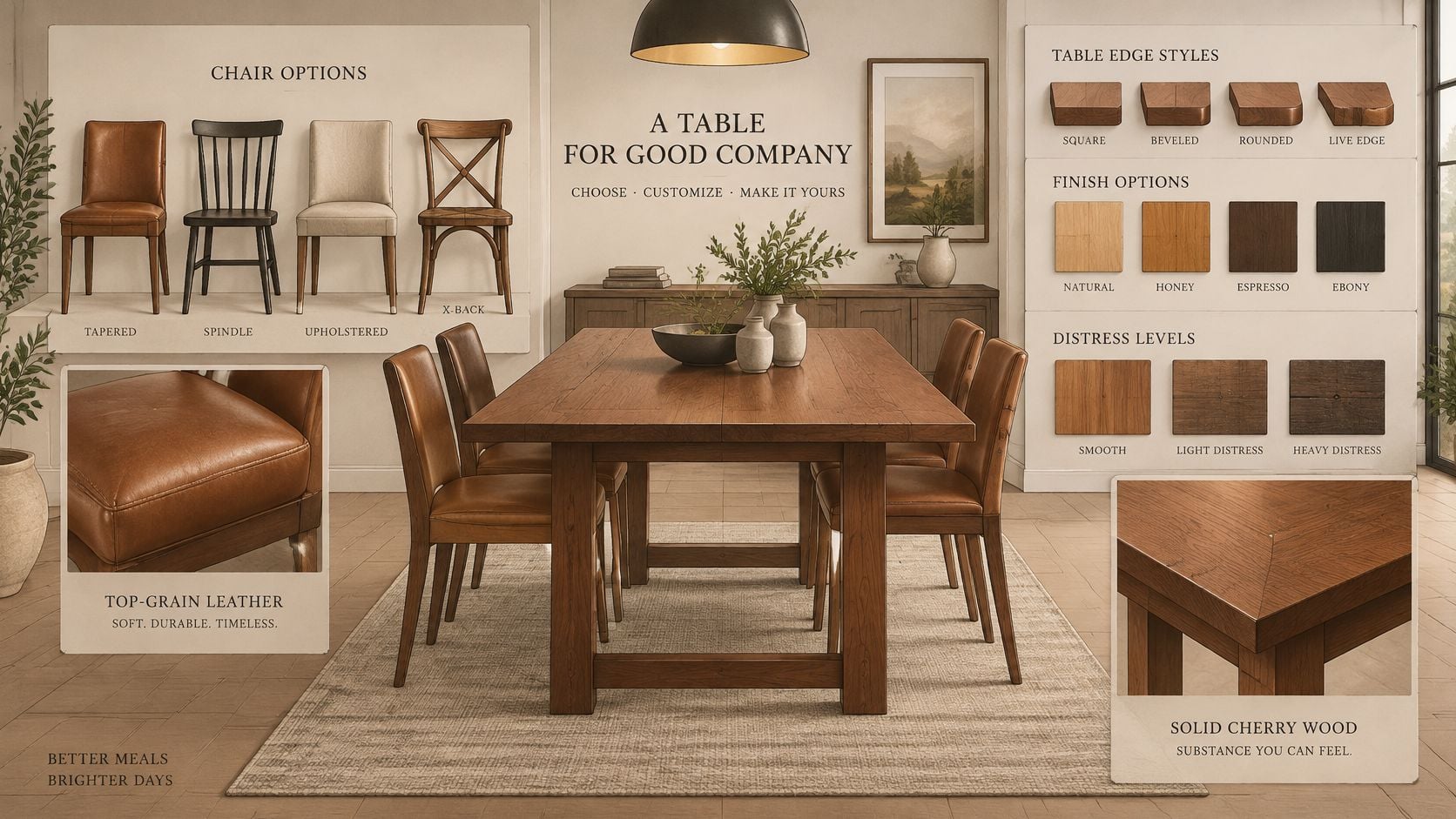
Stressless's materials guide describes matching covers across recliners, sofas, dining chairs, and home-office chairs, or contrasting textures in coordinated colors; it also states that selected fabrics receive heavy-duty-use and flameproofing treatments. Those treatment claims apply to the specified materials, not upholstery generally.
Compare construction, not just appearance
For bedroom and dining furniture, Tyner's Amish hand-crafted solid North American hardwood pieces provide a meaningful contrast with mass-produced veneer alternatives. Cherry, oak, and maple have material character throughout the solid component; veneer is a surface layer over a substrate and shouldn't be mistaken for solid hardwood.
Neither a solid-wood label nor a decorative joint alone proves durability. Joint fit, construction, finish quality, and repairability deserve attention. Furniture-frame engineering research measured average moment capacity of 204 Nm for mortise-and-tenon joints versus 154 Nm for dowel joints under its test conditions, supporting attention to joinery without promising a particular lifespan.
Specification checklist
- Wood species and stain: Record both, including any approved distressing.
- Upholstery grade: Identify the exact fabric or top-grain leather code, not merely a color name.
- Firmness: Confirm the selected cushion or support option where offered.
- Ergonomic size: Record Small, Medium, or Large for the applicable recliner.
- Configuration: Include orientation, components, and any selected mechanisms.
The buttery feel of top-grain leather and the visible grain of stained oak help narrow preferences, but material grade, species, and configuration can change the quoted price. Tyner's upholstery materials guide helps distinguish the choices.
Finish check: A stain sample belongs beside the wall paint in daylight and lamp light before approval.
An heirloom purchase should be evaluated through cost-per-year, craftsmanship, and care needs. A sustainable purchasing approach favors a piece the household can maintain and keep, without treating an unverified lifespan as a guarantee. More customization requires more checks before sign-off.
Measure and Sign Off Your Specification
A room can accommodate a sofa that the staircase cannot. Approving overall dimensions while overlooking a doorway or stair turn is a particularly consequential mistake because the problem may not become obvious until delivery.
Tyner's furniture measurement guide provides a starting point. A tape measure, painter's tape, and a written access sketch turn that information into a usable delivery plan.
Check the route and the sitter
- Measure the entire route. Record doorway openings, hallway widths, stair turns, landings, ceiling restrictions, and the lift path. Handles, railings, and low lights can reduce usable clearance.
- Tape the furniture footprint. Mark the floor and walk around it with nearby doors open. Include the operating space for a recliner, not just its closed dimensions.
- Fit the person. Note the intended sitter's leg length and compare seat height, seat depth, foot support, and ease of standing. A showroom display size isn't automatically the right size.
- Reconcile the specification. Check dimensions, wood species, stain, upholstery code, configuration, price, deposit, lead-time assumptions, cancellation terms, and delivery access.
- Approve a controlled version. Sign only when the written details match the selected piece and measured route. Later changes need written authorization and a fresh price and lead-time review.
The useful final test is whether the piece can reach its intended position without an unplanned door removal or an unsafe turn.
Tyner requires the delivery area to remain free and clear of obstructions. If the customer can't attend, a responsible person must be present to sign.
Special-order merchandise is not returnable and is repaired rather than exchanged or reordered. That makes the pre-order specification review the least costly opportunity to correct an unsuitable selection, rather than relying on a later change of mind.
Any uncertainty about removable legs, disassembly, or access should be resolved before approval. A diagonal measurement alone doesn't establish that a large upholstered piece can negotiate a tight turn.
Deposits, Financing and Cancellation Rules
Deposit, cancellation and financing rules for special orders
| Situation | Rule | What to do |
|---|---|---|
| Minimum deposit | Required on all orders | Plan for it at signing |
| Balance due | Paid in full before pick-up or delivery, except when financing | Confirm which applies to the order |
| Cancelling a placed special order | Not permitted once placed | Resolve the specification before signing |
| Return or cancel after payment | A 25% restocking fee on the entire sale applies where a return or cancellation is authorized | Don't treat the fee as permission to cancel |
| Long delay, not yet in production | Full refund on undeliverable merchandise if it can be cancelled with the factory | Request written notice of the delay |
| Deferred-interest financing | Finance charges may be waived only if the balance is paid by the payoff date | Record the deadline and set reminders |
The restocking provision doesn't override the restriction on cancelling placed special orders. Written clarification from Tyner is important before treating any exception as available.
What a missed payoff date can cost
Under the Consumer Financial Protection Bureau's deferred-interest regulation, finance charges may be waived or refunded when the balance is paid in full by the specified date. No interest doesn't necessarily mean permanently interest-free credit.
Consider an illustrative example, not a Tyner offer: a $3,000 sofa on a 12-month deferred-interest promotion with an assumed 26.99% APR. Full repayment by the deadline would mean $3,000 total if interest is waived and no other fees apply. If $50 remains, the agreement could trigger accrued interest back to the purchase date.
For scale, $3,000 × 26.99% is $809.70, roughly $800 over a full year if that entire balance remained outstanding. Actual deferred interest depends on balance history and contract terms; a declining balance won't necessarily produce that charge.
Special Financing is subject to credit approval. Tyner's furniture financing guide supports comparing repayment terms, while the Low Price Promise offers a price check on comparable pieces before commitment.
Payment safeguard: Obtain the payoff date in writing and set two reminders, including one early enough to resolve a failed payment.
Before signing, the household should confirm:
- Affordability: Does repayment fit after essential expenses?
- Total cost: What are the cash price, financed total, and applicable fees?
- Timing: When does repayment begin if delivery is delayed?
- Contract consequences: What happens after a missed deadline or an authorized cancellation?
A long-term investment shouldn't depend on a payment schedule that leaves no room for ordinary household surprises.
Production, Delivery and Aftercare Explained
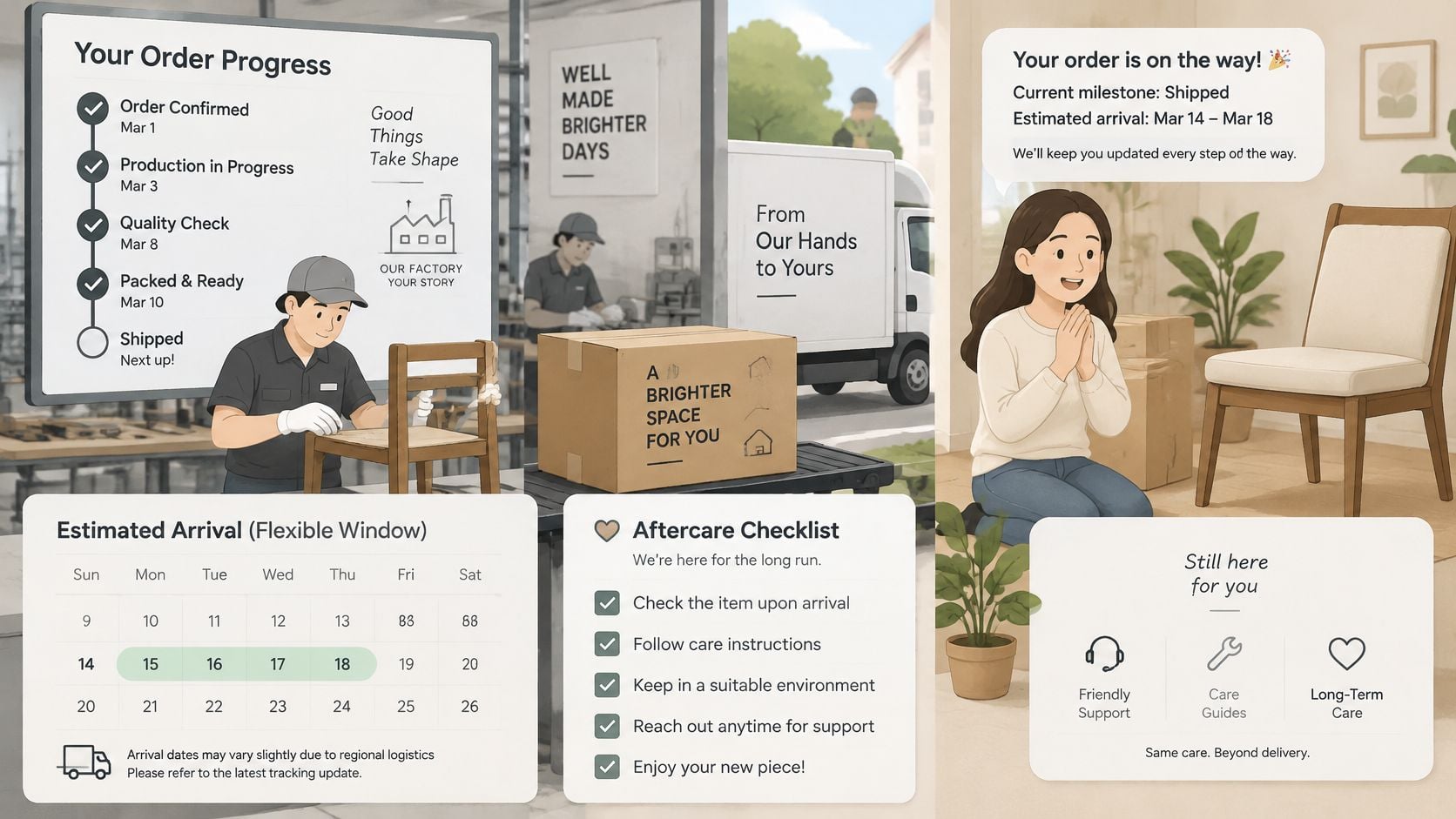
After signing, the waiting period should have identifiable milestones. Special-order arrival dates are estimates based on factory information, and actual delivery may differ. Written lead-time assumptions, factory acknowledgment, production progress when available, and delivery scheduling are more useful than treating an estimated date as guaranteed.
Tyner's Sourcing & Procurement work includes ordering, scheduling, and quality inspections for furniture, custom upholstery, textiles, and accent lighting. The customer should request confirmation of what was inspected and whether any unresolved exception affects the order.
Delivery acceptance needs attention
Tyner carefully disassembles merchandise as needed and loads the truck in reverse delivery order. The crew visits each routed address once until scheduled deliveries are complete, making readiness at the appointment important. The white-glove delivery service guide provides delivery context.
For separately purchased decorative accessories, households should also check the seller's shipping terms. For example, customers buying coordinating textiles can check cashmere shipping details at Cashmere Boutique rather than assuming those purchases follow the furniture schedule.
Delivery photo checklist: Photograph each piece, identifying labels, packaging condition, and any visible damage before the crew leaves. Record concerns on the delivery paperwork and contact the store promptly.
Tyner's general satisfaction guarantee allows an exchange for merchandise of equal or greater value or a 75% credit when the store is notified within 2 days of delivery; bedding is excluded. That general guarantee shouldn't be assumed to override special-order restrictions. Accepting bedding finalizes its sale, with no pick-ups, returns, or refunds.
Care and service after arrival
Solid wood benefits from protection against direct sun, standing moisture, and hot objects. Coasters help protect the finish; leather conditioning should follow the specific leather manufacturer's care directions rather than an arbitrary schedule.
- Transportable components: Unattached cushions, pillows, and removable drawers must go to the service department for repair.
- Product concerns: Customers can submit Tyner's service request form for a support response.
- Schedule changes: Delivery or service changes should be communicated promptly, not left until the crew arrives.
If a long delay leaves merchandise outside production and the factory permits cancellation, the undeliverable merchandise qualifies for the stated full-refund exception. Written notice helps establish exactly what has changed.
Book a Sit Test or Browse Quick Specs
A recliner's fit depends on the person who will use it. During a showroom visit, sit in the model and check the support, arm height, and effort needed to stand. Tyner Furniture offers a Custom Order option, so customers can also ask about configurations suited to their room and preferences.
Two ways to move forward
- Visit the showroom: Bring a room brief or a measured sketch to discuss your needs with a sales associate.
- Start online: Use the Custom Order section on Tyner Furniture's website to explore custom options.
For questions about an existing order, delivery scheduling, service appointments, or delay updates, call 734-995-3900. A measured sketch is a practical next step before discussing a configuration.
Tyner Furniture offers custom-order guidance and material selection to help customers develop a furniture order. Visit Tyner Furniture to explore the Custom Order section or request a design consultation.