Custom Upholstery Seats: How to Order Well

Somewhere in a Southeast Michigan living room there's a sofa with a sound frame, tired cushions, and a fabric decision made in a hurry ten years ago. The frame is fine. The springs are fine. What failed was the layer everyone looked at first.
That's the usual pattern with custom upholstery seats. The piece that disappoints is rarely badly built. It's built to the wrong brief: soft foam where the household needed density, a gorgeous weave where the household needed cleanability, a color chosen under showroom light that later met a west-facing window. Ordering well is a skill, and it's learnable in about an afternoon.
How to Order a Custom Upholstered Seat
An upholstered seat is a stack of decisions before it is a piece of furniture. Padding, springs, webbing, filling, and cover each do a separate job, and the Museum of Fine Arts, Boston conservation record documents a chair where the webbing had failed, the seat edges had collapsed, and the filling had dropped through the underside.
Conservators installed new internal frames, attached new webbing to carry the springs, and finished the work with a custom-woven green damask. Examination then found the visible green silk velvet was already the third-generation cover, with fragments of the original satin-weave silk still sitting beneath it. Three covers, one frame, and the frame was never the problem.
Keep that picture beside the order form the whole way through. A seat is a frame plus a renewable cover, and the cover you choose this year is the layer someone will replace a decade or two from now. Order with that in mind and the abrasion number settles into its proper place as one input among fiber, cleanability, foam density, and edge wear.
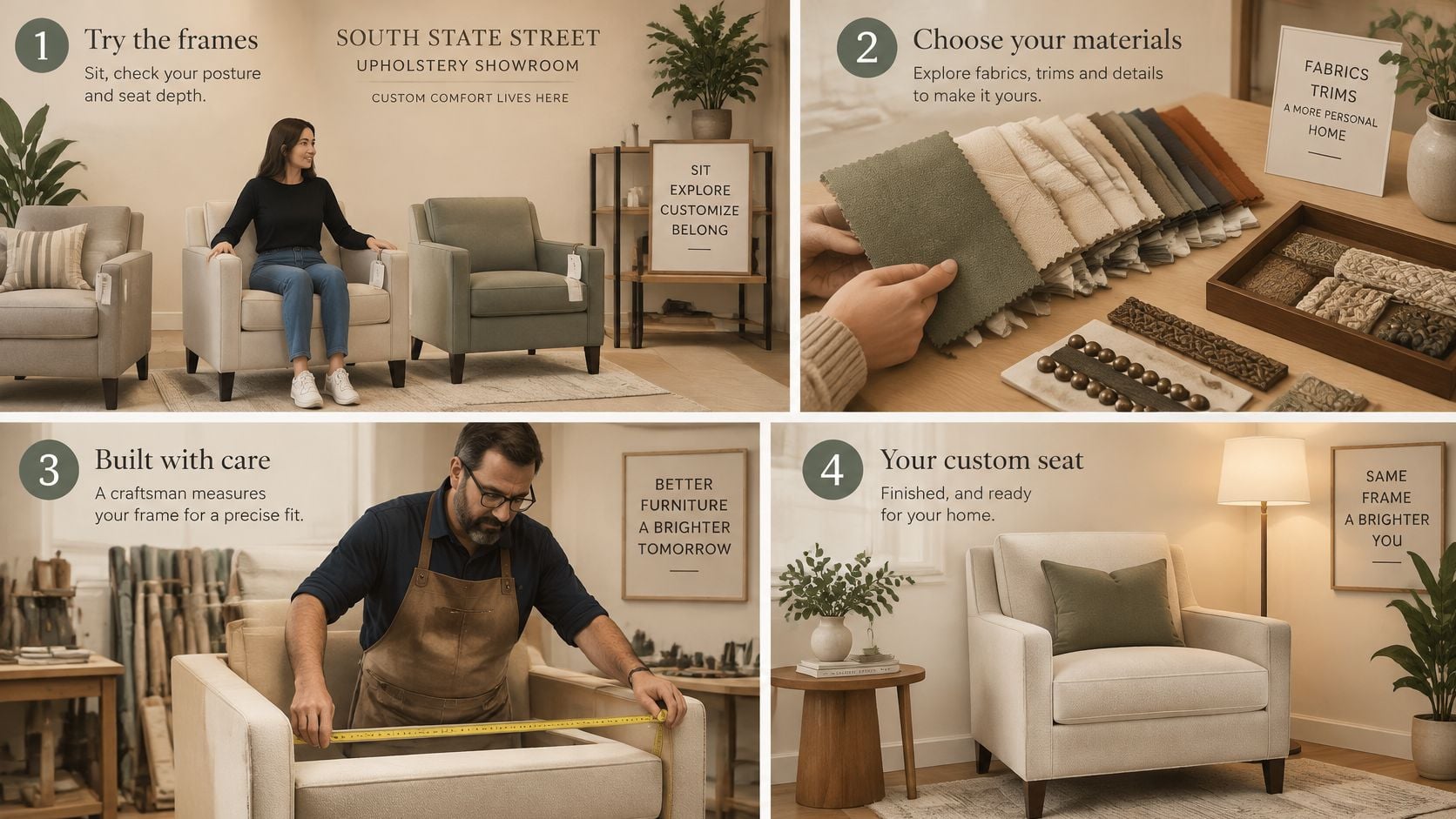
Seven Steps From First Sit to Delivery Day
- Sit before you specify. Spend real time on the Ann Arbor showroom floor with the actual candidates, noting posture, seat depth, and whether the true brief is a sofa, a sectional, a chair, or a recliner. When a recliner is the answer, Stressless builds its seats in Small, Medium, and Large so the frame fits the sitter instead of asking the sitter to adapt.
- Measure the room and the people. Record doorway clearance, finished seat height after the foam compresses, seat depth for the shortest and tallest person in the house, and where the front edge lands behind the knee. A seat two inches too deep is a seat nobody chooses twice.
- Choose the cover from a production sample, not a screen. In-stock is only the beginning, because finishes, fabrics, and configurations can be customized, including Canadel and Stressless pieces. Weigh top-grain leather against a performance weave on grain, hide variation, hand-feel, and how each handles that specific room's sunlight and pets, and read the cleaning code before falling for the color.
- Write the cushion build down. Density, firmness, wrap, and orientation belong on the sheet as numbers, not adjectives, because the workshop sews to the sheet and not to the conversation.
- Confirm configuration, finish, and customization, then ask the design team to read the order back. Reading it aloud catches the swapped arm style and the mismatched welt far more reliably than a signature does.
- Get the production window in writing. Made-to-order seating typically runs from several weeks to a few months, and the design team can tell you which frame, hide, or mill availability is driving your date. A floor sample's availability is not the custom date.
- Plan the arrival. Tyner Furniture blanket-wraps each piece and covers upholstery with plastic before delivery, and customer pick-up by appointment is available when a delivery window gets awkward.
What Should Be on Paper Before You Say Yes
Five items carry the whole order: the sample name and colorway, the foam specification with density and firmness, the finished dimensions including seat height after compression, the price as configured, and the lead time.
Dimension decisions get easier with a clearance guide beside the tape measure. The mnml.ai walkthrough of furniture clearances and seating placement covers walkway widths, sight lines, and how far a chair should sit from a traffic path, which is the part often estimated by guess. Tyner Furniture's customer order process shows how those five items move from a floor conversation into a confirmed specification.
Specs That Predict How Custom Seats Age
Two swatches can look equally handsome under showroom light and behave nothing alike two winters later. The variable that separates them is how the seat will be used. A formal chair that holds a book for an hour a day asks less of a cover than a family sofa that absorbs movie nights, pet traffic, and the occasional fort-building session.
The table below turns that idea into a shopping filter, so the conversation moves from prestige to fit. Read across a row to see which specification should win when the sales floor presents a trade-off.
| Household use | Abrasion benchmark | Foam direction | Let this win if specs conflict |
|---|---|---|---|
| Occasional chair or formal seat | Private-use benchmark; breathability and repairability can matter more than a higher count | Everyday residential density, confirmed in writing | Breathability, hand-feel, and repairability |
| Daily living-room sofa or chair | Private-use benchmark, with headroom for steady traffic | Density suited to daily use, confirmed in writing | Cleanability plus density, not softness alone |
| Pets, children, or dining-height seating | Heavier-use benchmark | Higher-density foam and firm edge support | Cleaning code, seam strength, and pilling resistance |
| High-use recliner or power seat | Heavier-use benchmark because friction and long sitting accelerate wear | Higher-density foam rated for heavier duty | Edge wear, cushion recovery, and a sit test in the actual size |
The Two Abrasion Tests Aren't Interchangeable
The Association for Contract Textiles publishes the benchmark most mills quote, and its performance guidelines for woven indoor upholstery put private and lower-traffic applications at roughly 15,000 Wyzenbeek double rubs or 20,000 Martindale cycles, with heavier commercial use around 30,000 Wyzenbeek or 40,000 Martindale. The methods measure differently: Wyzenbeek drags cotton duck across the fabric along warp and weft, while Martindale uses a wool abradant in an oscillating figure-eight. A Martindale result cannot be swapped for a Wyzenbeek result in a conversation, and treating 20,000 on one test as equal to 20,000 on the other is the most common arithmetic error in fabric selection.
A rub count works like a forecast: it suggests the likelihood of wear, not the exact day the fabric will fail.
What Flat Abrasion Cannot See
Foam density and firmness get confused in the same conversation. Density measures mass per cubic foot and predicts how long a cushion resists permanent breakdown. Firmness predicts how it feels on delivery day. A soft high-density cushion can outlast a firm low-density one, which is why the table pairs a density direction with the abrasion benchmark rather than treating the rub count as the whole decision. That is also why a cover you can replace and a frame a shop can service make a seat a repairable investment rather than a one-time fabric choice.
The cleaning routine often decides more than the rub count. ACT's guidance notes that lab flat-abrasion tests do not account for edge wear or all application variables.
Bring this checklist to a consultation and the conversation gets specific fast:
- Fiber content, named exactly, not "performance polyester."
- Test method and load, so the number means something.
- Cleaning code, matched to what the household will realistically do on a Saturday.
- Lightfastness, especially for a room with afternoon sun.
- Seam slippage and pilling results, which matter more than rub counts in homes with children and pets.
- Whether protection lives in the fiber or sits on it as a finish, because the two age differently.
A lower-rated textile with better breathability, better cleaning behavior, and a weave that ages gracefully can be the better choice for a formal living room. The rub count narrows the field; cleanability, seam strength, and repairability decide. For a side-by-side look at fiber types and how each ages under real household traffic, Tyner Furniture's guide to choosing the best fabric for sofa upholstery pairs weaves with the rooms they suit.
Frames Foam and Fit That Hold Their Shape
A seat that sags after two years usually lost its shape at the frame or in the cushion core. The fabric rarely gets a vote. Run a hand along the underside of a candidate frame before you sit on it. Stapled cardboard and particleboard rails tell you the piece has no second life, which matters if you intend to recover it once the household traffic changes. A frame worth recovering has real corner blocks, glue, and joinery that survives being stripped to bare wood.
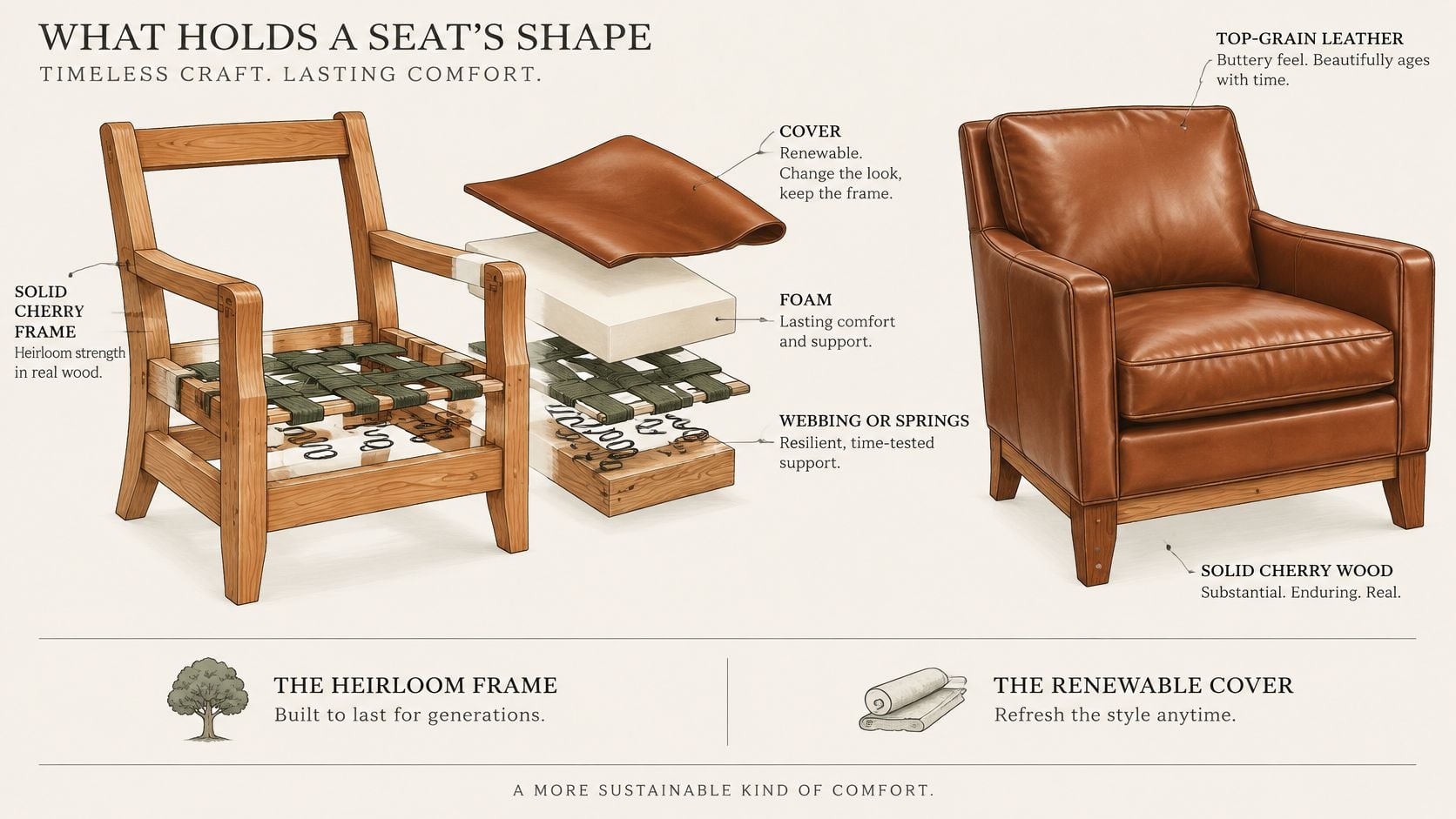
Then look up under the deck. Webbing and sinuous springs should be anchored to a rail rather than stapled into a thin panel, and the deck itself should be taut enough to hold the cushion instead of letting filling sift down through the gaps. Ask whether a local shop can replace those springs later. If the answer is no, the frame has already decided how long the seat lasts.
The Cushion Build, in Order
Plain language beats a spec sheet here, because the order of these decisions is what keeps a seat looking new in year five.
- Measure the finished cushion envelope. The foam needs a defined space, otherwise the cover fights the core and wrinkles win.
- Set the target seat height after compression. Foam settles under a sitter, so the height that matters is the height on a Tuesday night, not the height on the showroom floor.
- Choose density first and firmness second, working from the ranges in the table above. Confirm the density figure in writing rather than judging by feel, because two foams can feel identical for a month and diverge sharply in year three.
- Add a fiber or down-blend wrap only if it won't collapse the intended height. A wrap that swallows an inch of seat height has changed the ergonomics of the whole piece.
- Confirm the cover pattern preserves those dimensions after sewing. Welt, seams, and pattern matching all consume fabric, and a tight envelope on a dense core is how covers wrinkle.
- Specify front-edge support wherever people sit near the edge, which includes dining-height chairs, lift chairs, and any recliner someone uses to stand up.
Why Density and Firmness Get Confused
Density is weight per unit of volume. Firmness is how hard the foam pushes back. A dense foam can feel soft, and a firm foam can be light, so the two figures have to be written separately or the workshop is guessing at one of them.
Early cushion failures tend to trace back to a short list of causes: very soft low-density foam used in a primary seat, firmness chosen with no density check, foam compressed into an undersized cover, and no edge support at all. Each of those is cheap to correct on the order and expensive to correct after the cushion is sewn shut.
Ask for the cushion in numbers. A written foam specification, finished dimensions, cushion orientation, and a sit test with the actual person who will use the seat daily. Feel is the test, but the number is what the workshop builds.
Tyner Furniture's custom upholstery cushions work follows that paper trail, and any remaining seat-height question can be settled in person at the Ann Arbor showroom before the order closes. Keep the cover's construction notes with the receipt. Whoever re-covers the piece in fifteen years will want the seam allowance and the pattern name.
When High Ratings Still Disappoint
A household orders a sofa with a strong double-rub label and calls a year later about a front edge that has gone soft. The fabric has not failed. The seat has. That gap between a lab rating and daily life is the main source of disappointment in custom upholstery. The rub-count discussion earlier explains why the number alone cannot promise a longer life. The next step is to catch the mismatch before production, while the cover is still a specification rather than a finished piece.
| What you notice | Usual cause | What to change |
|---|---|---|
| Cover wrinkles within months | Low-density foam or a cover cut too tight | Rewrite density, firmness, and finished dimensions |
| Front edge sags or bites behind the knee | Soft foam and no edge support | Specify a firmer edge and sit-test height after compression |
| Arm caps or front rail wear first | Abrasion test ignored edges | Mock up those points and choose a tougher textile there |
| Pilling or seams opening | Weave and seam not matched to traffic | Ask for slippage and pilling results before ordering |
| Color shift near a window | Lightfastness never checked | Match hide or fabric to the room's sun exposure |
A Front Edge That Fails After a Year
Consider a recliner used by someone who pushes off the front rail to stand. That rail takes repeated load, not the middle of the seat. A soft foam core with no edge support compresses there first. Within a year the cover looks loose and the rail bites behind the knee. The fix is not a tougher leather. It is a firmer edge, a denser core, and a sit test at the height the seat reaches after compression. Dining-height chairs and lift chairs follow the same pattern because the edge carries more load than the back.
Pilling, seam slippage, and color shift follow a similar logic. Each symptom points to a different decision: weave and seam construction for pilling, lightfastness for a sunny room, and fiber content for a household that cleans often. The specification sheet is where each cause gets an answer.
Ask What's Inside the Seat
A compliance label isn't a materials list. Upholstered furniture sold in the United States must satisfy the CPSC's upholstered furniture requirements under TB 117-2013, which covers cover fabric, filling, barrier, and decking materials and tests char length, smoldering, and transition to open flaming. The federal rule does not prescribe a chemical composition, and it neither requires nor prohibits flame-retardant chemicals.
Four questions close that gap. What are the filling and barrier materials? Were flame retardants added? Which third-party certifications apply? Is stain resistance built into the fiber or applied as a finish? Ask for the answers in writing so the order sheet carries them to the workshop.
The decision rule is simple. If the sample cannot survive the room's real edges, real pets, and real light, change the textile before production. After delivery, the same conversation becomes a repair bill. Judge the order as a repairable investment: match fiber to cleanability, foam density to daily load, and edge support to how people get up. A high rating on one line item will not rescue a seat where those decisions disagree.
Lead Time Cost per Year and Financing
A custom seat's price makes more sense when considered alongside how long it may serve the household. For a useful comparison, divide the purchase price by the number of years you expect to use it. This is a planning estimate, not a guarantee: fabric, cushion condition, frame quality, and the possibility of future repairs all affect the result.
Reupholstery is an established service sector. According to the Federal Reserve Bank of St. Louis series on U.S. reupholstery and furniture repair receipts, the sector generated about $1.365 billion in annual receipts in 2024, up from roughly $1.043 billion in 2020. Those figures show the scale of the service market; they do not explain why households use it.
Longevity Isn't Automatically the Lowest Impact
Durability deserves a caveat. A peer-reviewed study of 25 office and household furniture pieces, published in Scientific Reports, found that producing 1.4 shorter-lived chairs had lower impacts across every measured category than producing one durable chair, despite requiring 40% more anticipated material. Material quantity, finishes, adhesives, manufacturing, and end of life all matter.
The practical takeaway is to specify what the household will use. A second set of cushions adds little value if nobody will rotate them, while durability features make sense when daily use is likely to test them.
What Moves Both the Price and the Calendar
- Frame construction, since materials and construction choices affect the finished piece.
- Cover material, which can shift the price depending on the fabric or leather selected.
- Foam and cushion options, including added fill or different cushion configurations.
- Extra cushions and bolsters, which can be included in the custom order.
- Unusual dimensions, which may require a pattern made for the specific piece.
- Material availability, which can affect the production window.
Ask for the estimated production window in writing, along with the factors that could change it, such as material availability or a revised measurement. A timeline is more useful when its dependencies are clear.
Ask about the lead time twice. A written estimate gives you a date to plan around; a clear explanation of what could shift it makes that date easier to assess.
Paying for It Without Pretending It's Cheap
Special financing, subject to credit approval, may spread a purchase across monthly payments. Promotional periods may be available, and financing can apply to floor models as well as custom orders. Tyner Furniture's furniture financing options explain the available terms. Its Low Price Promise offers a way to compare value, provided the specifications match; quotes built around different materials or construction are not like-for-like.
Try a simple cost-per-year calculation with your own numbers: divide the seat's price by the years you expect to use it. For example, a $2,000 seat used for 10 years works out to $200 per year. Adjust the estimate if you expect a repair or re-cover, and choose a monthly payment that fits your budget.
Book a Sit Test on South State Street
A useful showroom conversation starts with three things: the room's dimensions, photos showing its natural light, and a short list of who will use the seat. Those details help narrow the choices without repeating the fabric, foam, and fit decisions covered earlier.
At Tyner Furniture's Ann Arbor showroom, you can discuss custom options with the design team or request a consultation online. The website's Custom Order section is another place to review available options. Tyner has served Southeast Michigan since 1957.
If back or neck comfort is part of the decision, read about Tyner Furniture's ergonomic seating solutions before your visit. For a wider room project, Tyner also offers full-service interior design. Its final design step is a coordinated white-glove installation, with upholstery covered in plastic and each piece blanket-wrapped for delivery.
Bring the room measurements, a few photos, and the names of the people who will use the seat. Then book a consultation online or stop by the showroom to discuss your vision and explore custom options.
Custom upholstery is easier to choose when the conversation starts with how the seat will be used. Visit Tyner Furniture to plan a showroom visit or begin a custom order.