Amish Furniture Rockers: Buyer’s Guide for Lasting Comfort


The reading lamp is in place, the blanket is folded, and the empty corner still needs the right chair. A rocker looks promising online, but a photograph can't reveal whether its arms lift the sitter's shoulders, its seat presses behind the knees, or its rails move smoothly across the floor.
Amish furniture rockers deserve separate evaluations for craftsmanship, comfort, and safety. A beautifully fitted wooden frame can still be wrong for a particular body. The best purchase combines sound construction with suitable proportions, controlled motion, and care that respects how solid wood behaves in a Southeast Michigan home.
What Makes an Amish Rocker Different
Consider a typical showroom comparison. A shopper settles into a mass-produced rocker that clicks at the arms and sways unevenly, then tries a hand-crafted chair whose rails move smoothly and predictably. The difference invites a closer inspection, but neither the smooth motion nor the traditional appearance proves how either chair was built.
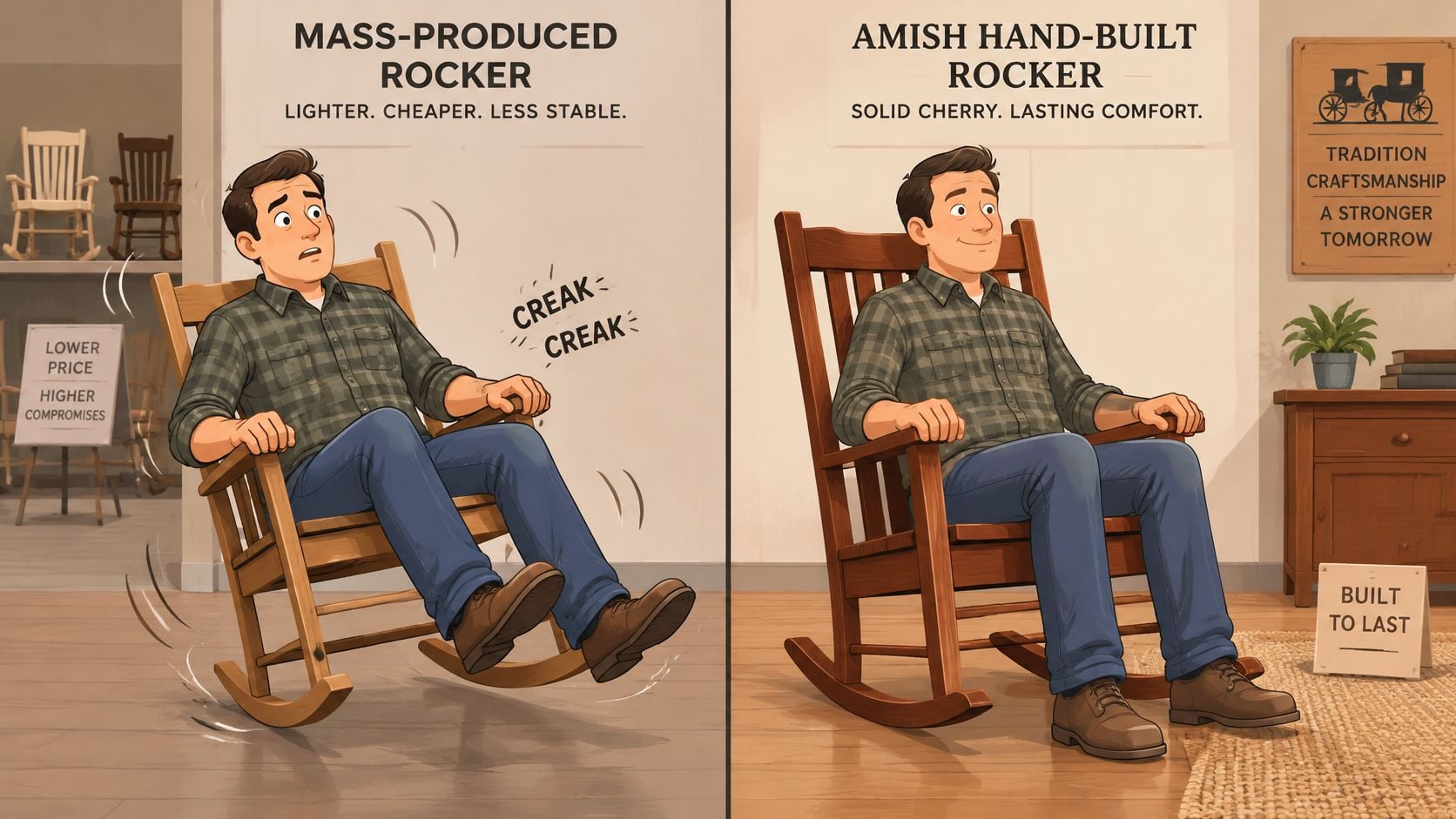
An Amish rocker generally belongs to a furniture-making tradition associated with small, family-oriented workshops, usually using solid hardwood and often offering made-to-order choices. Amish and Mennonite woodworking share historical connections, although buyers should confirm the actual maker rather than treating those identities as interchangeable.
A Tradition Rather Than a Fixed Style
The Global Anabaptist Mennonite Encyclopedia's furniture history documents handcrafted furniture-making continuing through the 1980s, including traditional bent-hickory rockers in some Ohio and Indiana Amish communities. Hickory's combination of strength and flexibility makes it useful for curved components and frames.
That history doesn't establish a universal Amish silhouette. Some workshops preserve older American chair forms; others build clean-lined furniture suited to contemporary rooms. Decentralized production also means that material choices, finishing methods, and joint details differ among makers.
A useful explanation of Amish furniture starts with origin and construction, not decorative styling. Rustic distressing isn't proof of authenticity, and a smooth modern finish doesn't disqualify a hand-crafted piece.
Recognizable Details Worth Inspecting
Several features make a rocker easier to evaluate without turning the showroom visit into a woodworking examination:
- Curved runners: The paired rails should follow compatible curves and sit in alignment.
- Structural connections: Leg, arm, and stretcher joints should look deliberate and closely fitted, whether exposed or concealed.
- Continuous wood character: Grain through the arms and back should make sense for the stated material, without unexplained surface transitions.
Weight alone isn't enough. A substantial chair may feel reassuring, but its connections still have to carry repeated loads without shifting.
Pro-Tip: Ask for the wood species, joint types, and finish by name. A clear answer is more useful than a broad promise of heirloom quality.
The strongest showroom conversation begins with practical questions:
- Origin: Which workshop built this chair?
- Construction: How are its rails, legs, and arms connected?
- Service: Who handles a loose joint or damaged finish after delivery?
Materials and Joinery Compared Side by Side
Joinery and material checklist for Amish rockers
| Joint or Material | Where It Appears | Strength and Repairability | What to Look For |
|---|---|---|---|
| Mortise-and-tenon | Rocker rails to legs, seat frame | Fitted wood surfaces resist racking; sound joints can often be re-glued | Tight shoulders and no gaps at the cheeks |
| Dovetail | Drawers, case corners in companion furniture | Interlocking pins and tails resist pulling apart | Even, tight pins and tails with no glue voids |
| Dowel | Light stretchers, secondary joints | Adequate with proper glue coverage and sizing; small joints are vulnerable to twisting | Glue-relief grooves on unassembled examples and no visible wobble |
| Screw and corner block | Hidden seat blocks, supports | Works in thick hardwood; accessible fasteners can be serviced | Blocks glued and screwed, not screws alone |
| Solid hardwood, including cherry, oak, maple | Rails, arms, posts, seat | Sound material can support durable construction and allow repairs or refinishing | Grain continuity and no splits at joints |
| Veneer over particleboard | Common mass-produced panels | Surface can look like solid wood; damaged cores can swell and delaminate | Avoid for runners, arms, and structural seat frames |
What Rocking Asks of a Joint
A rocker carries more than a stationary downward load. Starting, stopping, leaning, and rising repeatedly load its connections, while uneven weight can rack the frame sideways. A well-proportioned joint spreads those forces through fitted wood surfaces rather than concentrating them at a small fastener.
A mortise-and-tenon joins a projecting tongue to a matching socket. Its effectiveness comes from fit, proportion, glue coverage, and surrounding wood, not merely the presence of a tenon. A loose tenon in an oversized mortise isn't rescued by a handsome finish.
This guide to mortise-and-tenon construction provides useful background for inspecting the connections. Tight shoulders are visible evidence, but concealed joints still require a maker's explanation.
A plain butt joint secured with a few screws places more responsibility on the fasteners and the wood around them. Corner blocks can strengthen a seat frame when fitted securely into substantial material. They shouldn't serve as camouflage for an otherwise loose assembly.
Dovetails deserve a different interpretation. They matter in drawers and casework, including coordinating bedroom or dining pieces, but a conventional rocker usually has no drawer. Their absence from a rocking chair isn't a defect.
Reading the Material Beneath the Finish
Solid cherry offers warmth and a reassuring heft. White oak has an open, textured grain; hard maple presents a paler, denser-looking surface; walnut brings darker tones and varied figure. These are useful visual distinctions, not a ranking of finished-chair strength.
Veneer isn't automatically poor furniture construction. A well-made veneered panel can be appropriate in casework, but a thin decorative surface doesn't establish what lies underneath. Particleboard deserves particular scrutiny where exposed edges, fasteners, and moisture could compromise a load-bearing component.
For companion bedroom and dining furniture, solid hardwood and serviceable joinery offer a different repair path from thin surfaces over vulnerable cores. The comparison should remain specific to the actual pieces, not a blanket dismissal of factory production.
An Underneath Inspection
With an associate's help, inspect the underside rather than tipping a display chair unaided.
- Structural material: Confirm solid wood through the rails, arms, and principal frame members.
- Stress points: Look for clean connections without cracks, displaced glue lines, or movement.
- Surface preparation: Feel accessible edges for roughness that could catch clothing.
- Finish coverage: Ask whether hidden faces and the underside receive the specified protective coating.
- Repair access: Check whether serviceable hardware can be reached without destructive disassembly.
A gentle rocking test should remain quiet and consistent. Creaks and clicks warrant investigation, but aggressive rocking isn't an appropriate way to prove strength.
Customizing Finish, Fabric and Configuration
A reading corner already holds a warm wood bookcase and a cool-toned sofa, and the rocker going between them has to make sense of both. Matching the bookcase stain exactly can look forced, while a complementary cherry frame and a textured cushion connect the pieces more naturally. Coordinating undertones usually produces a calmer result than chasing an exact match across unrelated woods. This is the kind of problem made-to-order choices solve best. A display chair demonstrates construction and feel; the ordered chair can still change species, fabric, and configuration to fit the room and the body.
Choose Wood and Finish Together
Cherry suits a warm, figured appearance. Oak offers prominent grain, while maple supports a cleaner, lighter look. Stain changes the result, so a color name alone can't establish how the completed chair will appear.
Natural-looking finishes preserve more visual contrast between boards. Darker stains reduce that contrast but won't erase the underlying grain. Distressing, where offered, adds surface character like softened edges and a worn patina. Choose it for the look, since the chair sits and rocks the same with or without it.
Available options should be checked against the maker's custom wood finishes before committing. Not every stain works identically across species, and not every frame comes in every finish.
Sample-board advice: Review the proposed finish on the actual wood species in daylight and under the room's lamps. A screen image isn't a dependable substitute.
Upholstery Should Support the Intended Use
A cushion softens a wooden seat, and it also changes effective seat height and usable depth. A thick back cushion can move the sitter forward enough to alter arm support or rocking control. Craftsmanship and comfort are separate tests here: a beautifully built rocker can still be wrong for a particular body once the cushion package shifts the geometry. Upholstery earns the same careful sit test as the bare frame.
The buttery feel of top-grain leather suits a quiet reading space, while a textured fabric may better complement a nursery or shared living room. Cleaning requirements, cushion construction, and replacement options matter as much as the initial hand-feel.
Customization also extends beyond rockers. Canadel dining programs offer choices such as leg styles, table edges, finishes, and distress levels, subject to the selected collection. For ergonomic seating comparisons, Stressless explains its Small, Medium, and Large sizing, making underlying proportions part of the selection rather than leaving everything to upholstery.
Specs to Confirm Before Ordering
- Wood species: Identify the material for the frame and any contrasting components.
- Stain: Record the approved sample and sheen.
- Arm profile: Check width, edge shape, and forearm support.
- Seat height: Evaluate the finished chair with its intended cushion.
- Cushion fill: Ask about firmness, recovery, and replacement.
- Fabric or leather grade: Confirm care requirements and current availability.
- Overall size: Include the full moving footprint, not just the stationary dimensions.
The current fabric, leather, stain, and distress selections should be confirmed before ordering. Read the written order back against the approved samples before signing: species, stain and sheen, arm profile, cushion fill, fabric grade, and the full moving footprint. A vague or missing line on that sheet is far easier to correct at the counter than after the chair arrives.
Durability, Seasonal Movement and Long-Term Care
Solid wood remains responsive after leaving the workshop. The USDA Forest Products Laboratory's wood guidance identifies approximately 6–8% moisture content as common for hardwood furniture manufactured for interior conditions. After construction, the wood keeps exchanging moisture with the surrounding air.
That matters in Southeast Michigan homes that alternate between furnace-heated winter rooms and humid summer conditions. Boards change dimension primarily across the grain, and a protective finish only slows that exchange, so poorly restrained parts can still split or stress the joints around them.
Good joinery gives that movement somewhere to go.
Construction Must Allow Movement
A wide wooden component shouldn't be locked rigidly across its grain. Appropriate details can include floating panels, elongated attachment holes, or other connections that restrain the part without preventing necessary movement. A rocker built this way can show a faint seasonal seam while remaining structurally sound, which is why workmanship and wood behavior deserve separate judgments.
Before ordering, buyers should ask whether the lumber is kiln-dried and acclimated, how broad components are attached, and which repairs the maker supports. Longevity depends on those hidden decisions as much as the visible finish.
Solid wood symptoms, likely causes and actions
| Symptom | Likely Cause | Action |
|---|---|---|
| Hairline check along the grain | Drying or a humidity swing | Monitor; ask the maker about filling and finish touch-up if it widens |
| Small seasonal gap at a joint | Wood moving with humidity | Stabilize room conditions; tighten hardware only as directed if the gap persists |
| Rocker rail squeaks | Loose fastener, rubbing surface, or joint movement | Inspect accessible hardware; contact the maker if the wooden joint moves |
| Finish clouding or white haze | Moisture or heat exposure | Remove the exposure and ask about finish repair |
| Split along a joint or rail | Excess dryness, heat, or stress | Stop using the chair until the maker inspects it |
| Rail or arm loose at joinery | Stressed joint or repeated racking | Arrange inspection and repair before continued use |
A small cosmetic change and a moving structural joint aren't equivalent. Any crack near a load-bearing connection deserves more caution than a superficial finish mark.
Placement Is Part of Maintenance
Keep an interior hardwood rocker away from radiators, HVAC outlets, damp basements, and persistent direct sunlight. A level floor and clear space behind the runners allow the full arc without striking a wall or crossing a busy doorway.
A reading corner needs accessible light without a cord beneath the rails. A nursery benefits from clear circulation, while a home office rocker should sit outside the desk chair's working path. Coordinating undertones usually produces a calmer result than trying to match unrelated wood finishes exactly.
Solid construction can make an indoor rocker look ready for a covered porch, but indoor joinery and interior finishes are matched to indoor humidity. Exterior use calls for a chair expressly built and finished for that exposure.
Routine care stays simple:
- Dust gently: Use a soft, dry cloth.
- Remove spills: Blot promptly and dry the surface.
- Respect the finish: Use only cleaning and maintenance products the maker approves.
- Inspect connections: Check rail and arm joints during seasonal room-care routines.
The wood furniture protection guide covers scratch and stain care in more detail. Repairable construction and steady upkeep support a more sustainable purchase, and thoughtful maintenance earns heirloom status over decades rather than assuming it at the sale.
Pricing, Value and Buying Through Tyner
Cost-per-year is more useful than sticker price alone, provided the expected service life isn't treated as a promise. A sound comparison weighs the initial cost against likely repairs, finish upkeep, delivery, and the harder question of whether the chair stays comfortable enough to earn daily use.
A hypothetical example shows the arithmetic. A rocker costing $1,500 that remains useful for 25 years works out to $60 per year before maintenance. That figure describes the math rather than predicting how long any chair will last, and it collapses if the chair sits unused. A beautifully joined rocker that doesn't fit its owner's body is expensive at any price, because craftsmanship and comfort are separate tests.
Match the Specifications Before Comparing Prices
Quoted prices for solid hardwood rockers spread across a wide range, and the spread rarely reflects build quality alone. Species, upholstery, finish options, construction details, warranty coverage, and delivery can each move a total substantially. Two quotations only compare fairly when they describe the same chair: the same wood, the same seat and back configuration, the same finish selections, and the same delivery terms.
Published dimensions deserve the same caution. An overall width, depth, and height listing doesn't establish seat depth, rail geometry, or the floor space a rocker needs while moving. Request the missing measurements in writing rather than assuming two listings that look alike will sit alike.
Compare the Complete Order
A written quotation should identify the selected materials and every applicable charge. The made-to-order furniture guide can help frame that conversation without assuming a floor sample includes every available feature.
- Construction: Confirm the frame material and principal joints.
- Finish and upholstery: Record selections and any added charges.
- Delivery: Clarify placement, access limitations, and service scope.
- Aftercare: Request warranty terms and the repair contact.
- Timing: Obtain the current production estimate rather than assuming immediate availability.
Solid wood keeps moving after it leaves the workshop, so the aftercare and repair terms in a quotation carry real weight rather than serving as paperwork.
Ordering safeguard: Request an itemized custom-order total before approval. Finish, upholstery, delivery, and taxes should be clear before a deposit is paid.
Special Financing and a Low Price Promise can make a high-end purchase easier to plan, and the written terms are what make either one real. Financing is subject to credit approval, so eligibility for showroom pieces and custom orders, promotional interest terms, and payment obligations should all be confirmed before commitment. Ask how each program applies to a custom order specifically, since terms covering a floor model may not transfer to a made-to-order chair.
The practical next step is to request an itemized custom-order total in writing. Once the full number sits on paper, judge it against cost per year and against fit, because the price earns its keep only if the chair behind it will be used.
Testing Stability, Fit and Your Sit Test
An Ann Arbor showroom visit on South State St. gives Southeast Michigan shoppers something an online photograph cannot provide: a controlled comparison between actual chairs. Inspect stability first, evaluate personal fit separately, and discuss appearance only after both checks succeed.
Showroom staff can answer construction questions and pull finish samples on the spot. That guidance is useful, but a helpful associate is no substitute for a chair-specific inspection, documented specifications, and a careful sit test.
Check the Moving Structure First
Chair stability testing addresses resistance to overturning, including rocking conditions. Eurofins' furniture testing explanation identifies ISO 7174 methods in that context. A showroom check isn't certification, but it can reveal obvious problems that deserve attention.
With an associate nearby, the shopper should:
- Load gradually: Sit down under control rather than dropping into the seat.
- Start gently: Confirm smooth, paired rail contact along the normal rocking path.
- Watch alignment: Notice sideways shifting, twisting, or an interruption in motion.
- Inspect attachments: Look for movement or cracking where legs meet runners.
- Request capacity information: Obtain the maker's intended weight rating and use instructions.
Rail curvature, seat height, and the user's position influence how readily a chair moves and how it approaches its travel limits. The appropriate feel is controlled: an abrupt backward drop or a hard stop that surprises the sitter is a warning sign, whatever the wood or joinery.
Homes with children, pets, or uneven floors require particular care with placement and travel. A solid wood frame by itself does not establish a safe capacity; the maker's weight rating and use instructions do. Nobody should deliberately push a display chair toward tipping to test its limits.
Separate Ergonomic Fit From Craftsmanship
Rocking changes how sitting feels, and Amish origin says nothing about therapeutic benefit. In a small controlled seating study, adults doing computer work reported less discomfort in the neck, shoulders, back, and lower back while sitting in rocking seating, though pressure at the seat surface increased.
That finding concerns motion and posture rather than a particular woodworking tradition. A rocker is not a treatment for chronic back pain, and a beautifully joined chair can still be wrong for a particular body.
A practical fit check should include:
- Feet: Rest securely without sliding forward.
- Shoulders: Stay relaxed rather than lifted by the arms.
- Back: Maintain comfortable contact without forcing an exaggerated posture.
- Knees: Have clear space behind them instead of pressure from the seat edge.
- Forearms: Receive support during the intended activity.
- Motion: Remain manageable while reading, conversing, or holding a device.
- Standing: Feel controlled without a struggle against an overly deep seat.
The test should last long enough for pressure points and awkward positions to become apparent. Comparing a rocker with a recliner and a sofa can reveal whether movement, adjustable support, or a different seat geometry matters most.
Arrive With a Shortlist, Not a Commitment
A productive visit begins with the room, the main user, and the intended activity. Reading, nursing, conversation, and occasional laptop use call for different support priorities.
- Record the setting. Bring room measurements, doorway constraints, and photographs of nearby furniture.
- Review online Quick Specs. Shortlist suitable sizes, woods, and finishes for special orders.
- Arrange a sit test and finish review. Have regular users compare the options, and request samples for a home-lighting check.
A good rocker shouldn't require its owner to adapt constantly to an uncomfortable seat. The right choice feels manageable, supports its intended activity, and comes with clear answers about construction and future care.
Tyner Furniture offers hand-crafted Amish furniture, made-to-order finish choices, Canadel dining, and Stressless seating, with guidance rooted in its local service since 1957. Visit Tyner Furniture at the South State St. showroom in Ann Arbor for a rocker sit test and a discussion of Special Financing and the Low Price Promise, or browse the online Quick Specs to begin a special-order shortlist.