High End Dining Chairs: How to Judge Quality and Value


The most popular advice on high end dining chairs is also the least reliable: spend more, get more. Price can buy styling, advertising, and a handsome showroom photograph. It doesn't guarantee tight joints, a seat that fits a real body, or upholstery that can be replaced in 15 years. Joinery, repairability, and cost per year of service tell a shopper what money actually bought. Style still matters, but it belongs after the tests, not before them.
What Makes a Dining Chair High End
A costly chair can be veneer over particleboard. A plainer solid wood chair can be superbly built. That's why high end works best as a test, not a label: construction that stays tight under daily use, dimensions that fit real bodies, materials with documented specifications, and a hand-applied finish that can be repaired. Think of a good pair of leather boots. The stitching and sole matter more than the shine.
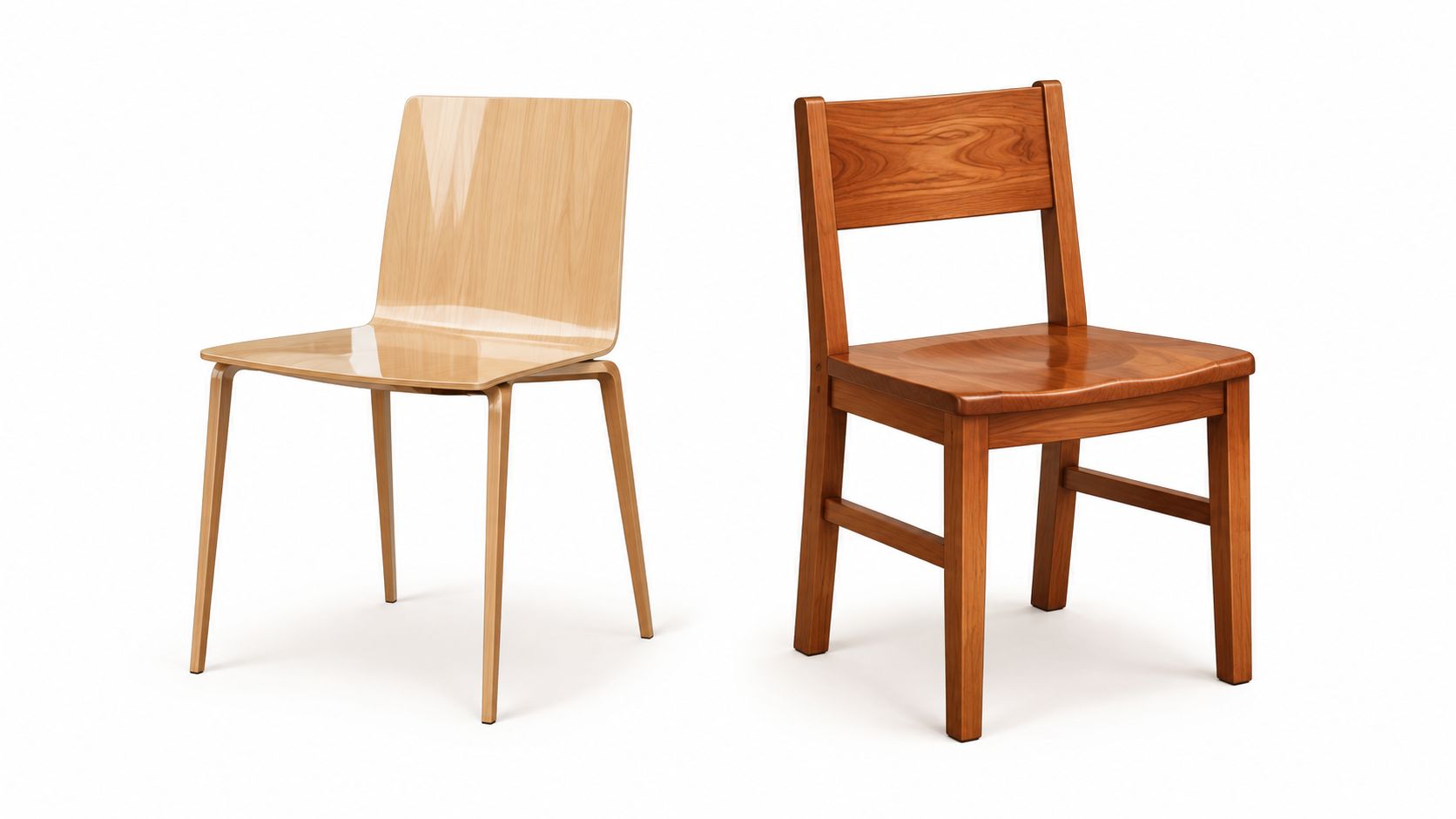
In person, the difference is sensory. A solid cherry chair has real weight when lifted by one side rail. A hand-rubbed finish has depth rather than a plastic film look. Good joints are quiet when the chair is shifted on the floor. The category is substantial, too. CSIL estimates that luxury and design furniture account for nearly 15% of the worldwide furniture market, a figure from the CSIL world high-end furniture market report, and its framework includes dining and living tables and chairs. That benchmark covers high end furniture broadly, not chairs alone.
Tyner Furniture has served Ann Arbor and Southeast Michigan since 1957 from its South State Street showroom, a local legacy built on helping shoppers run exactly these checks. Good chairs also support better gatherings, and hosts who want elevate dinner gatherings with exceptional ingredients know the room, food, and seating all shape the evening.
Pro-Tip: Ask three questions of any chair. How is it built, how does it fit a body, and what can be repaired later?
The Quality Checklist for Any Dining Chair
Treat the table below as a scorecard, not a wish list. A chair that fails on frame joinery or repairability isn't high end, whatever its price or silhouette. Materials, finish, and styling can't compensate for a frame that works loose or a seat that can't be replaced.
How to Read the Benchmarks
Work in the order a shopper encounters a chair. Frame and wood come first because they decide service life. Seat height, seat depth, and backrest shape decide comfort at the actual table. Upholstery specification and finish decide how the surface ages. Repairability and customization decide whether the chair can adapt when fabric wears, a room changes, or a household grows.
Dining chair quality checklist, benchmark, warning sign and showroom test
| Criterion | High end benchmark | Warning sign | Showroom test |
|---|---|---|---|
| Frame joinery | Mortise-and-tenon or dovetailed joints visible at rails and legs | Corner blocks, staples or glue-only butt joints | Gently pull the back rail and seat corners and watch for movement |
| Wood | Solid cherry, oak, maple or walnut | Veneer over particleboard or MDF, or vague 'hardwood' labels | Check edges and the underside of the seat for layered grain |
| Seat height | Suited to your table, typically 17 to 19 inches | Too low or high for a standard 29 to 30 inch table | Sit at your own table if the showroom allows, or bring your measurements |
| Seat depth | Roughly two inches of space behind the knees when sitting back | Front edge cuts into the calves | Sit fully back and check the gap |
| Backrest | Supportive lumbar curve with a slight recline | Flat board that pushes shoulders forward | Sit for ten minutes, not ten seconds |
| Upholstery specification | Documented abrasion rating, seam and cushion data | 'Premium' with no written spec | Request the spec sheet before ordering |
| Finish | Multi-step, hand-applied stain and topcoat with an even sheen | Film-like coating with sheen variation or thin edges | Inspect in raking light across the seat and back |
| Repairability | Replaceable seats and parts available for years | Components glued in place with no parts support | Ask about parts, reupholstery and repair timelines |
| Customization | Choice of wood species, stain, fabric and leg style | One fixed option only | Ask which elements are configurable |
Turning the Score Into a Decision
- Bring a tape measure: A chair that suits a 30-inch catalog table may crowd knees at home.
- Record table height: Measure floor to underside of apron, not just to the tabletop.
- Get paperwork in writing: Upholstery specifications, parts availability, and warranty terms shouldn't rest on a verbal assurance.
Most rows can be checked in person at the Ann Arbor showroom on South State Street. Count the rows where a chair meets the benchmark, and treat any failure on frame or repairability as a serious concern that needs a clear answer before ordering.
Why Joinery and Solid Wood Outlast Veneer
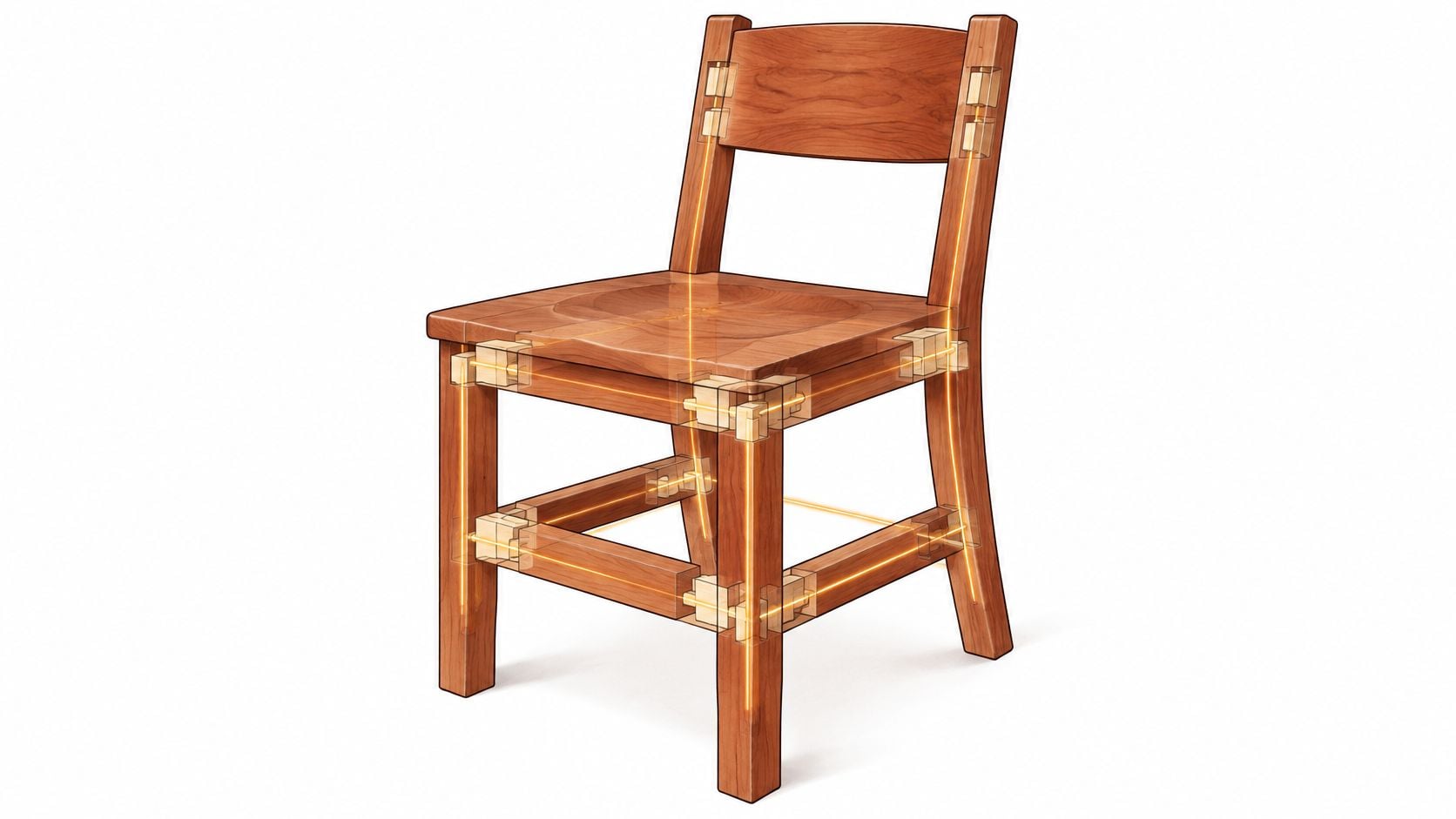
A chair is a set of connections under repeated stress. People lean back, drag chairs sideways, and push off the seat to stand. The wood matters, but the joints decide how long the chair stays tight.
What Controlled Testing Shows
In controlled strength testing described in controlled strength testing of wood-furniture joints, a traditional mortise-and-tenon joint withstood more than 26 kilonewtons of applied load before elastic failure, while a common No. 20 biscuit joint handled just over 12 kilonewtons, approximately half as much. Dovetails varied by design. Thinner, low-angled dovetails containing three dovetails averaged more than 8 kilonewtons, compared with more than 6 kilonewtons for the weakest tested configuration. Geometry matters as well. In the experimental study of dovetail-keyed wooden boxes, a ratio of hole depth to slope height of 75% produced the strongest compression and tensile performance, while 50% produced the weakest strength. Longer, wider tails and tenons outperformed smaller versions. These are lab results. They don't guarantee any chair's lifespan, but they show why construction deserves direct questions, a point explained further in this guide to mortise and tenon construction.
Choosing a Wood Species
- Cherry: Deepens toward warm amber with age and feels substantial in the hand.
- Oak: Shows bold open grain and handles daily wear well.
- Maple: Dense and fine-grained, suited to crisp, durable profiles.
- Walnut: Dark, even tone that reads as formal.
Species matters less than whether the wood is solid throughout and how it's joined. Tyner's Amish hand-crafted pieces are built by master craftsmen from solid North American hardwoods such as cherry, oak, and maple, using dovetails and mortise-and-tenon joinery. Veneer over engineered board can look identical in a photograph while offering a thinner structure beneath.
Tap the seat rail and listen for a solid note, then lift the chair and feel its weight. Solid wood also expands and contracts with humidity. A well-built piece accommodates that movement, which is one reason stable indoor humidity helps.
Turn the chair over. The underside of the seat and the joint where leg meets rail reveal more than the polished top ever will.
Upholstery Choices and How to Care for Them
A strong hardwood frame doesn't guarantee durable upholstery. Frame strength and surface wear are separate questions, and structural testing doesn't tell a buyer how fabric, leather, seams, or foam will age. For any upholstered bespoke chair, shoppers should request abrasion, seam, finish, and cushion-resilience data before ordering. The basics are covered in this overview of upholstery materials, but the written specification for the exact covering matters most.
Matching a Covering to a Household
Upholstery types compared for dining chairs
| Upholstery | Feel | Durability notes | Care demand |
|---|---|---|---|
| Top-grain leather | Smooth and supple, with a buttery give that deepens with age | Holds up well to daily use; scratches read as character | Condition every six to twelve months |
| Full-grain aniline leather | Soft, nearly unfinished surface with natural markings | Shows wear and patina; less protection against stains | Gentle cleaning; keep out of direct sun |
| Performance fabric | Crisp, slightly tighter hand | Check the abrasion rating before ordering; pass if unrated | Vacuum and spot clean promptly |
| Woven linen blend | Textured, breathable and airy | Lower abrasion resistance; shows wear sooner in busy homes | Vacuum regularly; professional cleaning for stains |
| Velvet | Plush, deep pile that changes shade with brushing | Pile can crush under heavy use; request the abrasion rating | Brush pile in one direction; blot spills at once |
The sensory cues are worth testing slowly. Run the back of a hand across top-grain leather and feel its buttery give. A linen blend feels faintly warm and airy. Velvet changes shade when brushed, a beautiful effect that also shows marks quickly. Households with pets should weigh cleanability and snag resistance carefully, starting with pet-friendly upholstery tips from J G Carpet before falling for a delicate weave.
A Practical Care Routine
- Vacuum weekly: Use a soft brush attachment to lift crumbs and grit before they abrade fibers.
- Blot spills within minutes: Use a clean, dry cloth. Rubbing spreads liquid deeper.
- Condition leather: Apply a product suited to its finish every six to twelve months.
- Control sun and heat: Keep chairs out of direct sun and away from heating vents.
- Rotate chairs: Move chairs occasionally so wear spreads evenly across the set.
Made-to-order upholstery lets a household choose fabric or leather around real cleaning habits, children, pets, and entertaining frequency instead of hoping a floor model happens to fit.
Practical rule: Test any fabric with a damp cloth in an inconspicuous spot before committing to a full set.
Ergonomics and Fit at the Dining Table
The softest, most heavily padded chair isn't always the most comfortable over a two-hour meal. Deep sink-in makes standing harder, reduces stable posture, and can drop the sitter too low relative to the table. Ergonomic comfort comes from fit, not plushness alone.
What Fit Actually Means
A published ergonomic evaluation of dining furniture reported that several assessed products failed to comply with ergonomic standards, primarily because of inappropriate seat height, limited seat dimensions, and insufficient back support. The best performers better supported a neutral sitting posture. Separate Cornell University guidance in that evaluation notes that lumbar disc pressure and back-muscle activity are lowest with a supported recline angle of approximately 110°–130°. Dining chairs still need a more upright posture than lounge seating, so the goal is a supported upright, not a lounge recline.
Standard tables sit about 29 to 30 inches high and seats about 17 to 19 inches, leaving roughly 10 to 12 inches between seat and tabletop. That gap must clear knees, thighs, and arms comfortably. Table aprons reduce usable space, so shoppers should measure to the apron underside. A fuller explanation is available in this guide to dining table heights.
Tests for Mixed-Height Households
- Sit for a full meal's length: Ten seconds reveals padding. Twenty minutes reveals support.
- Stand up three times: Rising without pushing on the table should feel stable, especially for older adults.
- Check armchair clearance: Arms should slide under the apron without scraping or forcing the sitter too far from the table.
- Try two body sizes: A shorter and a taller person should both sit fully back with feet supported.
A visually identical six-chair set isn't always the best answer. Side chairs with a different seat depth, or armchairs only at the ends, can serve mixed-height households and people who work or do homework at the table far better.
Bring a family member of a different height to the showroom. A chair that fits only one body in the household fits the household poorly.
Customizing Chairs Beyond the Showroom Floor
In-stock is the beginning, not the limit. An off-the-rack suit fits many people reasonably well. A suit cut to measure fits the person wearing it. Made-to-order dining chairs work the same way, matching wood, finish, upholstery, and proportions to a specific room and table.
The ladder is practical. Amish solid wood pieces can be built in the species and stain that complement existing decor. Canadel dining offers thousands of combinations, from leg styles and table edges to finishes and distress levels, so chairs and table share one coherent look. Upholstery can be selected from hundreds of premium fabrics and top-grain leathers. The process is outlined in this guide to custom furniture made simple.
Stressless provides a useful sizing model through Small, Medium, and Large ergonomic seating. Dining chairs rarely offer that exact ladder, but the principle applies. Ask which dimensions can change, not only which fabrics.
Demand for that control is measurable. The 2024 survey of 1,016 U.S. adults who had recently bought or planned to buy upholstered furniture found that 40% considered customization extremely or very important. Among shoppers considering chairs, 65% said they would consider placing a custom order, even though only 23% of recent stationary or motion-chair buyers ultimately chose a custom version. That gap suggests many shoppers settle before learning their options.
Matching versus mixing is a functional choice as much as an interior design one. A coordinated six-chair set gives a unified room. A mix of side and armchairs adds character and suits different body sizes. Wall art can complete either approach, and how to choose dining room prints helps scale artwork to the finished set.
Pro-Tip: Bring a table finish sample to the showroom so chair stains can be compared in the same light.
Cost per Year of Ownership and Financing
The better question isn't what a chair costs today. It's what the chair costs for each year it stays in service. Total cost of ownership includes purchase price, expected service life, reupholstery cost, repairability, delivery, and resale or inheritance value.
Repair access changes the math. The 2025 global survey of 30,701 adults across 30 countries found that 70% try to repair, sell, or donate unwanted or broken furniture, with many attempting repairs rather than immediately replacing items. A sustainable purchase may therefore be the chair with replaceable upholstery, durable joinery, and long-term parts support, not the one with the strongest materials claim alone.
Illustrative Cost Per Year
The figures below are illustrative calculations, not quoted prices. Total cost is divided by expected years of service.
Illustrative cost per year for four dining chair types
| Chair type | Expected service (years) | Cost per year |
|---|---|---|
| Mass-produced veneer chair, $350 | 5 | $70 |
| Mid-range upholstered chair, $900 | 10 | $90 |
| Solid wood chair, $2,400 plus $600 reupholstery | 25 | $120 |
| Heirloom solid wood chair with repair access, $4,800 | 50 | $96 |
The ranking changes as service life changes. The heirloom chair costs less per year than the 25-year example because its cost spreads across twice the service. One reupholstery also keeps a sound frame in use instead of sending the whole chair out of the home.
Special Financing, subject to credit approval, can spread a made-to-order purchase over manageable monthly payments, often with promotional no-interest periods. Details appear in Tyner special financing information. The Low Price Promise pairs competitive value with local support, making investment grade construction easier to plan for.
Ask the showroom team to write down reupholstery costs, parts terms, and repair timelines before placing a special order.
Book a Sit Test at the South State Street Showroom
A sit test at the Ann Arbor showroom on South State Street is the decisive step. Measurements, specifications, and photographs narrow the field, but only a real chair at a real table confirms seat depth, arm clearance, and ease of standing. Tyner Furniture has served Southeast Michigan since 1957, and that neighborly, unhurried approach suits a purchase expected to last decades.
Bring table height, room measurements, a fabric or finish sample, and everyone who will use the chairs regularly. Photographs of the room in daylight also help when comparing stain and upholstery.
A Three-Step Visit Plan
- Run the tests in person: Pull gently on rails, inspect undersides, and compare candidates against household measurements.
- Sit through a meal's length: Stay seated, stand several times, and have different heights try the same chair.
- Collect the paperwork: Request upholstery specifications, repair terms, and configurable options in writing.
Shoppers who prefer to start remotely can browse online Quick Specs for special orders to review configurations before visiting. Tyner covers the full home, from living and bedroom furniture to the Home Office and Outdoor Spaces, so a dining set can be coordinated with the rest of the house. Special Financing and the Low Price Promise can make a hand-crafted purchase manageable. Chosen carefully today, a high end dining chair should still be at the table for the next generation.
Visit Tyner Furniture to explore solid wood, upholstered, Canadel, and Stressless dining options before coming in for a sit test. Bring table measurements and finish samples to the Ann Arbor South State Street showroom, compare joinery and upholstery specifications in person, and leave with a made-to-order plan built for years of meals.