How Much Is a Table? Real 2026 Price Ranges

In 2026 a residential table runs about $200–$400 in pine or rubberwood, $500–$1,500 in solid oak or maple, $1,500–$6,500 in walnut, cherry, or custom work, and above $10,000 when the piece is artisan, live-edge, or bespoke. There is no single price, because those bands describe different materials and different ways of building.
If two tops seat the same six people, why can one cost more per year to own than the other? The tag only records what leaves the register. It doesn't record how long the top can be sanded, whether a leaf still fits in ten years, or whether the base will rack the first time someone leans on a corner. Households in Ann Arbor and across Southeast Michigan feel that gap when a listing looks similar on a phone and then feels hollow, or wonderfully heavy, in person.
A useful answer starts with a range, then asks what the range is buying: species, room fit, joinery, and years of use. Tyner Furniture has walked neighbors through that kind of comparison since 1957, from dining tables to pieces for the home office and outdoor spaces.
2026 Price Bands for a Residential Table
How much is a table in 2026? The honest answer is a band, not a single sticker. Material, size, construction and customization set the number; seat count alone does not. These estimates apply to North American residential purchases and exclude restaurant and heated-table pricing.
| Table type | Typical 2026 range | What the range buys | Range source |
|---|---|---|---|
| Entry pine or rubberwood | $200–$400 | Lighter species and simpler construction | Solid-wood dining table market report |
| Engineered wood or veneer | $200–$800 | Panel or veneer core rather than solid hardwood | Same solid-wood report |
| Solid oak or maple | $500–$1,500 | Domestic hardwood with a repairable surface | Same solid-wood report |
| Premium walnut, cherry or custom | $1,500–$6,500 | Higher timber value plus made-to-order labor | Same solid-wood report |
| Artisan live-edge or bespoke | Above $10,000 | Figured wood and one-off fabrication | Same solid-wood report |
| Residential dining tables overall | $800–$5,000 | Everyday household dining, mixed construction | Classic-table market review |
| Traditional tables | $1,500–$12,000 | Heavier classic construction and craftsmanship | Same classic-table review |
What a band does and doesn't cover
A band is a starting mark, not a promise. The top of one row can overlap the bottom of another because a small table in a costly species may land where a larger table in a modest species begins. A showroom tag in Ann Arbor can sit inside one of those rows. A custom-order quote moves when the species, the length or the finish changes.
A six-seat top in a domestic hardwood can cost less than the same footprint in cherry or walnut, because the timber and the finishing work are not the same job. Larger tops use more lumber and need a stronger base so seasonal movement does not twist the frame. That is why two tables in the same band can separate over a decade: one top can be sanded and re-oiled, while a veneer face cannot.
Practical rule: Treat the closest row as a starting mark. Then test material, room fit and years of usable life before you treat that number as the full cost.
Tyner Furniture's South State Street showroom is the local place to put those bands side by side, including dining, home office and outdoor tables. Ask for species, thickness, finish system and construction method. A solid wood label by itself does not tell you which row you are buying.
How Much Table the Room Can Hold
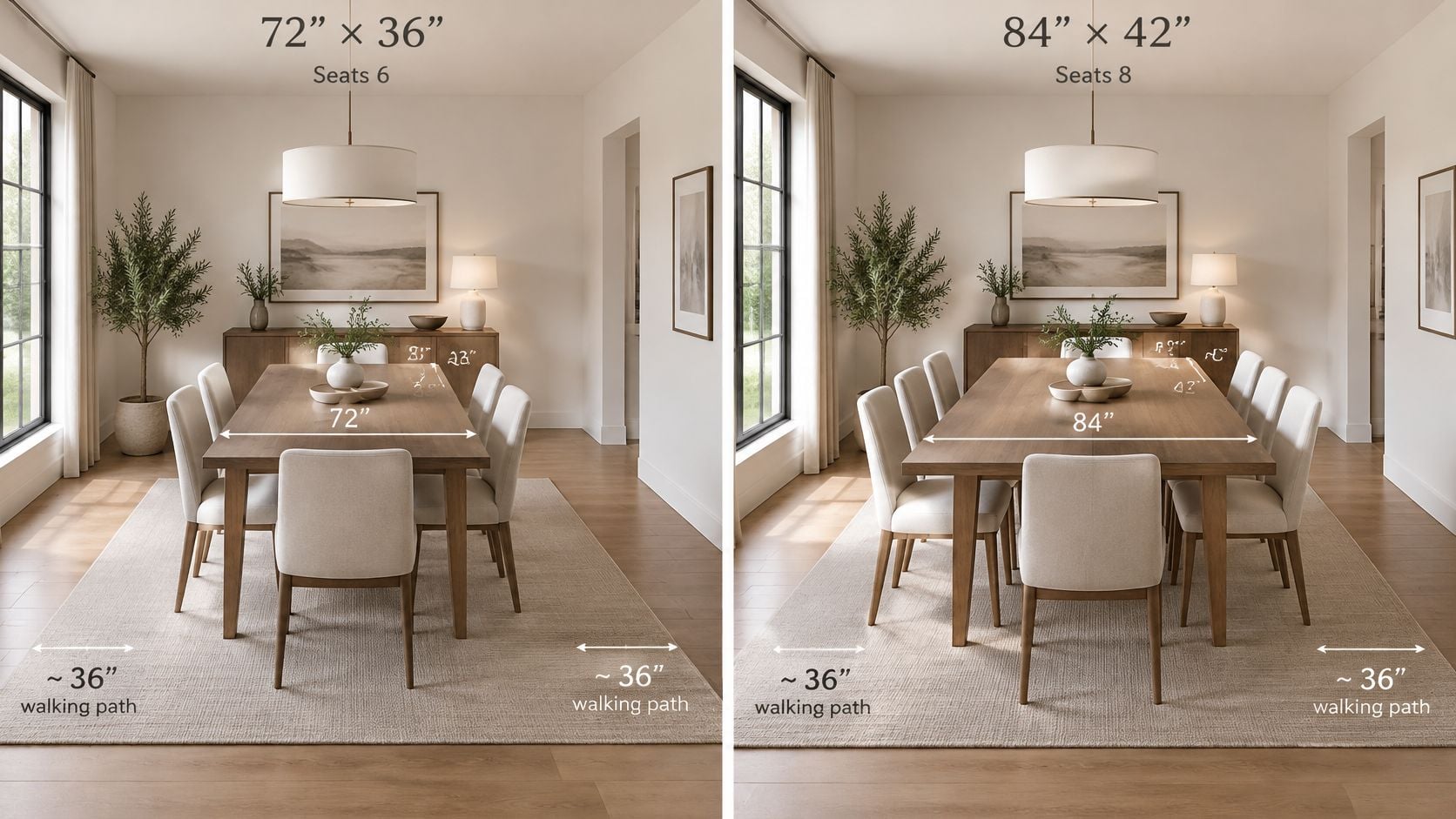
Price is the wrong first filter if the top blocks the walkway. Current design guidance puts a 72-by-36-inch top at about six seats and an 84-by-42-inch top at about eight, with at least 36 inches of circulation and preferably 42 inches where people serve or a wheelchair needs to pass, a clearance worth holding next to broader household spending patterns.
| Top size | Seats about | Minimum walkway | Better for serving |
|---|---|---|---|
| 72 by 36 inches | 6 | 36 inches | 42 inches |
| 84 by 42 inches | 8 | 36 inches | 42 inches |
Measure before you fall in love with a length
- Measure the clear floor, not the rug. Note door swings and the path to the kitchen.
- Subtract 36 to 42 inches on each side people walk.
- Mark everyday seats versus holiday seats. Four on a Tuesday isn't eight on Thanksgiving.
- Check leg placement against chair arms. A pretty pedestal can still clip a pulled-out chair.
- Decide where leaves live. In the table, or in a closet you can reach without moving the sofa.
A smaller extendable table often beats a permanently large one in compact Ann Arbor homes, for renters, and for households that host only a few times a year. The reverse mistake is just as costly. A too-small top that crowds plates creates the same long-term regret as overspending, because nobody enjoys eating with elbows tucked for a decade.
Say weeknight meals are four people, with leaves stored and a clear path to the sink. That household may be happier with a shorter top most of the year. Say the holiday table needs eight, and someone still has to carry a platter behind a pulled-out chair. That path wants the 42-inch serving width, not a squeeze.
Changing length, leaf style, edge, or leg position can change the quote. It can also stop you from paying for the wrong footprint. Shape and seating choices are laid out in Tyner's guide to dining table shapes and seating arrangements. The right size seats real meals and still lets someone walk behind a chair that is fully out.
What Changes the Price of the Same Size Table
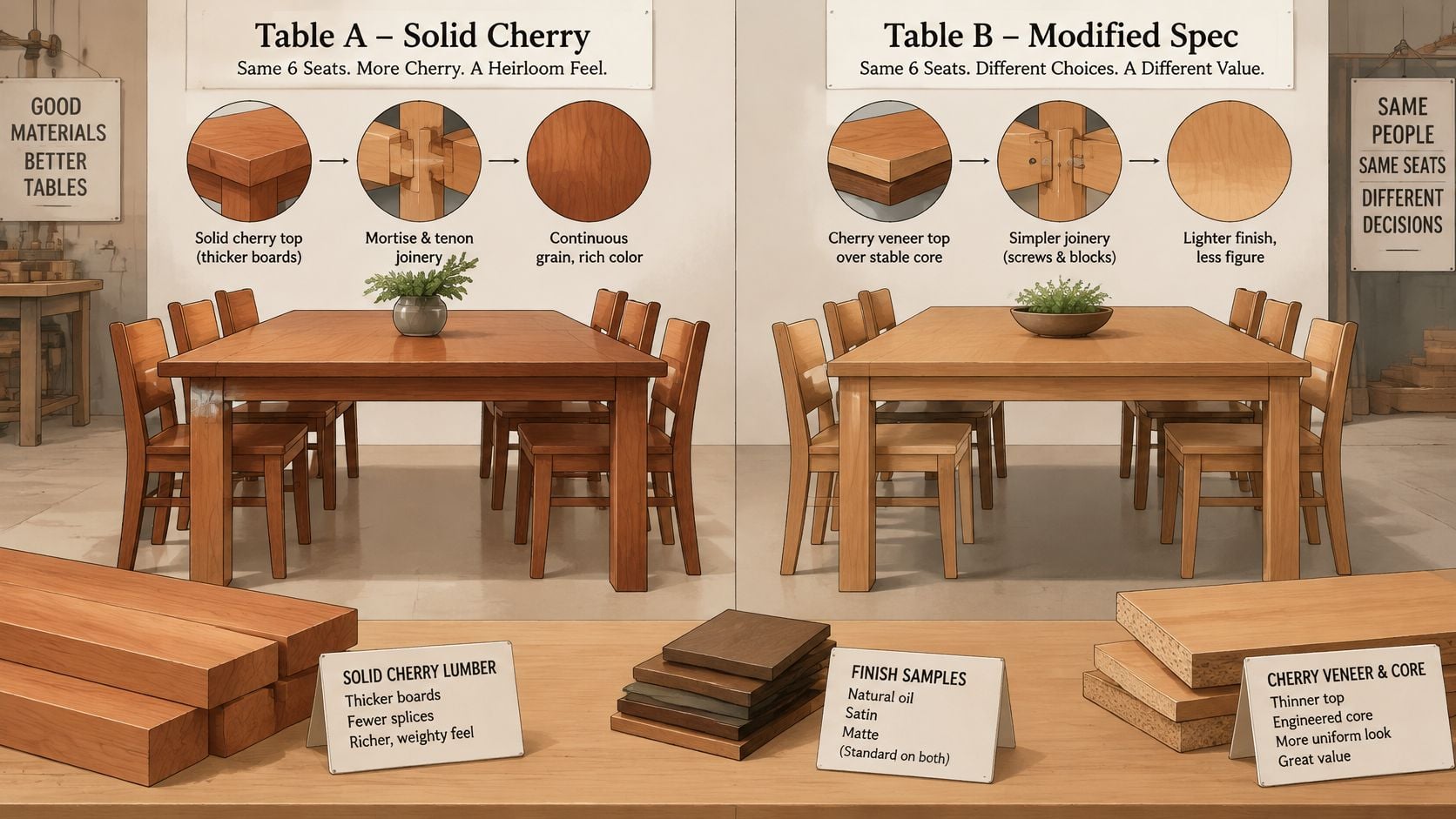
Two six-seat tables can share a footprint and still be different products. Seat count is the easy number. The lumber specification is the one that moves the bill.
A typical dining top may use about 30–50 board feet. A board foot works like a measuring cup: one piece 12 by 12 by 1 inch, however the mill saws the board. Species and figure change what that cup costs. Plain red oak sits toward the lower end of hardwood pricing. Figured walnut or spalted maple sits far higher. The same pile of boards can therefore cost several times more before anyone mills, dries, machines, joins, sands, finishes, packs, or delivers it.
Yield is the quiet multiplier. Knots, cracks, wild grain, and wet spots come out of the usable pile, the way you trim the ends off a roast before it reaches the plate. A quoted price per board foot is not the whole material bill. A thicker top, or a set of extension leaves, raises volume again. The base then has to carry that weight without racking when someone leans on a corner.
Why the same footprint isn't the same bill
Labor stacks on the wood even when length and width stay put.
A simple square edge needs less machine time than a shaped edge or a turned leg. Extra stain steps and hand rubbing add hours while the species name on the tag stays the same. Hand-cut dovetails and mortise-and-tenon take longer than fasteners hidden in a panel core, and a joint you can tighten later is a different product from a core you cannot open. A hand-crafted top is priced for skill and for how much lumber had to be discarded, not only for the word cherry or oak.
Delivery belongs in the total around Ann Arbor. Within a 50 mile radius of the showroom, the delivery fee is $119. Clearance items are $149. The fee does not change the species. It does change what you pay to get the table into the room.
Solid cherry, oak, and maple carry weight and grain you can feel in the hand. A veneer panel puts a thin face over an engineered core. That face can photograph well. The core underneath is not something you sand through for decades the way you renew a solid top. Oak and maple also part ways on color and hardness, so a side-by-side look at oak versus maple furniture belongs next to the quote, not after you have already paid.
A written estimate should separate lumber, construction, finish, customization, and delivery. Ask for species, thickness, finish system, and joinery. A solid wood label by itself does not say whether the top can be repaired. Households who later pass a well-built table along, including families selling inherited tables through estate sales, are usually selling construction and condition, not a mystery core.
Cost per Year Instead of the Checkout Total
The better question is what the table costs for each year it is usable. A 2019 Journal of Cleaner Production study, cited by Tyner's guide to Amish furniture, estimated usable life of about 25–50 years for solid-wood furniture, against about 5–15 years for particleboard and MDF.
| Example | Purchase price | Assumed life | About per year |
|---|---|---|---|
| Panel or MDF dining table | $700 | 7 years | $100 |
| Solid-wood dining table | $2,000 | 25 years | $80 |
| Solid wood at the long end of the range | $2,000 | 50 years | $40 |
Those annual figures come before another delivery, disposal, or a full replacement. A $2,000 solid-wood table used 25 years is about $80 a year. A $700 panel table used 7 years is about $100 a year, and then the household buys again.
Copy the arithmetic for your own quote
- Start with the purchase price. Use the quote for the specification you would keep.
- Add one delivery and a refinishing or repair allowance. A renewed finish is not a new table.
- Divide by realistic years of use. Use 7 for a panel core you cannot sand, and 25 or 50 only if the top and base can be repaired.
The extra money is buying solid North American hardwood, joinery that can be repaired, a finish that can be renewed, and parts that aren't glued into a disposable core. Solid wood is not an automatic heirloom if the finish is thin or the base is weak. Lift a corner in the showroom. The weight of solid cherry is a different sensation from a top that feels hollow under the hand.
Pro-tip: Ask whether the top can be sanded and refinished, and whether leaves and hardware can be replaced.
BSI's circular-economy survey found that 68% of surveyed adults name cost savings as the leading reason for circular purchasing, and 42.3% of adults in a Denmark study reported repairing furniture. A repairable top can cost less over time than a panel table that has to be replaced. The contrast between solid wood and particle board is the material test behind that math. A higher Ann Arbor quote can still be the stronger investment when the household plans to keep the table through several homes.
Showroom Tables versus Amish and Canadel Orders
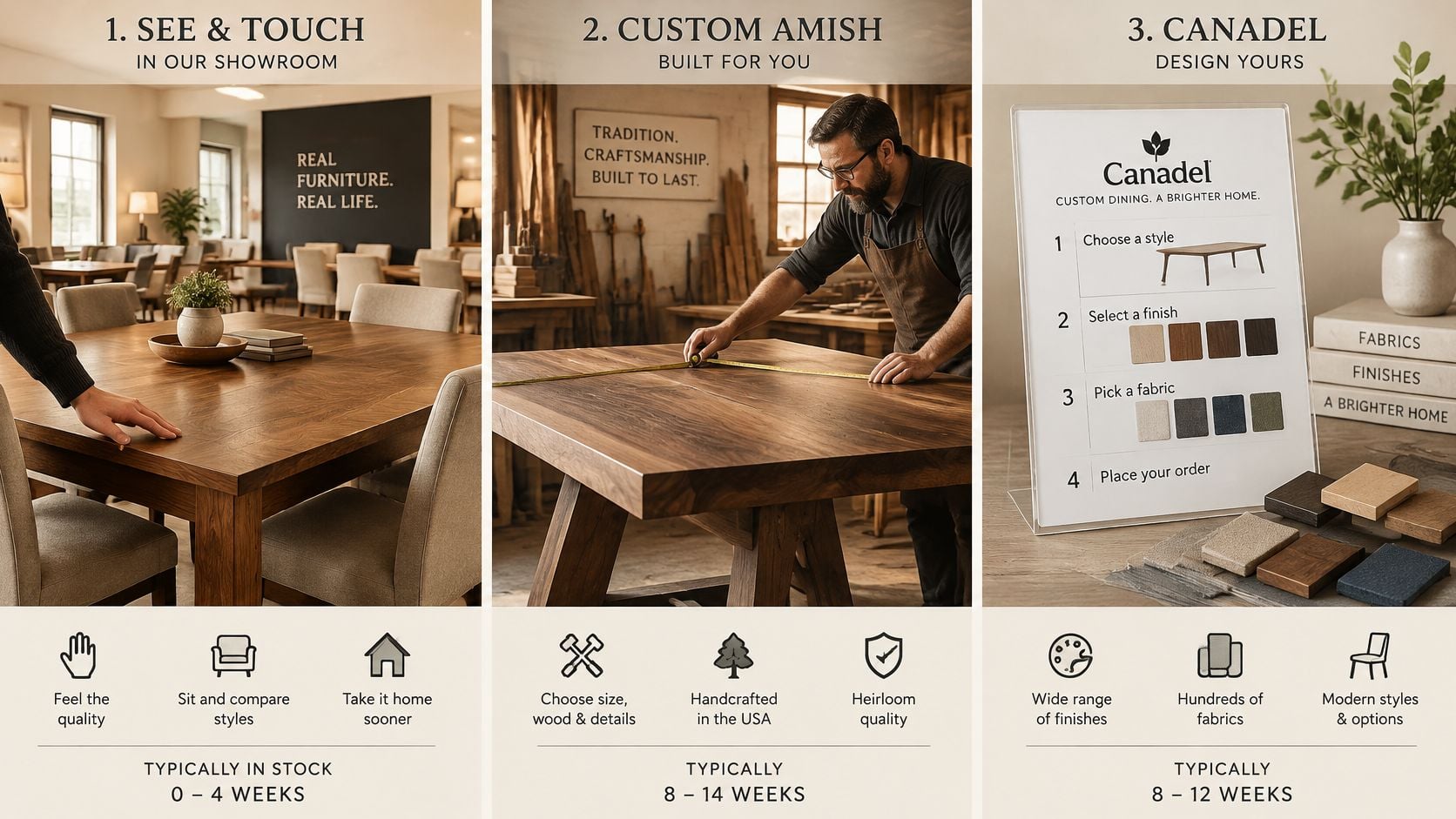
An in-stock price is a starting reference. It is not the only table you can buy. Furniture shopping gets overwhelming when every tag looks final. Choosing the path first, ready now versus built for the room, makes the numbers comparable.
Three paths, three clocks
Showroom piece. On South State Street you can see the finish, feel the edge, and take a table on a known lead time. That path suits a household that needs a top soon and already likes what is on the floor. You are buying a known configuration, not a blank specification.
Hand-crafted Amish order. The wood is solid North American cherry, oak, or maple, with species and stain chosen for the house. Joinery is meant to outlast veneer alternatives. Lead time is the trade for material integrity and a finish that matches the room rather than the warehouse. Tyner builds that path through Amish furniture made to order.
Canadel dining order. Canadel's dining program is described as offering thousands of combinations, including leg style, table edge, finish, and distress level. You are pricing a configuration, not one SKU. Each choice changes labor and materials, which is why two quotes for a six-seat top can diverge.
The same made-to-order idea shows up in seating, not as a table price. Stressless recliners come in Small, Medium, and Large so an ergonomic chair can match the person who sits in it. Don't fold a recliner price into the table quote. Do plan the chairs with the top, or the interior design of the room will feel unfinished when the leaves come out.
Write down room length, wood, edge, leaf style, and finish before you compare an in-stock tag with a custom quote.
A photo can't settle the buttery feel of a finished hardwood edge or the weight of a solid top. Those are showroom facts. Once they are written next to the specification, the three paths stop competing as vague "tables" and start competing as schedules, materials, and years of use.
How to Read a Furniture Financing Offer
Special financing can make a higher-quality table possible this month. It only helps if the household can finish the offer. Luma Ledger's deferred-interest guide separates two deals that sound alike in an ad.
A genuine 0% introductory APR doesn't charge interest for the promotional period. Deferred interest, often worded as "no interest if paid in full within" a stated period, is different. The lender may calculate interest from the purchase date and waive it only if the entire promotional balance is paid by the deadline. Miss that date, and previously accrued interest can become payable.
Common windows are 6, 12, 18, and 24 months, with some offers longer. A $2,400 table over 12 months needs at least $200 a month before tax, delivery, or other account charges. The minimum payment may not clear the balance in time.
Terms to verify before you sign
- Promotional length: Count the months, and write the last day on a calendar.
- Required payment: Use the amount that pays the table off, not the smallest amount the statement allows.
- Payoff date: Confirm it in writing, including how payments are applied.
- APR after the promotion: Know the rate if a balance remains.
- What the offer covers: Check custom orders as well as in-stock goods.
Tyner's special financing sits beside a competitive Low Price Promise. It doesn't replace a budget. More detail on how those offers are structured is on the furniture financing page. Don't stretch a payment just to reach a larger top the room can't hold. Use financing when the monthly amount that pays the table off fits the household. Skip it when only the minimum payment looks comfortable.
Plan a Sit Test on South State Street
A showroom visit answers questions a spec sheet cannot. Tyner Furniture's floor at 3900 South State St, Ann Arbor, MI 48108 has been part of the local furniture story since 1957, and the 60,000 square feet run from dining and bedroom pieces through home office and outdoor. Call 734-995-3900 to ask when a specialist can walk the floor with you.
Bring four things: your clear-floor measurements, your everyday and holiday seat counts, a wood preference, and the price band you already marked. Then run the feel test, the checks that only work in person.
- Rest a forearm on the edge. A solid cherry, oak, or maple top stays cool and firm under your arm. A thin veneered panel gives a hollow tap and lifts easily at the corner.
- Lift one end. Ask for help if the top is heavy. A table two people can carry without strain is a different object from one that resists the lift, and that resistance hints at how it will take a bumped chair over twenty years.
- Slide a chair in and out on the actual floor. Carpet, tile, and hardwood all change how much room a chair needs, which is why the number you measured at home can feel wrong here.
- Set the finish beside the order. Compare the piece on the floor with a sample of an Amish solid-wood finish or a Canadel leg, edge, and distress combination. Colors shift under showroom light.
The heavier, repairable piece usually costs more today and less per year of usable life. That trade is the whole reason to sit at the table instead of reading about it.
If you cannot come in yet, write the specification yourself before you compare two tables: wood species, top thickness, leaf count, edge profile, finish, and delivery window. Six lines turn a conversation into a decision.
Leave with three written numbers: the specification you agreed to, the month a promotional balance would be paid off, and the cost per year you accept.
Tyner Furniture helps Ann Arbor and Southeast Michigan households price a table by material, fit, and years of use, with showroom pieces, Amish solid wood, and Canadel configurations under one roof. Visit Tyner Furniture when you are ready to compare the weight of the wood with the number you plan to live with.