Top Grain Leather Rocker Recliner: A Buyer’s Guide


The old recliner still opens, but the seat has lost its give and the arms look tired. Across the showroom, a leather replacement feels wonderfully soft. Then the tag introduces another decision: top grain, genuine leather, leather match. For an Ann Arbor household making a substantial furniture investment, those labels can make an otherwise comfortable purchase feel overwhelming.
A top grain leather rocker recliner deserves more than a quick sit and a glance at the upholstery tag. The useful comparison is how its finish handles daily contact, how its mechanism fits the person using it, and what ownership costs over time. A beautiful surface matters, but so do repairable parts, supportive proportions, and enough room to rock without rearranging the living room.
Top Grain Leather Grades Side by Side
A rocker recliner puts repeated contact on the seat front, arm caps, and the leather that folds around the footrest. Grade names describe the hide and its surface; the finish and panel placement determine what you see and touch day to day.
| Grade | What It Is | Wear and Look | Where It Belongs |
|---|---|---|---|
| Full-grain | Outer grain kept with its natural surface, lightly cleaned only | Develops patina; marks and scratches show openly | Pieces buyers want to age over decades |
| Top-grain | Outer layer sanded or buffed, then sealed with a protective finish | Even colour, easier cleaning, less natural patina | Seat, arms and back on everyday recliners |
| Corrected grain | Surface altered and finished to hide natural marks | Very uniform, least natural character | Panels where uniform appearance matters most |
| Split leather | Layer beneath the grain surface, coated or embossed | Rougher underlying texture, less durable than grain layers | Sides, rear panels and non-contact areas |
| Bonded leather | Shredded leather fibres bonded to a backing | Can peel, crack or flake with wear | Not recommended for high-contact recliner zones |
“Genuine leather” alone does not identify a specific grade. Popular Mechanics' guide to leather terminology explains that there is no single official grading hierarchy and that full-grain is technically a type of top-grain leather. On a spec sheet, “top-grain leather seating” identifies the seating material, but it does not tell you whether the outside arms or back use the same leather.
What the finish changes
The StitchMath leather guide describes top-grain leather as retaining the outer grain layer while receiving sanding or buffing and a protective finish. The result is often an even sheen and a more consistent colour. A heavier finish can make routine care easier, while offering less of the natural surface variation associated with full-grain.
For a family-room rocker, that trade-off may be worthwhile: a more uniform surface can suit frequent use, while natural marks may be more visible on an uncorrected hide. Check the specification for each upholstered panel, especially the seat, arms, and footrest. The top-grain leather versus bonded leather guide explains the difference between hide upholstery and a bonded composite.
The hand-and-eye test
Ask to see the chair under a lamp. Hold the light low and sweep it along the seat front, arm caps, and footrest folds. A smooth, even sheen is easy to read; scattered dull patches, raised marks, or abrupt changes in texture deserve a closer look. Then glide your palm lightly across those same areas. Notice whether the finish feels consistent, without scratching, stretching, or pressing hard.
If you are weighing leather against fabric for nearby seasonal seating, compare fabrics for seasonal sofa covers. For the recliner itself, choose the upholstery based on the feel and appearance you want in its high-contact zones.
The practical verdict: Top-grain suits buyers who prefer an even look and a finished surface; full-grain suits those who welcome visible character and patina. Either way, the panel specification and the actual surface matter more than the grade name alone.
How to Test Leather Durability Before You Buy
A rocker recliner takes repeated friction in a few predictable places: the seat front, arm caps, headrest and folding footrest. Check the written material details alongside the chair's movement. A soft cushion and even sheen can look inviting, but they do not show how a finish handles wear.
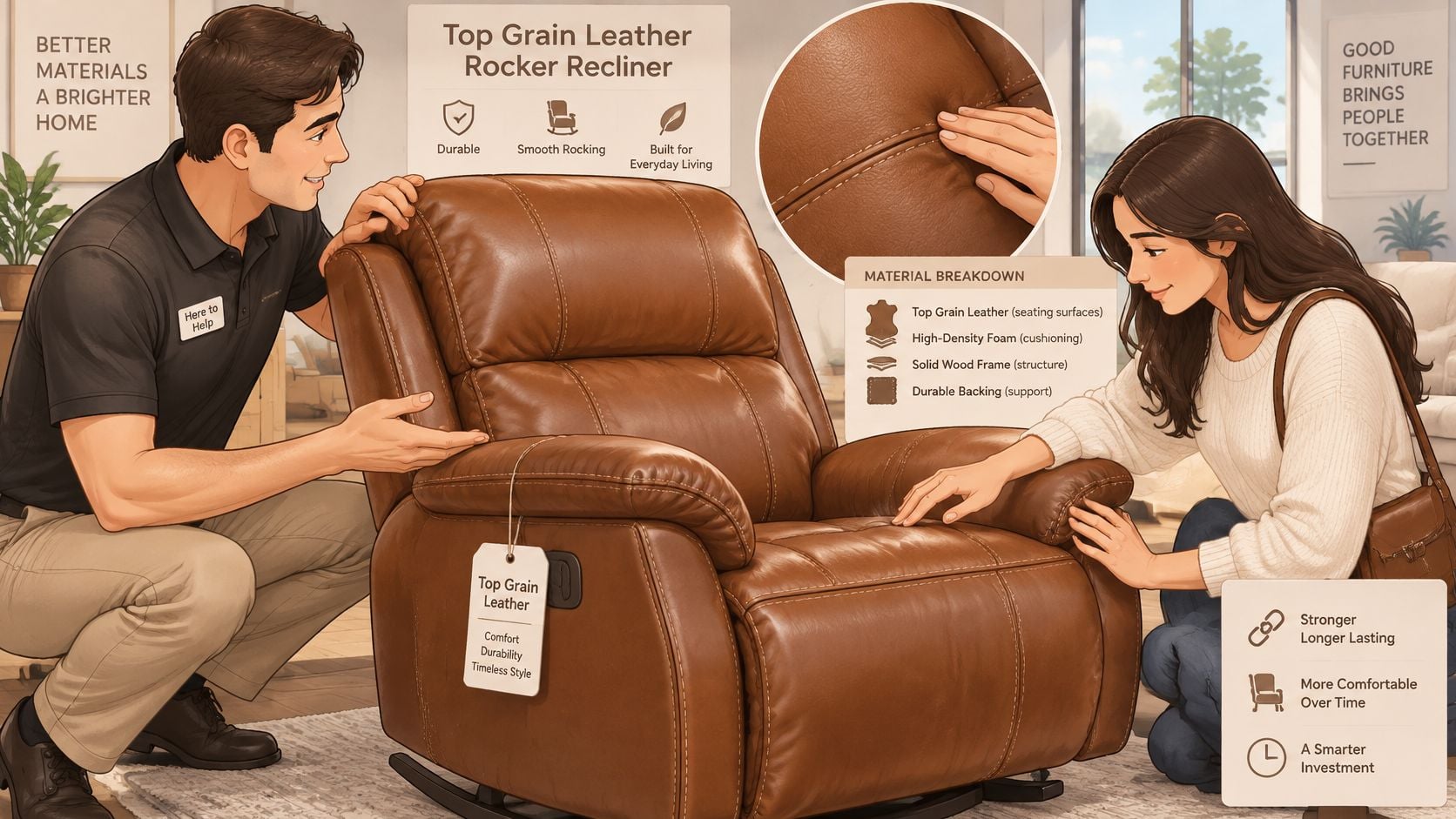
A materials-and-motion inspection
Confirm panel coverage in writing. Ask which panels use top-grain leather and whether split leather, vinyl or bonded material appears on the outside arms, back or rear panels. Get the answer for the specific chair, not just the collection.
Ask for abrasion results for the exact upholstery. ISO 17076-2 describes a Martindale abrasion procedure for semi-aniline, pigmented and coated upholstery leather. Ask the seller for the result, test method and upholstery identification. A result for another leather or finish does not establish how this chair's upholstery performed.
Keep test methods separate. Wyzenbeek double rubs and Martindale cycles use different equipment and procedures, so their results cannot be directly converted. Ask, “What is the rub count for this exact leather, and which test method produced it?” Treat the figure as one piece of evidence, not a prediction of household service life.
Inspect the high-contact zones in motion. Look closely at the seat front, where people slide in and out, and at arm caps that take repeated hand and forearm contact. Check the headrest for a smooth, even finish. Ask the salesperson to operate the footrest while you watch for rubbing, pinching or folds that catch at the hinge.
Ask what abrasion results leave out. Request information about flexing, lightfastness and cleaning, plus hydrolysis resistance where a coating or match material is involved. A rub result alone does not establish resistance to perspiration, colour change or flex cracking.
Record the chair's condition on delivery. Photograph the full chair, seams, panel transitions and any finish differences before use. Clear images make it easier to identify a change later.
Pro tip: Ask whether a damaged seat panel can be replaced separately, who handles the repair and whether matching leather can be obtained. Repair options affect the cost of keeping a chair in service, so include them when comparing the purchase price with the years you expect to use it.
A showroom checklist worth keeping
- Material allocation: Written panel-by-panel coverage.
- Finish evidence: Test method, rub-count result and exact upholstery identification.
- Moving surfaces: Check for rubbing, pinching and trapped folds as the footrest operates.
- Service path: Confirm panel replacement, repair responsibility and matching-material availability.
For a cost-per-year comparison, divide each chair's purchase price by the years you reasonably expect to use it, then factor in the repair options. A higher leather grade does not guarantee better value. The finish, contact-zone wear and serviceability all matter.
How to Check Recliner Fit for Your Body
Body measurements to compare with the chair
| Body Measurement | How to Take It | Chair Spec to Compare |
|---|---|---|
| Seated hip width | Sit upright and measure across the widest part of the hips | Arm spacing and seat width |
| Buttock-to-knee length | Sit back fully and measure from the back of the buttock to the back of the knee | Seat depth |
| Popliteal height | Seated, measure from the floor to the underside of the thigh behind the knee | Seat height and footrest clearance |
| Seated shoulder height | Sit upright and measure from the seat to the top of the shoulder | Backrest height and headrest position |
A tape measure and a firm dining chair provide a useful starting point. These measurements narrow the selection, but upholstered cushions compress, and the seat's pitch changes how a nominal dimension feels. Overall chair width says little about usable room between the arms.
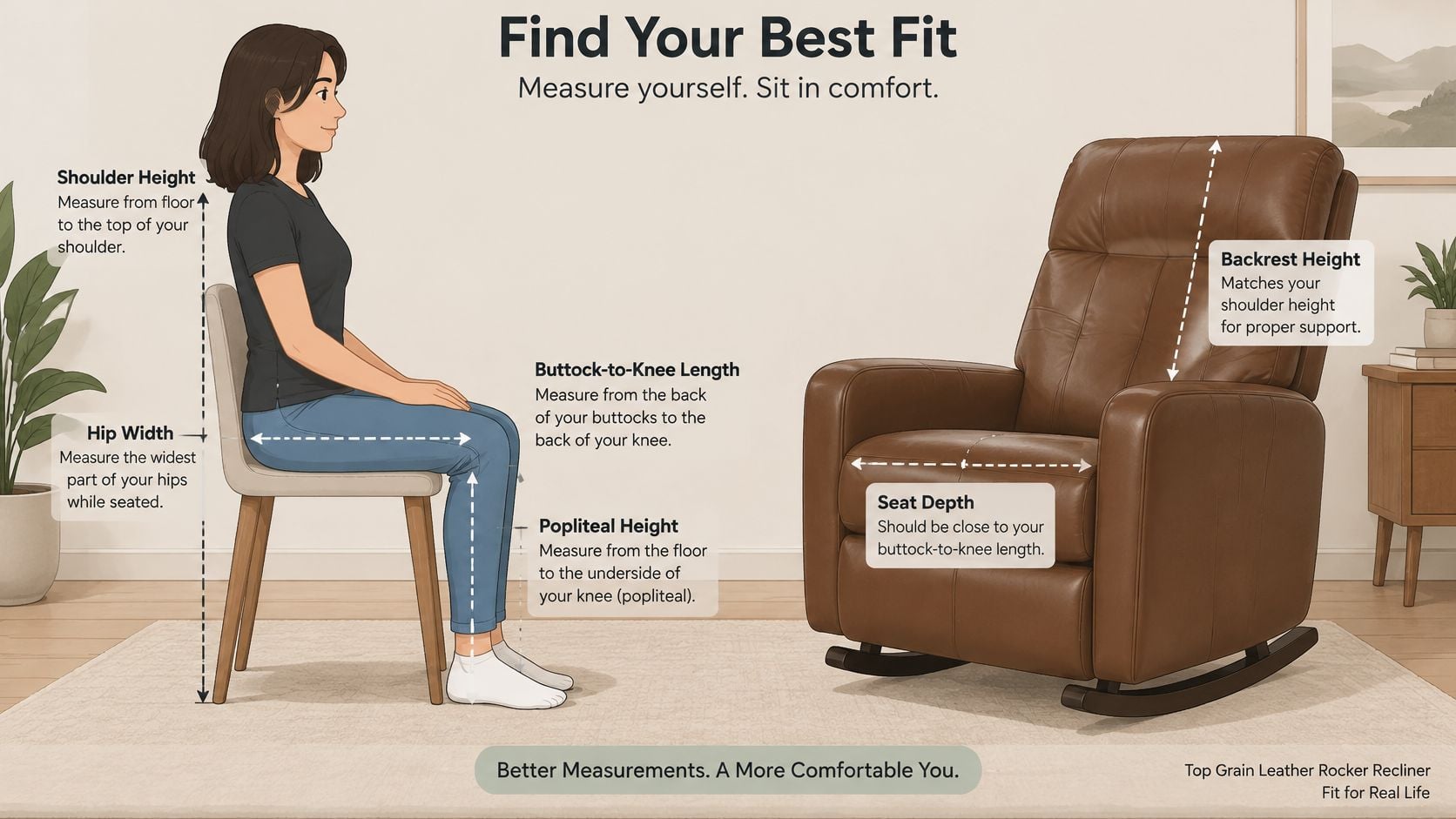
Test the whole operating sequence
Sit upright and rock gently. Normal footwear gives the most useful comparison with home use. The feet should feel supported, the shoulders relaxed, and the lower back in contact with the cushion.
Move into partial recline. This is often the reading or television position. The pelvis shouldn't slide forward just to make the backrest feel comfortable.
Continue to full recline. The headrest should cradle the head rather than push the chin toward the chest. The lumbar contour should remain supportive as the back angle changes.
Assess the deployed leg rest. On mechanisms that deploy it during recline, this check happens as part of that movement. The heels need support without forcing the knees straight or creating pressure behind them.
Return upright and stand. Older adults and anyone with reduced mobility should assess whether rising feels controlled and independent. A deep, plush cushion isn't a benefit if getting out requires an awkward pull on the arms.
Repeat the controls and locking sequence. Handles and switches should remain reachable without twisting. The user should also understand when rocking stops or locks on the chosen mechanism.
Comfort isn't a universal angle
A recliner-posture study published in BioResources identified a 60° footrest angle and approximately 122° conventional seat-to-backrest angle as comfort-related starting points for young adults in short-term static use. Those findings aren't universal prescriptions for older adults, larger users, or people with musculoskeletal conditions.
A meaningful showroom assessment allows at least 10–15 minutes in each primary posture. That time helps distinguish an initially pleasant cushion from one that encourages sliding, knee pressure, or unsupported shoulders.
Tyner Furniture carries Stressless furniture, with Small, Medium, and Large sizing available within its sizing approach. Each model's rocking and reclining functions still need confirmation; sizing options don't mean every chair uses the same mechanism.
The guide to recliners for back support offers additional selection context. Existing pain or mobility limitations call for clinician input, because an Ergonomic label and a comfortable showroom impression aren't medical evidence.
A chair that fits the body in use is more valuable than a larger chair that merely looks more generous.
Excessive depth, a forward-sliding pelvis, and testing only full recline are avoidable mistakes. Sitting time reveals those problems more reliably than the specification sheet alone.
Caring for Top Grain Leather Year After Year
Cost-per-year = purchase price ÷ realistic years of service. In a clearly hypothetical example, a $2,400 chair used for 10 years costs $240 per year; extending that same chair's service to 15 years reduces the purchase cost to $160 per year. Repairs, care products, delivery, and financing costs belong in a fuller ownership calculation.
The Hoerner leather guide estimates roughly 5–15 years for top-grain upholstery depending on use and care, not as a guarantee for an entire reclining chair. Sun exposure, body oils, cleaning habits, and mechanism condition all affect the sensible planning period.
Leather care schedule for a rocker recliner
| Interval | Task | Why It Matters |
|---|---|---|
| Daily | Wipe with a dry, soft cloth | Removes grit that abrades the finish |
| Weekly | Check seams, crevices and the seat edge | Catches early wear before it spreads |
| Monthly | Inspect seat front, arm caps and headrest for gloss change | Shows where body oils and friction build up |
| Every 6 to 12 months | Condition only as the manufacturer advises | Supports suppleness without applying an unsuitable product |
| Yearly | Check hinges, controls and stitching; ask about repair options | Supports timely mechanism and upholstery service |
Protect the finish, not just the appearance
This is a practical inspection routine, not a substitute for the upholstery maker's care instructions. Some protected finishes don't need a generic conditioner, and applying more product won't necessarily improve them.
Headrests and arm caps deserve particular attention because repeated skin contact leaves residue. Harsh household cleaners can damage the protective surface, while direct sunlight can change colour and accelerate deterioration.
Aquastar Cleaning Services, LLC discusses using baking soda on household furniture, but that general household advice shouldn't be treated as approval for finished leather. The leather protection guide provides more relevant care context.
Spill response: Blot promptly rather than rubbing. Any approved cleaner should first be tested on a hidden area, with drying time allowed before assessing the result.
Tyner Furniture blanket wraps each piece and covers upholstery with plastic before delivery; after one year, an in-home service call carries a minimum charge of $69.00.
Before purchase, the written answers should cover:
- Conditioning: The product and interval approved for that finish.
- Warranty: Separate leather, mechanism, electrical, and labour coverage.
- Repair: How damaged panels are repaired or replaced.
Room Placement and Clearance Checks
A rocker recliner may fit its owner but still block the hallway. Measure the chair's operating space, not only the footprint it occupies when closed. For fit and body-size considerations, use the recliner dimensions guide.
Measure the movement envelope
- Record closed width and depth with the footrest retracted. Use painter's tape to mark the footprint on the floor.
- Measure fully reclined depth from the wall to the footrest at full extension. Include the space behind the chair required by its manufacturer.
- Check the recline path. Wall-hugger designs need less rear clearance, but each model has its own placement requirements. Compare the chair's movement with nearby windows, vents and outlets.
- Check the delivery route. Measure doors, hallways, turns and stair landings. A wide doorway does not guarantee the chair can make a tight turn beyond it.
- Locate the outlet and plan the cord route. Keep the cable out of walkways and away from moving parts. Power models need a reachable outlet.
Room clearance checks for a rocker recliner
| Check | How to Measure | Why It Matters |
|---|---|---|
| Closed footprint | Width and depth with the footrest retracted | Confirms the chair fits the walkway and corner |
| Fully reclined depth | Measure from the wall to the footrest at full extension | Shows the true space the recline needs |
| Wall clearance | Compare the recline path with the wall; check the model's rear-clearance requirement | Prevents interference with a window, vent or outlet |
| Doorway access | Compare chair dimensions with doors, halls and turns | Helps establish a workable delivery route |
| Cord and outlet | Locate the outlet and plan the cord route | Keeps the cord reachable and clear of walkways and moving parts |
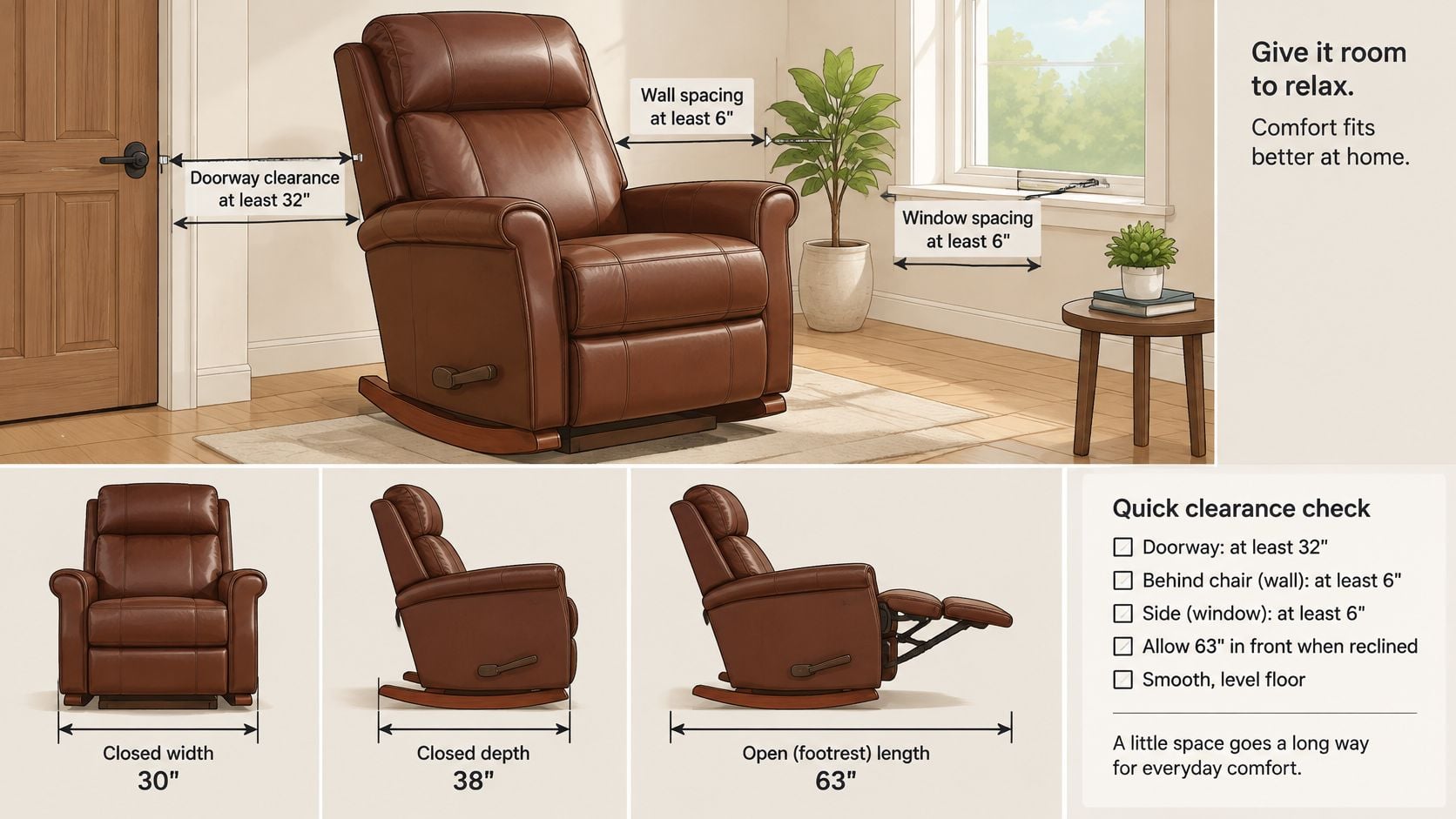
Plan for power and daylight
Power recliners need an outlet within reach, with the cord routed clear of walkways and the mechanism. Check the manufacturer's placement requirements before choosing the chair's position.
Direct sunlight through south- or west-facing windows can affect leather over time. Place the chair outside the sun's path or use suitable window treatments while keeping the reading area comfortable.
Tape the chair's closed and fully reclined footprints on the floor, then check that the walking route still works. If you are also planning guest accommodation, bunk room layouts for vacation rentals offer a related reminder to account for circulation as well as furniture footprint.
Custom Orders and Financing at Tyner
A custom order makes sense when a specific choice improves how the chair fits the room or the person using it. Tyner Furniture offers a Custom Order option, and most pieces can be customized to personal style and comfort. Fabrics, top-grain leathers, finishes, and configurations vary by model, so confirm the available choices for the rocker recliner you're considering. The custom upholstered recliner options at Tyner Furniture are a useful starting point.
Personalisation with a purpose
Choose a finish suited to daily use, and a seat size that fits the sitter. Stressless furniture is available at Tyner, with Small, Medium, and Large sizing. Because height alone doesn't determine fit, compare how each size supports your thighs and back while seated.
Custom choices extend beyond recliners. Canadel dining furniture offers options such as leg styles, table edges, finishes, and distress levels. Amish solid wood furniture provides another route for coordinating dining or bedroom pieces, with craftsmanship and material choices shaping the look and long-term use.
- Useful customisation: A finish, size, or function that improves daily ownership.
- Unnecessary complexity: Added features the household won't use or maintain.
- Long-term value: Consider construction and repair options alongside the leather specification.
Keep the payment separate from the value
Tyner Furniture offers special financing with approved credit. Financing may help spread the cost into monthly payments, but compare the full purchase cost and payment terms before deciding. Confirm eligibility, payment obligations, and any promotional conditions.
A lower monthly payment doesn't determine whether the chair is good value. Compare the complete specification, expected use, and ownership costs, then choose an order the household can comfortably afford and maintain.
Book Your Sit Test in Ann Arbor
A useful sit test starts with measurements, not a colour choice. Bring the room dimensions, the intended recliner location, and questions about the leather specification so the showroom conversation can focus on fit and finish.
Compare chairs against how they will be used at home. Rock gently, try the full recline sequence, and check whether the headrest and lumbar support stay comfortable. Run a hand over the seat front and arm caps, where repeated contact can make differences in texture and sheen easier to judge.
Bring the decision into focus
- Body notes: Any difficulty sitting, standing, or reaching the controls.
- Room notes: The planned footprint, delivery route, nearby outlet, and window exposure.
- Material questions: Which panels use top-grain leather, what finish is applied, and which care or repair options are available.
Tyner Furniture has served Southeast Michigan since 1957. Its shop includes furniture categories from Living Room and Home Office to Outdoor, so the recliner can be considered alongside other rooms and furnishings.
For a custom-order discussion, bring the preferred dimensions, colour, and finish, along with a clear idea of the features that matter most. Tyner offers a Custom Order option, and most pieces can be customized to suit personal style and comfort. A showroom sample helps you judge the leather and seat feel; the final selection should also fit the room and the person who will use it.
A top-grain leather rocker recliner is a long-term purchase. Compare its high-contact areas in person, confirm the specifications, and weigh the expected years of use against the price. Visit Tyner Furniture to arrange a sit test in Ann Arbor and discuss options.