Aniline Leather Sofa Guide for Beauty and Longevity

A shopper in Ann Arbor runs a hand across two leather samples. One shows open grain, subtle color shifts, and small natural marks; the other looks more even and seems easier to live with. Choosing between them means deciding what kind of surface will share everyday life, not just what looks striking under showroom lights.
An aniline leather sofa can become an heirloom-quality choice when its natural character suits the room and its owner accepts attentive care. It can also be a frustrating fit if spills, pets, sunlight, or expectations of a uniform finish make protection the priority. For a local furniture business serving Southeast Michigan since 1957, the right guidance starts with understanding the finish, then weighing construction, household habits, care, repair, and long-term value.
Why Leather Choice Changes Over Time
The natural sample may feel buttery and warm, with grain that makes each section look a little different. The more uniform sample may feel reassuring to someone who wants a sofa to look composed through busy evenings and regular use. Neither reaction is wrong. They reflect different expectations for a material that changes as people sit, stretch out, and gather around it.
Aniline leather is often chosen for its softness and visible character, but those same qualities can make marks and color changes more noticeable. A buyer who welcomes patina may see a surface that grows more personal with use. Someone who wants a consistently even appearance may instead find that ordinary wear looks like a flaw. The key is to decide what aging should mean in the home before selecting a finish.
A useful question: Would the sofa still feel right if its color and surface changed unevenly over time?
That question matters as much as the room's dimensions or the sofa's silhouette. A quiet reading room, a family room where people eat and drink, and a sunlit apartment place different demands on upholstery. Room conditions, cleaning habits, and access to qualified restoration all affect whether natural leather feels like a sound investment.
A sofa's long-term value also depends on its frame, cushioning, and craftsmanship. A beautiful hide can't compensate for construction that doesn't suit regular use. Buyers should consider longevity and cost-per-year alongside the initial appeal, rather than judging value by appearance or price alone.
The decision becomes clearer when shoppers identify the exact finish, compare alternatives, and test samples under the room's lighting. Then they can ask about care, repairs, customization, and whole-sofa construction before committing. That's a calmer path through what can otherwise feel like an overwhelming furniture purchase.
Understanding What Aniline Leather Is
The word aniline describes how leather is finished, not the sofa's shape, construction, or guarantee of durability. The process begins with a hide colored primarily by transparent, soluble dyes. Unlike an opaque pigment layer, these dyes don't conceal the hide's grain and natural markings.
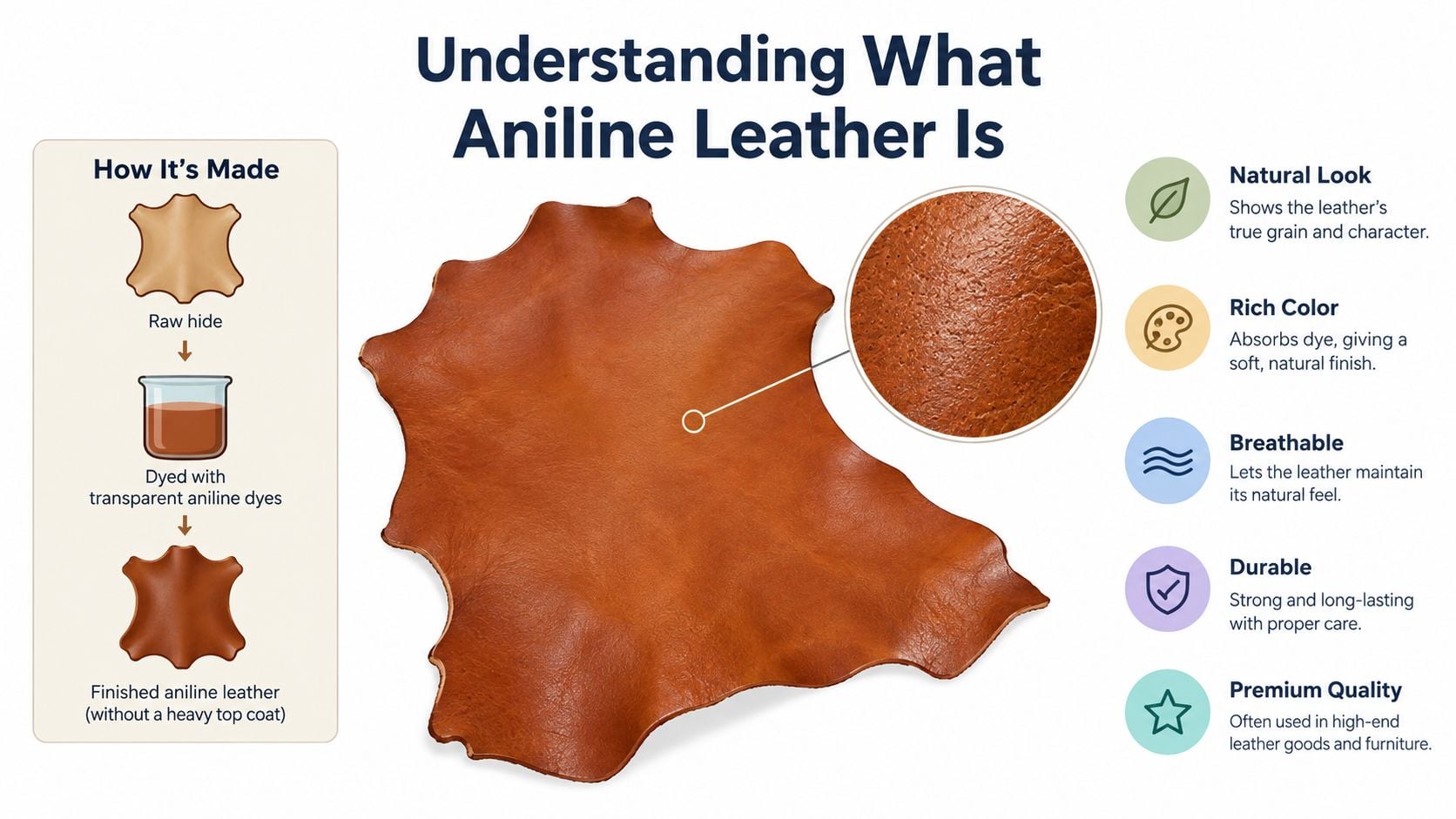
From dye to surface character
Think of the dye as entering the hide rather than sitting on top as a painted layer. The grain, pores, scars, wrinkles, and variations in tone remain visible. With less surface coating between a person and the leather, the feel can be soft and temperature-responsive, often described as buttery. The same openness that preserves texture also leaves the surface more exposed to moisture, oils, scratches, and light.
Over time, use can leave a visible patina, a gradual record of the sofa's life. Some owners value that changing appearance; others prefer upholstery that stays more consistent. Aniline leather is a premium, limited-selection material: a peer-reviewed leather-industry article reports that fewer than 5% of upholstery hides qualify for the category because makers need hides with especially attractive, consistent natural texture (leather-industry research on aniline finishes).
The label alone doesn't settle what a buyer is getting. Pure aniline has no protective coating that substantially changes its surface. Semi-aniline has a light protective topcoat and may include limited pigmentation. Protected aniline sits in a category worth clarifying with the maker, since product descriptions may use the term differently.
Pro-Tip: Ask for the exact finish classification in writing, then handle a large sample rather than relying on a small swatch.
That inquiry belongs alongside questions about hide selection, care instructions, and expected variation. A guide to upholstery materials can help shoppers compare material terms, while a leather document holder UK guide offers a related example of how leather character appears in a smaller everyday object.
At the South State St. showroom, shoppers can ask whether a sample is pure aniline, protected aniline, or semi-aniline, and compare its color and texture in person. A large sample viewed under lighting similar to the intended room is more useful than judging a product photo alone.
Comparing Aniline and Semi-Aniline Leather
The practical difference between leather finishes is the balance between natural appearance and surface protection. Pure aniline shows the hide most directly. Semi-aniline adds a light topcoat, and may use limited pigmentation, for greater consistency and resistance. Protected aniline also has added protection, but the exact finish should be confirmed with the manufacturer rather than inferred from a label.
Pigmented leather takes a more uniform approach, using an opaque surface layer that can mask some natural variation. That can make it a sensible option when consistent color and easier maintenance matter more than seeing every mark in the hide. More protection doesn't make a finish universally better; it makes it better suited to particular expectations and patterns of use.
Leather Finish Choices at a Glance
| Finish Type | Appearance and Feel | Maintenance Profile | Best Household Context |
|---|---|---|---|
| Pure aniline | Most visible natural variation, soft and direct-feeling | Highest care needs, with greater exposure to stains and fading | Quiet rooms and owners who value patina |
| Protected aniline | Natural grain remains visible, with some added surface protection | Care needs depend on the specific protective treatment | Buyers seeking a natural look with some added protection |
| Semi-aniline | Visible grain with a more consistent appearance and light topcoat | More manageable than pure aniline, but still requires maker-approved care | Everyday seating where character and practicality both matter |
| Pigmented | More uniform color, with less natural variation visible | Generally selected for a more protected, consistent surface | High-use rooms and households prioritizing easier upkeep |
A quiet reading room may suit pure aniline if its owner welcomes natural variation and can manage sunlight and spills. A busy family room may call for semi-aniline or pigmented leather if drinks and frequent use make a more forgiving surface important. In a sunlit apartment, no label alone resolves the concern: the buyer should discuss exposure and placement, then compare large samples in the room's intended lighting.
Practical rule: Don't choose by a finish name alone. Ask what protective treatment is present and how the maker expects the surface to behave.
Natural grain can look different across a large sofa than on a small sample. That's expected with aniline, where visible variation is part of the material's character, not necessarily a sign of inconsistent manufacturing. Seeing a larger piece under realistic light helps shoppers decide whether that variation feels warm and distinctive or too unpredictable.
Evaluating Durability Without Misleading Numbers
A durable hide is only part of a durable sofa. The frame, cushioning, seams, and suitability for the room's use all matter. Buyers comparing leather options should also ask how performance figures were measured, because a test number without its method doesn't provide a reliable prediction of household life.
Leather and fabric aren't always evaluated through the same abrasion method. Fabric commonly uses Wyzenbeek double-rub or Martindale testing, while leather is often assessed with a rotary Taber abrasion test. Results only become useful when the test method, wheel, load, leather finish, and point at which visible wear is recorded are identified. A figure for one finish and test setup can't be treated as a universal rating for every leather sofa (leather abrasion testing methods).
What a performance test does and doesn't tell you
A European Union procurement specification sets a dry-flex requirement of 20,000 cycles without finish damage or cracking for aniline leather with a non-pigmented finish (technical background on aniline leather). That's a laboratory performance benchmark, not a promise about how long a sofa will last at home. Household longevity also depends on construction, use, care, humidity, and sunlight.
A useful inspection starts with documentation, then moves to the whole piece:
- Confirm the test details: Request the standard, test equipment, load, finish classification, and visible-wear endpoint behind any abrasion claim.
- Inspect construction: Ask about frame materials, joinery, cushion support, and the maker's care and warranty terms.
- Look closely at seams: Check that the seams appear consistent and suited to the sofa's design.
- Ask about the hides: Find out how natural variation is handled across the visible panels.
- Consider the room: Be honest about sitting frequency, pets, food and drink, and sun exposure.
Shoppers comparing upholstery categories can also review a guide to top-grain and bonded leather, while keeping finish classification separate from hide terminology. A sofa is a long-term purchase, so cost-per-year can help frame value more thoughtfully than a single price or test result. The most attractive number is still only one piece of the decision.
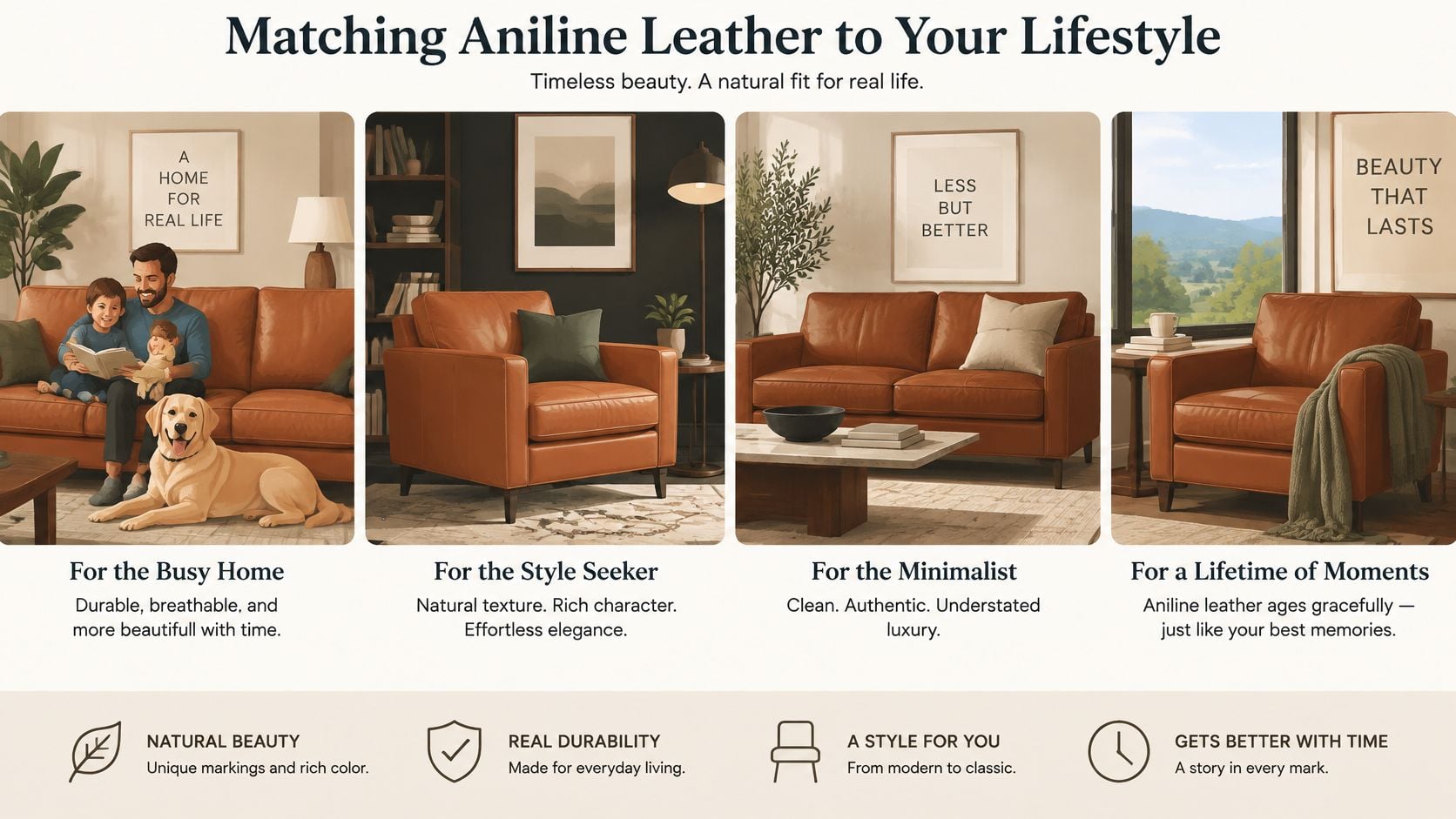
Matching Aniline Leather to Your Lifestyle
A finish that feels effortless in one home can create worry in another. The difference often comes down to where the sofa sits, how people use it, and whether the owner accepts visible changes as part of leather's character.
| Room or household setting | Aniline may fit when… | A more protected finish may fit when… |
|---|---|---|
| Low-risk room | Use is occasional and the owner welcomes patina | A steady, uniform appearance matters more |
| High-traffic room | Regular wear is acceptable and care is consistent | The sofa serves as a daily gathering place |
| Spill-prone setting | Food and drinks are kept away from the upholstery | Eating and drinking on the sofa are routine |
| Sun-exposed room | Placement can limit prolonged direct exposure | Light exposure can't be managed easily |
A pet household deserves a direct conversation about behavior, not just the presence of animals. Light scratches may become part of the surface's evolving character, but claws and accidental punctures can also produce damage that the owner doesn't welcome. Families who expect frequent spills may prefer a finish with more protection and easier day-to-day management. A guide to kid-friendly and pet-friendly furniture can support that wider room-planning discussion.
Renters and owners of shorter-term homes should think about moving and repair access as well as daily use. A sofa that fits a current layout may need to move through different doorways or serve a different room later. If restoration is important to the purchase decision, shoppers should identify qualified help before choosing a finish that shows marks readily.
Sunlight, humidity, cleaning habits, and planned length of ownership all deserve attention alongside color. Someone furnishing a forever home may be comfortable watching leather evolve; someone seeking an even appearance through changing rooms may prefer a more protected surface.
A simple self-check can clarify the choice: Does natural variation feel appealing? Can the sofa be kept away from prolonged direct sunlight? Will spills be addressed promptly, and is visible wear acceptable? If the answers are mostly yes, aniline may be worth considering. If not, the finish can be adjusted to suit the room rather than abandoning leather altogether.
Caring for an Aniline Leather Sofa
A care routine should protect the leather without trying to make it look artificially uniform. Gentle, regular attention is safer than an improvised treatment, especially when the exact finish is unfamiliar.
A calm care sequence
- Remove dust gently: Use a clean, soft cloth and avoid abrasive materials that could mark the surface.
- Respond to spills promptly: Blot rather than rub, and follow the sofa maker's instructions for that specific finish.
- Manage prolonged sunlight: Consider the sofa's placement and the way direct light reaches its upholstery.
- Check high-contact areas: Look over arms, seats, and other frequently touched places for changes in appearance.
- Condition only when advised: Use a product only if the maker recommends it for the particular leather.
Pro-Tip: When the sofa arrives, locate its care guidance and photograph the upholstery in natural room light. That baseline makes later color changes easier to understand as patina rather than a sudden, unexplained shift.
Generic household cleaners and improvised remedies can be a poor match for an unfamiliar finish. A product intended for another surface may alter the leather's appearance or conflict with the maker's care guidance. Before cleaning a mark, shoppers should identify the finish and ask which products and methods are approved.
For Southeast Michigan households, seasonal dust and changing exposure to daylight are practical reasons to keep up with gentle dusting and review the sofa's placement. Those checks don't require an elaborate routine. They do require consistency and an understanding that aniline leather's natural appearance won't stay perfectly unchanged.
Owners who also care for leather accessories may find storage tips from Colorado Art Services useful as general context for handling leather goods. Furniture, however, has its own construction and finish requirements, so the sofa maker's instructions should take precedence. A focused leather furniture protection guide can help buyers prepare before the first spill occurs.
Judging Repairability Safety and Real Value
Visible wear isn't automatically a reason to replace a sofa. Some light scratches, drying, and localized discoloration may improve with qualified leather restoration, while deep dye transfer, ink, severe fading, or cushion failure may require specialist work or replacement. A repair assessment depends on the damage, finish, and condition of the whole sofa, so owners shouldn't assume every mark is either harmless patina or permanent failure.
Repairability can contribute to long-term value, but it doesn't erase the need for care. Before buying, ask whether restoration support is available locally and what kinds of damage a specialist can reasonably address. A leather couch repair guide may help shoppers understand why repair decisions should account for the specific surface rather than relying on a one-size-fits-all approach.
Odor and indoor-air questions
“Natural” doesn't mean emission-free, and concerns about odor deserve practical answers rather than alarm. A study of leather sofas detected volatile organic compounds, including aldehydes and ketones, and found barely detectable non-carcinogenic and carcinogenic inhalation risks under its tested conditions, while recommending stronger emissions specifications for manufacturers (research on emissions from leather sofas). A separate chamber study identified VOCs from natural upholstery leather. Buyers can ask what material or emissions disclosures are available for the leather, adhesives, dyes, and foam, then follow the maker's advice about ventilating new furniture. Those questions may matter especially in tightly sealed homes or for people with asthma or chemical sensitivities.
A premium finish can be the wrong fit if its care needs, odor, or appearance don't suit the household.
Long-term value is a relationship between durability, use, repair access, and how long the owner wants to keep the sofa. Cost-per-year can help frame that relationship without pretending that a particular finish guarantees a certain lifespan. Special financing, subject to credit approval, may help make a considered purchase manageable, and the Low Price Promise offers another way to evaluate value without treating the lowest upfront cost as the only measure.
Made-to-order options can help buyers select a configuration and covering that suit their home rather than accepting an in-stock setup as the final answer. The in-stock selection is just the beginning. Custom upholstery can involve finishes and fabrics, while Canadel offers bespoke dining choices and Stressless provides ergonomic seating options with different sizing. For context on careful upkeep of older goods, a guide to vintage Singer sewing machines offers a related perspective on maintaining items with character, though leather restoration should be handled by a qualified specialist.
Making Your Final Leather Decision
The decision doesn't hinge on whether aniline is the most luxurious finish or the most practical one. It depends on whether its natural appearance, care requirements, and capacity to change suit the room and the people using it. Buyers who value visible grain, softness, and patina and can manage careful upkeep may consider pure or protected aniline. Those who want more consistency and easier exposure management may feel better with semi-aniline or pigmented leather.
Before ordering, confirm the exact finish classification and ask for written care terms. Assess the frame, cushions, seams, and hide matching, then consider room conditions, delivery access, repair options, and cost-per-year. Only after those questions are answered should appearance carry the decision.
Customization can make the choice more precise. In-stock is just the beginning: a made-to-order sofa may offer a better fit for a room's dimensions, preferred configuration, or leather finish. Stressless seating also brings ergonomic considerations into a furniture decision, while Canadel supports bespoke dining choices for a coordinated home. Solid-wood Amish hand-crafted bedroom and dining furniture offers a different kind of longevity, with attention to joinery and material integrity rather than mass-produced construction.
The local selection extends from the Home Office to Outdoor Spaces, making it easier to consider how upholstery relates to the home as a whole. A business serving the community since 1957 brings a local legacy to furniture decisions that may last well beyond a change in décor.
Visit the Ann Arbor showroom on South State St. for a sit test and to inspect leather samples under real lighting, or browse online Quick Specs to begin a special order. A few direct questions about finish, care, construction, and repair can turn a complicated decision into a confident one.
For an aniline leather sofa, the right choice begins with an honest look at daily use, not a promise of flawless upholstery. Visit Tyner Furniture to compare leather samples, explore made-to-order configurations, and get practical guidance for choosing a finish that suits your home.