Recliners for Heavy Man: A Buyer’s Guide to Real Comfort


A shopper walks into a showroom after another evening spent in a recliner that pinched his shoulders, left his knees unsupported, or rocked every time he leaned back. He isn't looking for a chair that merely carries his weight. He needs a recliner that feels planted, supports his frame, helps him stand, and remains comfortable after years of daily use.
That search requires more than filtering products by a large number on a specification sheet. Recliners for a heavy man should be evaluated as engineered seating, with attention to load margin, seat geometry, base stability, mechanism design, upholstery, and long-term craftsmanship. The right chair is an investment in comfort and independence, not another living-room purchase.
Why Most Recliners Disappoint Heavier Shoppers
A heavier shopper can sit in a showroom and know within minutes that a recliner is wrong. The arms crowd the hips, the cushion bottoms out, or the footrest leaves the lower legs unsupported. The problem is rarely padding alone. It is usually a mismatch between the chair's structure, proportions, and the way the body moves through sitting, reclining, and standing.
Standard recliners are designed around typical household use. Heavy-duty models use a stronger frame, reclining mechanism, seat platform, and pivot points to manage greater loads through the full range of motion. A capacity label matters, but it does not tell you whether the chair feels stable, gives your shoulders room, or lets you stand without fighting the mechanism.
Comfort failures usually begin with poor geometry
Generous cushioning cannot correct the wrong dimensions. A narrow seat presses against the hips and arms. A shallow seat leaves the thighs unsupported. A deep seat can pull the back away from the lumbar area and place the knees too far forward. Those problems become more noticeable after extended daily use.
The footrest must support the legs when fully extended, and the back should stay in contact with the body as the chair reclines. Watch what happens when you shift your weight. A chair that feels acceptable upright may rock, twist, or lose balance once the body moves backward.
Internal construction matters as much as upholstery. Repeated transfers and reclining cycles place changing forces on the frame, joints, and mechanism. Thick fabric or dense-looking padding cannot compensate for a weak foundation.
Practical rule: Choose a recliner around the user's body and movement pattern, not merely around a published capacity.
A better question for the showroom
Ask whether the frame, mechanism, and proportions were built for regular use by your body, then test the answer in person. Tyner's ultimate recliner buying guide can help you prepare, but a product page cannot show how the chair responds to your posture and reach.
Use this showroom checklist:
- Measure the body: Record hip width, seated thigh length, shoulder height, and the arm clearance you need.
- Check the full recline: Raise the footrest and confirm that your thighs, calves, back, and head remain supported.
- Test the transfer: Push from the arms and seat without twisting or forcing your shoulders.
- Inspect the base: A broad, planted footprint should feel steady as you sit down, recline, shift, and rise.
- Consider daily wear: A chair used every day needs structural margin and durable working parts, not just attractive upholstery.
At Tyner Furniture's South State St. showroom in Ann Arbor, you can sit-test chairs with your own posture, reach, and movement. That hands-on check exposes fit and stability problems before they become an expensive online guess.
What Weight Capacity Really Means for a Heavy-Duty Recliner
A capacity number tells you the maximum tested load. It does not tell you whether the chair will feel stable, align with your body, or hold up through repeated reclining and standing. For a heavier buyer, capacity is an engineering starting point, not the final buying decision.
A practical target is a rating at least 50 pounds above the user's actual weight. Heavy-duty seating commonly spans 350 to 550 pounds and may include reinforced steel or iron frames with upgraded mechanisms, according to heavy-user recliner guidance. A 300-pound shopper is better served by a chair in the 400-pound class than one rated exactly at 300 pounds. That margin accommodates movement, transfers, and repeated loading.
Capacity tiers in context
| Tier | Typical Capacity | Frame and Mechanism | Best For |
|---|---|---|---|
| Standard residential | About 250 to 300 pounds | General-purpose frame and mechanism | Lighter users whose proportions match the chair |
| Large occupant | About 350 to 500 pounds | Reinforced rails and upgraded reclining components | Heavier users needing additional structural margin |
| Heavy-duty | Commonly 350 to 550 pounds | Reinforced steel or iron structure and stronger mechanism | Daily use with repeated reclining and transfers |
| Bariatric | Published limits of 20 to 25 stone, or 127 to 160 kilograms, as standard, with bariatric versions reaching up to 70 stone, or 444 kilograms | Specialized frame, lift, and mechanism design | Users requiring substantially greater load support |
These categories describe structural capacity, not personal fit. A 500-pound rating on a narrow chair can still leave the occupant cramped or unstable if the seat, arms, and base do not match their proportions. A chair with a lower rating may feel better built for a particular body, but the manufacturer's stated limit must never be exceeded.
Capacity should be paired with a recognized benchmark
ANSI/BIFMA X5.1 provides a mainstream general-purpose chair benchmark. ANSI/BIFMA X5.41 addresses large-occupant public and lounge seating using 400-pound and 600-pound basis users, as explained in this BIFMA seating standards overview. These benchmarks help separate a documented structural claim from vague sales language.
A rating also needs context. Ask whether it applies to the upright position, the fully reclined position, or both. Ask what the frame and mechanism are made of, whether the base stays planted during transfers, and whether the warranty covers frame or mechanism failure.
Use the capacity number to narrow the field, then test the chair in person. Sit upright, recline fully, shift your weight, and rise using the arms. If the chair flexes, rocks, pinches, or leaves your head unsupported, the rating has not solved the problem.
Capacity plus safety margin plus correct geometry earns trust. At a Southeast Michigan showroom, a sit-test reveals those factors far more clearly than an online specification sheet.
Sizing and Measurements That Actually Fit a Bigger Body
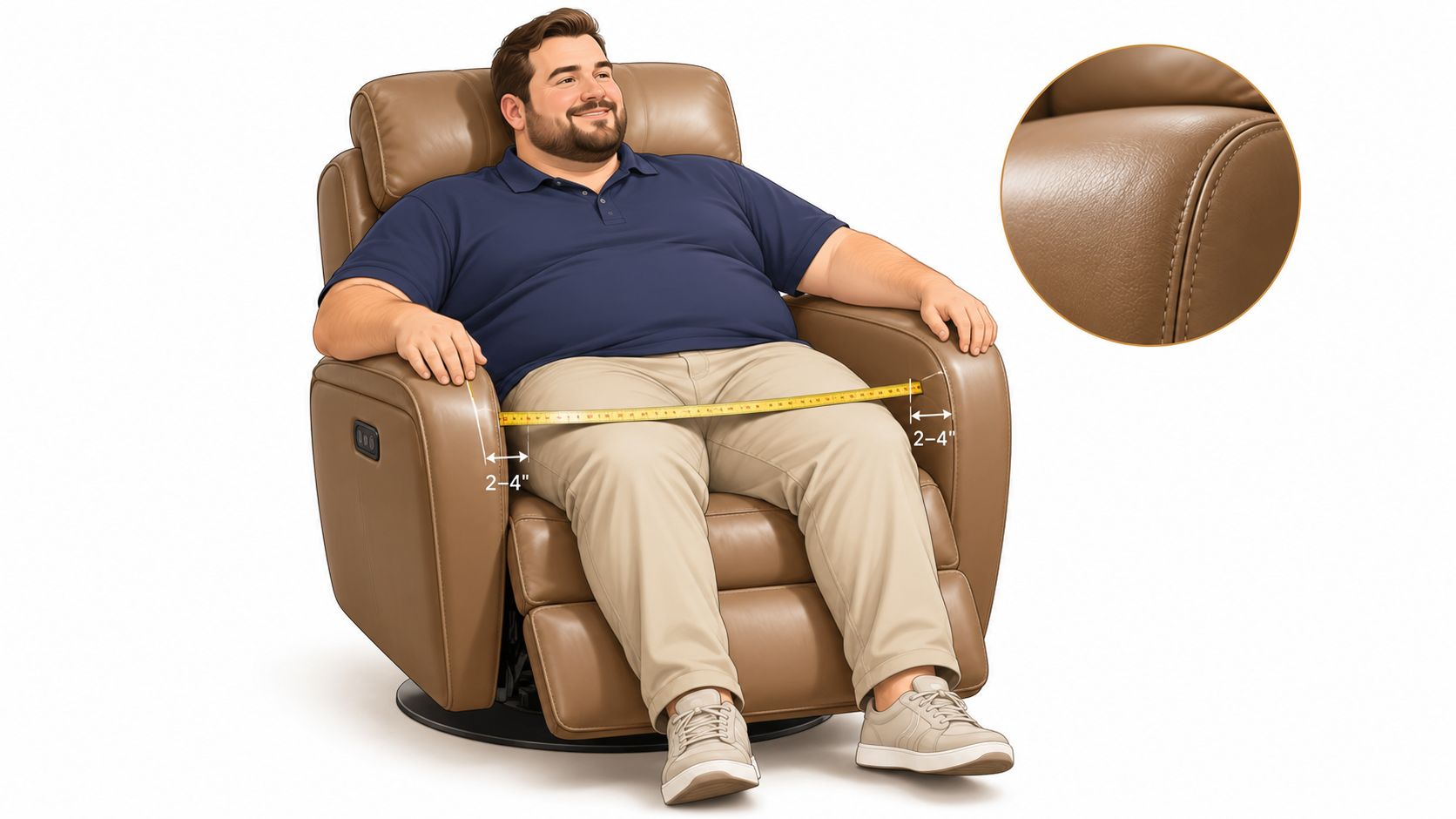
A larger recliner is not automatically a better fit. The seat should clear the hips without letting the body drift away from the back. The depth should support the thighs while keeping pressure off the backs of the knees. Those two measurements determine comfort more reliably than an oversized label.
Use size classes as a first screen. Small chairs generally run 18 to 20 inches wide and support up to about 250 pounds. Medium models measure 20 to 22 inches and support up to about 300 pounds. Large chairs measure 22 to 24 inches and support up to about 350 pounds. XL models measure 24 to 26 inches and carry a capacity of 400 pounds or more. These ranges help narrow the showroom choices, but your body still has to confirm the fit.
Start with width and depth
Measure the widest part of your hips, then compare it with the chair's usable seat width. Leave enough clearance to change position without rubbing the arms. Excess width creates a different problem. If the arms sit too far away, they stop supporting the body during ordinary movement.
Seat depth needs the same attention. Large-occupant seating guidance points toward about 21 to 23 inches of seat depth and 22 to 25 inches or more of seat width for better thigh support and pressure distribution. Sit fully back and check that the lumbar area meets the back cushion. Your feet should rest naturally, with no hard cushion edge pressing behind the knees.
Check back height and arm position
A taller shopper usually needs a taller backrest. In full recline, the shoulders and head should remain supported. The headrest should meet the head without pushing the chin toward the chest or leaving the neck suspended.
Arm height controls how confidently you enter and leave the chair. Low arms force the shoulders upward and pull the torso forward. High arms interfere with a natural push-off. Set both hands on the arms and rise once. Your feet should move beneath you without twisting or straining.
Bring a tape measure to the showroom, plus a small pillow if you normally use lumbar support. Use this recliner dimensions guide to compare measurements before visiting the South State St. showroom. Then sit in the actual chair. Your knees, lumbar area, shoulders, and arms should stay supported without conscious adjustment.
Showroom test: Sit fully back, place both feet naturally, recline, and check every contact point before you judge the chair.
Stability, Recline Geometry, and Why Ratings Can Mislead You
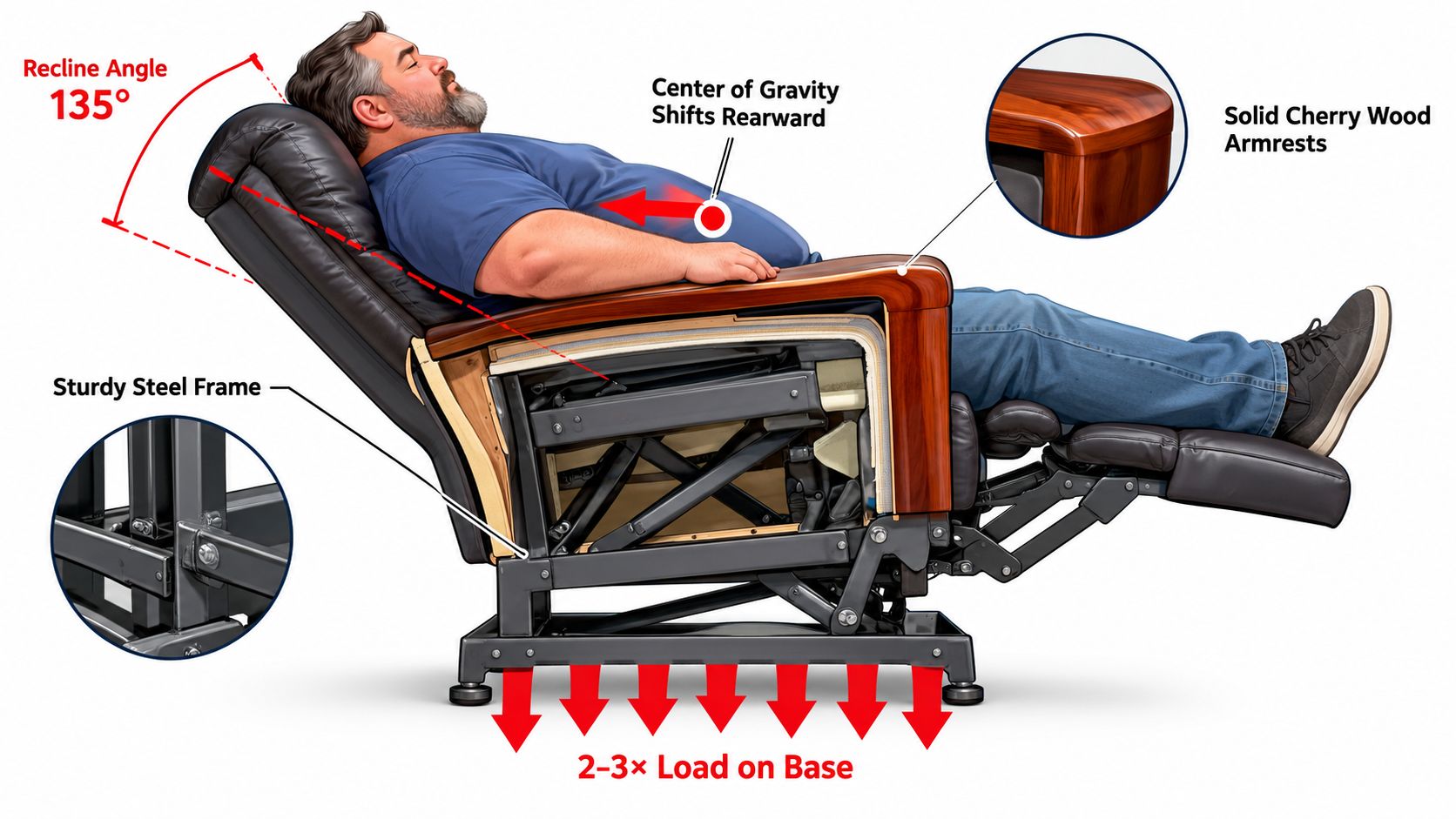
A chair can meet its published capacity and still feel unstable in daily use. Stability comes from the relationship between the body's center of mass, the recline angle, the base footprint, and the force produced by the moving footrest, not from the capacity label alone.
As the back reclines, the body's weight shifts toward the rear. When the footrest extends, it sends force forward and lengthens the load path across the base. A narrow footprint, flexible cross-support, or poorly controlled mechanism can make a high-capacity recliner feel unsettled when you lean, rock, sleep, or sit down with momentum.
Static ratings do not describe daily movement
Published ratings usually reflect controlled loading. Real use includes lowering into the seat with momentum, pushing against one arm, shifting sideways, pulling on the footrest, and standing while the chair remains partly reclined.
That movement creates forces beyond a perfectly centered seated position. Choose a chair with clear room between your body weight and its stated capacity, then test whether it stays planted through each transition.
Inspect the chair beneath and around the upholstery:
- Base footprint: A broad stance generally feels more planted than a narrow pedestal.
- Seat deck: Cross-bracing and reinforced rails spread force through the frame instead of concentrating it in one area.
- Pivot construction: Steel-to-steel pivot points suit repeated heavy use better than visibly light hardware.
- Footrest travel: The extension should move smoothly, without scraping, dropping, or hitting its stop abruptly.
- Side movement: Reject a chair that shifts laterally under ordinary pressure.
Recline geometry controls comfort and control
A recliner should support a relaxed posture while keeping the pelvis from sliding forward and the lumbar area from collapsing. The useful test is physical, not theoretical. Recline fully, keep your shoulders against the back, and check whether your hips remain stable as the footrest opens.
Center of mass matters most during transitions. If your torso moves rearward while the footrest reaches forward, the base must resist rocking. Sit off-center, lean gently to each side, and rise from a partly reclined position. Any rocking, twisting, or sudden catch indicates a poor match between your body and the chair's geometry.
A shopper who sleeps, rocks, or leans to one side needs extra testing. Use this recliner type guide to understand broad categories, then sit-test the actual chair at a local showroom. Custom-fit options let you judge balance, contact points, and control in person instead of trusting a rating alone.
Mechanisms, Frames, and Materials Built to Last
A heavier body exposes weak hardware quickly. Test how the chair starts, moves, stops, and returns to an upright position. The mechanism must control those transitions without sudden catches, frame movement, or excessive effort.
A manual lever offers direct operation and fewer electronic parts, provided the hardware and mounting points are reinforced. Push-back recliners have a clean appearance, but they require more body force and balance to open and close. Power recline gives finer positioning with less exertion. Zero-gravity positioning changes the chair's overall angle to distribute pressure more evenly, while lift assist helps the user move toward standing.
For anyone with limited leg strength, lift assist serves a practical purpose. Inspect the motor, scissor assembly, controls, frame connections, and backup battery, rather than accepting the capacity label as proof of quality.
Compare the moving parts
| Mechanism or Material | Load Handling | Durability for Daily Use | Best Fit for Heavy Buyer |
|---|---|---|---|
| Manual lever recline | Direct mechanical control | Fewer electronic components, but hardware still needs reinforcement | Users who can operate a lever comfortably |
| Push-back recline | Uses body pressure to open | Depends heavily on frame balance and pivot quality | Users wanting a simple appearance and controlled movement |
| Power recline | Motorized adjustment | Requires quality motors, wiring, and protected controls | Users seeking precise positioning with less exertion |
| Zero-gravity positioning | Changes overall body angle | Strong construction is essential because the chair moves as a system | Long sitting periods and pressure-conscious positioning |
| Lift-assist mechanism | Helps transition toward standing | Motor, scissor mechanism, frame, and battery must work together | Users who need safer sit-to-stand support |
| Kiln-dried hardwood frame | Broad structural support | Resists the problems associated with poorly prepared wood | Buyers prioritizing longevity and heirloom construction |
| Steel-reinforced rails | Transfers force through the frame | Well suited to repeated loading when properly joined | Heavier users needing structural confidence |
| Top-grain or full-grain leather | Flexible, durable surface | Generally better suited to repeated flex than bonded coverings | Shoppers wanting the buttery feel of leather and long use |
| High-density foam with Dacron wrap | Consistent seat support | Holds shape longer than cut foam alone | Users needing resilient cushioning under daily load |
Materials reveal the chair's intentions
Kiln-dried hardwood, reinforced rails, and properly joined structural members provide a stronger foundation than particleboard held mainly by staples and adhesive. Joinery matters because it determines how forces travel through the frame. A well-cut mortise-and-tenon joint in hardwood handles racking stress through interlocking wood surfaces, supporting the broader craftsmanship principle behind durable furniture construction.
Tyner Furniture offers hand-crafted Amish solid wood pieces, with material integrity, joinery, and custom finishes separating them from mass-produced construction. Solid cherry, oak, and maple also create a substantial feel throughout the home, from Home Office furniture to Outdoor Spaces. For a recliner, the same standard applies: inspect the frame connections, rail support, and hardware instead of judging the chair by upholstery alone.
Review power reclining seating options to compare control styles and positioning features, then test the actual chair in person. A showroom trial exposes motor noise, footrest control, side movement, and transition stability far better than an online rating. Choose the chair that stays planted and operates cleanly under your body, not merely the one with the highest printed capacity.
Custom Fit and Ergonomic Precision for Long-Term Comfort
Capacity solves only one problem. Fit determines whether the chair remains comfortable after the novelty wears off. A broader or taller user may need more seat depth, greater arm clearance, a taller back, and cushioning that resists early collapse. A generic “large” label cannot account for all of those variables.
Guidance for big users commonly places seat depth around 21 to 23 inches, while some taller occupants benefit from 23 to 25 inches for stronger thigh support and lumbar contact (large-occupant seating guidance). The correct measurement depends on the individual's leg length and seated posture. A deep seat that supports one shopper may leave another slouching.
Made-to-order changes the decision
Custom ordering can address details that standard inventory can't. Depending on the collection, a shopper may be able to specify:
- Seat width: More hip clearance without losing centered support.
- Back height: Better shoulder and head contact during full recline.
- Arm height: A more natural position for pushing up to stand.
- Foam density: Cushioning selected for resilience and pressure distribution.
- Fabric or leather: A surface chosen for touch, maintenance, and interior design.
- Configuration: A recliner that works with the room rather than overpowering it.
Tyner Furniture's in-stock selection is only the beginning. Made-to-order programs can extend into finishes, fabrics, and configurations, including Canadel dining pieces and Stressless ergonomic seating. Stressless offers adjustable headrests, contoured lumbar support, and systems designed to respond to body weight, giving shoppers a more active relationship with the chair than a fixed cushion provides.
Comfort should support the whole routine
A recliner may serve as a reading chair, television seat, recovery space, or place to doze. Buyers who are also trying to improve nighttime rest can explore quieter deeper sleep strategies as part of the broader comfort plan. The chair itself still needs sensible positioning, because a relaxed posture isn't automatically the right posture for every person or every length of use.
In Ann Arbor, a shopper can compare Small, Medium, and Large seating in person, feel the difference between premium leather and fabric, and test how the lumbar contour meets the back. That physical feedback is where ergonomic precision becomes practical rather than decorative.
Your In-Store Trial Checklist Before You Buy
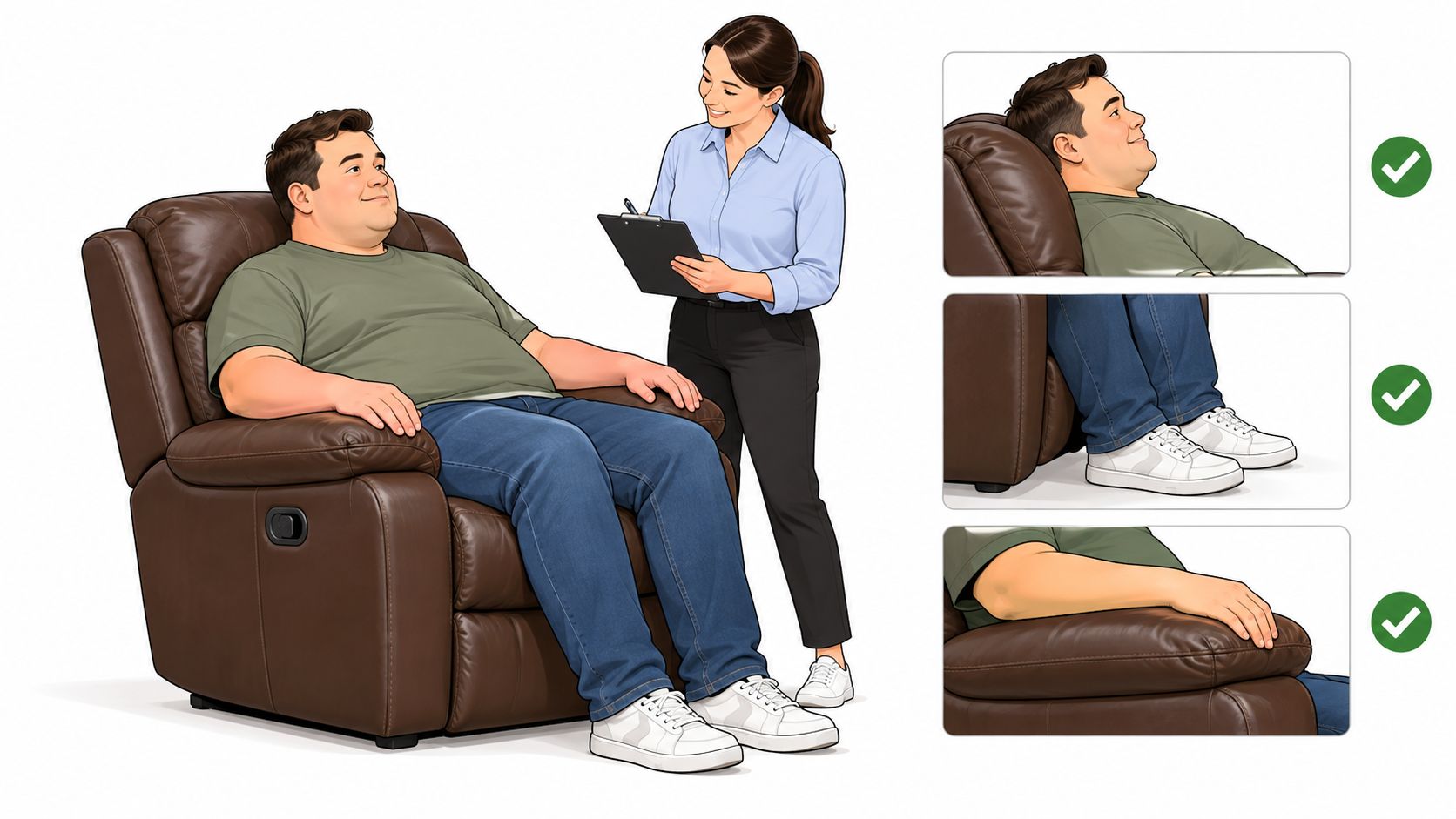
A showroom visit should feel systematic, not like a quick five-minute sit. A heavier shopper needs to test the chair through the same movements that will happen at home, including sitting down, leaning back, extending the footrest, shifting position, and standing.
Posture checks
Start upright, with the back fully against the cushion and both feet supported.
- Lumbar contact: The lower back should feel supported without requiring a forward lean.
- Knee position: The knees should remain comfortably bent rather than dangling or being pushed sharply upward.
- Headrest alignment: The headrest should meet the head without forcing the chin toward the chest.
- Arm clearance: The elbows should rest naturally without the shoulders lifting.
- Hip room: The user should be able to shift slightly without pressing into the arms.
Recline slowly and stay in the position long enough to notice pressure points. If the body slides forward, the seat angle or depth isn't working. If the heels sit beyond the footrest, the chair may be too short for the user.
Mechanism tests
Operate every control more than once. A power lift should rise smoothly and stop without a sudden lurch. A manual recline should engage without excessive force, while the footrest should open fully without scraping, flexing, or dropping.
Check the chair in both upright and reclined positions. A mechanism that feels smooth while empty may respond differently under the user's full weight, so the test must happen with the shopper seated.
Frame and base inspection
Place both hands on the arms and apply moderate side pressure. Excessive rocking, sharp creaks, or visible movement at the base are warning signs. Look beneath the chair where possible, checking for substantial rails, secure fasteners, clean welds, and a base footprint that feels proportionate to the seat.
Pass or fail: The right chair feels stable before, during, and after movement. It shouldn't require the shopper to brace against a wall, avoid one arm, or ease around a reluctant footrest.
Warranty, Financing, and Bringing the Right Recliner Home
The final decision should combine four facts: the user's actual body weight, a capacity margin, the chair's measurements, and the construction of its frame and mechanism. A heavy-duty label isn't enough if the seat is narrow or the base feels unsettled. A comfortable chair isn't enough if its rating leaves no room for repeated movement.
Warranty language deserves close reading. The useful questions are specific:
- Frame coverage: Does the warranty protect structural failure?
- Mechanism coverage: Are recline, lift, motor, and pivot components included?
- Cushioning terms: Does the policy address premature loss of support?
- Upholstery provisions: Are leather, fabric, seams, and surface wear treated separately?
- Use conditions: Are there exclusions related to capacity, commercial use, or improper placement?
The warranty information should be reviewed before purchase, not after a problem develops. A written policy gives the shopper a clearer picture of how the manufacturer defines normal use and which components carry the long-term risk.
Premium seating can be a measured investment
Cost-per-year provides a more useful frame than the initial ticket alone. A chair that maintains its shape, operates smoothly, and supports safe transfers over a long service life may deliver better value than a lower-priced chair that needs replacement after its structure or cushion gives out.
Tyner Furniture has served Southeast Michigan since 1957, and its Ann Arbor showroom connects shoppers with recliners, lift seating, Stressless ergonomic options, and made-to-order upholstery. The same store covers furnishings from the Home Office to Outdoor Spaces, along with Amish hand-crafted bedroom and dining furniture built from solid wood rather than mass-produced veneer.
Special Financing, subject to credit approval, can help spread the cost of a premium recliner or custom order. Tyner's Low Price Promise also supports competitive value while preserving access to bespoke finishes, fabrics, configurations, and local guidance. Those options matter when a heavier shopper needs a durable, properly fitted chair instead of settling for whatever happens to be in stock.
The strongest buying decision is straightforward. Select a capacity with room above the user's weight, verify width and depth against the body, test stability in full recline, inspect the mechanism, and read the warranty. Then judge the chair by how confidently it supports real daily movement.
Tyner Furniture offers heavy-duty recliners, lift seating, Stressless options, and made-to-order upholstery that can be tested for fit at the Ann Arbor showroom. Visit Tyner Furniture on South State St. for a personal sit test, or browse the online Quick Specs before arranging a special order.