Solid Wood Furniture vs Particle Board: Which Lasts Longer?

A dining table looks right online, the stain matches the floor, and the price seems manageable. Then the material description mentions engineered wood, and the same-looking table across the aisle costs considerably more. For a household furnishing a home in Ann Arbor, that's a familiar point of confusion.
The useful question in solid wood furniture vs particle board isn't which finish looks richer. It's which construction suits the room, what can be repaired, and how the purchase price compares with the years of useful service. A modest upfront purchase can be sensible, but it isn't automatically the better long-term investment.
Solid Wood and Particle Board at a Glance
Solid wood vs particle board across key criteria
| Criterion | Solid Wood | Particle Board |
|---|---|---|
| What it is | Continuous hardwood such as cherry, oak, or maple | Wood particles pressed with resin under heat and pressure |
| Typical lifespan in normal home use | Potential for multigenerational service with suitable construction and care | Useful indoor service, with replacement more likely after swelling or structural damage |
| Moisture response | Moves with humidity; sound construction accommodates movement | Exposed edges can swell after leaks and remain distorted |
| Repairability | Can often be sanded, refinished, re-glued, or partly replaced | Decorative surface limits sanding; damaged panels often need replacement |
| Typical price for a dining table seating six | Quote by species, dimensions, finish, and construction | Quote by panel grade, surface, hardware, and dimensions |
| Formaldehyde rules | Not covered by the particleboard-specific composite-wood standard | Regulated composite wood requiring applicable compliance documentation |
| Resale | Better potential when condition, craftsmanship, and maker appeal align | Usually limited, especially with damaged edges or hardware |
These are typical market comparisons, not verified price or lifespan ranges. Exact pricing requires a written quote at the South State St. showroom in Ann Arbor, where shoppers can sit with the pieces before deciding.
Particleboard's affordability starts with manufacturing. The USDA Forest Products Laboratory's panel-products report describes dry wood particles bonded with resin under heat and pressure. Smaller particles and manufacturing residues become uniform panels suitable for decorative overlays, supporting standardized production of desks, storage, tables, and bed frames.
Solid wood requires a different combination of lumber selection, machining, and joinery. Its value lies less in a flawless showroom surface than in the continuous material available for future repairs and refinishing.
Read Beyond the Finish
A label that says wood doesn't settle the construction question. The structural parts may be solid lumber, veneer over a composite core, or particleboard underneath a printed surface.
For species selection, The Knotty Lumber Co.’s guide helps shoppers compare hardwoods and softwoods for furniture. The showroom's guide to choosing hardwood for longevity and style adds another useful distinction: choosing a species and identifying the underlying construction are separate decisions.
How Each Material Handles Moisture, Heat and Daily Use
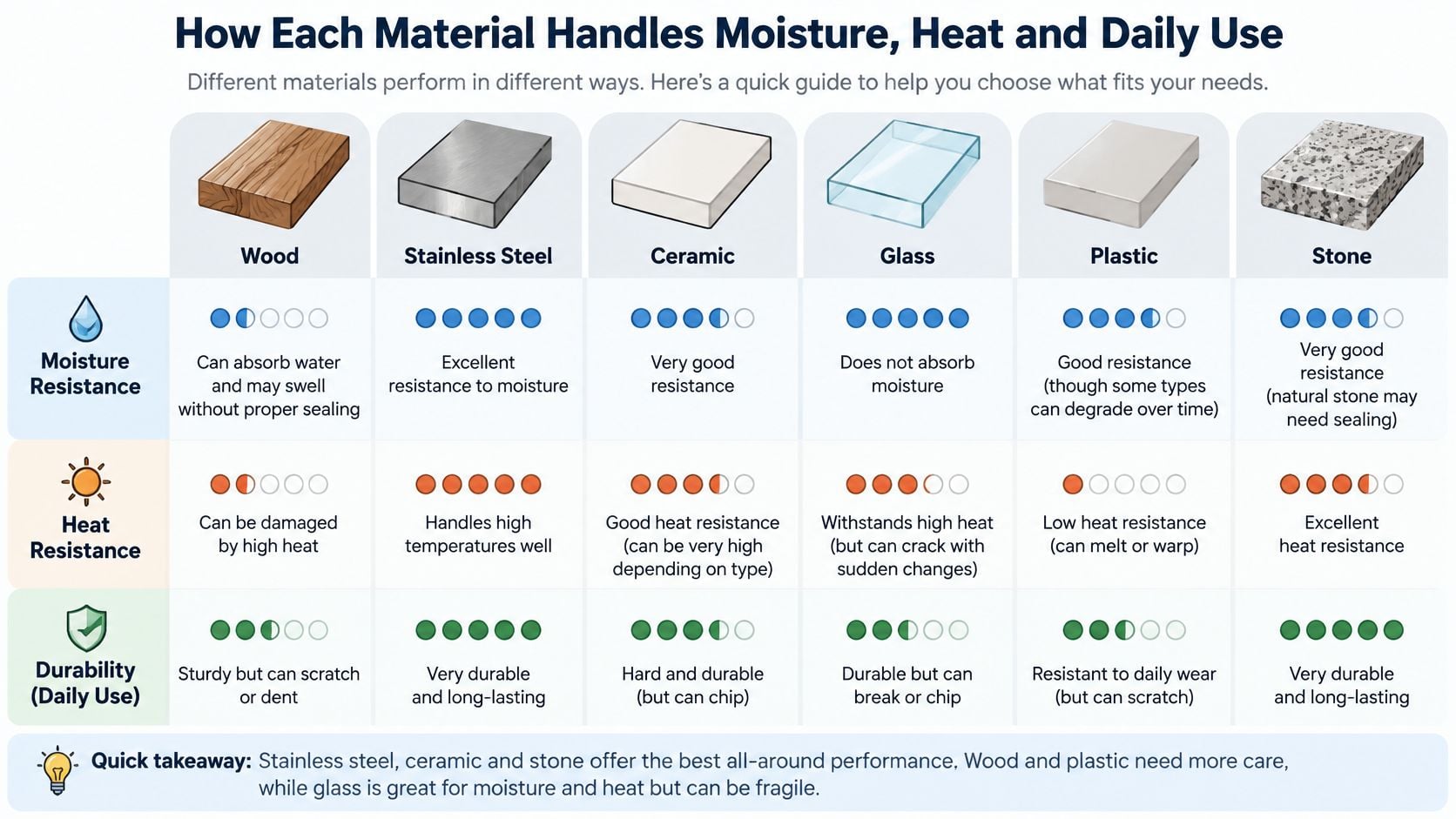
Unprotected wood-based boards experienced their greatest deterioration during the first year of outdoor exposure in USDA Forest Products Laboratory durability testing; phenolic-resin boards outperformed the tested urea-resin and urea-melamine-resin boards, all of which failed completely outdoors. In separate controlled testing reported in that document, two years at 158°F and 20% relative humidity had little effect on strength and thickness swelling in phenolic or melamine-fortified urea boards, while urea-resin boards generally lost significant strength.
That's evidence about particular boards under particular conditions, not an expiration date for an indoor dresser. The practical lesson is that binder chemistry and exposure matter, so particleboard shouldn't be judged as though every panel performs identically.
Where Indoor Furniture Gets Into Trouble
Properly graded panels with intact overlays and protected edges can work well in a dry interior. Trouble often begins where the finished surface ends or where a fitting repeatedly stresses the core.
- Exposed edges: Unsealed cuts beneath a desk or behind a cabinet give moisture a route into the panel.
- Nearby leaks: A dishwasher, radiator, or plumbing connection can wet furniture from below, where damage isn't immediately visible.
- Humid rooms: A damp basement or enclosed sunroom creates a different service environment from a conditioned bedroom.
- Repeated fastener removal: Disassembling and rebuilding a particleboard unit can damage the material surrounding its connectors.
Solid wood isn't waterproof or motionless. Humidity changes its dimensions, and construction must accommodate that movement rather than restrain a wide board rigidly across its grain.
A well-built top uses attachments that permit seasonal movement. Keeping furniture away from direct heat, wiping spills promptly, and using insulated protection beneath hot serving dishes help both materials.
Care That Protects the Construction
A finished surface still needs protection from wet planters, abrasive grit, and hot cookware. The guide to protecting wood furniture from scratches and stains provides a practical starting point for household care.
Pro-Tip: Inspect drawer runners and exposed panel edges before purchase. Ask which binder the panels use, whether the edges are sealed, and whether the construction suits the intended room.
For an Ann Arbor household moving furniture between a dry living area and a basement office, placement deserves as much attention as finish color. A stronger material won't compensate for an unresolved leak or persistent condensation.
Joinery and Construction Details That Separate the Two
The U.S. Environmental Protection Agency's composite-wood guidance defines particleboard as discrete wood particles pressed together with resin. That definition explains why a wood-look exterior doesn't establish solid-hardwood construction.
The better question concerns the parts carrying weight and resisting movement. A dresser's drawer fronts may be hardwood while its sides, bottom, and back use different materials. That combination isn't automatically a flaw, but it should be disclosed plainly.
What the Joints Reveal
Solid wood furniture commonly uses dovetailed drawer boxes and mortise-and-tenon frames. These joints use fitted wood surfaces to resist pulling and racking, rather than asking a screw alone to hold everything together.
Particleboard furniture often uses cam locks, dowels, and screwed panel connections. Well-designed hardware can make assembly straightforward, but overtightening or repeated dismantling can damage the surrounding core. A loose connector in sound material is a different repair from a connector surrounded by crumbling particles.
The mortise-and-tenon construction guide helps explain what shoppers should look for where a table leg meets its apron. Joint fit, reinforcement, and assembly quality matter more than decorative trim hiding the connection.
A Showroom Inspection That Goes Beneath the Surface
The showroom's Amish hand-crafted bedroom and dining pieces offer a useful contrast with mass-produced panel construction. Master craftsmen in America use solid North American hardwoods such as cherry, oak, and maple, with time-honored joinery and made-to-order species and stain choices.
The weight of a solid cherry drawer, visible end grain, and a firm tabletop feel make construction tangible. Still, heft and a solid knock aren't proof by themselves. Dense composite panels can also feel substantial, so inspection should confirm the impression.
- Drawer boxes: Examine the corners, bottom support, and runner attachment, not just the decorative front.
- Back panel: Check whether it braces the case and how securely it's attached.
- Leg-to-rail joints: Look for tight connections without gaps or movement under gentle pressure.
- Edge treatment: Identify solid edging, veneer, laminate, and any exposed core.
- Tabletop underside: Inspect the material, support rails, and attachments that accommodate wood movement.
During a sit test at the South State St. showroom in Ann Arbor, shoppers can compare these details side by side. For Southeast Michigan homes, craftsmanship becomes useful when it supports everyday loads, not merely when it looks traditional.
What a Decade of Ownership Really Costs
Cost per year equals purchase price divided by years of useful service. It gives a practical way to compare two pieces built for the same job, as long as the quote and estimated service life refer to the complete furniture item.
A six-seat table quoted at $1,200 with an estimated six years of service costs $200 per year. A $2,400 table estimated to last twelve years also costs $200 per year. These are hypothetical figures, not typical market prices or guaranteed lifespans. The comparison is useful because it weighs construction and expected use, rather than treating the word “wood” or the finish as proof of value.
Questions to ask before comparing cost per year
| Piece | What to include in the comparison |
|---|---|
| Dining table, seats six | Compare the written quote for the complete table with a conservative estimate of useful service. Account for edge damage and joint wear when assessing particleboard, and repair options when assessing solid wood. |
| Bedroom dresser, six drawers | Compare the full dresser quote and estimated service life. Check how runner attachment, panel support, and fasteners affect expected use. |
| Queen bed frame | Include the complete frame, not only the visible headboard. Assess the connectors and supports on particleboard, and the potential to repair components on solid wood. |
Compare the Whole Ownership Plan
A table replaced during the years you expected to use it can cost more overall than a repairable table kept for that same period. The reverse can also be true: paying extra for a long service life has little value if a move or a change in household needs means you will not keep the piece.
For a rental, a lightly used guest room, or a first apartment with a planned move, particleboard may fit a defined, shorter-term need. Base the decision on the intended use and likely ownership period. A wood-looking surface alone does not tell you whether the core is solid wood or composite.
Replacement costs include more than the next purchase. Delivery, disposal, assembly, and time spent shopping can affect the household budget. Include financing charges or professional refinishing costs when they apply, rather than comparing purchase prices alone.
What Changes a Solid Wood Quote
Species, dimensions, joinery, finish, and customization all affect a solid wood quote. A standard-size table and a made-to-order table with a specialized finish are different specifications, so compare matching details before weighing the prices. The American-made solid wood furniture guide can help organize those details before requesting estimates.
Special Financing, subject to credit approval, can spread payments over time. The Low Price Promise supports competitive value, but compare the payment terms, total cost, and specifications included in each quote.
Buying rule: Request a written quote and a realistic service-life estimate for each option. Divide the full purchase cost by estimated years of useful service, and use conservative estimates rather than treating a showroom lifespan as a guarantee. A $1,200 table lasting six years costs $200 a year; a $2,400 table lasting twelve years costs $200 a year too.
Repair Options and Resale Value Over Time
A deep scratch is a useful test of heirloom potential. On solid wood, the repair may involve removing damaged finish and leveling the surface. On a thin decorative layer, aggressive sanding can destroy the appearance before the scratch disappears.
The EPA's consumer guidance on composite wood distinguishes particleboard from hardwood plywood and medium-density fiberboard. Those material differences matter when selecting a repair method; not every wood-looking panel can be treated like solid lumber.
Damage types and realistic repair options
| Damage | Solid Wood Repair | Particle Board Repair |
|---|---|---|
| Deep scratch or gouge | Fill where appropriate, sand, and refinish without excessively thinning the part | Cosmetic touch-up or panel replacement; don't sand through the decorative layer |
| Water ring or heat mark | Assess the finish first; clean, restore, or refinish as needed | Surface treatment may help a finish mark; damaged veneer or core may require replacement |
| Loose joint or wobbly leg | Clean and re-glue a suitable traditional joint, then clamp correctly | Repair hardware attachment if the core remains sound; replace damaged connectors or panels |
| Swollen corner after a spill | Dry gradually, assess distortion, then repair or refinish | Swelling rarely reverses sufficiently; panel replacement is often necessary |
| Broken leg or rail | Splice, reinforce, or replace with a matching component after assessing the break | Replace the structural member or damaged panel assembly |
| Resale after extended ownership | Better prospects when condition, construction, and maker are desirable | Limited prospects, particularly after swelling or connector damage |
Repair the Actual Failure
A loose table leg doesn't always need more glue. A bolted attachment may need hardware adjustment, while a failed glued joint needs disassembly and removal of old adhesive before proper re-gluing.
Likewise, a water ring may be confined to the finish rather than the wood. Sanding should follow diagnosis, not serve as the automatic first step.
Load-bearing legs, rails, drawer boxes, table aprons, and bed supports deserve special attention. A mixed-material piece with sound solid structural members and compliant composite panels can offer a more serviceable ownership proposition than one built predominantly from particleboard.
Preserve the Details That Help Later
Documented species, stain, finish type, and order information make a future replacement part easier to specify. A matching part still may need color adjustment because exposed wood and finishes change with use and light.
Solid hardwood furniture has a place in secondhand and estate markets, but resale isn't guaranteed. Condition, scale, style, and local demand still matter; customization doesn't automatically increase what another household will pay.
Before purchase, shoppers should ask whether repair parts are available, how the piece was finished, and who can perform a compatible repair.
Emissions, Compliance and Sustainable Sourcing
Particleboard's federal formaldehyde-emission limit is 0.09 parts per million, with compliance testing overseen through an EPA-recognized third-party certifier, according to the EPA's regulated-stakeholder guidance. Solid wood isn't among the composite-wood categories covered by that particleboard-specific standard.
The federal composite-wood regulation sets separate limits of 0.05 ppm for hardwood plywood and 0.11 ppm for MDF, and requires applicable TSCA Title VI compliance labeling for composite products, including finished goods containing particleboard, sold or imported in the United States since March 22, 2019.
What the Emission Limit Means
A product-emission standard isn't a prediction of a bedroom's actual formaldehyde concentration. Room conditions, ventilation, and the other materials present affect indoor exposure, so the threshold doesn't establish that every particleboard item creates unsafe air.
Nor does a solid exterior establish that an entire dresser contains no composite panels. Drawer bottoms, backs, shelves, and concealed substrates warrant the same documentation check as visible components.
Sustainable Choices Need More Than a Material Label
Particleboard makes efficient use of smaller particles and manufacturing residues. Solid wood offers a different sustainability argument through extended service, repair, and craftsmanship. Neither point establishes a complete environmental ranking without knowing sourcing and construction.
The guide to sustainable wood furniture can help frame questions about harvested wood, manufacturing, and usable life. Sustainable purchasing should consider what the maker uses and what the household is likely to retain.
Documentation check: Request compliance information for composite components and sourcing information for the wood. Imported furniture and enclosed bedroom storage deserve the same scrutiny as locally built pieces.
A useful purchasing conversation ends with clear material disclosure, not a broad reassurance that the furniture is natural or environmentally friendly.
Choosing the Right Material for Each Room
A dining table used daily takes repeated wear at its edges, leaves, chair joints, and base. Solid wood structural parts are generally the stronger long-term choice for that workload, especially when those components can be serviced. A dry, lightly used workspace has different demands, so the material choice can vary by room.
Which material fits which room or situation
| Room or Situation | Better Fit | Reasoning |
|---|---|---|
| Dining room used daily by a family | Solid wood | Heavy use favors durable joints and serviceable edges |
| Primary bedroom dresser and bed | Solid wood | Frequent drawer use and structural demands support an heirloom-minded purchase |
| Short-term rental or guest room | Particleboard with a compliant core | Lower upfront cost can suit a deliberately limited ownership horizon |
| Home office desk on a tight budget | Compliant particleboard, with solid wood top or legs where practical | Useful value in a dry room when spans, supports, and hardware suit the load |
| Humid basement or sunroom | Climate control first, then furniture approved for the conditions | A sealed finish alone doesn't make either material suitable for persistent dampness |
| Recliner or sectional for daily comfort | Verified structural frame with personally selected upholstery | Ergonomic fit, support, frame construction, and covering all matter |
In-Stock Is Just the Beginning
A showroom model is one option, not the limit of the selection. Made-to-order choices in wood species, stain, fabrics, top-grain leather, and configurations can help a piece fit the room and its use.
With Canadel, shoppers can select dining-table details such as leg style, table edge, finish, and configuration. Stressless recliners are available in Small, Medium, or Large sizing, so compare how each fits your body rather than relying on a photograph.
For upholstery, sit long enough to check whether your feet rest comfortably, the seat depth suits your legs, and the back supports you. Test the recliner controls, too. For a dresser, open and close each drawer; it should move smoothly without the drawer box twisting or catching.
Match the Investment to the Household
Tyner Furniture's local history dates to 1957, and its South State St. showroom in Ann Arbor serves households across Southeast Michigan. Its selection includes the Home Office to Outdoor Spaces, with guidance for different rooms and uses.
For cost comparisons, use the earlier discussion of ownership expenses, then judge the construction against how often the furniture will be used. A daily-use table or dresser merits close attention to its joints, supports, and moving parts. In a dry guest room, a compliant particleboard piece may suit a shorter ownership horizon.
Tyner Furniture offers customizable dining, bedroom, and seating options for shoppers weighing material integrity against long-term ownership cost. Visit the South State St. showroom in Ann Arbor to compare the fit of seating and inspect construction side by side, or review the online Quick Specs before discussing a special order.