Types of Recliner Every Buyer Should Know Before Shopping


A Saturday morning furniture errand can turn complicated quickly. A couple in Brighton measures a living room corner while their children drag ottomans across the rug, trying to decide whether a new recliner will fit before lunch. The chair looks comfortable online, but comfort depends on more than appearance. Room depth, body fit, health needs, longevity, and mechanism style all matter.
The right recliner affects daily recovery after work, posture during a movie, leg comfort, and the way a living room flows around family life. A chair that supports someone who is 5'4" can leave someone who is 6'2" with poor head or footrest support. Small measurement mistakes become noticeable when the chair is used every evening for years.
This guide treats the types of recliner as practical solutions rather than labels to memorize. The useful question isn't whether a chair is manual, powered, or rocking. It's which combination of footprint, scale, movement, support, materials, and serviceability fits the household. Shoppers beginning with the furniture buying journey can use the same approach here, leaving with a clear rubric instead of an expensive regret.
Why the Right Recliner Is a Decision, Not a Purchase
A recliner becomes part of a home's daily rhythm. One person may use it for morning reading, another for evening television, and a family may position it beside a sofa for movie nights. That range makes the chair a long-term seating decision, not a one-click accessory.
The first lens is room depth. A chair that reclines into a walkway can disrupt every trip through the living room. The second is body fit, including seat width, seat depth, headrest position, and footrest reach. A generous-looking chair can still leave a shorter sitter's feet unsupported, while a compact model may crowd a taller person's knees.
Five questions that prevent a poor match
- Room: Where will the chair sit when upright and fully open?
- Body: Does the seat support the sitter without forcing the knees, shoulders, or neck into awkward positions?
- Health: Does the chair make sitting, reclining, and standing easier for the person who'll use it most?
- Longevity: Can the frame, upholstery, cushions, and mechanism stand up to daily use?
- Technology: Does the household need a simple manual action, precise power adjustment, rocking motion, or lift assistance?
Health needs deserve careful attention. Reclining can feel relieving, but a chair that lacks suitable lumbar or head support can become uncomfortable during longer sessions. Anyone recovering from surgery or managing chronic pain should treat the sit test as essential and follow medical guidance when a chair will play a meaningful role in recovery.
Practical rule: The chair should fit the person who uses it most, not the person who happens to sit in it for five minutes at the showroom.
Longevity also changes the buying conversation. A well-made recliner is an investment in daily comfort, especially when the upholstery, cushions, and mechanical components can be assessed separately. That's why local guidance matters. A Southeast Michigan showroom can help a shopper compare the feel of a firm seat against a softer one, check how a footrest closes, and see whether the headrest supports the neck instead of merely looking substantial.
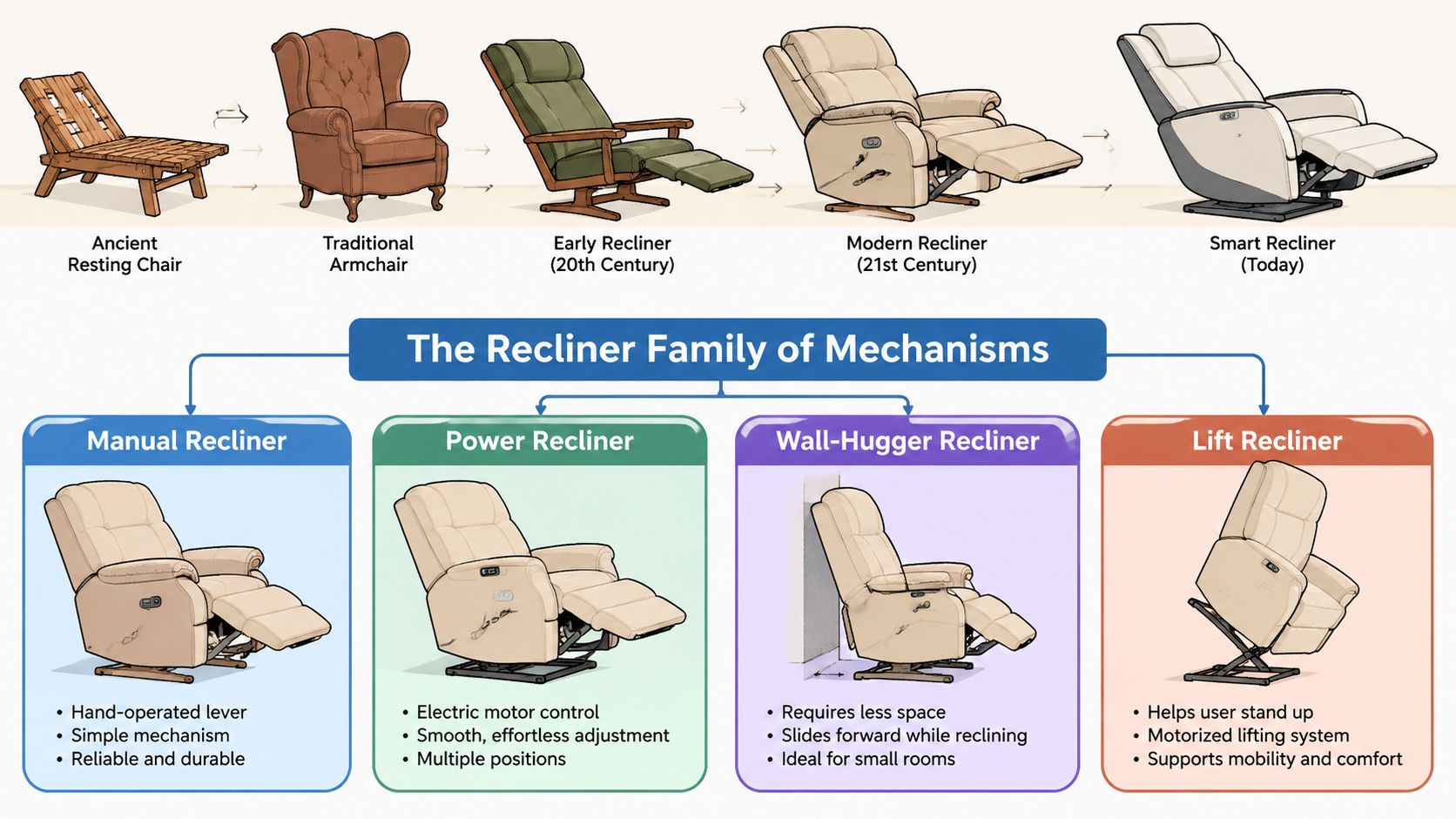
How the Recliner Evolved into a Family of Mechanisms
The modern recliner's commercial history is tied closely to Southeast Michigan. Detroit cousins Edward Knabusch and Edwin Shoemaker are credited with a wooden recliner concept in 1928, followed by an upholstered recliner in 1929. They filed a patent application on January 24, 1929, and received U.S. Patent 1,789,337 on January 20, 1931, according to the Detroit Historical Society's account of Edwin Shoemaker.
That timeline marks the transition from earlier reclining furniture into a recognizable commercial furniture category. The chair wasn't one fixed invention that stopped evolving. It became a platform for different mechanical answers to different household problems.
Each mechanism solved a practical problem
A reclining chair with an integrated footrest helped turn a simple reclining motion into a more complete relaxation position. A 1947 patent for that feature appears in the historical patent trail summarized by PatentPlaques' recliner history. Later patents point to continued experimentation with rocking action, improved mechanisms, and motor assistance.
The dated record includes a 1935 recliner-mechanism patent granted in 1937, followed by later patents in 1959 and 1962. Motor-operated reclining chairs were patented in 1962 and again in the late 1960s and early 1970s, showing how the category moved toward powered and ergonomic seating.
That progression explains today's product families:
- Push-back recliners use the sitter's body weight to move the back.
- Manual recliners use a lever or handle to activate a footrest and backrest.
- Rocker recliners add a rocking base for soothing motion.
- Wall-hugger recliners change the motion path to conserve floor depth.
- Lift chairs add assistance for standing.
- Power recliners use motors for controlled positioning.
- Swivel recliners add rotation to improve conversation and viewing angles.
A recliner is therefore a chair frame paired with a mechanism, base, cushion system, and upholstery package. Two chairs can share a similar silhouette while producing very different levels of support, movement, maintenance access, and price. Understanding that mechanical lineage makes it easier to evaluate the different types of power reclining seating without getting distracted by surface styling.
The Main Types of Recliner Compared Side by Side
The most useful comparison starts with movement. Manual and push-back chairs favor simplicity, power models favor controlled adjustment, and specialty designs solve specific space or mobility challenges.
Recliner types at a glance
| Recliner Type | Operation | Wall Clearance | Best For | Typical Price Range |
|---|---|---|---|---|
| Manual | Lever-operated mechanical recline | Standard room planning required | Shoppers who prefer straightforward operation | Competitive to premium, depending on construction |
| Power | Motorized adjustment by controls | Standard room planning, unless wall-hugger | Precise positioning and lower-effort use | Mid-range to premium |
| Push-back | Body pressure moves the backrest | Standard room planning | Clean lines and no visible lever | Mid-range to premium |
| Rocker | Manual or power recline with rocking base | Standard room planning | Nurseries, reading, and soothing motion | Mid-range to premium |
| Swivel | Reclining chair with rotating base | Depends on base and recline path | Conversation areas and flexible viewing | Mid-range to premium |
| Wall-hugger | Seat translates forward as back drops | 4 to 6 inches | Apartments and shallow rooms | Mid-range to premium |
| Lift | Powered recline plus assisted standing | Standard or space-conscious design | Mobility support and aging in place | Mid-range to premium |
| Sectional | Multiple connected reclining seats | Depends on configuration | Family media rooms and shared seating | Premium |
| Ergonomic Stressless | Glide-based ergonomic movement with adjustable support | Depends on model | Long sitting and posture-focused comfort | Premium |
A manual recliner suits a household that values a familiar mechanism and doesn't need minute-by-minute angle changes. A push-back chair offers a cleaner outline, but it requires the sitter to generate the movement. Power models are better when precise positioning, adjustable head support, or easier operation matters. Their added motors make the mechanism more complex, so shoppers should ask about service access and warranty coverage.
Rocker and swivel recliners change how the chair participates in a room. Rockers encourage gentle motion, while swivel bases help a sitter turn toward a conversation, window, or screen. Neither automatically solves a poor body fit, so the base should never take priority over seat support.
The wall-hugger is the strongest space-saving choice. Its seat moves forward as the backrest lowers, allowing 4 to 6 inches of wall space, while a standard recliner commonly needs 12 to 18 inches. Those figures describe the motion path, not a universal chair width, so the full product dimensions still need checking.
Lift chairs are designed around easier standing and sitting. Sectional recliners make sense for families who want coordinated seating, but their combined footprint and room layout require more planning. Stressless models belong in the ergonomic category, with Small, Medium, and Large sizing, a plus-system headrest, and glide response designed around the sitter's movement. Shoppers comparing support details can also review recliners for back support before visiting a showroom.
Measuring Your Room and Matching Chair Scale to Your Body
A recliner should be measured twice, once as furniture and once as a seating system. Start with the room, not the catalog photograph. Record the wall length, available depth, path to nearby furniture, doorway width, hallway turns, and the position of outlets if a power chair is under consideration.
The wall-clearance distinction is concrete. A traditional recliner typically needs 12 to 18 inches from the wall when fully reclined, while a wall-hugger can work with 4 to 6 inches because its seat travels forward as the back drops, as explained in this recliner buying guide.
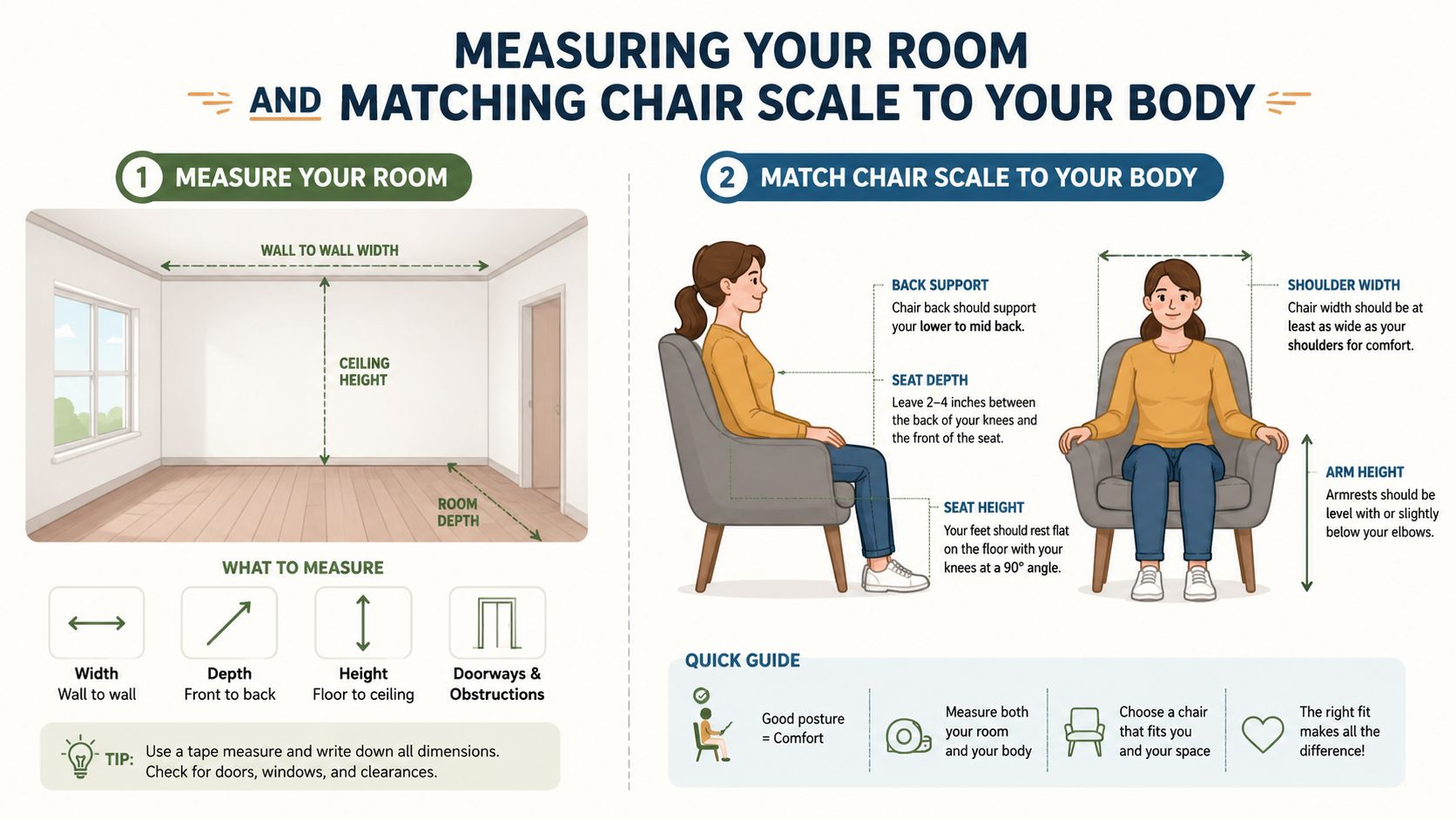
Use the room-first measuring sequence
- Measure the entry route. Check the front door, interior doors, hallway width, stair access, and tight corners.
- Mark the base position. Painter's tape can show the chair's footprint without committing the room to a layout.
- Account for full recline. Mark the open footrest and backrest path, not just the upright outline.
- Protect circulation. Leave enough space for people to walk around the chair and for the footrest to close safely.
- Confirm power access. A powered mechanism needs thoughtful cord placement and an accessible outlet.
Chair scale follows room planning. Practical width ranges commonly divide recliners into small or petite models at about 25 to 30 inches, medium or standard models at about 30 to 35 inches, and large or oversized models at about 35 to 45 inches, according to this recliner sizing guide.
Those bands are starting points, not a substitute for sitting. A shorter shopper may need a shallower seat and lower headrest, while a taller shopper may need greater seat depth, a taller back, and a footrest that reaches the heels. The body-fit check is simple: hips should sit comfortably within the seat, knees shouldn't be forced upward, the headrest should meet the head rather than the neck, and the footrest should support the legs without ending under the calves.
Measurement order: Room first, body second, chair third. Reversing that sequence creates the most avoidable problems.
For a more complete doorway and furniture planning process, shoppers can use Tyner's furniture measuring guide.
Ergonomic Fit, Stressless Sizing, and Custom Upholstery
Ergonomic seating works best when the chair moves with the sitter instead of asking the body to accommodate a generic frame. Stressless seating is especially useful for shoppers who spend long stretches reading, watching television, or recovering in a chair. Its Plus system, adjustable headrest, and Glide mechanism address different parts of the posture equation.
The Plus system helps coordinate head and lower-back support as the chair reclines. The headrest matters because neck alignment changes when the torso moves backward. The glide response lets the chair follow shifts in body weight, which can make position changes feel more natural than a fixed, one-angle recline.
Stressless sizing at a glance
| Model Size | Recommended Height | Seat Width | Key Adjustments |
|---|---|---|---|
| Small | Shorter body frame | More compact scale | Headrest, lumbar relationship, and glide response |
| Medium | Mid-range body frame | Standard scale | Headrest and balanced whole-body support |
| Large | Taller body frame | More generous scale | Extended back and leg support with adjustable headrest |
Exact fit still depends on proportions. Someone with a longer torso and shorter legs may need a different result from someone of the same height with longer legs. That's why the sit test should include upright reading, relaxed reclining, and the position used for television.
Health-driven shoppers need a clear distinction between comfort and treatment. A recliner can support recovery routines or make aging in place easier, but it doesn't replace medical advice. People managing post-surgical recovery or chronic back pain should bring any seating restrictions to the fitting conversation.
Customization adds another layer of value. In-stock is just the beginning. Made-to-order upholstery can allow a household to select a fabric or the buttery feel of top-grain leather, then coordinate color, stitch details, and wood accents with the room. Canadel and Stressless give shoppers different routes to personalization, one focused on bespoke furniture choices and the other on ergonomic seating.
A supportive cushion can also matter during recovery or extended sitting. Readers dealing with pressure concerns may find a practical companion resource in this donut chair cushion guide, particularly when evaluating how a chair and supplemental cushion work together.
For a broader look at posture-focused options, Tyner's ergonomic seating solutions offer a useful starting point. Custom upholstery can help extend a chair's useful life when the frame remains sound and cushions or coverings can be serviced rather than treated as disposable.
Cost per Year, Heirloom Craftsmanship, and the Local Legacy
Sticker price tells only part of a recliner's value. Judge the chair by its cost per year of dependable use, especially when it will serve a family every day. A lower-priced model that needs repeated replacement can cost more over time than a better-built chair with a longer service life. That calculation also includes inconvenience, discarded materials, and the trouble of finding a replacement that fits the room and the sitter.
A premium price does not guarantee longevity. Construction does. Inspect the frame, joints, cushions, upholstery, and reclining mechanism as parts of one maintenance plan. If those components can be repaired or replaced independently, the chair has a better chance of remaining useful for years.
What supports heirloom value
- Solid Wood frames: Properly selected and prepared hardwood gives a chair a stronger structural foundation than loose-fitting assembly.
- Precise joinery: Mortise-and-tenon construction joins a fitted projecting tenon to a cavity cut into another wood member. A sound fit should come together with hand pressure rather than force, as described in this joinery reference.
- Serviceable components: Cushions, upholstery, and mechanisms should be evaluated separately, since each may require attention at a different point in the chair's life.
- Craftsmanship: Hand-crafted construction and careful finishing suit a household seeking an heirloom rather than a temporary seat.
Tyner Furniture's local legacy began in 1957, giving Southeast Michigan families a longstanding Ann Arbor resource for home furnishings. At the South State St. showroom, shoppers can compare a firm, supportive cushion with one that lets the body sink too far. That comparison matters more than a label or a polished product photograph.
The same standard applies to bedroom and dining furniture. Tyner's Amish hand-crafted solid wood pieces show how material integrity and precise joinery differ from mass-produced construction. Solid cherry wood, a clean mortise-and-tenon joint, and a carefully chosen finish offer evidence that remains difficult to judge on a screen.

Financing can make a durable chair easier to plan for, but read promotional terms carefully. Confirm the APR, promotional end date, minimum payment rules, and whether the arrangement uses deferred interest or true 0% APR. Dividing the financed amount by the promotional months gives a basic monthly payoff target, as explained in this furniture financing guide. Use that calculation to protect the household budget, not to justify a chair that fails the room-depth, body-fit, or construction tests.
Which Recliner Type Fits Your Life and Where to Try It
The right chair becomes clearer when the household starts with a real user rather than a product label. A small apartment, a recovery room, and a family media room demand different solutions even when each shopper wants the same basic result, a comfortable place to sit.
| Buyer Profile | Best Recliner Type | Sizing/Spec | Must-Have Feature |
|---|---|---|---|
| Small-space apartment dweller | Wall-hugger or push-back | Compact width and a shallow recline path | Verified wall clearance and walkway access |
| Back-support-focused shopper | Ergonomic Stressless | Small, Medium, or Large body fit | Coordinated lumbar and headrest support |
| Mobility-limited owner | Three-position lift chair | Correct seat height and body scale | Smooth lift action and dependable power planning |
| Family media room | Sectional recliner | Configuration matched to the room | Durable upholstery and easy-to-reach controls |
| Reader or conversation host | Swivel recliner | Medium scale when appropriate | Rotation that supports the room's activity |
| Shopper prioritizing simplicity | Manual recliner | Body-matched seat and back | Smooth, accessible lever action |
Four decisive matches
For a compact Ann Arbor apartment, the wall-hugger is the first choice when floor depth is limited. A push-back chair works when the room can accommodate its recline path and the sitter prefers a minimal profile. The feature that cannot be skipped is the fully reclined clearance, not the chair's upright depth.
For back-pain-focused seating, the ergonomic category deserves priority. Stressless Small, Medium, and Large options should be tested in each available scale, with attention to whether the headrest meets the head, the lumbar area stays supported, and the feet rest naturally. A chair that feels soft for a moment but leaves the body unsupported later isn't a successful fit.
For aging in place or limited mobility, a lift recliner should be assessed for the full sit-to-stand movement. The control should be easy to reach, the seat should hold the user at a stable height, and the household should understand how power is managed. Battery backup may be relevant for a specific home, but it must be confirmed for the selected model rather than assumed.
For family movie rooms, a reclining sectional keeps shared seating coordinated. Cupholders, storage, charging access, and fabric durability may matter more than a swivel base. Families should test every seat because the smallest and tallest users may need different support.
Tyner Furniture serves Southeast Michigan households across the home, from the Home Office to Outdoor Spaces, with options that can be customized beyond what's in stock. The Ann Arbor showroom offers a practical sit test, where 15 minutes in the correct size beats hours of online research. Shoppers who prefer to shortlist first can browse online Quick Specs for special orders, then arrive with room measurements and the intended sitter's height.
Tyner Furniture helps Ann Arbor and Southeast Michigan shoppers compare manual, power, wall-hugger, lift, sectional, rocking, swivel, and ergonomic recliners with fit and longevity in mind. Visit Tyner Furniture for a sit test at the showroom, or browse the online Quick Specs before arranging a made-to-order consultation.