
Recliner Dimensions Guide to Fit Your Space Right


A recliner can look perfectly proportioned in a showroom and still create a delivery-day surprise at home. The back may press against the wall, the footrest may stop against a coffee table, or the chair may dominate a comfortable Ann Arbor living room. Measuring before ordering prevents that beautiful piece from becoming an obstacle.
Introduction Why Recliner Dimensions Make or Break Comfort
Recliner dimensions do three different jobs. They need to fit the person sitting in the chair, the room holding it, and the movement required to open, close, enter, exit, and walk around it. A chair can succeed at one job and fail at another. A compact model might fit through a doorway but leave a taller user without enough thigh or head support. A generous chair might feel wonderfully cushioned yet block the main path when fully open.
That's why overall width and depth are only the starting point. A practical buying decision also considers seat width, seat depth, seat height, reclined length, wall clearance, front clearance, and transfer space. These details affect comfort, safety, room flow, and the long-term value of the purchase.
A useful way to think about the process is simple:
- Body fit: Does the seat support the thighs, pelvis, lower back, head, and feet?
- Room fit: Does the closed chair sit comfortably among walls and surrounding furniture?
- Movement fit: Can the mechanism recline fully, and can people move safely around it?
A delivery crew needs more than the room's open floor area. The chair also has to pass through the entry door, turn through hallways, clear stair landings, and arrive at its final position without scraping walls or crowding circulation. These are easy details to overlook when attention is focused on upholstery, color, or the buttery feel of top-grain leather.
Tyner Furniture has helped Southeast Michigan households make these decisions since 1957. The showroom's role is practical and neighborly, helping shoppers translate a product specification sheet into a real room and a real sitting position. The ultimate recliner buying guide can support that early research, while an in-person sit test confirms what measurements alone can't reveal.
A careful plan also protects the investment. A well-sized recliner is more likely to remain useful through daily reading, television, conversation, and rest. The right dimensions are not a technical nuisance. They're part of the chair's comfort, durability, craftsmanship, and cost-per-year value.
Understanding Recliner Measurements That Matter
A specification sheet is easier to use when every measurement has a clear job. Recliner dimensions perform three jobs: body fit, room fit, and movement fit. Overall dimensions describe the chair's exterior envelope. Seat dimensions describe the space your body occupies, while the reclining mechanism determines how the chair moves through the room.
Start with the exterior envelope
- Overall width measures from the outside of one arm to the outside of the other. It controls room placement, doorway planning, and the chair's visual weight. Common consumer guidance places a standard single recliner near 33 to 36 inches wide, although broader guides show standard widths from 39 to 49 inches, depending on style, arm thickness, and mechanism. The recliner sizing guide from Wayfair outlines that broader range.
- Overall depth measures from the front edge to the back of the chair while upright. Standard guidance commonly places it around 35 to 40 inches, while some market guides use 35 to 39 inches. The base, back design, footrest, and reclining mechanism all affect this measurement.
- Overall height runs from the floor to the highest point of the back. A standard single recliner commonly falls near 40 to 42 inches high, while broader main-body guidance ranges from 38 to 45 inches, as outlined by The Size.
These figures form the chair's outside boundary. They show whether the recliner can occupy a location, but they cannot predict how supported your legs, back, or head will feel.
Read the seat as carefully as the shell
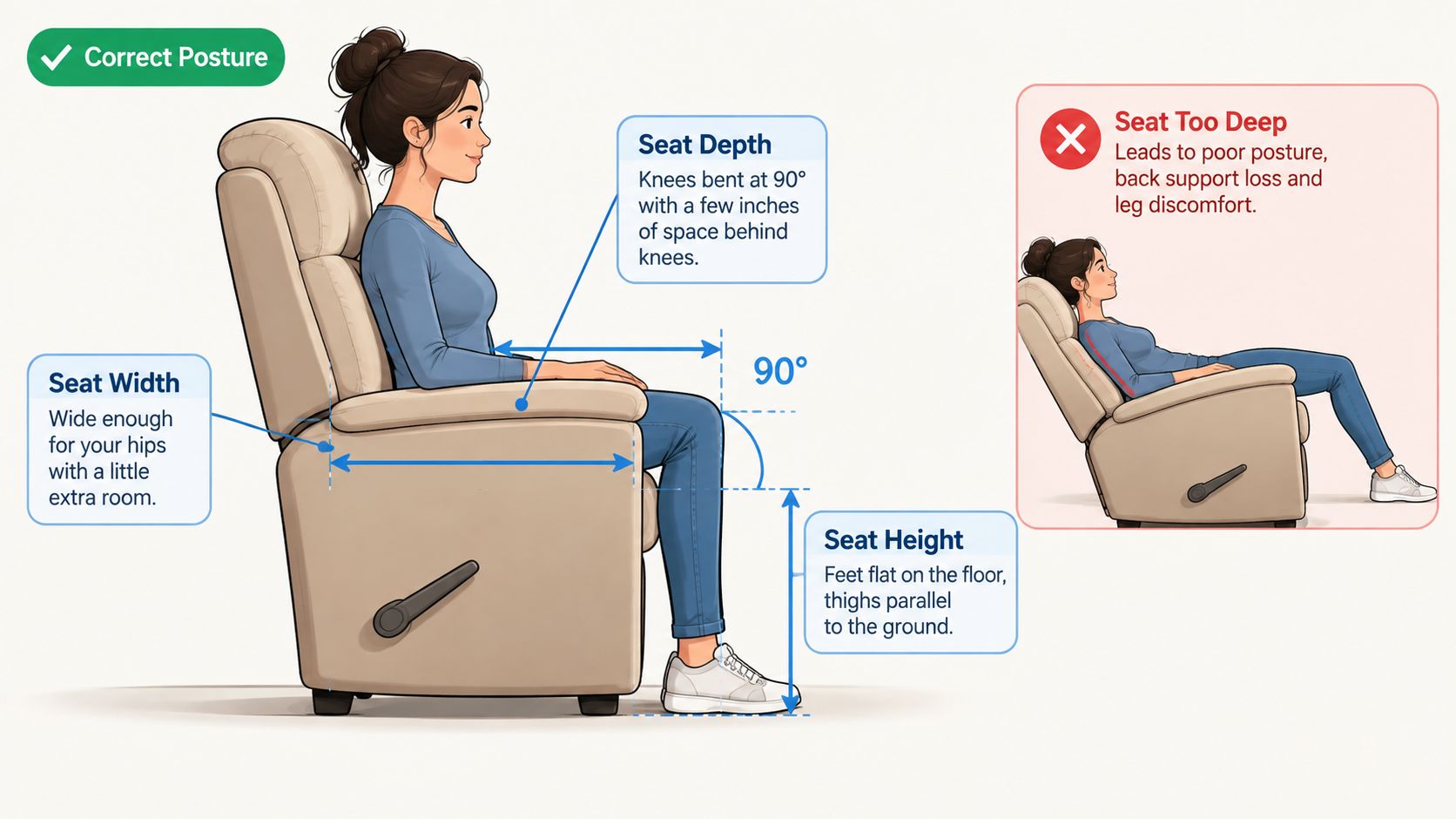
Seat width is the usable space between the arms. Two chairs can share a similar exterior width and still feel very different if one has thick arms and the other leaves more open seating space. Standard seat width commonly falls around 20 to 22 inches, while petite models often move closer to 18 to 20 inches, according to the recliner sizing reference.
Seat depth runs from the front of the cushion toward the backrest. It works much like shoe sizing for the upper leg. Too little depth leaves the thighs unsupported. Too much depth can pull the sitter away from the lumbar area and encourage slouching. Typical guidance places seat depth around 20 to 22 inches, with smaller models closer to the petite range.
Seat height measures from the floor to the top of the cushion. A common standard range is 18 to 19 inches, while small or petite chairs often sit around 17 to 18 inches. This dimension affects whether your feet plant securely and whether standing feels controlled.
Arm thickness, arm height, back height, lumbar placement, and headrest position add another layer. A broad padded arm may feel comfortable beneath the forearm while reducing usable seat width. A tall back may support one person's head beautifully but feel oversized or poorly aligned for another.
Size also interacts with mechanism. The different types of recliners can change the chair's movement envelope, even when upright width and height look familiar. A power model, wall-hugger, swivel, rocker, or lift chair may require a different clearance plan.
Practical rule: Read the seat measurements as the body's room, overall measurements as the home's room, and recline clearance as the movement room.
How Much Space a Recliner Really Needs When Reclined
A recliner can fit neatly beside a wall when closed, then crowd the room as soon as the back tilts and the footrest rises. Its dimensions have three jobs: fit the body, fit the room, and leave space for movement. Recline clearance belongs to the third job, because the chair needs room to operate without blocking people or furniture.
Closed depth versus working depth
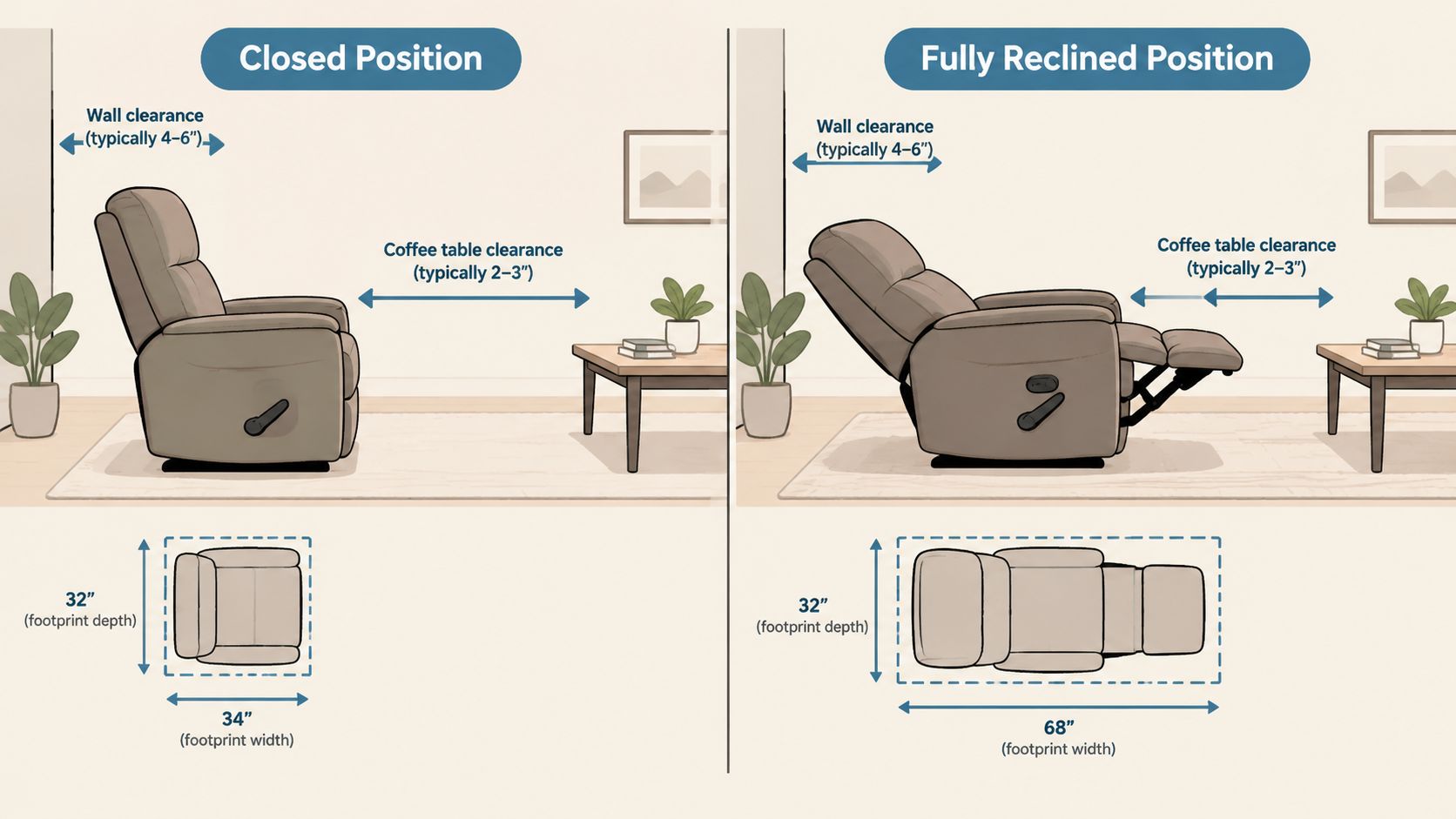
An upright recliner commonly occupies about 35 to 40 inches of depth. Fully open, its working footprint can extend to approximately 60 to 70 inches. Treat those figures as planning ranges, then confirm the open depth in the product specifications. The operating mechanism can change the path even when the closed chair looks compact.
A traditional recliner may send its back toward the wall. A wall-hugger design moves the seat forward as it opens, reducing the space needed behind it while increasing the area in front. Swivel, rocker, lift, and power models can also change the movement envelope. Shoppers comparing power reclining seating options should examine the chair in its open position, not only its closed width and depth.
Stressless Small, Medium, and Large sizing helps explain the body-fit part of the plan, but size does not determine room fit by itself. A larger chair may support a taller sitter comfortably while reaching farther into the room when reclined. A smaller model may suit a shorter sitter yet still need clear space for its footrest and turning path. Match the chair to the sitter first, then test its complete operating footprint.
In a compact Ann Arbor living room, mark both shapes on the floor with painter's tape:
- Mark the chair's upright width and depth.
- Add a second outline for its fully reclined length.
- Place the coffee table, ottoman, side table, and walkways around both outlines.
- Check the route to the room entrance, another seat, a window, and the media area.
The first outline answers, “Can the chair live here?” The second answers, “Can the chair work here?”
Protect clearance and circulation
Wall clearance keeps the back from striking paint, trim, or plaster. Front clearance keeps the footrest away from the table and gives the sitter room to stand without an awkward shuffle. The walkway must remain usable in both positions. A chair that works only when upright is not properly placed.
Swivel and glide functions need their own check. A chair may turn toward a conversation group, window, or television, so a side table that seems safely positioned beside the closed chair can become a collision point during rotation.
Power seating needs access to its cord and enough room for service or adjustment. Keep the cable from running beneath a leg or across a walking path. Lift chairs need a particularly clear route in front because the user rises through the chair's lifting motion.
A media room may accommodate a deeper open footprint when seating rows are planned around it. A bedroom corner may call for a more compact mechanism and tighter circulation control. The same recliner dimensions can suit one room and fail in another because the surrounding movement pattern changes.
Finding Your Ergonomic Fit With Seat Depth Width and Height
You sit down after a long day, but your knees sit too high, your lower back floats away from the cushion, or the armrests feel just out of reach. The recliner may fit the room beautifully and still fail its first job: supporting your body. Seat-level dimensions determine how your pelvis settles, how your legs rest, and how easily you rise.
Let the three body-fit measurements work together
Seat depth supports the thighs while keeping the lower back in contact with the backrest. Choose the shorter option when your legs are shorter or you prefer an upright posture with firm lumbar contact. Choose more depth when your legs are longer or you recline into a relaxed lounging position. Too much cushion in front of the knees can push the pelvis forward, leaving the back unsupported.
Seat width should give you room to shift without making the armrests feel distant. A close fit can press against the hips and restrict repositioning. Excess width may feel generous at first, yet your elbows and forearms can lose the natural support that helps the shoulders relax. Sit with your arms resting as they would at home, rather than judging width only by the open space beside your body.
Seat height affects both stability and transfers. A lower seat bends the knees more sharply and can make standing harder. A higher seat may leave the feet partly unsupported, reducing the grounded feeling you need when changing position. Check whether both feet plant securely and whether your knees feel naturally bent before testing the footrest.
Use your body as the measuring tool. With the lower back supported, the seat edge should carry the thighs without pressing sharply behind the knees. Your lumbar area should meet the backrest, not hover forward. The chair should feel steady when you stand, too.
Match the chair to posture and proportions
A petite adult often needs a smaller seat envelope and lower sitting position. Someone with average proportions may prefer a balanced profile, while a taller sitter may need more thigh support, a longer footrest, and a higher back. Exterior size can suggest the fit, but it cannot confirm how the seat, back, and leg support meet your body.
Stressless sizing gives this decision a useful framework through Small, Medium, and Large categories. Treat those labels as starting points for body fit, then test how the chair behaves through its movement. A well-matched recliner lets your body settle as it opens. You should not need to brace with your feet, slump to reach the headrest, or stretch awkwardly toward the control.
For a practical refresher, read this guide to improving sitting posture. Firm support should feel steady, while loose cushioning can allow the pelvis to drift. A short sit test reveals that difference more clearly than a measurement chart.
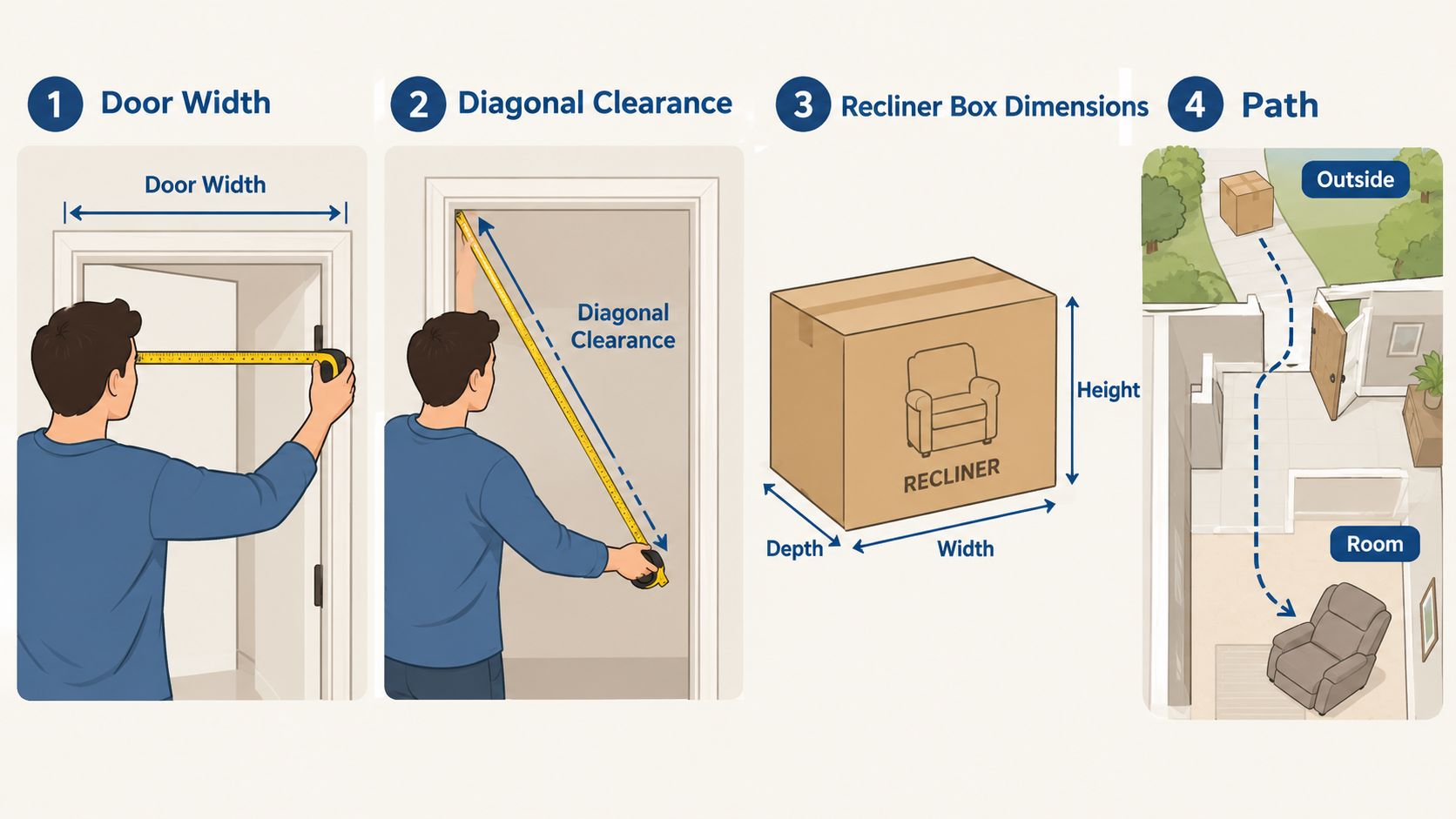
Body fit is only one part of the decision. The chair must also travel through the doorway and turn through the delivery path without a risky lift or improvised maneuver. A comfortable recliner belongs in the room only when its dimensions support your body, your movement, and the route into the space.
Stressless Size Guide Small Medium and Large Explained
Small, Medium, and Large categories are most helpful when they're treated as body-fit starting points rather than rigid labels. Stressless sizing gives shoppers a way to compare the relationship between seat scale, back support, leg support, and the person's stature.
The following ranges summarize common recliner categories and the way shoppers can interpret them. They describe typical exterior bands, not a guarantee for every model.
| Size Category | Typical Width | Typical Depth and Height | Best Fit User |
|---|---|---|---|
| Small | 29 to 30 inches | 33.5 to 37.5 inches deep, 39 to 42 inches high | Petite adults and rooms needing a smaller footprint |
| Medium | 32 to 38 inches | Similar depth and height ranges within the category | Most adults seeking balanced support and room fit |
| Large | 40.5 to 44 inches | 39 to 42 inches deep | Taller users or those wanting more lounging space |
These dimensional bands are summarized in recliner category guidance from Homenish. Broader guides also place small recliners under 38 inches wide and oversized models above 46 inches, making width a useful first clue for capacity and room fit. Those thresholds should still be checked against the actual seat width and mechanism.
Use the category as a sit-test question
A Small chair should feel supportive rather than restrictive. The sitter's feet should reach the floor naturally, the arms should fall within comfortable reach, and the headrest should meet the head without pushing it forward.
A Medium chair often gives the widest range of comfortable proportions. It may provide enough seat width and depth for everyday lounging without the visual bulk of a larger frame. For a shared household, several people should test it because one person's balanced fit can be another person's shallow or overly deep position.
A Large chair should give taller users room to settle without bending the legs too tightly or losing head support. Extra exterior width is useful only if it creates better body contact. More open space isn't automatically more ergonomic.
Measure before the showroom visit
The room-measuring routine is straightforward:
- Record the wall width and the floor depth available for the upright chair.
- Mark the fully open footprint with tape.
- Measure every doorway, hallway turn, stair landing, and entry point.
- Note the narrowest diagonal route, not only the straight doorway width.
- Bring the measurements to the South State St showroom for comparison with actual chairs.
For households planning a difficult stair or hallway route, a practical guide on how to use a hand truck on stairs may help clarify handling considerations. Delivery planning should always account for the chair's weight, shape, pivot points, and professional handling requirements.
Stressless also provides a customization path beyond choosing a category. Shoppers can explore made-to-order upholstery, finishes, and configurations, including the sensory difference between supple leather and fabric. At Tyner Furniture, in-stock is just the beginning. The right fit may involve a bespoke selection rather than accepting a compromise because the showroom sample happens to be available.
How to Measure Your Room Doorways and Delivery Path
The room is only the destination. A successful purchase begins at the street-facing entry and follows every turn to the final placement.
Build a complete measurement trail
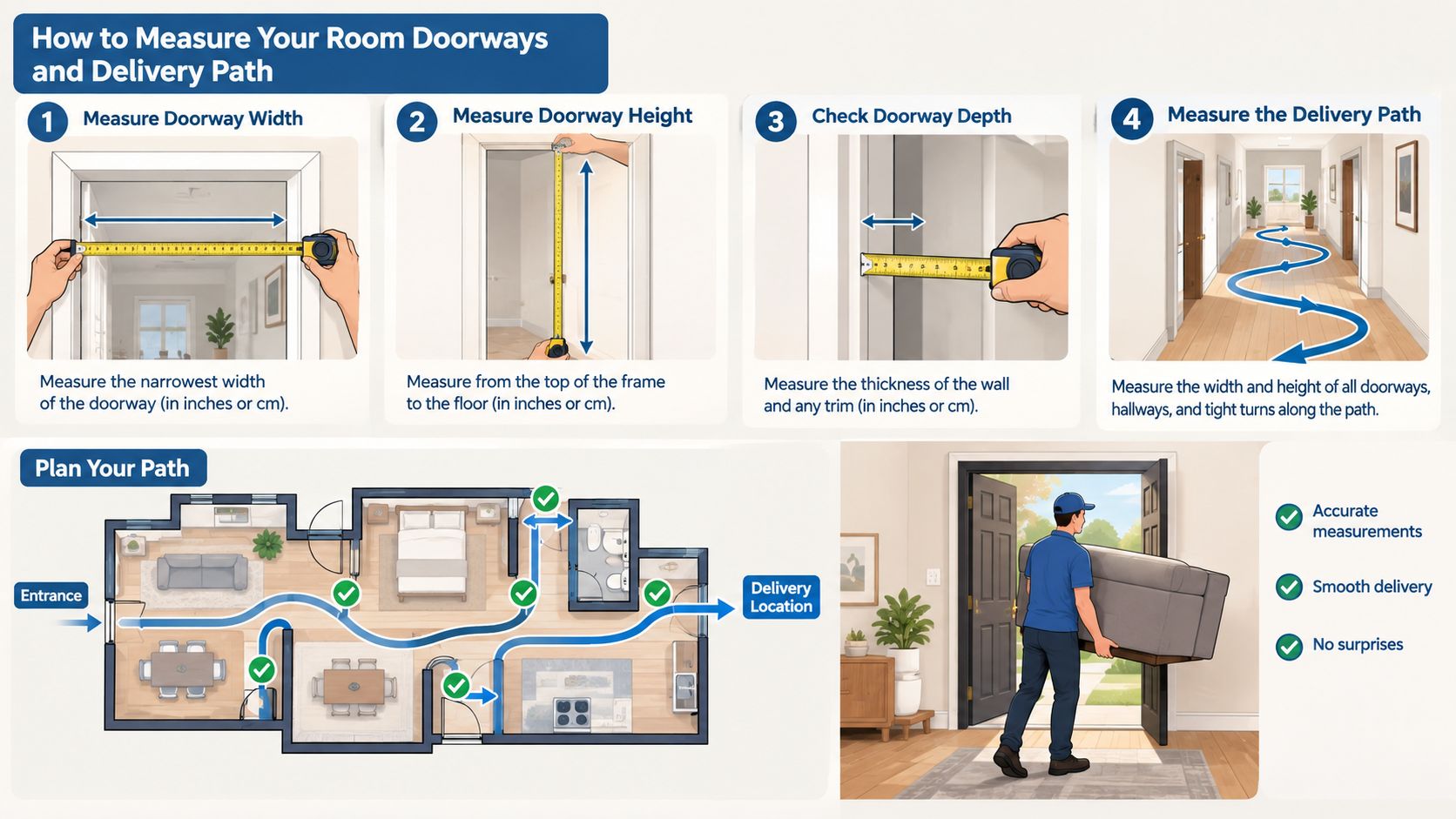
Start with the intended wall and floor area. Measure the clear width available for the upright chair, then mark the chair's footprint with painter's tape. Add the open position separately so the footrest and back movement can be judged against a coffee table, sofa, doorway, or main walkway.
Next, measure the delivery path in sequence:
- Entry door: Record the clear opening, not just the frame's outside size.
- Door height: Check whether the chair can pass upright or must be angled.
- Diagonal clearance: Measure the turning space where a hallway or stair changes direction.
- Hallway width: Identify the narrowest point, including trim and handrails.
- Stairs and landings: Note short turns, low ceilings, and limited pivot space.
- Final room entrance: Confirm that the chair can enter without removing nearby obstacles.
Write every number down with its location. A single narrow corner can control the entire delivery plan, even when the front door looks generous.
Account for power and access
A power recliner needs a nearby outlet and a cord route that doesn't cross a walking path. The cord should have enough slack for the chair's operation but shouldn't sit where feet, pets, or cleaning tools can catch it. A lift chair requires additional attention to the space in front and beside the chair because the user's movement includes a controlled rise from the seat.
The mechanism also changes wall planning. A traditional recliner may need more space behind it, while a wall-hugger may use a forward-moving motion. The exact product specification should settle the question.
Pro tips for Southeast Michigan homes
For narrow entries: Remove doors only when the delivery plan and hardware allow it, and protect trim before moving a large upholstered piece through the opening.
Older homes around Ann Arbor can include tight vestibules, offset stairways, or compact room transitions. Southeast Michigan apartments may add elevator doors, shared hallways, and sharp turns that don't appear on a basic floor plan.
For stairs: Measure the landing where the chair must pivot, not just the stair width.
A helper makes measuring safer and more accurate. A rigid tape measure, a phone or notepad, and a simple floor plan are enough to create a useful record. The furniture measuring guide can help organize those checks before the showroom visit.
Tyner Furniture can review the numbers at the Ann Arbor showroom and discuss Special Financing and the Low Price Promise when a customized piece becomes a larger investment. Those options can reduce the pressure to choose a less suitable chair just because it appears easier to purchase.
Planning Clearance and Choosing Your Heirloom Recliner With Confidence
The best recliner decision balances three forms of fit. Body fit protects posture and everyday comfort. Room fit preserves proportion and circulation. Movement fit ensures the chair can open, close, and support transfers without creating a hazard.
Cost-per-year thinking belongs in that decision. A recliner used regularly deserves attention to frame integrity, mechanism quality, upholstery, and repairability, not just its initial price. Durable craftsmanship can make a chair feel like an heirloom rather than a short-lived furnishing, especially when the upholstery and configuration suit the household from the beginning.
Customization is often the difference between a chair that merely fits and one that feels intentional. At Tyner Furniture, in-stock is just the beginning. Made-to-order options can include finishes, fabrics, leather, and configurations, with Stressless providing Small, Medium, and Large ergonomic sizing. Canadel extends that same bespoke approach into dining furniture through choices in wood finish, table details, and configuration.
The broader collection supports a coordinated home, from the Home Office to Outdoor Spaces, as well as living rooms, bedrooms, dining areas, entertainment spaces, and patios. When bedroom or dining furniture enters the plan, Tyner's Amish hand-crafted solid wood pieces offer a different standard from mass-produced alternatives. Solid cherry, oak, and maple carry visible material integrity, while time-honored joinery such as dovetailing and mortise-and-tenon construction supports heirloom durability.
A local legacy since 1957 also matters when a question appears after delivery or when a special-order detail needs review. Special Financing and the Low Price Promise can make a carefully selected investment easier to plan without turning the decision into a race toward the lowest initial cost.
The final check is physical and practical. The sitter should feel supported, the room should retain its natural walking paths, and the chair should open without touching walls or nearby furniture. Those are the recliner dimensions that create lasting value.
Tyner Furniture offers ergonomic recliners, made-to-order upholstery, Stressless sizing, and furniture for spaces from the Home Office to Outdoor Spaces. Visit Tyner Furniture on South State St in Ann Arbor for a sit test, or browse the online Quick Specs when planning a special order.