Exposed Wood Frame Sofa Guide for Lasting Style


Does visible hardwood prove a sofa is built to last, or does it only prove the wood is easy to see? That question changes how a shopper looks at an exposed wood frame sofa. The visible arms, rails, and legs offer useful evidence about finishing and design intent, but concealed joints, suspension, cushions, and secondary materials still decide how the piece performs. Treating the frame as a diagnostic tool, rather than a style badge, gives shoppers a calmer, clearer way to evaluate durability, craftsmanship, and long term value.
Why an Exposed Wood Frame Sofa Earns a Second Look
A shopper crossing a bright showroom often notices this style before a fully upholstered model. A smooth wooden arm catches the light, a rail shows its grain, and the cushions appear to rest inside a piece of furniture rather than cover it completely. The silhouette feels lighter, and the weight of solid cherry wood or walnut in a hand held sample makes the difference tangible.
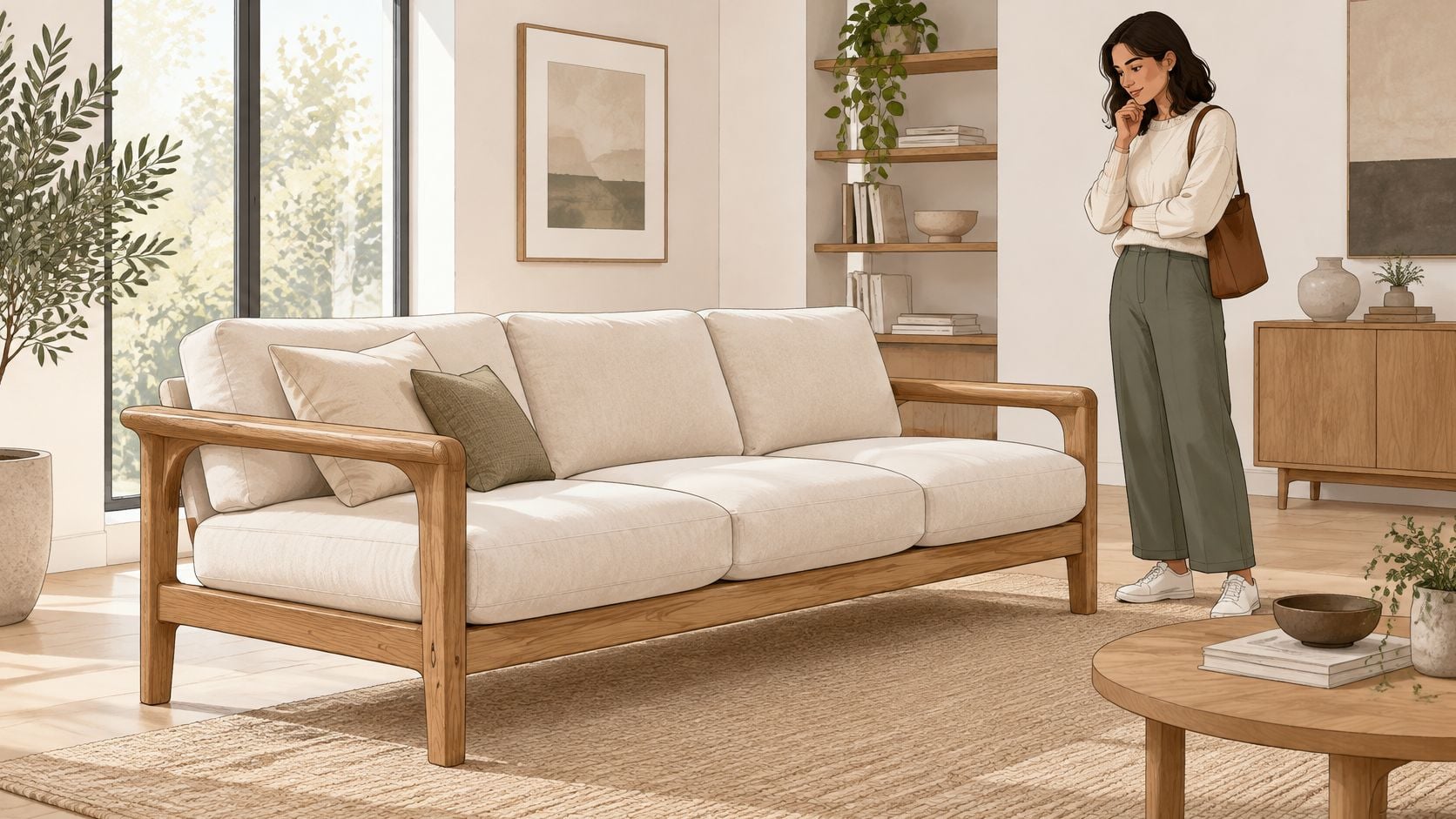
That visibility is the practical advantage. On a fully covered sofa, important structural details remain hidden beneath foam and fabric. On an exposed frame, a shopper can examine the finish, follow the grain, check whether an arm feels solid, and look closely at places where wood meets wood. Those clues don't tell the whole story, but they provide a stronger starting point than a general claim about quality.
What Visible Wood Can and Cannot Reveal
A clean finish and tight exposed joints suggest careful specification and assembly. They don't guarantee that hidden corner blocks are screwed properly, that springs are supported well, or that cushion foam will recover after years of use. A thoughtful buyer therefore views the exposed wood frame sofa as a connected system, with the frame, suspension, cushions, finish, and replacement parts judged together.
Visible hardwood is an invitation to inspect more closely. It isn't, by itself, proof of a stronger sofa.
That mindset also helps with styling decisions. Natural grain pairs naturally with woven throws, upholstery texture, and wood elsewhere in the room, much like layering textures on a farmhouse table can bring a dining setting together without matching every material exactly. For shoppers who feel overwhelmed by fabric names and construction terms, the goal is manageable. Learn where to look, ask a few precise questions, and separate visual appeal from structural evidence.
A Short History of Visible Wood Framing
Makers have left legs, arms, and rails visible for more than two centuries. Cabinetmakers in the 18th and 19th centuries routinely exposed structural wood on European and American seating, choosing decorative hardwoods such as walnut, mahogany, rosewood, and cherry for show areas while reserving softer species like pine for concealed framework. That habit served a practical purpose as much as a decorative one. An open frame let an owner watch a joint loosen, spot moisture staining creeping up a leg, and catch a small crack before it traveled into a load bearing member.
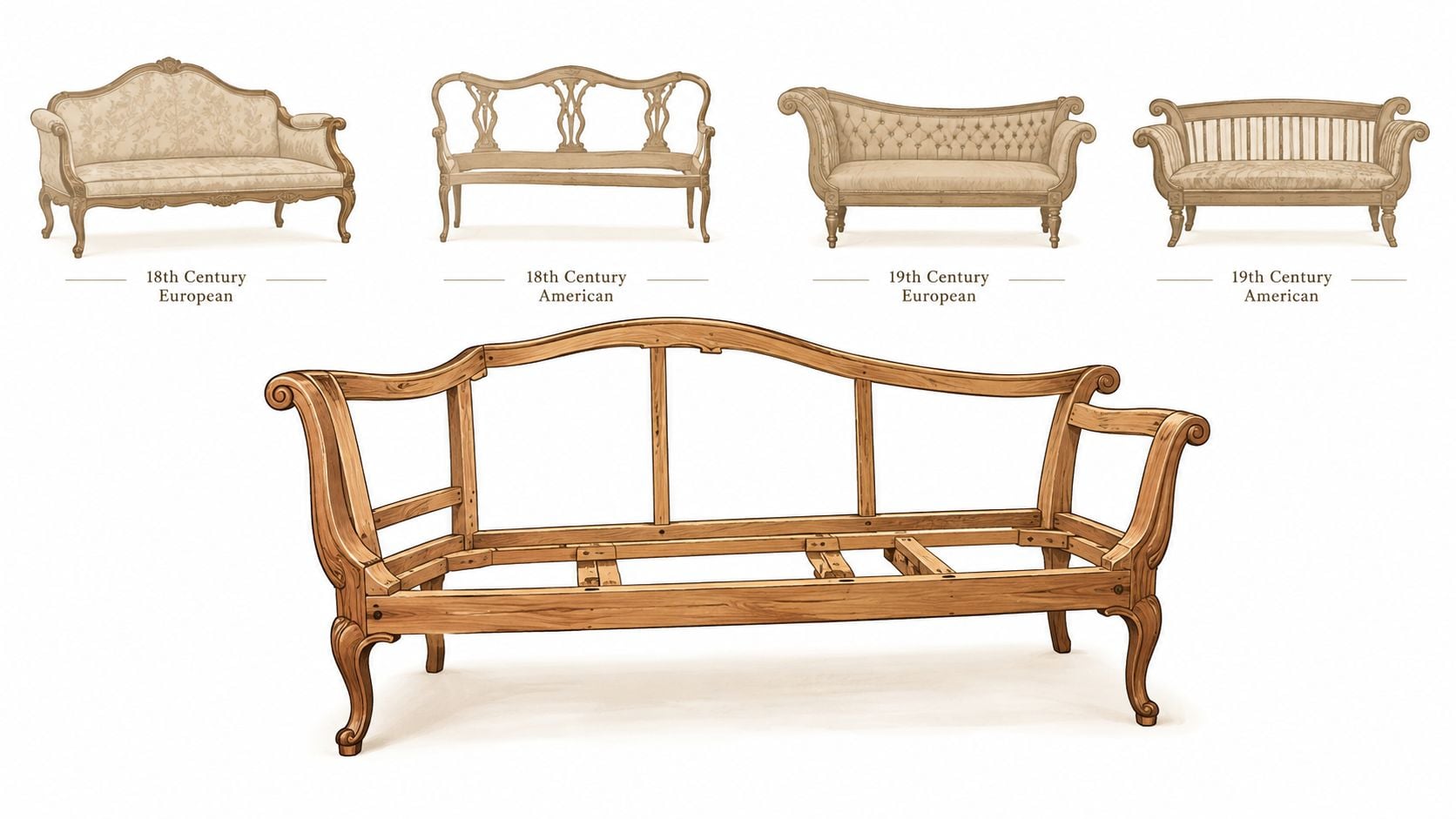
In the United States, the form became especially associated with the Hepplewhite period, roughly from 1800 through the early Victorian era. During that period, the sofa sat at the center of the American parlor, and a room without one was considered incomplete. Louis XV and Rococo settees followed a related idea in France, using exposed and often carved frames to create a lighter silhouette than fully upholstered seating.
Visible and Concealed Woods Working Together
Period makers used materials strategically. A Philadelphia camel back sofa held by the Metropolitan Museum of Art uses yellow pine and tulip poplar as secondary woods, showing that concealed components never required the same decorative quality as show wood. That distinction still guides a careful inspection today. A sound modern frame can pair visible hardwood with plainer secondary material, as long as each species sits where its strength and moisture behavior make sense.
- Show wood: Selected for grain, color, carving, and finish quality on arms, legs, and rails
- Secondary wood: Used where upholstery or structure hides the surface, judged by load and location
- Upholstery: Provides seating comfort while the visible structure shapes the visual identity
Industrial production later changed the balance. Mechanized woodworking and mass produced textiles in the 19th century encouraged manufacturers to cover more of the frame, which hid the same joints an owner once checked at a glance. Victorian makers introduced coil springs for seats that recovered their shape, and laminated rosewood layers could be steamed and forced into curves to reduce splitting during carving. Comfort improved, and more of the structure moved out of sight. On period pieces, a loose arm or worn rail could be re-glued, re-pinned, or replaced without disturbing yards of upholstery, which is why so many of them still sit in living rooms today. Shoppers drawn to that honest, inspectable construction often appreciate related traditional forms explored through Mission style furniture available near Ann Arbor, where visible joinery remains part of the appeal.
How to Judge Build Quality and Joinery
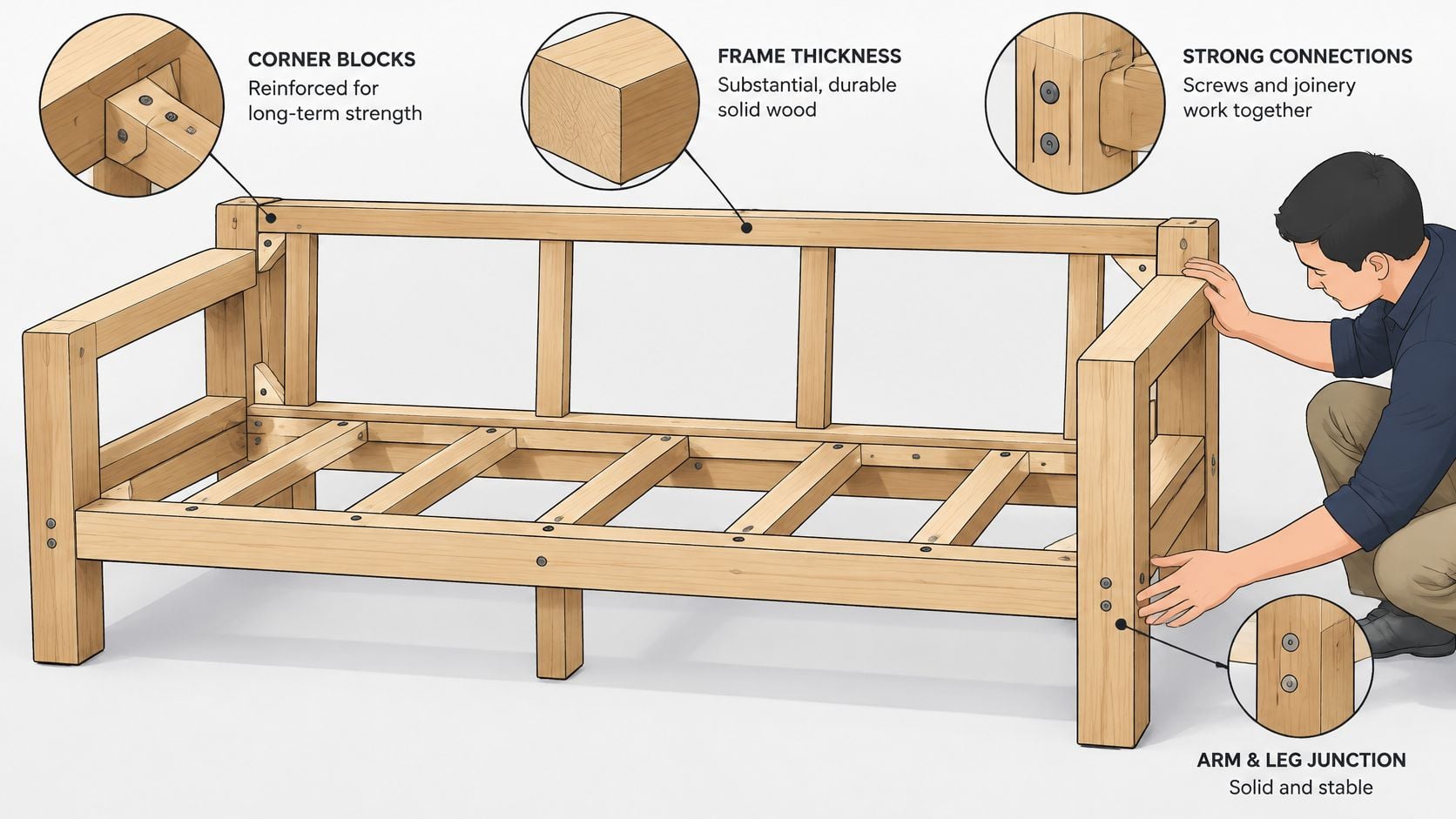
What can a sofa's exposed frame reveal about the work inside it? Start with the points that carry stress: where the arms and legs meet the rails, and where the seat suspension attaches. Press gently on each arm and lift one front corner a little. A shifting joint or repeated creak can signal movement in the frame, much as a loose hinge gives away a problem in a door.
Joints That Deserve Specific Questions
Ask how the high-stress connections are built. Mortise-and-tenon joints, dowels, glued-and-screwed connections, and corner blocks can all provide sound support when properly made. Corner blocks should meet both intersecting rails and be secured to each; a block that merely sits in place adds little resistance to racking, the sideways force that can push a frame out of square over time.
- Arm to rail connection: The arm should stay steady when you push or pull it gently.
- Leg attachment: An integrated or reinforced connection offers more support than a small fastener in a thin panel.
- Corner blocks: Check that they are firmly attached to both rails.
- Suspension support: Springs or webbing need secure attachment to rails that hold their shape under load.
For a closer look at how a shaped projection fits into a matching opening, see how mortise and tenon construction forms a mechanical joint. That fit helps align the joined pieces and resists movement through more than a surface fastener alone.
Moisture Content Is Part of Joinery
Wood responds to its surroundings. As indoor humidity rises, it takes on moisture; as humidity falls, it loses moisture. Repeated expansion and contraction can strain joints and finishes, leaving small gaps around legs or arm-to-rail connections.
Practical rule: Ask whether the solid wood parts were kiln-dried and conditioned for indoor use. The “solid wood” label alone does not tell you how well the material was prepared.
Southeast Michigan homes can have dry air during the heating season and more moisture in summer. Keep indoor humidity steady where practical, since large swings put wood joints and finishes through repeated movement. For related background on protecting visible wood, explore oak floor refinishing options.
Choosing Upholstery and Finish Options
Fabric numbers confuse even careful shoppers because the two common tests measure abrasion in different ways. Wyzenbeek reports double rubs and Martindale reports cycles, so the two results should not be converted into one another. A rating is a screening tool that helps compare fabrics, and it says little about how many years a sofa will look fresh.
Read an abrasion figure the way a mechanic reads a tire rating. It tells you the cloth survived a machine; it stays silent about the seam holding that cloth to the frame or the cushion underneath it. On an exposed wood sofa, where the frame can outlast several covers, that distinction decides whether fabric choice becomes a maintenance plan or a repair bill.
Upholstery Abrasion Ratings by Use Level
| Use Level | Martindale Cycles | Wyzenbeek Double Rubs | What It Does Not Measure |
|---|---|---|---|
| Light to medium residential | 15,000 to 25,000 | Medium range below heavier benchmarks | Frame strength, seams, staining, or fading |
| Medium residential | Within general residential guidance | 20,000 to 30,000 | Cushion recovery, pilling, or pet claw damage |
| Heavier residential use | 30,000 to 50,000 or more | 30,000 to 40,000 | Comfort, spill behavior, or ultraviolet fading |
These ranges are general screening benchmarks for residential use rather than guaranteed service lives. Rub counts above roughly 100,000 add little practical life, so a very high number should not outweigh seam strength, fiber type, or cushion construction.
Matching Fabric and Finish to Contact Patterns
Wear concentrates where bodies touch the piece, so mapping household habits against each surface reveals more than any single rating. Run a hand along an exposed arm in the showroom and you will feel exactly where rings, watches, and toy trucks will land for the next decade.
- Seat and back cushions: These areas need abrasion resistance plus resilience, since fabric and foam wear together
- Exposed arms and rails: Wood receives direct hand contact, rings, watches, bags, and toys, so finish repairability matters
- Removable cushions: Replaceable covers or cushions can extend usefulness when one area wears sooner than the frame
- Cleaning code and fiber content: Both should be requested with the test method, rating, and warranty conditions
That last point carries the diagnostic weight. A sofa with removable cushions lets you re-cover the seat that takes the brunt of daily use while the frame and arms stay original, which is how a piece earns heirloom status instead of a trip to the repair shop.
A household that stretches out sideways places different pressure on arms and cushions than one that sits upright for conversation. Leather adds another consideration, since the buttery feel of top grain leather differs from woven fabric in cleaning, scratch visibility, and temperature against skin. Detailed comparisons in guidance for choosing the best fabric for sofa upholstery help shoppers weigh those trade offs before a custom order is placed.
Sizing and Placement for Real Rooms
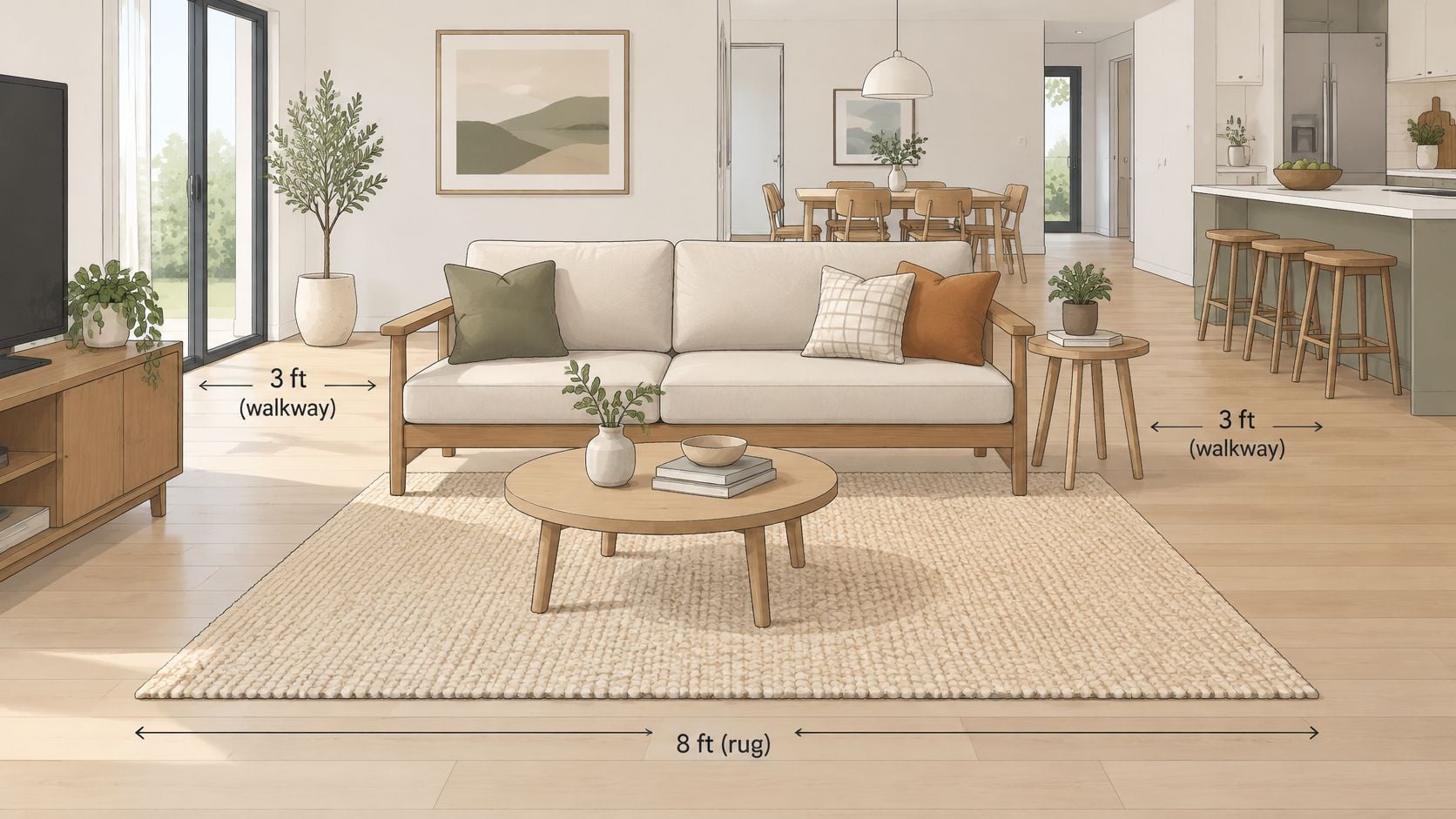
Could a sofa fit against the wall and still make the room harder to use? Measure the room, the delivery route, and the space people need to move around it before choosing a size. Depth, back height, and diagonal clearance often decide whether a piece turns through an opening, so measure all three alongside width.
A Room First Measuring Routine
- Map the floor area: Mark the sofa's footprint with tape, including room for side tables and lamps.
- Test the seat and arms: Have taller and shorter household members sit and check whether the depth and arm height suit their posture.
- Trace the walking paths: Allow room around exposed legs and rails, especially near doors and routes to the kitchen.
- Check the delivery route: Measure the narrowest doorway, hallway, stairway, and turn before placing an order.
An exposed arm has a different feel from a padded one. Its wood rail can offer a steady grip when standing, while a person who likes to lean against the arm to read may prefer a softer surface. Children, pets, and luggage add scratch and spill exposure, and an exposed leg in a busy entry takes more knocks than one tucked against a wall.
Check that the sofa carries the permanent compliance label for its upholstered components. Ask whether a custom fabric or replacement cover also carries the appropriate label. That label covers the upholstered components, so it tells you little about the wood frame itself. Look closely at the frame's joints and finish, and ask whether worn cushions or covers can be replaced.
Room layout affects both comfort and frame wear. A sofa placed too far into a walkway may expose its back rail to frequent bumps; one positioned for television viewing alone can leave conversation feeling awkward. Use this guide to calculate sofa and television placement and test viewing distance and seating angles before settling on the sofa's position.
Custom Order Options and the Tyner Difference
A floor model works like a demonstration unit: its real job is to show scale, seat feel, joinery, and finish quality before anyone commits. From that starting point, a made-to-order specification can adjust fabric, leather, finish, and configuration for a particular room. The approach connects construction knowledge with daily life, so no shopper has to accept the single combination already sitting on the showroom floor.
Specifying Each Part of the System
Custom upholstery lets a household choose premium fabrics or top grain leathers with cleaning and wear characteristics matched to real use. Finish selection can coordinate exposed cherry, oak, or maple with existing floors and case goods without forcing an exact match. Shoppers weighing those combinations can begin with custom upholstered sofas built around fabric and configuration choices, then refine details during a showroom visit.
The same philosophy carries across coordinated rooms. Tyner supports made-to-order dining combinations across leg styles, table edges, finishes, and distress levels, and offers ergonomic recliners with custom sizing in Small, Medium, and Large so seating can match the sitter rather than a single average. For plans that move from the living room to the dining room or home office, that breadth reduces mismatched decisions.
Longevity Measured by Cost Per Year
A well built exposed hardwood frame can stay structurally sound for roughly 15 to 25 years under normal use, while cushions, foam, and suspension usually need attention sooner. Solid hardwood can also be sanded and refinished after surface damage.
That gap between frame life and component life is what makes a visible frame such a useful diagnostic. It shows which part of the sofa is the heirloom candidate and which parts are wear items. Under a cost per year view, the frame is the long term investment and everything around it is judged by serviceability.
An heirloom minded purchase asks what can be repaired separately, cushions, webbing or springs, hardware, upholstery, and finish, before the first failure occurs.
Cushions, covers, and springs are usually easier to replace than a damaged structural rail, so ask which parts can be serviced separately. Tyner Furniture, serving Southeast Michigan since 1957, pairs that hand crafted focus with Special Financing and a Low Price Promise. Together, those options make a carefully specified, sustainable purchase easier to plan without lowering the construction standard.
Your Next Step Toward a Lasting Sofa
Treat the exposed frame like a diagnosis you can read before you buy. Before you visit, print the sit test, joint, and drying questions you want answered, and bring a tape measure for the room and the delivery route. At the showroom, sit in your household's real posture, run a hand along arms and rails, and ask which cushions, covers, springs, and finish can be serviced later.
A sofa that can be serviced is worth more over time than one that can only be replaced.
A visit to the Ann Arbor showroom on South State St. allows a proper sit test, hands on inspection, and comparison of finishes under real light. Shoppers who prefer to begin at home can browse online Quick Specs for special orders, then bring room measurements and fabric questions to the store. From the living room and home office to outdoor spaces, one informed visit can coordinate the next several furnishing decisions.
Tyner Furniture helps Southeast Michigan households choose exposed wood frame sofas and coordinated pieces with an emphasis on craftsmanship, customization, and long term value. Readers can visit the Ann Arbor showroom for a sit test and design guidance, or browse current options and begin a special order through Tyner Furniture.