How to Choose Wood Stain for Furniture That Lasts


A pair of Ann Arbor neighbors can choose the same “warm chestnut” stain and end up with two very different tables. One may show a rich, even brown; the other may turn darker in some places, with patches that compete with the grain. The can's color name is only a starting point. The wood species and the complete finishing process determine the result.
That distinction matters when choosing custom furniture meant to stay in a home for years. Since 1957, Tyner Furniture has helped Southeast Michigan households make considered choices about furniture, craftsmanship, and finishes. For a made-to-order piece, the better question isn't “Which stain looks right?” It's “Which wood and finish schedule will create the right appearance for this room and stand up to the way the piece will be used?”

Why the Stain on the Can Is Not the Stain on Your Furniture
Wood absorbs stain; the label only suggests the outcome. How much pigment a board accepts, and how evenly it spreads, depends on the species, the grain, the sanding, and any conditioner or washcoat applied first. The USDA Forest Products Laboratory explains that most wood species can absorb approximately 30% water within their cell walls before reaching the fiber-saturation point, though behavior varies by species. The same guidance shows why absorbency matters during finishing: a surface that takes up more liquid can over-absorb a coating. (USDA Forest Products Laboratory research on wood and moisture)
A swatch cannot promise you an attractive finished table. On a blotch-prone surface, one area may take pigment evenly while the next turns patchy, leaving dark spots and lap marks under the same color. Sanding grit, pre-stain conditioning, and the protective topcoat shift the appearance again. The color on the lid is a promise made to generic wood, and solid hardwood is never generic.
The finish is a process, not a paint chip
A reliable selection starts with the wood itself, then tests how that wood responds to the planned preparation, stain, and topcoat. That approach beats falling in love with a color name and hoping the furniture cooperates. On a custom Amish-made piece, where the finish schedule is chosen before the first board is stained, a completed sample in the actual species is the soundest way to judge the result.
Practical rule: Don't approve a stain from a can label or an unfinished color chip. Judge a completed sample on the wood the furniture will actually be made from.
The sequence that protects the wood's character is straightforward: identify the species, work with its natural undertone, choose a stain chemistry, prepare and test a sample, then match sheen and upkeep to the way the piece will live. Families who visit our South State Street showroom can compare finished samples side by side, the exact comparison a can label can't give you.
Match the Wood Species Before You Match the Color
Choose the wood first. Cherry, oak, maple, and walnut carry different grain patterns and different natural base colors, so the same stain will read differently on each one. The wood's undertone blends with the stain pigment, and that blend, not the name printed on the can, determines what the finished surface looks like. Cherry darkens noticeably with light exposure during its first year, so a stain approved on fresh cherry can read warmer months later. Judge a completed sample, not a color name.
Species choice shapes the whole piece. A handcrafted solid-oak dining table makes the grain a feature of the room. A solid-cherry bedroom piece brings its own warmth to the finish before any pigment touches it, while maple's tighter grain produces a quieter, more even surface. Walnut works when its naturally rich tone suits the design without much help from stain. Each species earns its place for a different reason, and the right finish works with that character instead of covering it.
Start with undertone, then consider the room
Look at the floors, cabinetry, trim, and any large wood pieces already living in the space. A stain that looks neutral in isolation can pull warm beside oak floors or go flat beside painted trim, and no color name tells you that in advance. With custom Amish furniture, the species itself stays part of the decision because you are finishing solid hardwood through and through, which is a different situation than a thin veneer laid over another material.
A workable sample checklist stays short:
- Confirm the species and whether the piece is solid wood, veneer, or previously finished.
- Set the sample beside fixed finishes in the actual room, since flooring and cabinetry shift how the stain reads.
- Check what the stain does to the grain: does it highlight the pattern or make it visually heavy?
- View the completed finish, topcoat included, under the room's real lighting at more than one time of day.
When the species is still open, settle that question before debating stain names. Review the character of the available North American hardwoods first. A light or clear finish lets a distinctive hardwood speak for itself, and our finishers at Tyner Furniture can show you finished samples in each species so the comparison happens on real wood, not on a printed chip.
Comparing Oil-Based, Water-Based, and Gel Stains
Species first, chemistry second. The same quart of stain behaves one way on open-grained red oak and another on tight-grained hard maple, so settle the formula for the wood and the schedule before comparing color names. Chemistry controls working time, odor, application, and which topcoats can go over the dried stain. The benchmarks in the table below come from one technical guide: oil-based stains get a longer working time and generally call for overnight drying before a topcoat, water-based stains are typically ready for topcoating after about one hour, and gel stains run roughly 4 to 8 hours before recoating and about 24 hours before a topcoat. Treat them as benchmarks, since each product's technical data sheet governs the actual project. (Oil-based, water-based, and gel stain drying guide)
| Stain type | Typical dry time | Best for | Watch for |
|---|---|---|---|
| Oil-based | Generally overnight before topcoating | Large surfaces where longer working time helps with wiping and an even application | Longer wait before the protective finish; confirm product instructions and topcoat compatibility |
| Water-based | Often about one hour before topcoating | A tighter schedule or a household prioritizing lower odor | Faster drying means working in smaller areas; check the complete finish system |
| Gel | Roughly 4–8 hours before recoating, about 24 hours before a topcoat | Blotch-prone woods such as pine, poplar, or cherry, where surface control matters | Slower curing; follow the product's directions rather than rushing the next coat |
Decide by control, not a label
Oil-based penetrating stains reward broad surfaces. On a solid-wood Amish dining top, the longer open time gives the finisher room to wipe evenly across the full piece before the stain sets, and that consistency is hard to buy any other way. Water-based formulas fit a tighter schedule or a household that wants lower odor, and speed never excuses skipping a sample on the actual species. Gel stain sits closer to the surface and tames uneven absorption, which is why our finishers reach for it on blotch-prone cherry, pine, or poplar even though it cures the slowest of the three.
Whichever chemistry wins, read the technical sheet for application conditions, recoat windows, and topcoat compatibility before committing. The custom wood finish options at Tyner Furniture are built around the entire schedule, from species selection through the final topcoat, and our South State St. showroom keeps finished samples in each species on hand. A water-based label lowers odor during application and says nothing about cure time, so confirm the full system before the first coat goes on.
Sample Testing the Way the Pros Do It
A customer picks a stain off a store swatch, applies it to her solid oak table, and watches it come out two shades darker than the card promised. This happens constantly, and it is why I tell every client the same thing: never approve a color from a swatch or a screen. A sample only predicts the actual result when it is built on the same species, sanded the same way, conditioned the same way, and sealed with the same topcoat as the finished piece.
A repeatable sample routine
- Identify and clean the surface. Confirm whether the wood is bare solid wood, veneer, or previously finished. Remove wax, grease, polish, dirt, and any unstable old finish before testing.
- Sand with the grain. A general preparation schedule may start around 120 grit and progress toward approximately 220 grit, but stop before you polish the surface closed. A widely used finishing guideline recommends no finer than 150 grit for hard woods such as maple, birch, and oak, and no finer than 180 grit for softer woods such as pine, alder, and cherry. Confirm the limits against the stain manufacturer's directions for your specific product.
- Compare conditioner and no-conditioner samples. Run side-by-side panels on blotch-prone or unevenly absorbent species, keeping preparation and stain schedule identical so the comparison stays fair.
- Apply consistently. Keep stain quantity, dwell time, wiping method, and direction the same across each test. Work in manageable sections and wipe excess along the grain before it dries.
- Complete the finish. Apply the intended topcoat, let the test panel dry and cure per its product instructions, then judge color and sheen in the room where the piece will sit.
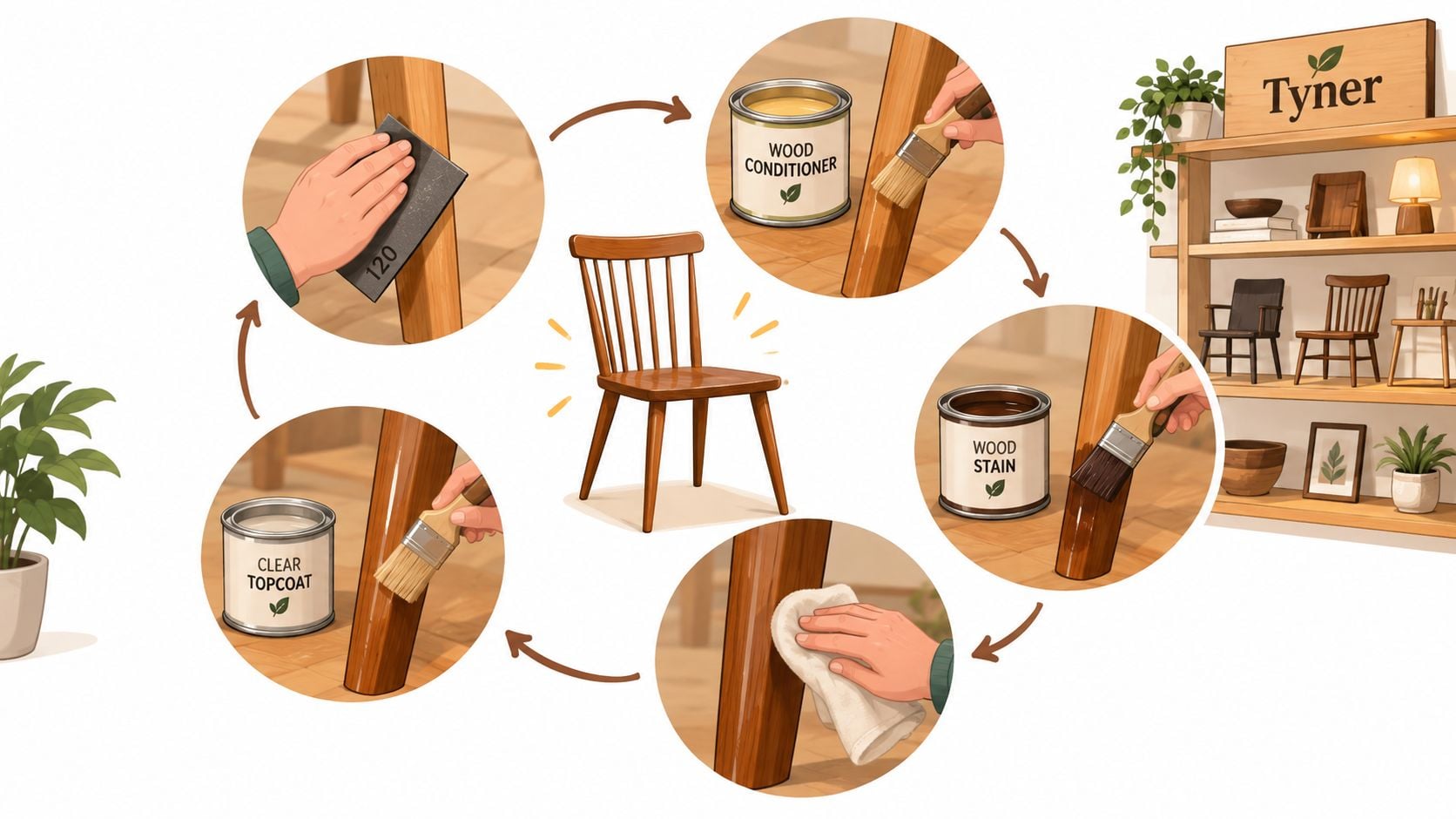
One mistake ruins more test panels than any other: letting unabsorbed stain dry on the surface. It can interfere with clear-finish adhesion and leave dark patches. And never try to correct the color by sanding stained wood, since sanding pulls pigment unevenly and makes the blotching worse.
For made-to-order Amish furniture, ask to review a fully finished sample on your chosen species before production begins. Our finishers at the South State St. showroom prepare these panels on the same solid wood that goes into the build, so what you approve is what the piece becomes. Tyner Furniture's steps for avoiding color mismatch when ordering online make the same point: judge the finish itself, never a screen or a label. Approval before production is a small step that protects the cost-per-year value of an heirloom piece.
Sheen Levels, Topcoats, and Where the Piece Will Live
Sheen is more than a style preference. It affects how a piece looks in the room, while the topcoat helps determine how the surface handles everyday use. Choose stain and protection together. A dining table that regularly faces spills and cleaning needs a different finish plan from a bedroom chest that sees less contact.
| Sheen | Typical look | Possible use | Finish decision |
|---|---|---|---|
| Matte | Soft, low-reflection appearance | Bedroom pieces or accent cabinets where a quieter look suits the room | Confirm that the chosen protective finish offers the needed durability |
| Satin | Gentle sheen without a strong gloss | Everyday furniture where a balanced appearance matters | Match the topcoat to handling, cleaning, and product guidance |
| Semi-gloss | More reflected light | A cabinet or table where a brighter surface fits the design | Check that the finish schedule suits the expected wear |
| Gloss | High reflection and a pronounced surface | A deliberate, polished accent | Test the finished sample carefully; reflectivity can change how color reads |
Let use decide the protection
A dining table, desk, and frequently handled cabinet need a stain-plus-topcoat system suited to abrasion, spills, and cleaning. A decorative piece with little direct contact may allow a different sheen or finish choice. Possible topcoat categories include oil-and-wax, polyurethane, conversion varnish, and water-based clear finishes, but they aren't automatic matches for every stain. Follow the product makers' compatibility and curing instructions.
EPA materials treat wood-furniture finishing as a system with distinct stages, including stains, wash coats, sealers, clear topcoats, and repair coatings. The agency's listed rules also distinguish coating categories and specify limits for certain covered coatings, underscoring that “the finish” can involve several materials rather than one color choice. (EPA materials on wood-furniture finishing systems)
Finish the sample completely. A stain-only panel can't show the final sheen, color, or compatibility of the protective system.
Before approving a custom order, confirm the chosen stain works with the intended lacquer, varnish, oil, wax, or water-based clear finish. For a table, tabletop finish considerations can help focus the conversation on the surface's use, not just its appearance.
Indoor Air Quality, Curing, and Long-Term Maintenance
A finish that smells mild isn't necessarily fully cured. For bedrooms, dining rooms, and homes with children or pets, consider the complete stain-and-topcoat system, product information, ventilation, and the time needed before regular use. The EPA defines volatile organic compounds, or VOCs, as compounds that evaporate under normal indoor conditions, so coating chemistry matters during and after finishing. (EPA overview of volatile organic compounds)
Ask about the whole schedule
Request the product's VOC information and its instructions for ventilation, recoat timing, and cure. Low odor and fully cured are not interchangeable descriptions. A finish may feel dry before it has reached the manufacturer's stated cure point, so follow the product guidance before placing objects on the surface or cleaning it.
Ann Arbor homes also move through seasonal changes, from humid summers to drier winters. Use the manufacturer's recommended temperature and humidity limits during finishing, and avoid assuming that a comfortable room automatically provides suitable application conditions. A technical sheet cited in USDA research specifies temperatures above 50°F and relative humidity below 85%, while another recommends conditions near 70°F and 50% humidity with good air movement. The same guidance notes that drying times depend on conditions and advises treating stated times as benchmarks, not promises. (USDA Forest Service guidance on stain application conditions)
Build maintenance around the finish rather than a fixed calendar. Keep the surface clean using care instructions appropriate to the coating, wipe spills promptly, and avoid harsh cleaners unless the finish maker approves them. For specific care questions, Tyner's guide to protecting wood furniture from scratches and stains offers a practical starting point.
For households looking into indoor-air measures, VOC removal for your home is a resource on that topic. Furniture finish decisions still begin with the product details: select a system suited to the room, ensure appropriate ventilation during finishing, and allow the full recommended cure before daily use.
Turning the Right Finish Into an Heirloom Investment
The finish is one part of an heirloom decision, alongside the wood, construction, and intended use. A stain that complements the room and protects the furniture's character can help a piece remain welcome through changing decor. But color alone doesn't establish long-term value. Solid-wood construction and joinery matter, too.
A furniture-joint study measured a traditional mortise-and-tenon joint made from the same stock enduring more than 26 kilonewtons of applied load before elastic failure, compared with just over 12 kilonewtons for a common #20 biscuit joint. The study also found that dovetail strength varied with dovetail count, angle, and available glue surface, with its strongest tested configuration averaging more than 8 kilonewtons and its weakest more than 6 kilonewtons. Those findings support looking beyond a finish sample when evaluating furniture intended to last. (Furniture-joint strength study)
Look beyond the color
Tyner Furniture, serving Southeast Michigan since 1957, offers hand-crafted Amish solid-wood furniture made to order, with finish choices for hardwoods such as cherry, oak, and maple. The in-stock selection is just the beginning: made-to-order options include finishes, fabrics, and configurations, with bespoke Canadel dining choices and ergonomic Stressless seating. The range extends from the Home Office to Outdoor Spaces, making it possible to consider a room as a whole rather than as a single stain decision.
That craftsmanship changes the cost-per-year conversation. A well-made table or bedroom piece is an investment in material integrity, joinery, and a finish selected for its actual role in the home. Special Financing and a Low Price Promise can make that investment easier to plan without reducing the decision to the initial price.

For a closer look at wood species and bespoke finishes, visit the South State St. showroom in Ann Arbor for a sit test and finish consultation. Tyner Furniture can help Southeast Michigan households compare made-to-order Amish furniture, Canadel and Stressless options, and finishes suited to the home.