Cherry Dining Room Sets: A Buyer’s Guide to Lasting Style

A Saturday morning furniture decision can look deceptively simple. Two tape outlines sit on the dining room floor, one marking a compact online table with a cherry-colored finish, the other showing the footprint of a solid cherry table, chairs, and hutch measured against the bay window. The household needs a place for homework tonight, holiday meals later, and perhaps an heirloom a daughter could inherit someday.
That's the question behind cherry dining room sets. The purchase isn't only about a reddish-brown color or a traditional silhouette. It's a long-term material decision involving wood integrity, joinery, finish, room scale, comfort, customization, and cost-per-year. In a Southeast Michigan home, the right set should work through changing family routines, changing interiors, and the seasonal movement that comes with Michigan weather.
Since 1957, Tyner Furniture has helped local households make those decisions with a showroom experience that includes dining rooms, bedrooms, living spaces, Home Office furnishings, entertainment areas, and Outdoor Spaces. In-stock is just the beginning. A shopper can also explore made-to-order finishes, fabrics, and configurations, including Canadel dining furniture and ergonomic Stressless seating.
Standing in the Empty Dining Room
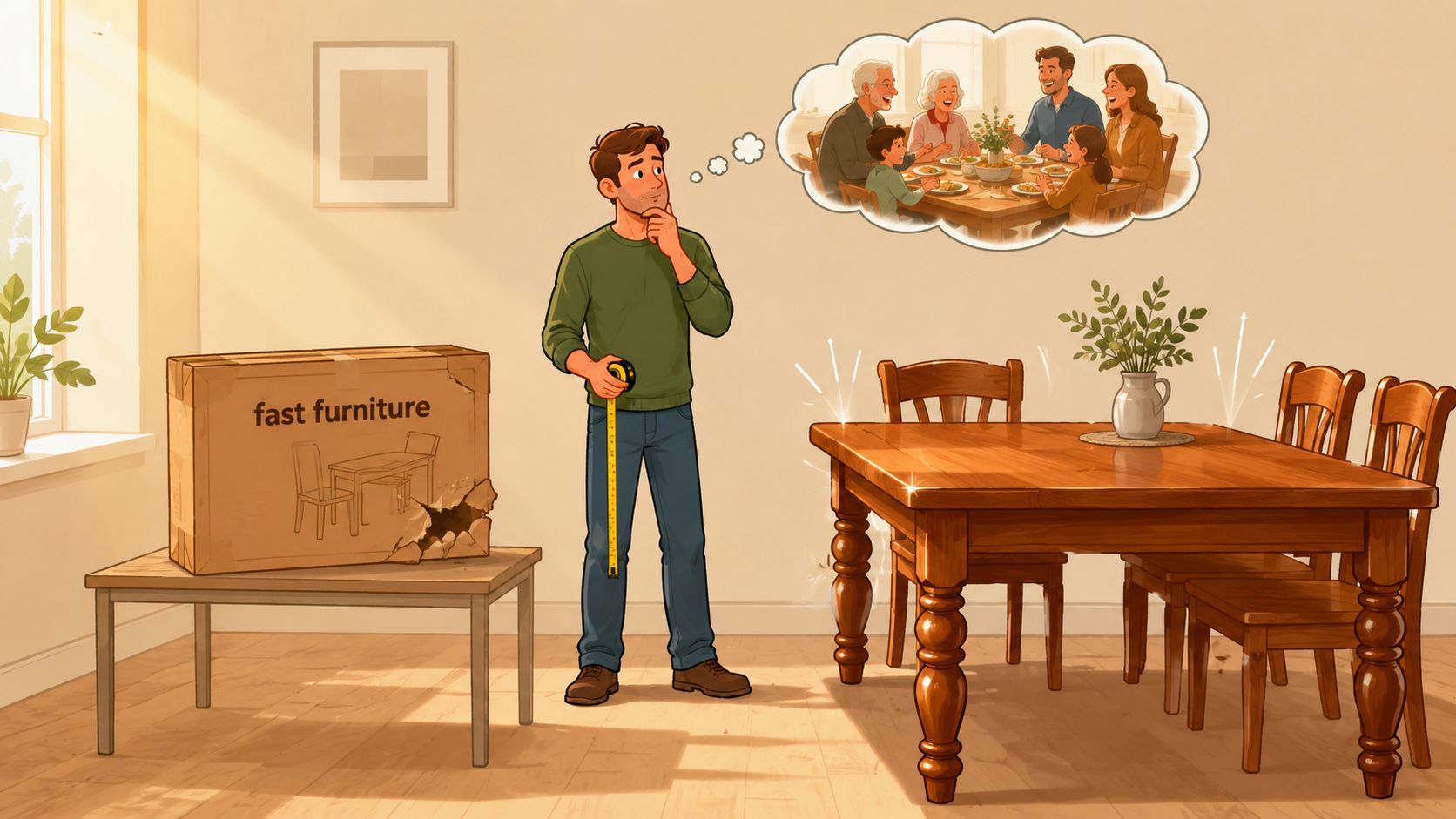
The shopper stands near the window with a tape measure in one hand and a phone in the other. One screen shows a table with a convincing cherry photo finish. The other option has the visual weight that only solid wood brings, a substantial top, carefully fitted chairs, and a hutch whose proportions make the room feel intentional rather than filled.
The cheaper-looking choice may solve the immediate problem. The solid cherry set asks better questions. Will the table remain comfortable when children use it for homework? Will the leaves make holiday hosting practical? Will the finish coordinate with flooring after the wood changes color? Can the chairs be repaired instead of replaced when years of daily use leave their mark?
Cherry has a long furniture history. One historical account traces its use by Greeks and Romans as early as 400 BC, while American makers were using native cherry in Philadelphia by 1796. By the 1950s, cherry had become a major mass-market furniture wood in the United States, and colonial makers called it “New England Mohogany” because it darkened with age in a way that resembled mahogany. Those milestones help explain why cherry furniture carries such a strong association with tradition and heirloom continuity. (Cherry furniture history)
The purchase should answer five practical questions
- Material: Is the set built from solid cherry, cherry veneer, or a combination?
- Construction: Do the joints support repair and long service?
- Aging: Will the buyer appreciate cherry's gradual deepening in color?
- Configuration: Does the table fit everyday use, larger gatherings, and traffic flow?
- Customization: Can the finish, chair fabric, table shape, and storage pieces suit the room?
A cherry set will collect evidence of family life. It may acquire small dents, softened edges, and a richer patina. That's not a flaw in a well-made piece. It's the visible record of use, and it's why a proper cherry dining room set should be evaluated as a 30-year material decision, not a quick décor transaction.
What Cherry Wood Really Brings to a Dining Set
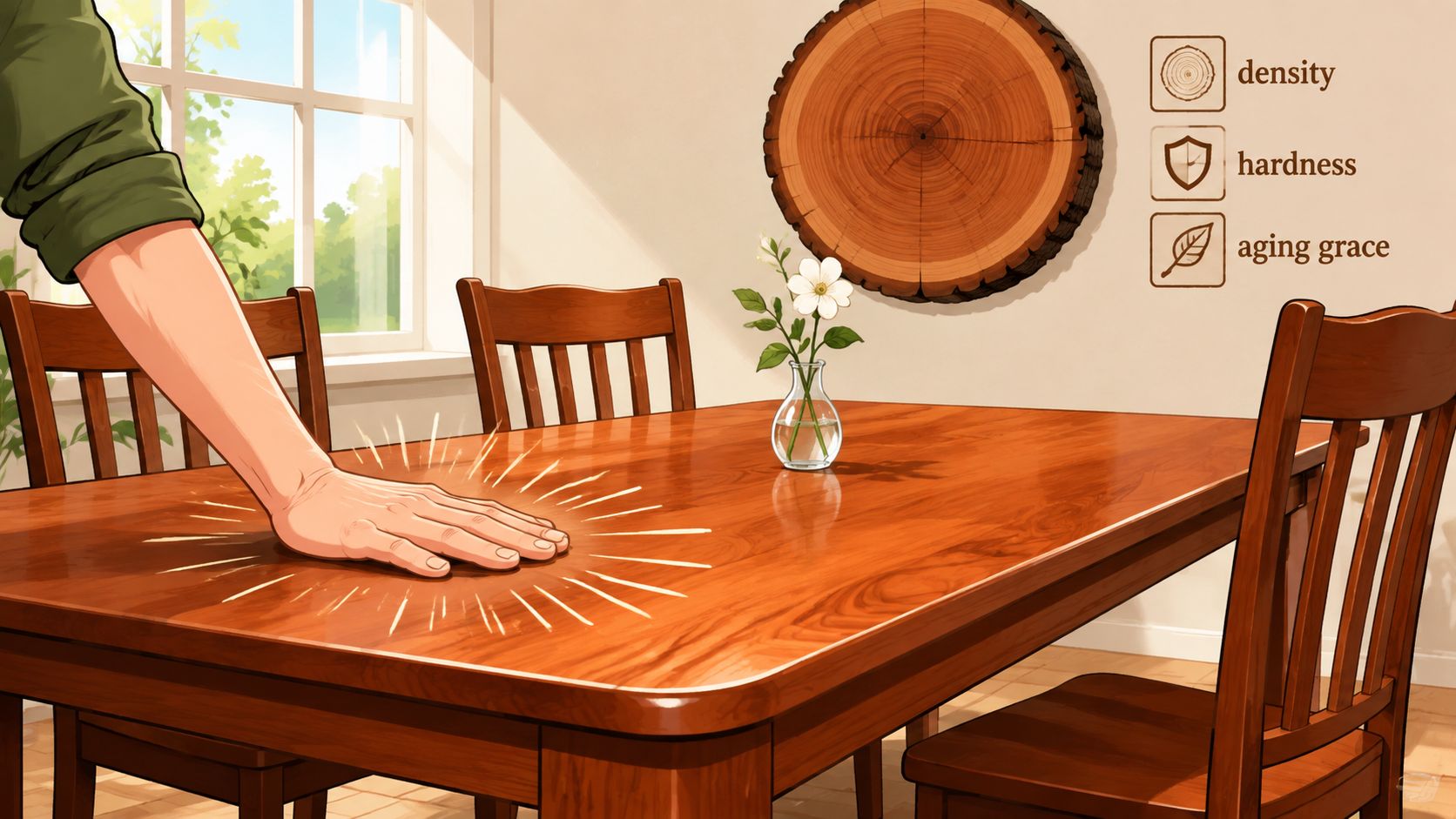
Cherry earns its place in a dining room through balance. It's a medium-density domestic hardwood with an average dried weight of about 561 kg/m³ and a specific gravity near 0.50, according to the American Hardwood Export Council's American cherry guide. That places it in a useful middle ground, substantial enough for tables and case pieces without feeling excessively hard or brittle.
Its movement is moderate. The same guide reports approximately 3.7% radial shrinkage, 7.1% tangential shrinkage, and 11.5% volumetric shrinkage. Properly kiln-dried cherry can therefore perform reliably in a dining room when seasonal humidity changes are managed. The point isn't that cherry ignores the environment. No solid wood does. The point is that experienced builders account for movement in the design.
Hardness affects daily living
Cherry's Janka hardness is commonly cited at about 950 lbf, a figure documented in woodworking industry guidance on American cherry. That makes it a moderately hard furniture wood. A dropped serving dish can leave a mark, but cherry machines cleanly and accepts a smooth, premium finish.
That working quality matters in dining furniture. Cherry can carry shaped edges, curved chair components, and restrained carved details without looking coarse. It also takes finish attractively, allowing a natural surface, a lighter stain, or a deeper traditional tone.
Light changes the furniture
Cherry darkens with exposure to light. Fresh-looking material gradually shifts toward a deeper amber-brown tone, and the change continues as the set develops its patina. That aging behavior is central to the appeal, but it also means a buyer should avoid choosing a stain only from a small online image.
Showroom rule: A cherry sample should be viewed beside the home's flooring, cabinetry, wall color, and actual lighting before the finish is approved.
The wood furniture guide for longevity and style offers a useful framework for comparing hardwood choices. Cherry is a strong fit for households that want warmth, workable durability, and a surface that grows more characterful over time.
Choosing the Right Cherry Set Format
The right format depends less on tradition than on how the room works every day. A dedicated dining room may welcome a complete formal arrangement, while an open-plan space often needs a lighter footprint and more flexible seating.
| Format | Seats | Best Room | Key Trade-Off |
|---|---|---|---|
| Formal table and chairs | Four to six commonly | Dedicated dining room | Cohesive and polished, but less flexible |
| Extension table set | Expands for larger gatherings | Homes that host occasionally | Requires leaf storage and adequate clearance |
| Mixed-chair dining set | Flexible by table length | Open-concept rooms | More personal, but requires careful coordination |
| Hutch and server set | Depends on table configuration | Dining rooms needing storage | Adds useful organization while increasing visual mass |
Formal table and chairs
A rectangular table with matching side chairs creates the most traditional reading. A pedestal base can make entry and exit easier, while a leg table may suit a more custom or farmhouse-inspired interior design. This format works well when the dining room has a clear boundary and the household wants the furniture to act as a composed set.
Extension tables
An extension table earns its space by changing roles. It can remain compact for daily meals, then open for Thanksgiving or larger family gatherings. Self-storing leaves are especially practical, but the room still needs enough space to move around the expanded top. Buyers should confirm where the leaves remain when they aren't installed, since an elegant table becomes inconvenient if the stored parts have no sensible home.
Mixed-chair arrangements
A cherry table doesn't require every chair to match. Two armchairs at the heads and simpler side chairs along the rails can make a long table feel less formal. Upholstered seating can add softness, while wood side chairs preserve visual connection to the table.
The pairing should still agree in scale, warmth, and seat height. In-stock is just the beginning, especially when a shopper needs specific fabrics, finishes, or configurations. Canadel's made-to-order approach can support that more customized direction.
Hutches and servers
A matching hutch, buffet, or server adds closed storage for linens, serving pieces, and dishware. It also changes the room's visual balance, so the piece should be measured against windows, door swings, and wall height before purchase. For a smaller home, a lower server may provide the needed storage without making the dining zone feel formal or crowded.
Finishes, Stains, and How Cherry Ages Over Time
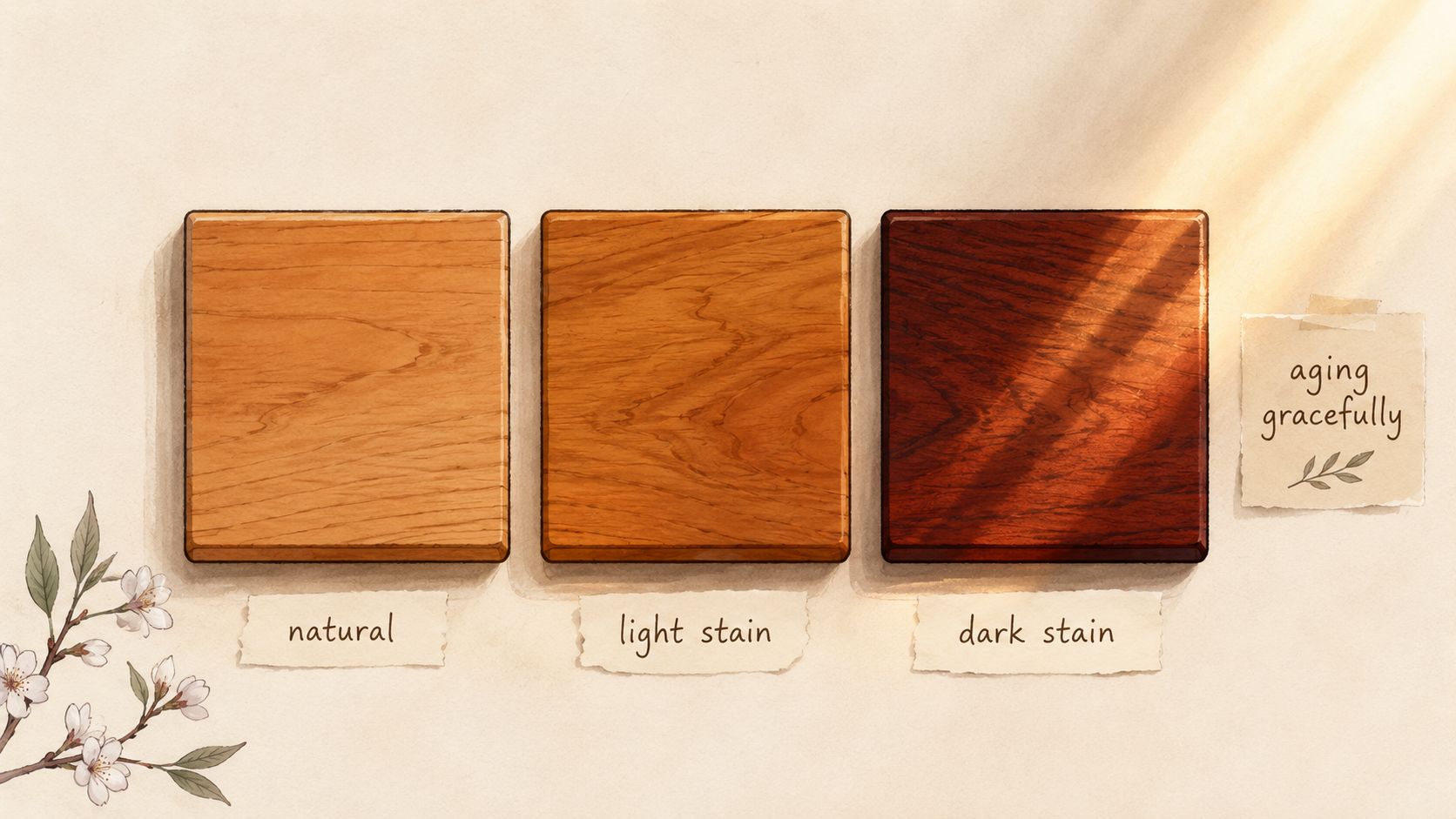
Cherry's natural color is part of the material's identity, not a fixed factory setting. A natural finish lets the grain and gradual patina do the work. A light stain can soften the pink and salmon character while keeping the room bright. A dark stain creates a more formal presence and can coordinate with traditional case goods, though it may make dust and fingerprints more visible.
The buyer should treat stain as a starting point, not a guarantee of the final color. Light exposure deepens cherry, so a newly delivered set may look lighter than the same finish after years in a bright dining room. A pre-aged or distressed finish can provide a more settled appearance from the beginning, which suits households that don't want to wait for the wood to develop its warmth.
Coordinate by undertone
- Honey oak floors: A natural or light cherry finish can keep the room warm without creating a heavy brown-on-brown effect. A rug with muted greens, creams, or blue-gray accents can separate the surfaces.
- Espresso cabinets: A medium or darker cherry finish can create continuity, but contrasting upholstery or a lighter wall tone prevents the room from becoming visually dense.
- Cool gray walls: Natural cherry provides needed warmth. Cooler bulbs can make the wood appear more subdued, while warm bulbs emphasize its amber and red undertones.
The guide to matching wood stains can help households compare existing finishes before committing. A physical sample remains essential because the same stain reads differently beside flooring, painted walls, and cabinetry.
Choose sheen for use, not showroom drama
A moderate sheen usually balances cleanability with a natural appearance. Very glossy surfaces can emphasize fingerprints and reflections, while very flat finishes may show handling in a different way. Consistent topcoats and thoughtful placement near windows help a matched set age more evenly.
Why Solid Wood Joinery Outlasts Veneer Furniture
A cherry-colored surface doesn't make a dining set solid cherry. Mass-produced furniture may use veneer over engineered panels, staples, and simplified assemblies. That construction can look attractive when new, but it gives the buyer fewer options when edges lift, hardware loosens, or a high-use joint begins to rack.
Solid cherry has a stronger cost-per-year argument when the structure is built correctly. The wood itself offers moderate durability, while the joinery determines how that material behaves under daily loading and seasonal movement. Mortise-and-tenon construction places a fitted tenon inside a matching mortise, creating a mechanical lock that resists racking and tension. With glue, it's widely described as one of the strongest furniture joints, particularly for solid wood frames designed for long service. (Mortise-and-tenon construction)
The joint should match the job
Dovetails belong where drawers need resistance against being pulled apart. Their interlocking shape tightens under pulling force, making them especially suitable for servers, hutches, and buffet drawers. Mortise-and-tenon joints make sense for table bases and chair frames, where lateral stress and repeated movement matter.
| Feature | Solid Cherry, Amish | Mass-Produced Veneer |
|---|---|---|
| Main material | Solid North American hardwood | Veneer or engineered panels may dominate |
| Frame joinery | Mortise-and-tenon can resist racking | Simplified joints, staples, or fasteners are common |
| Drawer construction | Dovetails can resist pull-apart stress | Less mechanically interlocked construction |
| Repairability | Components can often be serviced or refinished | Damaged veneer and panels can be difficult to restore |
| Aging character | Wood develops patina and surface history | Appearance depends heavily on the applied surface |
A solid cherry piece can still move seasonally, and it can still be dented. That honesty matters. The advantage isn't invincibility. It's material integrity, repairability, and serviceable craftsmanship.
Cost-per-year test: A higher initial price makes more sense when the household expects the table to serve daily meals, celebrations, and future generations rather than a short decorating cycle.
Amish hand-crafted construction adds a human repair ethic to the purchase. The result is an heirloom rather than a disposable arrangement, especially when the buyer selects a configuration that fits the room instead of forcing the room to accommodate an oversized set.
Sizing and Layout for a Comfortable Dining Room
A beautiful table can become a daily nuisance if chairs strike walls, doorways pinch traffic, or a hutch blocks a natural path. Measurements should happen before a shopper falls in love with a finish.
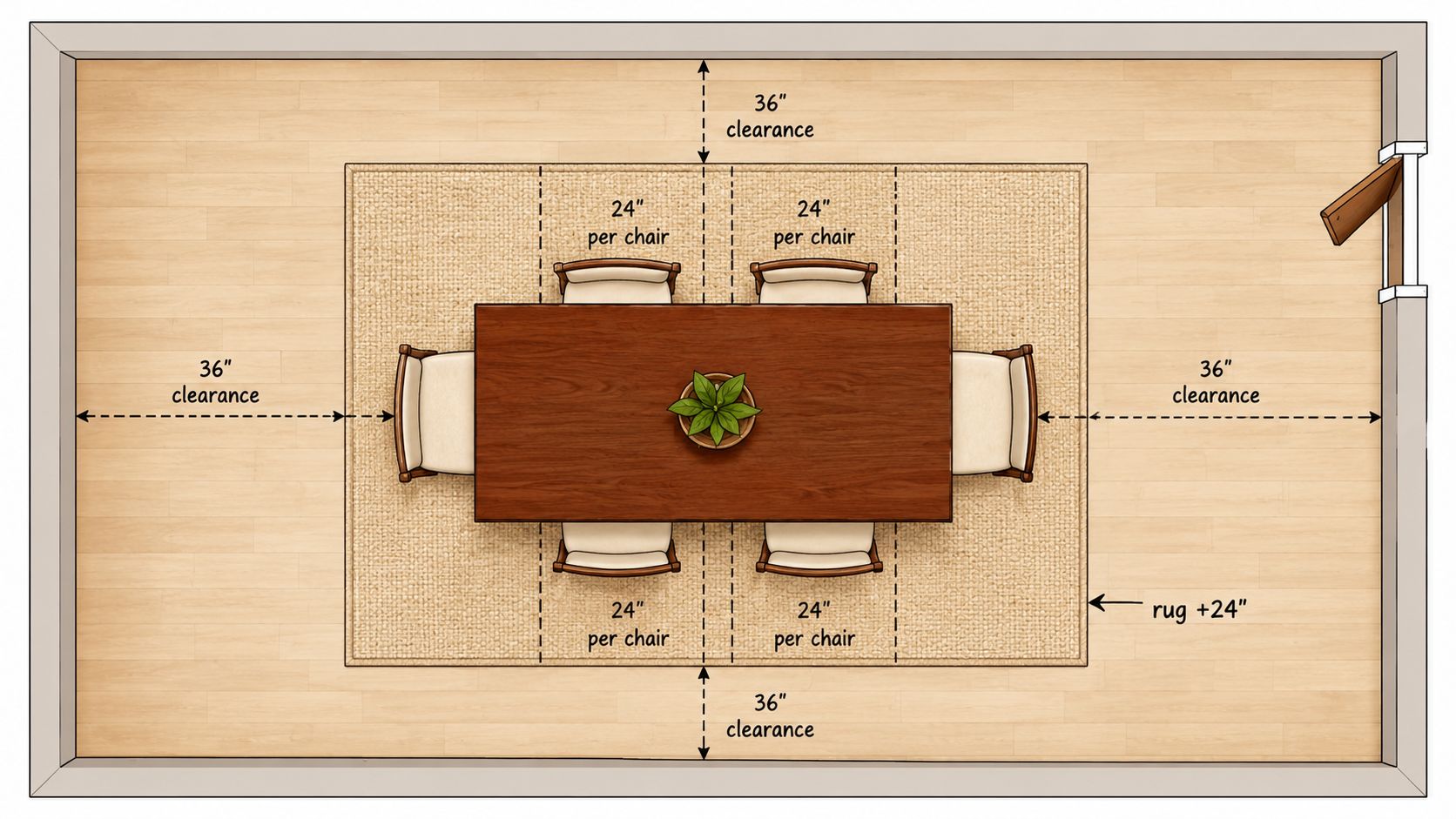
A practical planning baseline allows 36 inches of clearance behind each chair and approximately 24 inches of table edge per chair. A dining rug should extend 24 inches beyond the table on every side so pulled-back chairs remain on the rug. These figures should be checked against real chair widths, armrests, table aprons, and nearby furniture rather than treated as automatic guarantees.
Measure the usable rectangle
The furniture measuring guide helps shoppers record the room before visiting a showroom. The planning formula is straightforward:
Available table length = room length minus chair clearance at both ends.
Available table width = room width minus chair clearance along both sides.
That usable rectangle must also account for doors, hallways, windows, radiators, and built-in cabinetry. A buffet needs its own operating space. A hutch needs wall height and a clear sightline. A chandelier needs sufficient ceiling height and should be centered over the table, not merely over the room.
Think about the leaves
An extension table needs two footprints, closed and open. Tape both outlines on the floor, then mark where chairs sit in each arrangement. If the leaves don't store inside the table, the buyer should identify a dry, accessible storage location before ordering.
Pro-Tip
- Mark traffic first: A table that technically fits but interrupts the route between the kitchen and living area will frustrate the household.
- Test arm clearance: Armchairs can require more room than side chairs, especially at the heads.
- Include storage doors: Hutch and server doors need operating space, not just wall space.
Good sizing protects comfort. It also protects the visual proportion that makes cherry feel architectural rather than overpowering.
Custom and Amish Options Worth the Wait
A customer entering a Southeast Michigan showroom may begin with a table shape and leave with a much more precise design. The Canadel process gives the household room to decide whether the table should have tapered legs, turned legs, or a pedestal base. Edge profiles can move from eased and quiet to mission-inspired or more expressive, depending on the desired character.
The finish comes next. Natural cherry, a lighter tone, a deeper stain, and hand-distressed options each tell a different story. Chair upholstery adds another layer, from durable fabric to the buttery feel of top-grain leather. The choice should support how long people sit, how often the chairs are cleaned, and whether the room leans formal, casual, or collected.
A made-to-order decision has consequences
A custom order is sketched, quoted, and scheduled for production rather than pulled from a warehouse rack. That process takes patience, but it also prevents the familiar compromise where the table is almost the right length, the chairs almost fit, and the finish almost works with the floor.
Useful decisions include:
- Base style: Tapered, turned, trestle, or pedestal construction changes both appearance and legroom.
- Top profile: Edge treatment affects how substantial or refined the table feels.
- Expansion: Self-storing leaves can support everyday flexibility without requiring a separate storage plan.
- Storage: A matching hutch, buffet, or server can keep the room organized.
- Seating: Upholstered chairs, wood seats, armchairs, and coordinated alternatives can be combined intentionally.
For shoppers who want a solid hardwood standard, Amish-built pieces offer a different path. Small Michigan and Ohio workshops use construction details such as dovetailed drawers and mortise-and-tenon chair frames, giving the furniture a repairable, hand-crafted character. The Amish table and chairs collection reflects that emphasis on material integrity.
The strongest recommendation is to decide the room's needs before choosing the decorative details. A made-to-order cherry set should solve seating, storage, comfort, and finish coordination in one coherent plan.
Pricing, Financing, and Shopping Locally in Southeast Michigan
Cherry dining furniture spans a broad value range because “cherry” can describe very different construction standards. A Canadel cherry dining set may begin around the mid-four figures for a five-piece set and move beyond five figures for a table seating ten or more with a matching hutch. Amish-built solid cherry sets generally sit higher because the buyer is paying for full hardwood construction, detailed joinery, customization, and long-term serviceability.
Those exact figures should be treated as showroom planning guidance rather than a universal price list. Table dimensions, chair upholstery, finish complexity, storage pieces, and special configurations all change the quote.
| Set Type | Seats | Typical Price Range | Best For |
|---|---|---|---|
| Canadel five-piece cherry set | Five-piece configuration | Mid-four figures and upward | Everyday dining with customization |
| Expanded Canadel set with hutch | Ten or more | Past five figures for larger configurations | Hosting and coordinated storage |
| Amish solid cherry set | Varies by configuration | Higher investment level | Heirloom use and repairable construction |
Calculate value across service
A $4,500 set spread across 30 years equals roughly $150 annually. That calculation doesn't guarantee a piece will last that long, but it shows why purchase price alone can distort the decision. A solid set used every week may offer better cost-per-year value than a lower-priced table that needs replacement when its surface or structure fails.
Tyner Furniture offers Special Financing, subject to approval, and a Low Price Promise that supports competitive value when shoppers compare quotes. Local delivery options can also reduce the logistical burden for Southeast Michigan households, though coverage and terms should be confirmed with the showroom.
For readers who enjoy pairing a home purchase with thoughtful seasonal gifting, a separate guide to luxury gifts under 500 for Australia offers ideas outside the furniture category. It's a useful reminder that value can mean longevity, usefulness, and suitability, not just the lowest initial number.
The Ann Arbor showroom on South State St. gives shoppers a chance to view cherry samples under real room lighting, feel the weight of solid wood, test chair comfort, and compare formal, casual, mixed-chair, Canadel, and Amish configurations. The showroom's broader selection also reaches from the Home Office to Outdoor Spaces, so a dining decision can fit into a coordinated home plan rather than stand alone.
Tyner Furniture offers solid cherry dining furniture, Amish hand-crafted options, Canadel customization, Special Financing, and a Low Price Promise for Southeast Michigan shoppers. Visit the Tyner Furniture Ann Arbor showroom for a proper sit test and finish comparison, or browse the online Quick Specs for dimensions and special-order configurations before making a 30-year furniture decision.