Best Furniture Financing Options Compared for Smart Shoppers


A Southeast Michigan household often reaches the same uncomfortable crossroads. The kitchen table wobbles, the sectional has lost its shape, or the bedroom furniture no longer suits the room. Cash might cover a basic replacement, but the better-built piece costs more than the household wants to remove from savings at one time. That's where the best furniture financing becomes a budgeting decision, not a sales tactic.
The right plan can make an heirloom-quality purchase fit predictable cash flow. The wrong plan can turn a promotional offer into an expensive balance. Furniture financing deserves the same care as the furniture itself, especially when the choice involves solid wood, hand-crafted construction, top-grain leather, ergonomic support, or a made-to-order configuration.
A useful starting point is to compare the payment structure, payoff deadline, qualification requirements, and worst-case cost before anyone signs at the register.
| Financing structure | Payment style | Main advantage | Main risk |
|---|---|---|---|
| No-interest promotion | Equal payments during a promotional period | No interest when the balance is paid in full as agreed | Missed payoff terms can trigger interest |
| Fixed installment loan | Fixed payment over a stated term | Predictable payoff schedule | APR increases total cost |
| Deferred-interest plan | Promotional payment followed by standard account terms | Lower upfront carrying cost | Accrued interest may be charged from the purchase date |
| In-house store plan | Retailer-managed payment agreement | May offer simpler qualification | Terms, deposits, and fees vary by retailer |
Why Furniture Financing Deserves a Closer Look
A family near Ann Arbor can pay cash for a $1,200 dining set, but the solid-wood table across the showroom floor costs $4,200. The first option solves the immediate problem. The second may offer the weight, joinery, finish, and proportions that make a dining room feel settled for years.
That difference matters because furniture isn't decorative background. A dining table carries homework, meals, holidays, and ordinary weekday use. A sectional supports daily lounging. A bedroom group stays in service through moves, changing décor, and changing family needs. The household has to weigh the purchase against cash reserves, upcoming bills, and the cost-per-year of replacing a weaker piece repeatedly.
A well-built set may require more planning upfront, but replacing a lower-quality set every few years can consume more money over time than financing one durable purchase responsibly. The calculation isn't just the monthly payment. It includes construction, comfort, repairability, longevity, and whether the piece still fits the home after the first decorating cycle.
Practical rule: Financing should protect cash flow, not justify a purchase the household can't comfortably afford.
Furniture belongs in the household budget
Predictable payments can help align a dining set, bedroom group, mattress, or living-room upgrade with real income timing. That can be sensible when a household needs the furniture now, has stable room in its budget, and chooses a term that ends before the promotional deadline.
A shopper comparing options can use this guide to the furniture buying journey before applying. Research, room measurements, comfort testing, and financing review belong in the same decision.
Tyner Furniture has served Southeast Michigan since 1957, with a South State St. showroom in Ann Arbor that covers everything from the Home Office to Outdoor Spaces. The in-stock selection is only the beginning. Customers can explore finishes, fabrics, and configurations, including Canadel dining options and Stressless ergonomic seating.
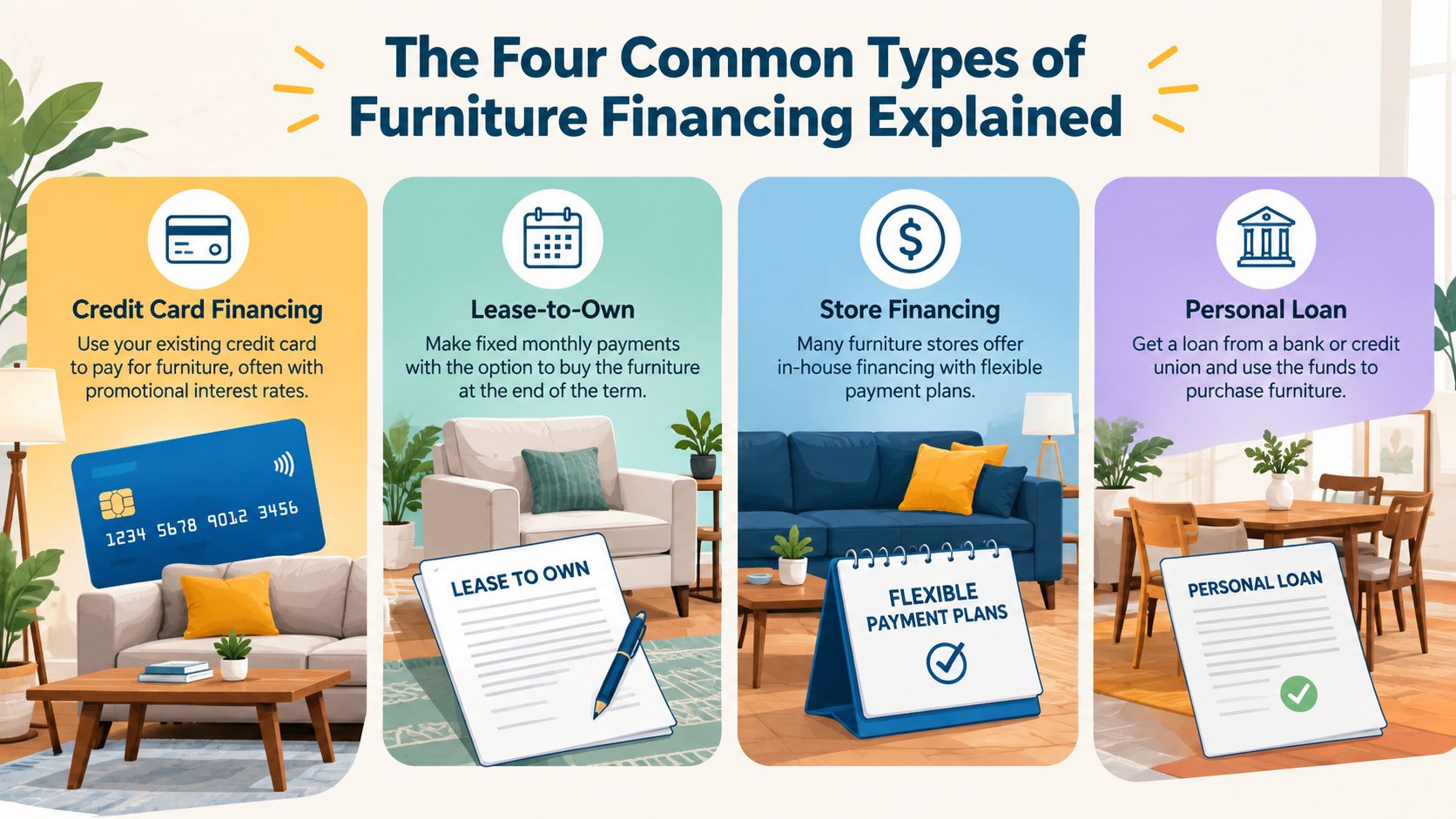
The Four Common Types of Furniture Financing Explained
The label on a financing offer can hide the part that matters most, the payoff obligation. A credit desk should be able to explain who funds the agreement, how long payments continue, what happens after the promotional period, and whether interest is waived or merely postponed.
No-interest promotional financing
A no-interest promotion waives interest if the buyer pays the promotional balance in full by the stated deadline and follows the agreement's payment rules. Retail furniture financing commonly uses short-term structures such as “pay in four” or “pay in 30 days,” while larger home-furnishing purchases may use 0% APR or deferred-interest plans lasting one to two years or longer, as described by Duke Fuqua's retail financing overview.
Remember: The advertised rate isn't the full answer. The payoff date and failure conditions matter just as much.
Fixed installment loans
An installment loan carries a stated APR and a fixed term. The borrower makes scheduled payments until the balance reaches zero, which makes the payoff date easier to track than an open revolving account.
This structure suits shoppers who need a predictable monthly obligation and don't want a promotional deadline controlling the decision. The tradeoff is straightforward: interest increases the final cost.
Deferred-interest plans
Deferred interest is the structure requiring the most caution. The account may show no interest during the promotional window, but interest can accrue from the purchase date. If the balance isn't paid in full by the deadline, the creditor may add the accrued amount to the account.
Remember: Deferred interest is not the same as permanently waived interest.
In-house store plans
An in-house plan is managed by the retailer rather than a separate lender. Approval may be simpler, terms may be shorter, and the retailer may set its own deposit and order conditions. Buyers still need the written APR, fees, payment schedule, early-payoff policy, and consequences of late payment.
A shopper considering buy-now-pay-later furniture can review Tyner's financing information and ask which terms apply to the specific order, especially when the piece is custom or made-to-order.
Side-by-Side Comparison of Financing Structures
The same purchase price can create very different obligations depending on the financing structure. A $3,000 purchase and a $7,500 purchase may both qualify for promotional financing, but the larger balance demands more payment discipline and may trigger different approval or deposit requirements.
| Financing Type | Typical Term | Qualification | Total Cost Risk | Best For |
|---|---|---|---|---|
| No-interest promotion | Short promotional window or stated promotional term | Subject to lender approval and offer rules | Interest or fees may apply if conditions aren't met | Buyers who can finish payment before the deadline |
| Fixed installment loan | Fixed term selected at approval | Credit and income review usually apply | APR raises the final cost | Buyers who value a known payoff schedule |
| Deferred-interest plan | Promotional window followed by standard account terms | Approval depends on lender criteria | Backdated interest can materially increase payoff | Highly disciplined buyers with a clear payoff plan |
| In-house store plan | Retailer-defined, often shorter terms | May use simpler approval standards | Deposits, fees, and terms vary | Buyers with special-order needs or limited traditional credit |
At the $3,000 level, a no-interest offer can be efficient if the household can divide the balance across the required payments without touching emergency savings. At $7,500, the same structure may become uncomfortable unless the buyer has a reliable payoff source and understands whether the offer is waived interest or deferred interest.
Qualification also changes with the order. A lender may review credit history, income, existing obligations, and the requested amount. A retailer may require a deposit before ordering a custom piece. A buyer should never assume that early payoff is penalty-free or that every payment plan reports activity to credit bureaus. Those details belong in the written agreement.
For shoppers comparing a complete room purchase with a narrower need, mattress financing options can help separate sleep-system budgeting from broader furniture financing. The best furniture financing plan is the one whose risk remains manageable if delivery timing, household expenses, or income changes.
Modeling Real Monthly Payments on Typical Purchases
Concrete math is more useful than a low monthly headline. The examples below use principal divided evenly by the stated term for the no-interest and same-as-cash columns. The fixed APR and revolving columns require the actual contract rate to calculate accurately, so the table shows the payment structure without inventing an APR or final interest amount.
| Purchase | 12-Mo No-Interest | 24-Mo Same-as-Cash | 36-Mo Fixed APR | 60-Mo Revolving |
|---|---|---|---|---|
| $1,800 sofa | $150 per month, $1,800 total if paid as agreed | $75 per month, $1,800 total if paid as agreed | Contract APR determines payment and final cost | Payment varies with APR, balance, and account rules |
| $3,200 dining set | About $267 per month, $3,200 total if paid as agreed | About $133 per month, $3,200 total if paid as agreed | Contract APR determines payment and final cost | Payment varies with APR, balance, and account rules |
| $6,500 bedroom suite | About $542 per month, $6,500 total if paid as agreed | About $271 per month, $6,500 total if paid as agreed | Contract APR determines payment and final cost | Payment varies with APR, balance, and account rules |
What the payment feels like matters
A $150 monthly payment for the sofa may fit comfortably beside ordinary household expenses. The $542 monthly payment for the bedroom suite demands a much closer look, even if the furniture is a better long-term value. Stretching the same purchase over a revolving term can lower the required payment, but it may keep the balance open longer and increase the final cost through interest.
The actual agreement controls the result. Buyers should request the payment amount, total of payments, APR, fees, promotional deadline, and post-promotion rate in writing. A plan that appears affordable at checkout may become difficult if the household pays only the minimum or carries the balance past the offer.
Adobe reported that consumers spent over $126 billion on home furnishings in 2022, with spending up 10.2% year over year, while BNPL online order share for home furnishings grew 14% in that period and another 38% year over year during the first two months of 2023. Those figures from Adobe Analytics show why installment payment options have become a normal part of the furniture checkout conversation.
The responsible comparison is simple: choose the highest-quality piece that fits the budget, then select a term that the household can finish without relying on a future windfall.
The Deferred-Interest Trap and How to Avoid It
The deferred-interest trap deserves plain language. Interest may accrue from the purchase date at the account's standard APR, even while statements display a promotional payment. If the buyer hasn't paid the balance in full by the deadline, the creditor can post the accumulated interest at once.
For example, a $3,200 dining set financed at 28.99% APR with a 24-month promotion could add roughly $900 to the payoff if the balance isn't cleared on time, based on the stated example terms. That isn't a small administrative charge. It can change the entire value calculation of the table and chairs.
Protection steps for promotional buyers
- Set the reminder early: Mark a payoff date at least two months before the promotion ends.
- Automate the target payment: Schedule enough to eliminate the full promotional balance, not merely the minimum due.
- Confirm posting rules: Ask the creditor when the final payment must post and how pending payments are treated.
- Request documentation: Obtain a paid-in-full letter after the final payment clears.
- Read the back page: Check the standard APR, late charges, fees, and any separate balances on the account.
Retail terms demonstrate why this review matters. One national retailer describes a qualifying 60-month no-interest plan with 60 equal monthly payments, while another states that interest can be charged from the purchase date if the promotional balance isn't paid in full. Those terms appear in the retailer's furniture financing information, and they illustrate why “no interest” must always be read alongside the payoff condition.
A shopper who can't reliably clear the balance inside the promotional period should choose a fixed installment loan instead. A fixed APR may cost more than a successful no-interest promotion, but its known schedule is safer than an unexpected retroactive charge. Details about no-interest furniture financing should be reviewed before the application, not after delivery.
Qualification Factors That Shape Your Real Options
Approval isn't determined by the furniture alone. Lenders and retailers typically evaluate the buyer's credit profile, income, existing obligations, requested amount, and deposit. The order itself matters too, particularly when the shopper chooses custom upholstery, solid-wood dining furniture, or a larger sectional.
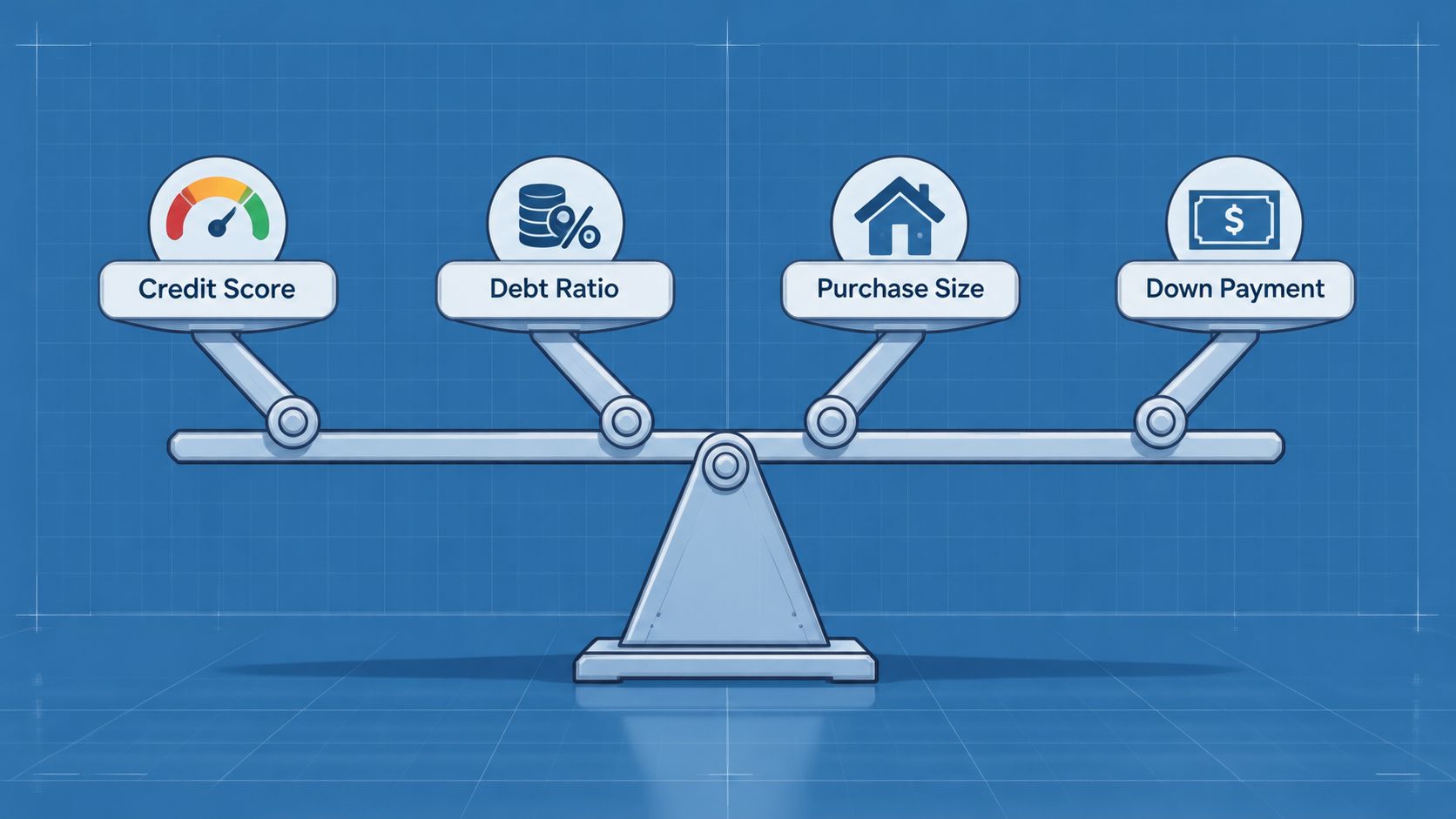
Four approval levers
Credit profile: A stronger credit profile may open more promotional choices or lower-cost installment terms. Buyers with thin or non-prime credit can still find options, but the APR, deposit, or available limit may change.
Debt-to-income ratio: Existing housing, vehicle, credit, and personal obligations reduce the room available for another payment. A buyer should calculate the proposed furniture payment alongside current monthly commitments before applying.
Purchase size: A modest mattress purchase and a substantial sectional don't create the same underwriting decision. The lender may compare the requested amount with the approved limit, income profile, and account history.
Deposit: A deposit lowers the financed balance and can be required for certain orders. One retailer lists a $4,998 minimum furniture purchase and a 25% deposit on regular and custom orders for its 0% interest offer, showing that eligibility can depend on ticket size and order type as well as credit approval. The terms are published in the retailer's financing details.

Custom orders change the calculation
Made-to-order furniture may require a deposit before production begins, and the remaining balance may not be financed under the same conditions as an in-stock item. The shopper should ask whether the deposit is refundable, when the financed balance is created, and how delivery timing affects the first payment.
Before applying, households can pull a credit report, list current monthly debt, identify a comfortable payment, and gather income documentation. A plain-language resource covering practical steps for credit approval can help organize that preparation. The showroom team should then review the exact order rather than offering a generic answer.
Some recent industry coverage places BNPL adoption strongest among consumers aged 18 to 40 with incomes between $40,000 and $80,000, often including thin or non-prime credit profiles, as reported by Furniture Today. That doesn't guarantee approval. It reinforces the need to ask how the specific lender evaluates the order.
How Tyner Pairs Special Financing With Heirloom Quality
Financing has more value when it helps a household buy better construction instead of merely buying more furniture. Tyner Furniture offers Special Financing on qualifying purchases, subject to approval and promotional terms, and pairs that option with a Low Price Promise. The arrangement can help a shopper consider brands such as La-Z-Boy, Flexsteel, and Stressless while still reviewing the total cost and contract conditions carefully.
The same logic applies to the physical piece. Solid North American hardwood, carefully fitted joinery, a durable finish, and replaceable components create a different ownership proposition from a low-cost item that may need replacement after a short service life. Peer-reviewed woodworking research comparing chair-construction joints found dovetail joints stronger than mortise-tenon joints in the tested samples, according to the published joinery study.
| Factor | Tyner Heirloom Purchase | Fast-Furniture Purchase |
|---|---|---|
| Construction | Hand-crafted solid wood, durable upholstery, or established frame construction | Materials and construction vary widely |
| Customization | Finishes, fabrics, sizes, and configurations can be selected | Usually limited to available configurations |
| Ownership horizon | Designed around durability, comfort, and long-term use | Often selected for immediate need or changing style |
| Financing purpose | Spreads the cost of a lasting investment | Low payment can mask replacement risk |
| Local support | Ann Arbor showroom guidance and service | Support depends on the seller and order channel |
Customization has financial value
“In-stock” is only the beginning. Canadel allows shoppers to tailor finishes, fabrics, leg styles, and configurations, while Stressless offers ergonomic seating in different sizes for a more personalized fit. Upholstery shoppers can also compare fabrics and top-grain leather, including the buttery feel that can't be judged accurately from a screen.
Bedroom and dining shoppers should pay close attention to material integrity. Traditional mortise-and-tenon construction fits a tenon into a matching mortise to resist pulling apart and twisting, a reason it remains standard in chair and table frames, as explained in this furniture joinery guide. Tyner's custom Amish furniture gives buyers a way to investigate that construction before deciding how much to finance.
Choosing the Right Plan for Your Home and Budget
The best furniture financing choice starts with the household, not the promotion. A young family replacing a worn sectional may need a payment that leaves room for childcare, groceries, and repairs. An empty-nester choosing a dining table for a long-term home may prioritize solid cherry wood, custom dimensions, and cost-per-year over the lowest required payment.
Use this decision checklist
- Set the ownership horizon. A piece expected to serve for many years can justify a quality-focused purchase. A temporary room arrangement may call for a smaller commitment.
- Choose a payment that leaves breathing room. The payment should remain manageable after ordinary bills and emergency savings contributions.
- Match the plan to payoff behavior. Buyers who can eliminate the balance before the deadline may consider no-interest financing. Buyers who need more time should favor a fixed installment schedule.
- Read the promotional language. Confirm whether interest is waived or deferred, identify the final payoff date, and ask what happens if the balance remains.
- Check early-payoff terms. Confirm whether paying early reduces interest and whether any fee applies.
- Price the whole order. Include the deposit, taxes, delivery, protection plans, and any custom-order charges in the budget.
A sound household decision: The payment should support the home's daily life, while the furniture should earn its place through comfort, craftsmanship, and serviceable longevity.
Financing adoption reflects that shoppers increasingly treat installment payments as part of the purchase decision. A 2023 U.S. survey found that the share of Americans who said they used BNPL for online purchases rose from 4% in 2021 to 8% in 2023, while reported purchase mix included 25% for homeware and furnishings and 18% for furniture, according to YouGov's BNPL report. Separate reporting states that BNPL represented 26% of installment-payment use cases in furniture, behind clothing and electronics, as covered by Furniture Today's category analysis.
Households working through broader priorities can also review guidance on aligning family financial goals before committing to a multi-month payment. The final recommendation is neighborly and practical: finance only what fits, choose construction worth keeping, and finish the balance before a promotional period creates a new problem. At the Ann Arbor South State St. showroom, shoppers can take a proper sit test, feel the weight of solid wood, compare upholstery, and ask for the exact written terms.
Tyner Furniture offers Special Financing on qualifying purchases, a Low Price Promise, and access to customizable pieces for living rooms, bedrooms, dining spaces, Home Offices, and Outdoor Spaces. Visit Tyner Furniture for a showroom sit test in Ann Arbor or browse Quick Specs online for special orders that fit the household's room, comfort needs, and long-term plans.