Barley Twist Tables: A Complete Buyer’s Guide for 2026


A shopper in Ann Arbor once stood between two tables that both had the same spiral legs, the same warm wood tone, and the same old-world charm. One felt solid in the hand, the other felt light and uncertain, and the difference wasn't obvious until the details were checked closely.
A barley twist table is one of those furniture pieces that looks simple from across the room and reveals a lot more up close. The twist, the joinery, the wood species, and the finish all tell a story about whether the piece is a true heirloom, a careful reproduction, or just something that borrows the look.
What a Barley Twist Table Actually Is

The easiest way to recognize a barley twist table is to look at the legs. They're spiraled, as if a straight column had been slowly turned while a cutting tool walked down its length in a diagonal path. That turned shape is why the style is also called spiral turning or, in older descriptions, barley sugar, because the form resembles twisted candy.
A shopper comparing two tables side by side often gets stuck on the same question. One table may have ornate legs but feel delicate, while the other looks quieter yet feels heavier and more intentional. The difference usually comes down to whether the spiral is just decorative or whether it's part of a solid, well-made structure.
How the form reads in the hand and eye
A true barley twist leg is not only about looks. Because the twist is usually turned from a single solid blank, the grain runs continuously through the leg, which helps the piece behave more predictably under load. That matters when the table is used every day, not just admired from a distance.
Practical rule: If the spiral looks busy but the table feels hollow, light, or weak at the joints, the style is probably doing more work than the construction.
The visual cue is usually in the leg, but the motif can also appear in column supports and trim. To see how that profile is handled in modern furniture, a useful reference point is this furniture-legs guide from Tyner Furniture, which helps shoppers connect the leg shape to the rest of the piece.
Hand-turned and machine-made are not the same thing
A hand-turned barley twist has small variations that come from the craft itself. A machine-made version can still look correct, but the surface rhythm, the underside details, and the way the twist meets the apron often look more uniform. That doesn't make every reproduction poor, but it does mean the buyer should look past the silhouette.
The key is not to obsess over whether the leg is “old” at first glance. It's to ask whether the spiral is part of a thoughtful, solid-wood build that can hold up to regular use. Once that's clear, the rest of the buying decision gets much easier.
The Four-Century History of Barley Twist Furniture
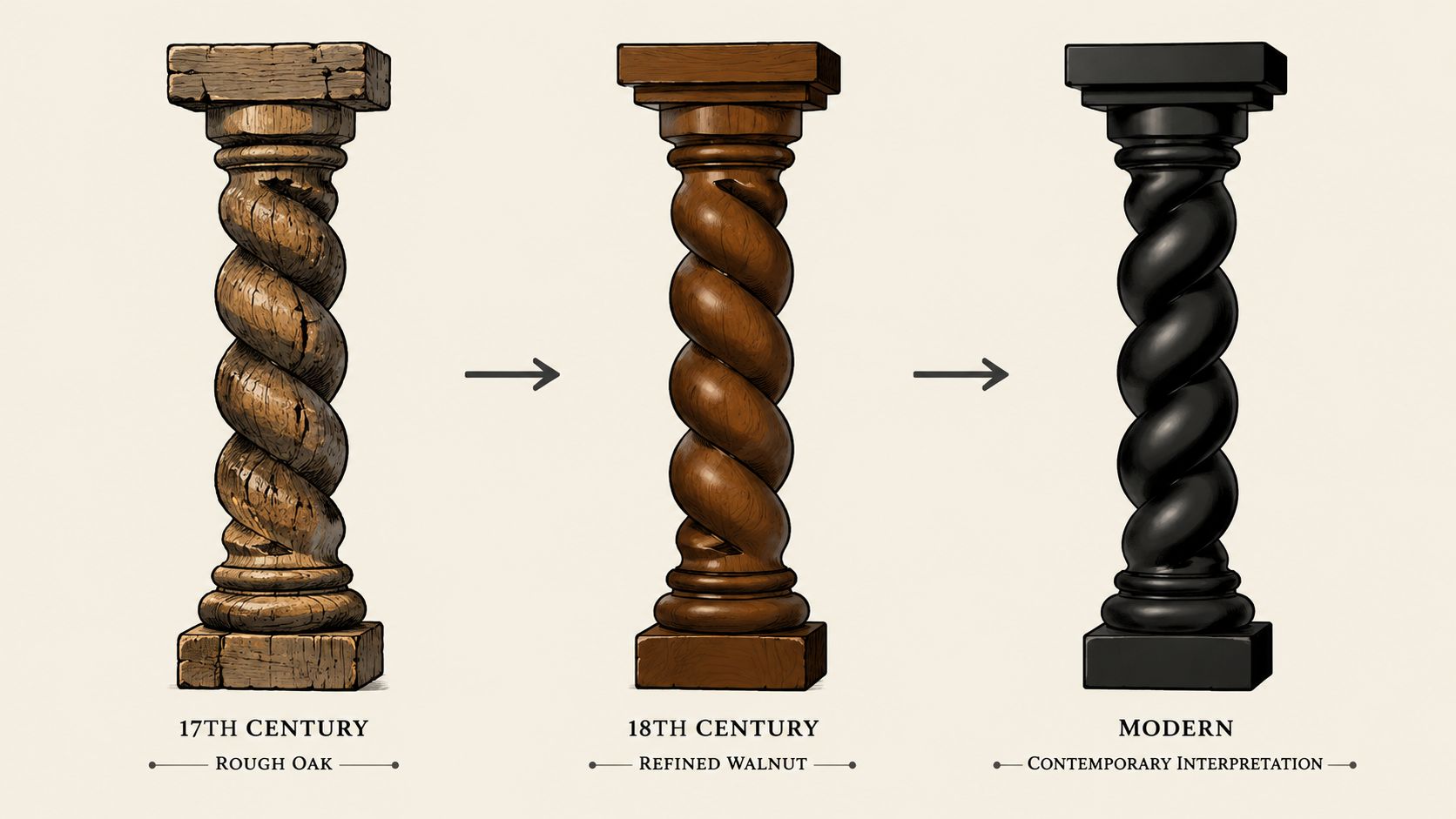
Barley twist furniture didn't appear as a passing trend. Its design lineage reaches back to the 1600s in England and France, where the spiral-turned form emerged in furniture making and became associated with Jacobean, Stuart, and later Baroque periods. The name itself comes from the look of barley sugar candy, which period descriptions used as an easy visual comparison. See the historical account in the Baltimore Sun's antiques feature on barley twist design.
The style then came back into fashion in the 19th century, especially during the Queen Victoria era (1837–1901), when barley twist again showed up in oak and mahogany furniture. Tables, chairs, beds, and other household pieces carried the motif widely, which is why the form still feels familiar today even when the exact piece is antique or newly made.
Why the shape kept returning
The spiral looks decorative, but it also signals craftsmanship. A turned leg asks for patient layout, careful tool control, and a good understanding of proportion. That's one reason the form stayed tied to furniture makers who wanted to show skill rather than hide it.
The historical arc matters for buyers because it changes what the piece means. A barley twist table is not just a pretty object from an old style book. It belongs to a production tradition that has moved through multiple centuries, with two major popularity peaks, and that gives the shape a real place in interior design history.
Why the name still matters today
Collectors and shoppers still use the older name because it points to the visual character of the piece. If the legs resemble twisted candy, the identification usually comes quickly. That little naming clue helps separate barley twist from other turned-leg traditions that are round, bobbin-like, or carved in a completely different way.
A barley twist table reads as historical because its form has stayed legible for centuries, not because every example is antique.
That long history also helps explain why these tables work in both traditional and updated rooms. They carry enough ornament to feel special, but the spiral itself is clean and geometric enough to sit beside simpler furniture without looking fussy.
How Barley Twist Tables Are Built and Why Construction Matters
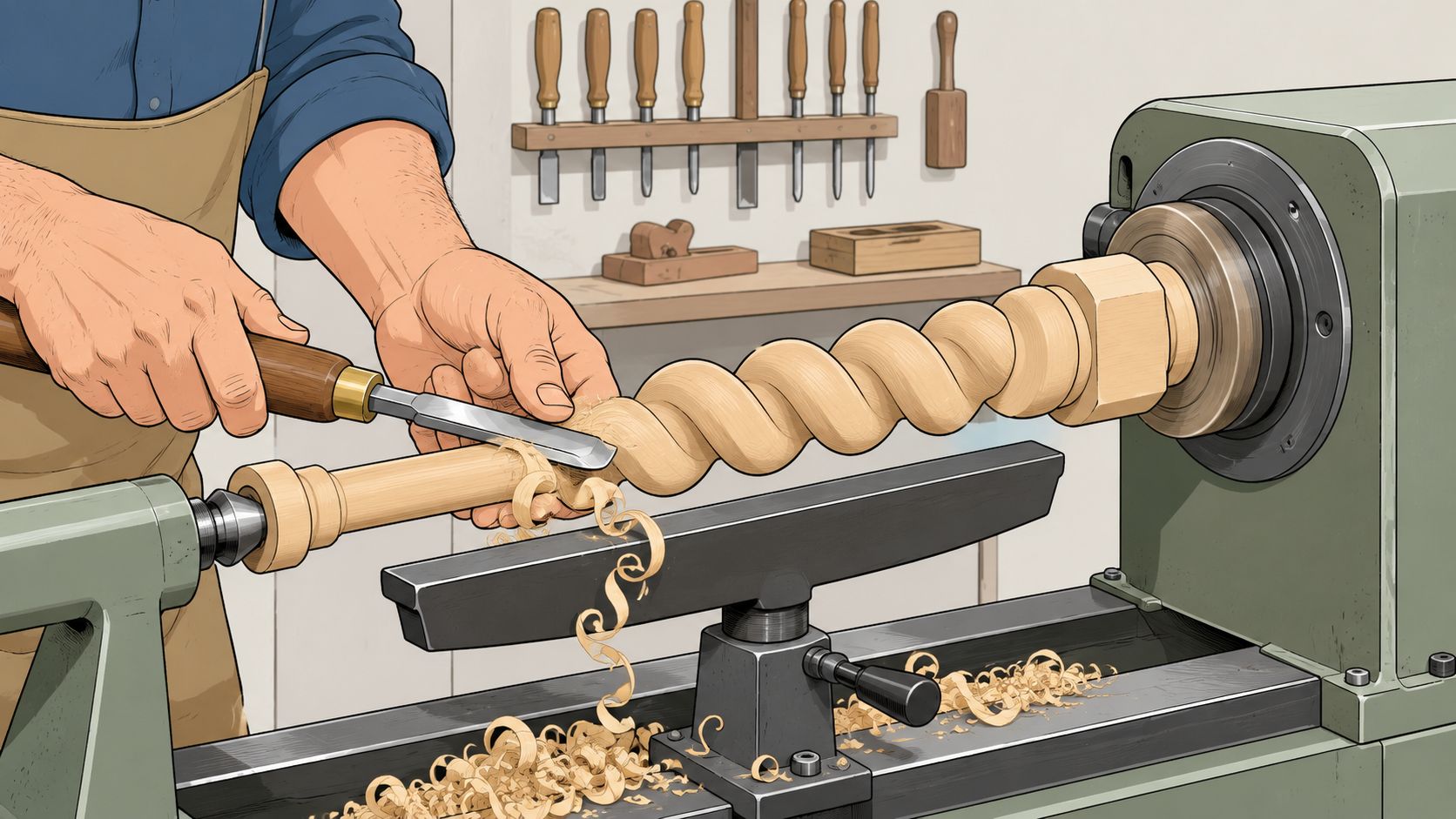
A good barley twist table begins with structure, not ornament. The twist is usually turned from a single solid blank on a lathe, so the leg's slenderness ratio and the quality of the aprons and stretchers matter more than the twist itself. When the joinery is sound, the profile can be both beautiful and durable, which is why the underlying build deserves as much attention as the visible shape.
For a closer look at traditional furniture joinery, mortise-and-tenon construction is a useful reference point. The same principle applies here, because a turned leg only performs well when the surrounding structure holds it in line under everyday use.
Hand-turned versus CNC-made
A hand-turned piece is laid out with careful geometry, then worked as a left or right spiral when a matched pair is needed. A separate marking guide shows the process can involve equal divisions around a cylinder and a full spiral wrapped around the workpiece, which tells you how exact the layout has to be. A detailed tutorial also notes that paired spirals are handed, meaning one twists left and the other right.
Modern CNC reproduction can still make a clean spiral, but the tool path and the setup are different from hand work. A PBS woodworking segment shows the layout using precise bevels, cutting gauges, and angle marks such as 1 in 12, 120 degrees, 90 degrees, and 60 degrees, which hints at how geometrically demanding the form really is. The result can be accurate, but it isn't the same tactile process as hand turning.
What actually makes a table stable
The twist isn't the weak point. The weak point is usually the connection between the leg and the rest of the table. Large-span tables should be checked for stretchers or concealed fasteners, because those details help reduce racking when the table is pushed, leaned on, or moved repeatedly.
Buyer's shortcut: A strong barley twist table feels planted at the floor, tight at the apron, and consistent when the top is pressed from different sides.
That's the reason made-to-order solid-wood pieces often hold up better than thin, visually similar imports. The spiral may be the feature that grabs attention, but the engineering underneath decides whether the table becomes a long-term piece or a short-term replacement.
Identifying Authentic Antiques, Quality Reproductions, and Imports
A careful eye can usually separate these categories without lifting the table apart. The first thing to inspect is the grain continuity in the leg, because a solid turned blank keeps a more believable long-grain path than a hollow or heavily faceted substitute. The next clues are patina, joinery evidence, and whether the proportions look honest rather than exaggerated.
What to check first
- Leg grain and surface: Look for a continuous grain flow along the spiral, especially where the twist passes through high-contact areas.
- Underside joinery: Check whether the apron and leg connection looks deliberate and tight, not stapled or crudely glued.
- Wear patterns: Real age usually appears where hands and dishes naturally touch, not just as a sprayed-on surface effect.
- Proportion: A quality twist should still read as structurally believable, not skinny to the point of looking fragile.
- Wood species: Dense hardwoods support the form better than soft, lightweight alternatives.
The secondary market often blends all of these categories together, which is why the buyer has to think in terms of craftsmanship level rather than just "antique or not." The 1stDibs resale snapshot in the earlier section shows how dramatically value can change with age, condition, wood species, and provenance, so the same style can live in very different price tiers.
Reproductions can still be good furniture
A quality reproduction doesn't need to pretend it's old. It just needs to be structurally honest. If the leg is solid, the joinery is tight, and the finish suits the wood, the table can be nearly indistinguishable in daily use from a period piece.
Imports are the category that deserves the most caution. Many look convincing from a few feet away, but the materials can be thin and the structure can depend on shortcuts that don't age well. When a buyer asks, “What level of craftsmanship am I paying for?”, that's the right question.
For shoppers trying to read labels and product language more carefully, this guide to understanding furniture descriptions helps make those hidden construction details easier to spot.
The safest purchase is the one whose construction can be explained clearly in plain language.
Common Types, Sizes, and Room Placement
Barley twist tables show up in a few familiar formats, and each one changes the room in a different way. A dining table makes the spiral legs part of the visual centerpiece. A coffee table softens a living room with a smaller dose of ornament. A console table works well in an entryway or behind a sofa, while an accent or side table gives the motif a smaller stage.
Common Barley Twist Table Formats and Typical Dimensions
| Format | Typical Dimensions | Best Room Placement | Design Note |
|---|---|---|---|
| Dining table | Varies by room and seating needs | Dining room | The legs are visible from every angle, so proportion matters most |
| Coffee table | Lower profile, sized for seating area flow | Living room | A smaller twist can add warmth without crowding the space |
| Console table | One example measures 240 cm wide, 45 cm deep, and 80 cm high source | Entryway, hallway, behind a sofa | A slim profile keeps traffic lanes open |
| Accent or side table | Compact, room-dependent | Beside a chair or lamp | The twist becomes the focal detail |
How to place the style well
A dining room can handle the strongest version of the motif because the table sits at the center of the action. In a living room, the surrounding upholstery, rug, and lamp bases need to stay calm enough to let the spiral legs breathe. An entryway is often the easiest place for a console because the piece is read quickly and doesn't have to carry as much daily load.
The main mistake is forgetting clearance. A table can be beautiful and still feel wrong if it blocks movement, interrupts a sightline, or competes with another ornate object nearby. That's especially true with barley twist, because the legs already create a lot of visual texture.
Care and restoration basics
Solid-wood tables respond well to patient upkeep. Dust collects in the twist channels, so soft cleaning along the spiral matters more than wiping across it quickly. If a finish dulls, cracks, or exposes raw wood, that's usually the point to pause and assess whether a professional touch is needed.
Maintenance rule: If the finish is failing but the structure is sound, the table is usually worth saving.
That applies even more when the piece has historical value or strong joinery. A well-made barley twist table can be restored, refinished, and used again without losing its character, which is one reason the style keeps showing up in homes that value long-term furniture.
Materials, Finishes, and Long-Term Care
The wood species changes how a barley twist table feels the moment someone runs a hand down the leg. Oak brings visible grain and a sturdy presence. Mahogany gives a deeper, more formal tone. Cherry softens and warms over time, while maple often reads cleaner and lighter. Because the twist exposes more surface area than a straight leg, the finish matters just as much as the species.
For broader hardwood selection guidance, this wood furniture overview is a useful companion when comparing tone, grain, and longevity.
Finish choices that age differently
An oil finish usually gives the most natural hand feel, though it often asks for more attentive upkeep. Lacquer tends to create a smoother surface and can be practical in regular use. Hand-rubbed conversion varnish usually sits between beauty and durability for buyers who want a more protective surface without losing all texture.
The right choice depends on how the table will be used. A dining table that sees daily meals needs a different finish conversation than an accent table in a quiet corner. The spiral form makes that decision more visible, because every edge and turn catches light.
A sensible care routine
Humidity control matters because solid wood moves with the room. Dusting should follow the twist, not fight against it. A soft cloth and a careful hand are usually enough for routine cleaning, while deeper marks deserve a slower look before any polishing product is used.
If the rest of the room is being refreshed around the table, cozy styling ideas can help the piece feel intentional rather than formal. A helpful place for broader home atmosphere ideas is discover more cozy tips from Jackpot Candles, especially for readers trying to make an older-style table feel relaxed in a modern home.
What restoration can and can't fix
Minor surface wear, finish dulling, and some water marks can often be addressed. Loose joints, warped parts, or badly repaired legs are a bigger issue and should be evaluated carefully. A barley twist table rewards patience, but it also tells the truth about its condition, especially along the leg where every repair is easier to see.
Price Ranges, Buying Advice, and the Custom Amish Option
A barley twist table can feel like a simple decorative purchase until you start comparing one piece to another. Then the price spread makes the differences clear. Resale examples of 19th-century barley twist items on 1stDibs averaged $2,500, with prices ranging from $188 to $19,950 source. That range reflects condition, age, wood species, craftsmanship, and provenance, and it shows how far apart two tables can be even when they share the same twisted silhouette.

Why custom can make better long-term sense
A made-to-order solid-wood table changes the question from sticker price to cost-per-year. If the table is built well, fits the room, and is cared for properly, the value comes from years of daily use rather than a short ownership cycle. That is why a bespoke piece can make more sense for homeowners who want longevity without giving up style. It is the furniture equivalent of choosing a well-built pair of boots over a trendy pair that looks good for one season and then starts to fail at the seams.
Tyner Furniture has served the Southeast Michigan community since 1957, and its Ann Arbor showroom functions as a design hub where heirloom-quality Amish-built furniture is made accessible through custom orders, special financing, and a Low Price Promise source. For buyers who want the barley twist look with stronger material integrity, that matters because the construction story is part of the final value.
What can be customized
- Finishes: Match the table to existing flooring, cabinets, or built-ins.
- Wood species: Choose the hardwood that fits the room's tone and use.
- Dimensions: Adjust the scale so the piece fits the room instead of crowding it.
- Configuration: Add the details that make the table work in the home, not just in the showroom.
That is why in-stock is only the starting point. With made-to-order furniture, especially in Amish-built programs, the buyer can shape the piece for the room instead of compromising around a fixed floor model. The twist pattern stays the visual anchor, while the size, wood choice, and finish do the practical work.
For Southeast Michigan shoppers weighing the full custom route, Tyner Furniture's custom Amish furniture page is a useful place to see what can be built to order.
A barley twist table works best when the buyer thinks like a steward, not a quick shopper. The right piece should feel strong in the room, honest in its materials, and worth keeping for the next generation.
If a barley twist table is on the shortlist, Tyner Furniture's Ann Arbor showroom on South State St. is ready for a sit test, a close look at wood grain, and a conversation about finishes, sizes, and special orders. Visit Tyner Furniture's custom Amish furniture collection to browse Quick Specs online, then stop in to compare custom Amish-built options with the feel of an authentic piece in person.