Furniture and Joinery: How Joints Make Pieces Last

A mortise-and-tenon joint withstood more than 26 kilonewtons before elastic failure, over twice the just over 12 kilonewton average for a No. 20 biscuit joint, in the University of New Brunswick joint testing. That gap explains why furniture and joinery belong in the same conversation. Finish gets the first look, but the hidden connection carries the pull of a drawer, the lean on a tabletop, and the sideways force on a chair rail. Shoppers don't need a workshop vocabulary to judge it. They need a few clear ideas about how joints work, where stress lands, how wood moves, and what a piece costs per year of service. That's a friendlier way to buy than guessing from a photo.
Why Joinery Decides How Long Furniture Lasts
Production work still accounts for 60.08% of furniture manufacturing employment, with 200,710 production occupations out of 334,090 workers counted in May 2023, according to the Bureau of Labor Statistics occupational data for furniture and related product manufacturing. Hands shape how long a piece holds together.
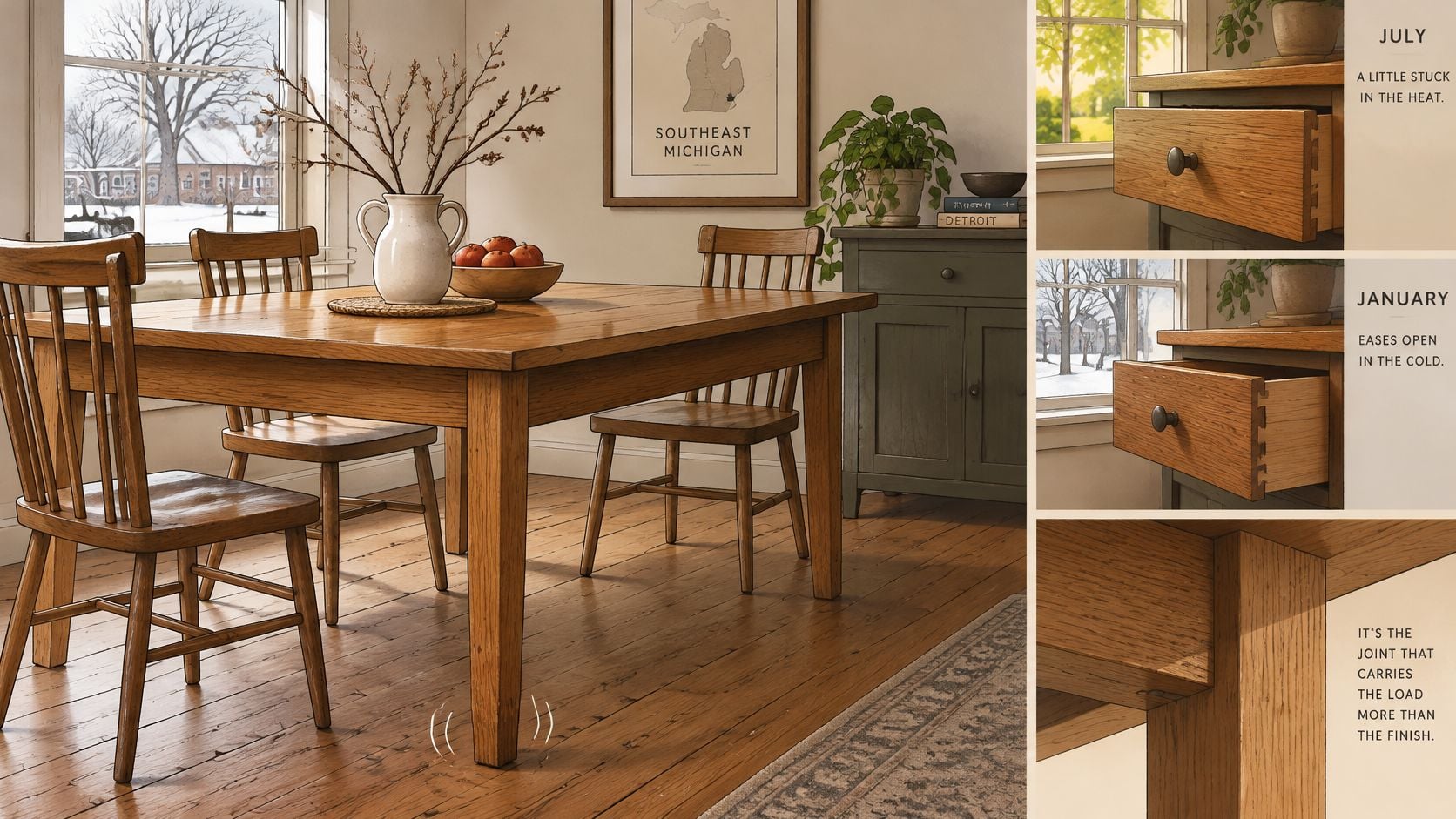
A Southeast Michigan dining table shows the pattern without jargon. It feels solid in October, wobbles after a few winters, then grows a drawer that sticks in July and rattles by January. Finish wears on the surface while the hidden connection carries every pull, lean, and sideways push.
Two connections matter most. Mortise-and-tenon locks rails to legs and resists racking, the sideways parallelogram motion that loosens frames. Dovetail joints interlock drawer and box corners so a pull tightens the wedge shapes instead of testing glue alone.
In seventeenth-century American shops, joiners shaped straight wood with saws, axes, and planes while turners formed parts on a lathe, and rectangular mortise-and-tenon chairs took longer to lay out and fit than turned chairs, according to the Metropolitan Museum of Art history of early American furniture. Dovetailing later let makers use thinner boards for lighter case pieces. That extra labor still signals craftsmanship and durability, measured in years of steady service rather than shine on day one.
Tyner Furniture has served Southeast Michigan since 1957 from its Ann Arbor showroom, covering everything from Home Office to Outdoor spaces. Homeowners dealing with a loose door elsewhere in the house may also appreciate SouthRay Kitchen & Bath renovation advice, and the guide to protecting wood furniture from scratches and stains helps a good joint's work last.
Joinery Types Compared at a Glance
A chair rail lives a hard life. It gets leaned on, dragged across floors, and racked side to side hundreds of times a year. A drawer side faces a different test, a straight pull every time it opens. Side by side numbers show which construction method suits each job.
Strength figures below are typical ranges reported in a comparative test published in Wood Material Science and Engineering. A kilonewton measures force, so a higher figure means the joint resisted more pull or pressure before elastic failure began. That failure point is where the joint stops springing back and starts to give.
Joint strength and best use by construction method
| Joint | Tested strength | Where it appears | Best use |
|---|---|---|---|
| Mortise-and-tenon (cheek and shoulder cut from same stock) | More than 26 kN before elastic failure | Chair rails, table aprons, bed components | High-stress frames and supports |
| Round floating tenon | About 22.5 kN average | Frame joins and panel alignment | Strong frame joins with simpler layout |
| Square-edged floating tenon | About 20 kN average | Case and frame assembly | General frame joins |
| Dovetail, three tails, thin low-angle | More than 8 kN average | Drawers, boxes and carcasses | Drawer sides and interlocking box corners |
| Dovetail, two tails, thicker low-angle | More than 6 kN average | Drawers and chests | Lighter-duty boxes |
| No. 20 biscuit | About 12 kN average | Panel alignment | Alignment aid, not the principal structural joint |
| Tongue-and-groove | No figure in this comparison | Tabletops, panels and backs | Panel glue-ups that need flat alignment |
The pattern is easier than the units suggest. The same comparison found a mortise-and-tenon configuration with cheek and shoulder cut from the same stock sustained more than 26 kN before elastic failure, versus just over 12 kN for a No. 20 biscuit joint. That is roughly twice the load capacity, which matters at a chair rail far more than at a quiet panel edge.
Floating tenons sit between those poles. Rounded floating tenons averaged 22.5 kN, compared with 20 kN for square-edged floating tenons in the same comparison. Both can serve frames well when fitted properly, and the rounded version holds a modest edge.
Reading dovetail numbers without overreading them
Dovetails answer a different force. A drawer front wants to pull away from its sides with every open and close, so interlocking tails and pins matter more than a frame number. Performance improved with more dovetails per unit width and more glue surface, with thinner, low-angle dovetails using three tails exceeding 8 kN and thicker versions using two tails exceeding 6 kN, as reported in the Wood Material Science and Engineering joint test.
Short version: frame joints carry weight and racking, dovetails resist pullout, biscuits and tongue-and-groove keep panels aligned.
Tongue-and-groove appears in tabletops and backs because it keeps boards flush and aligned. It is not the load carrier for a leg to apron connection, and no tested figure appears for it in this comparison. The same placement logic shows up in cabinetry, where shoppers who find framed bathroom cabinetry can compare how frame construction changes support.
Biscuits work best as alignment aids or supplementary reinforcement, not as the principal structural joint at a chair rail, table apron, or bed component. Before comparing stain colors, ask a simple question. Which joint carries the load here? A clear answer tells shoppers more about heirloom potential than a polished showroom surface ever will.
How Mortise-and-Tenon and Dovetail Joints Work
A mortise is the cavity, and a tenon is the projecting tongue that fits inside it. Once that picture clicks, the build sequence reads like common sense rather than a secret craft language.
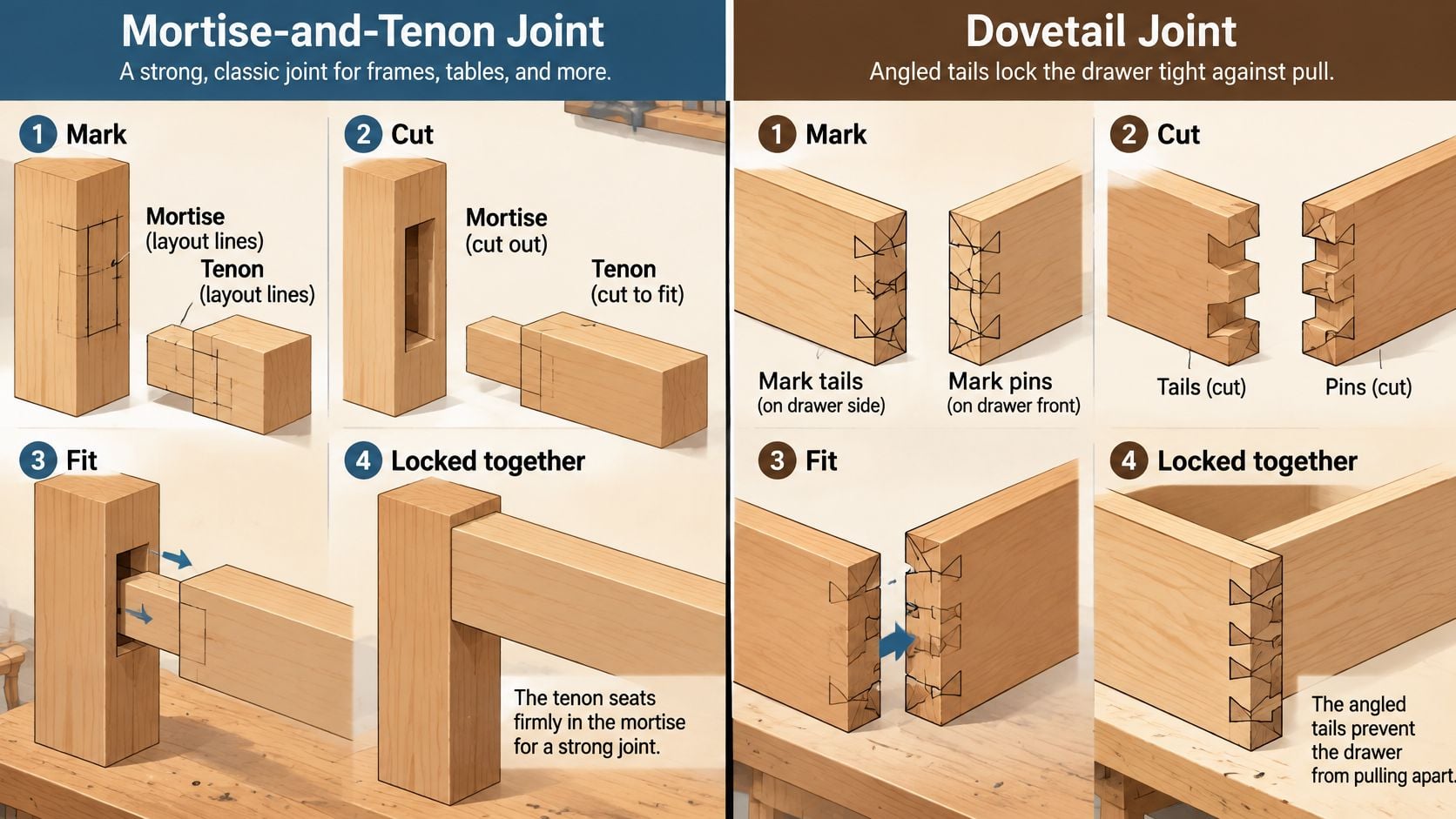
Building a mortise-and-tenon joint
- Mark the tenon at roughly one-third of the stock thickness, leaving enough material on both cheeks.
- Cut the mortise cavity into the leg or stile, keeping the walls clean and the depth consistent.
- Saw the tenon cheeks and shoulders from the same board so the rail end stays square to the leg face.
- Dry-fit the joint until it slides home with light hand pressure, firm but not hammered.
- Glue, clamp, and check for square before the adhesive sets, because a racked frame rarely fixes itself later.
The tenon mainly controls alignment and withdrawal. It stops the rail from twisting or pulling straight out, while the shoulders bear against the leg face and spread the load. Glue helps, but the mechanical fit does the serious talking.
A common point of confusion is tightness. A joint that needs force can split the mortised piece, while a sloppy joint leans on glue to fill gaps it can't bridge well. The sweet spot feels like a firm handshake, neat contact on the cheeks with the shoulders closing cleanly.
Building a dovetail joint
- Lay out the tails on the drawer side board, spacing them evenly across the width.
- Saw the tails and chop out the waste between them.
- Transfer the tails onto the pin board so both halves match exactly.
- Saw and pare the pins, trimming in small passes rather than forcing the fit.
- Test fit before glue, checking that the corner closes square and the faces sit flush.
Those flared shapes resist being pulled apart because the tail is wider at its end than at its root. Pulling the drawer front wedges the joint tighter across the grain. That's why dovetails suit drawers and boxes, where the main threat arrives as a straight tug, thousands of times.
Research on dovetail-keyed wooden boxes in BioResources found that compressive and tensile strength was highest when the ratio of hole depth to slope height reached 75%, while a 50% ratio produced the weakest joints. Fine geometry, not just the word dovetail on a tag, changes the result.
A drawer checklist anyone can use
- Visible interlocking tails: Alternating wedge shapes appear at the drawer corners rather than a plain butt seam.
- Substantial tails: The wood between pins looks sturdy, not reduced to thin slivers.
- Resistance to racking: A gentle side-to-side wiggle doesn't turn the drawer box into a parallelogram.
- A grooved drawer bottom: The bottom panel sits in a groove rather than being nailed flat underneath, so weight doesn't pry it loose.
Pro-Tip: Slide a drawer open and closed slowly. It should travel without tipping, grinding, or twisting, and the corner joints should stay tight at full extension.
That hands-on check takes ten seconds in a showroom. It reveals more about daily life with a dresser than the hardware finish does.
Choosing Solid Wood, Veneer and Panel Boards
Material choice gets muddled when shoppers treat solid wood as automatically perfect and every panel as automatically weak. The better question asks what each construction does well, how it moves, and how it can be repaired.
Solid wood, veneer and engineered panels compared
| Construction | Seasonal movement | Repair and refinishing | Typical role |
|---|---|---|---|
| Solid hardwood, one species throughout | Moves across the grain with humidity; wider than about 4 inches needs movement-accommodating joints | Can be sanded and refinished several times | Tabletops, doors, legs and frames |
| Veneer over a stable core | Face stable; movement depends on the core | Veneer can chip or delaminate; repair needs skill | Flat, wide surfaces and drawer fronts |
| Engineered panel (MDF or particleboard) | Low movement | Limited, usually surface only | Carcass backs and drawer bottoms |
Solid wood keeps absorbing and releasing atmospheric moisture after machining, and the BioResources research index on wood movement notes that expansion and contraction vary with species, climate, grain orientation, and whether boards are flatsawn, riftsawn, or quartersawn. Cross-grain movement can generally be ignored only for joints up to roughly 4 inches wide. A narrow apron may behave predictably, while a wide tabletop needs room to breathe.
That's why good tops use elongated fastener slots, figure-eight connectors, or buttons. They hold the top down while letting it move across the grain. Lock a wide panel rigidly and the wood often answers with splits, bowing, opened joints, or finish failure.
Cuts, species, and sensible placement
Flatsawn boards show broad grain arches and tend to cup more readily. Rift and quartersawn boards present straighter grain and move in a more even, restrained way, which helps legs, rails, and visible panels stay composed. Consistent orientation in a glue-up also keeps neighboring boards from fighting each other.
Solid hardwood suits legs, frames, and edges that take knocks, because it can be repaired and refinished. Veneer over a stable core suits wide, flat surfaces where a dramatic grain pattern matters and stability helps. Neither answer wins everywhere, and the comparison of solid wood and engineered wood lays out that tradeoff in plain terms. Similar material logic guides kitchen choices in the Jennifer Gilmer Kitchen & Bath material guide.
Species adds the sensory part shoppers remember. Cherry brings the weight of solid cherry wood and a surface that deepens in tone, quartersawn oak shows a warm, linear figure, and maple offers a pale, calm face that takes lighter stains gracefully.
Air quality deserves a brief question too, especially for bedrooms. The U.S. Environmental Protection Agency estimated annual average indoor concentrations from pressed-wood articles at approximately 5.53 to 16.58 micrograms per cubic meter in its formaldehyde indoor air exposure assessment. Finish choice also changes emissions, so asking about panel cores, finish type, curing time, and available ratings is reasonable, without turning a shopping trip into a medical claim.
Ask any seller four things. Which species, which cut, how does the top attach, and where can a wide panel move? Clear answers signal a builder who designed for Michigan humidity rather than just a photograph.
Joinery in Tyner's Amish Solid Wood Pieces
Consider a shopper standing in front of an Amish dresser in Ann Arbor, not sure where to look first. The order of the inspection matters less than touching the piece in the sequence daily life will. Open the drawer, feel the frame, lean gently, then look underneath.
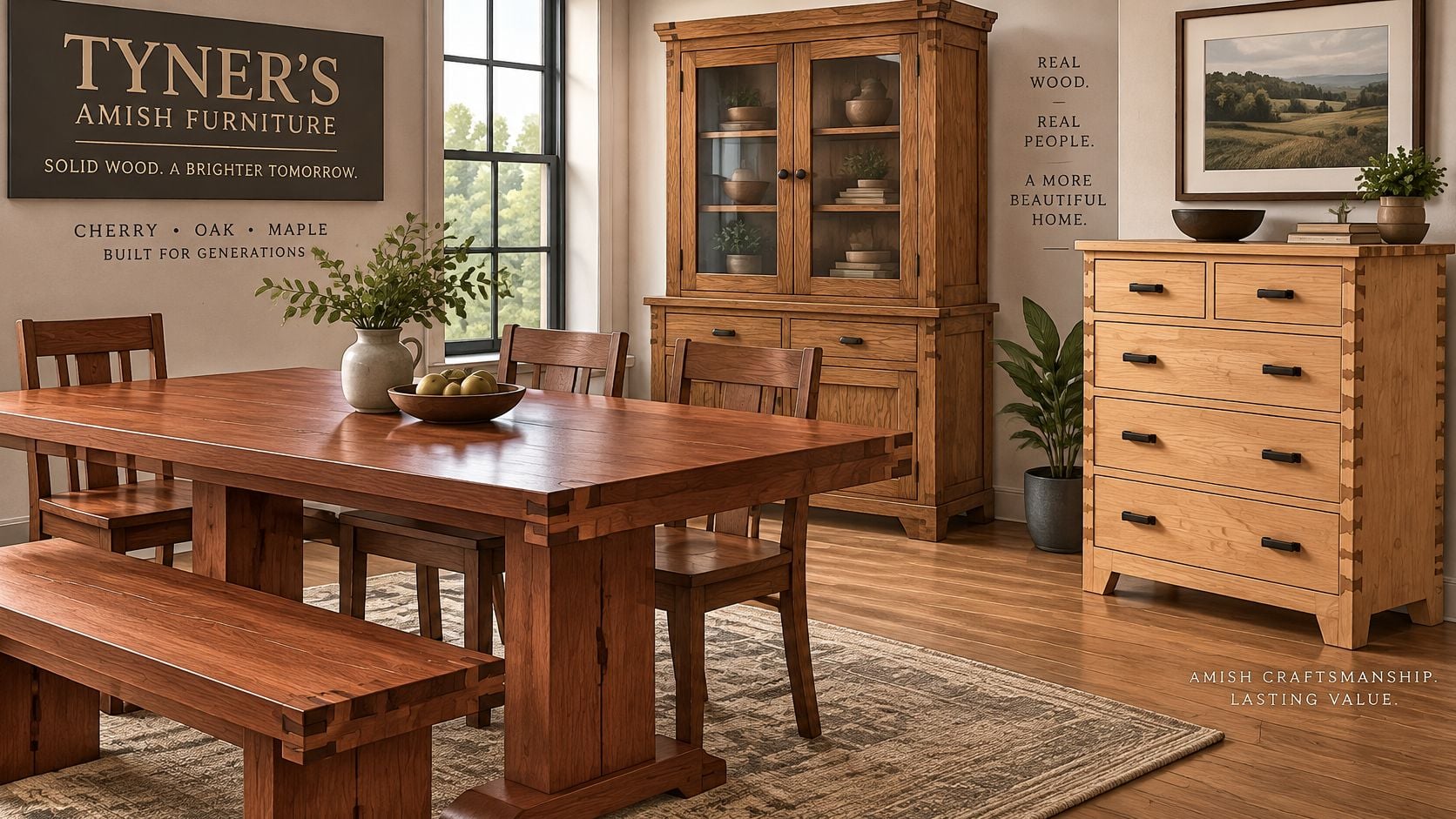
Tyner's Amish hand-crafted pieces use solid North American hardwoods such as cherry, oak, and maple, with time-honored dovetailing and mortise-and-tenon construction. Because they're made-to-order, buyers choose species and stain for the room rather than settling for the floor sample. In-stock is just the beginning, and that bespoke choice is the quiet luxury here.
The dresser walkthrough
Start with a drawer pulled fully forward. Dovetails should show at the corners, the box should feel rigid, and the bottom shouldn't sag under light pressure. Next, run a hand along the frame joints where a rail meets a post. The seam should sit flush, with no rocking when the case receives a modest sideways push.
Then check the top. On a dining table or dresser, the underside should reveal an attachment that allows seasonal movement, such as slots or buttons rather than a rigid ring of screws. A wide solid panel that can move is a feature, not a flaw, and the Hickory Craft furniture collection gives shoppers a useful rustic reference point for solid construction.
The contrast with many mass-produced alternatives isn't about snobbery. It's about visibility and material integrity. A veneer surface can look beautiful while hiding the joint method underneath, whereas solid construction lets a buyer see grain continue through an edge and judge the joint standard directly. That transparency supports refinishing later, which extends the working life of the piece.
Quality control continues beyond the workshop. In the Sourcing and Procurement step of the design process, Tyner Furniture handles ordering, scheduling, and quality inspections for the furniture, custom upholstery, textiles, and accent lighting. For a made-to-order purchase, that coordination matters because species, stain, and configuration choices all need to arrive as specified.
Pro-Tip: Pull a drawer to the front, then check the frame joint lines from the side. Tight corners plus flush rails tell a trustworthy story in under a minute.
Dining and bedroom programs also allow configuration and finish guidance, so a table can suit a narrow Ann Arbor dining room or a dresser can match an existing bed. Interior design help turns joinery knowledge into a room that works, not just a well-built object.
Judging Joinery by Cost per Year
A $1,800 dining set that serves for 25 years costs about $72 per year. A $600 set replaced every five years costs $120 per year, plus the hassle of shopping, hauling, and disposal each cycle. Cost per year makes that math visible, and joinery is what moves the number.
Durability helps that calculation, but material and maintenance shape it too. Research in the Journal of Industrial Ecology found that extra material, finishes, and adhesives can offset some durability benefits. Repair, reuse, and refurbishment may extend the life of moderately durable furniture with lower impacts.
Solid joinery earns its value when it can be repaired, refinished, or adapted. A lifecycle assessment noted that repair, refurbishment, and upgrades were not fully included in its analysis, even though those practices can substantially extend product life. For shoppers, the question is practical. Can this piece be fixed and refreshed instead of replaced.
Lifetime value factors to weigh
- Repairability: Can a drawer, hinge, or damaged rail be fixed locally?
- Replaceable parts: Are glides, hardware, and leaves available later?
- Finish maintenance: Does the finish allow touch-ups, or does damage demand a full strip?
- Refinishing options: Can solid surfaces be sanded and recoated when tastes change?
- Transport and end of life: Can the piece move houses, be resold, or be refurbished rather than discarded?
Policy details support that system view. If a component of a furniture item is defective, Tyner Furniture repairs or replaces that component rather than the entire product. Readers comparing cores can also review the guide comparing solid wood and particle board cores before deciding.
Context should guide the investment. A long-term family dining room rewards heavy joinery and refinishing depth. A short-term rental may favor a lighter build that moves easily and still serves well for a few years.
Pro-Tip: Keep a record of species, stain, finish, and hardware in a drawer or phone note. Future touch-ups get faster and color matches get closer.
Test the Joinery in Our Ann Arbor Showroom
Open a drawer and you learn more in ten seconds than photos can show. In the Ann Arbor showroom, shoppers can run a hand along a joint line, feel the weight of solid cherry or oak, and look under a wide top to see how it is fastened to allow movement. Sit down for a real test too, especially on dining chairs such as the handcrafted high-end dining chairs that absorb daily scraping and leaning.
Tyner Furniture's sales associates help customers find the right item or a new perspective on interior solutions, matching size and layout to the room. Canadel dining can be customized by leg, edge, finish, and configuration in thousands of combinations, while Stressless seating adds ergonomic sizing in Small, Medium, and Large, alongside the feel of top-grain leather. Start with in-stock pieces, then compare fabrics, finishes, and configurations side by side.
Think in cost per year of service. Special financing, subject to credit approval, can spread an heirloom purchase into manageable payments. Tyner Furniture offers guaranteed lowest prices on the furniture it procures for design projects, and the Low Price Promise supports competitive value without pressure.
Selection runs through Living Room, Bedroom, Dining Room, Entertainment, Home Office, Mattresses, and Outdoor spaces. Since 1957, that local legacy has rested on neighborly guidance in Southeast Michigan. Bring room measurements, pull the drawers, feel the frame joints, and talk through finish and care with a knowledgeable associate.
Visit Tyner Furniture to explore hand-crafted Amish solid wood pieces, customizable Canadel dining, and ergonomic Stressless seating built around joinery that earns its keep year after year. Stop by the Ann Arbor showroom for a sit test, pull the drawers, feel the frame joints, and talk through finish and configuration options with a knowledgeable associate.