Leg Dining Table Guide to Styles, Sizing, and Fit

A shopper in the Ann Arbor showroom often starts with a simple preference: a clean tapered leg, a traditional turned post, or a sculptural pedestal. Then the practical questions arrive. Will dining chairs slide fully underneath? Will a bench fit without trapping knees? Can guests sit comfortably at the corners, or will a table leg claim every prime seat?
A leg dining table is more than a tabletop placed on a support. The base controls comfort, chair placement, visual proportion, and long-term stability. Understanding those connections helps a household choose an heirloom piece with the right daily livability, whether the room is in Ann Arbor, elsewhere in Southeast Michigan, or part of a forever home furnished through a made-to-order process.
Why the Legs Matter on a Dining Table
A shopper once stood between two rectangular tables on a showroom floor. One had slender tapered legs that made the room feel open. The other had a broad trestle base with a richer, more grounded presence. Both looked beautiful, but the better question wasn't which one photographed best. It was which table would let the household sit, serve, clear plates, and move chairs without irritation every evening.
The legs determine where a chair can go. A four-leg table places support posts near the corners, which can reduce the usable space at those seats and make a guest straddle a leg. A trestle base moves its supports inward, often freeing more of the long sides and creating a more accommodating arrangement for chairs or a bench. A pedestal can open the corners even further, although its central base needs enough mass and balance to keep a large top feeling secure.
Comfort starts below the tabletop
Modern dining tables generally need to support a tabletop at about 28 to 30 inches high, with 30 inches often used for formal dining. Chair seats commonly fall around 18 to 23 inches, a relationship that preserves practical legroom when the apron and base are properly designed. Modern dining table sizing guidance also connects table length, width, and leg placement to the number of usable seats.
A chair may fit within the overall table dimensions but still feel wrong if the apron hangs too low or a corner leg meets the sitter's knees. Guests respond by turning their legs outward, sitting farther back, or avoiding the seat altogether. Those small compromises become obvious during long dinners, homework sessions, and holiday meals with serving dishes spread across the top.
Practical rule: A leg profile should be judged from the seated position, not only from across the room.
The base also carries the table's visual weight. A tapered Shaker leg reads light, restrained, and contemporary. A chunky turned leg feels traditional and substantial. A broad trestle suggests communal meals, while a pedestal creates a sculptural focal point with fewer restrictions around the perimeter.
The showroom test reveals the trade-off
A household comparing dining table leg options should slide the intended chairs into place, sit at the corners, and test the location where elbows will rest. The table shouldn't rock when someone leans gently against it, and serving dishes shouldn't force every diner to retreat from the edge.
The best choice depends on the room's habits. A pedestal may be ideal for flexible chair placement, while a trestle may better suit a long table with benches. Four legs offer a familiar silhouette and direct support, but they demand more attention to corner seating. In-stock is just the beginning at a local design showroom. Finishes, fabrics, and configurations can be coordinated across a home, including made-to-order dining from Canadel and ergonomic seating from Stressless.
A Quick Tour of Leg Styles Through History
Dining table legs carry a visual vocabulary. Once shoppers recognize that vocabulary, conversations about style become more precise. Instead of asking for something “classic,” a household can identify whether the desired effect is turned country, formal cabriole, clean Shaker, communal trestle, or sculptural pedestal.
The history also explains why leg profiles remain useful markers. Earlier support forms gradually developed into the four-leg layout because it made seating along the sides more practical. In Renaissance Italy, tables supported by two end trestles gradually gave way to four-legged tables, while extendable forms became more common as homes grew smaller. A reference guide to dining table sizing and historical leg vocabulary connects cabriole legs with the early 1700s, Marlborough legs with the mid-1700s, and Adam-style furniture with 1760 to 1792.
Profiles shoppers commonly see
Turned Spanish legs and bulb feet bring rounded transitions and a traditional country feeling. Queen Anne cabriole legs curve inward and outward in an elegant S shape, giving a dining table a formal, refined stance. Chippendale ball-and-claw feet add ornamental drama, while Federal designs tend toward disciplined lines and restrained detailing.
Shaker tapered legs remove much of that decoration. Their narrowing profile feels clean and balanced, especially with simple chairs and a straightforward solid wood top. Country turned legs create more shadow and ornament, making them a natural companion for warm stains, classic dining rooms, and traditional upholstery.
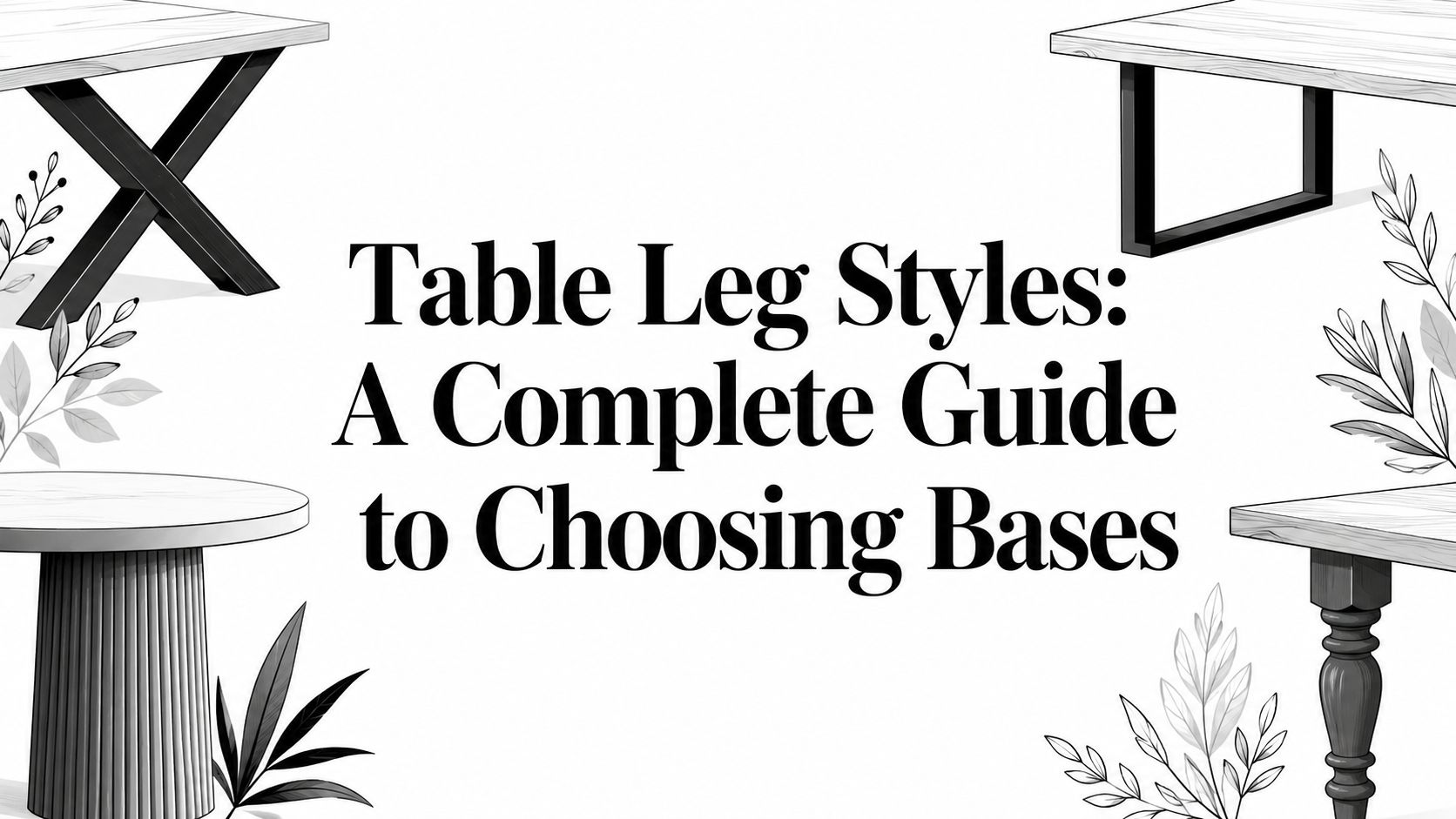
The twentieth century introduced profiles that still shape current orders. Parsons legs sit square and flush with the apron, creating a minimal block-like outline. Mid-century legs often splay outward, visually lifting the top. Trestle and refectory bases suggest farmhouse gatherings and long communal tables. Pedestal and A-frame bases move further toward sculpture, geometry, and open chair placement.
Leg profile vocabulary at a glance
| Leg Profile | Era / Style Cue | Visual Weight | Best Paired With |
|---|---|---|---|
| Turned or bulb foot | Spanish and country traditions | Medium to substantial | Traditional chairs and warm wood finishes |
| Cabriole | Queen Anne and formal interiors | Light but decorative | Upholstered side chairs and classic rooms |
| Ball-and-claw | Chippendale ornament | Substantial | Detailed furniture and formal dining spaces |
| Federal | Refined historic styling | Moderate | Restrained upholstery and balanced interiors |
| Tapered Shaker | Clean, simple craftsmanship | Light | Minimal chairs and contemporary rooms |
| Parsons | Modern square geometry | Medium | Upholstered seating and simple architecture |
| Splayed | Mid-century influence | Light and open | Low-profile, modern chairs |
| Trestle or refectory | Farmhouse and communal dining | Grounded | Benches, armchairs, and long tops |
| Pedestal | Sculptural modern and classic forms | Base-heavy | Round or oval tops and flexible seating |
| A-frame | Geometric contemporary styling | Medium to substantial | Industrial or modern chair designs |
A useful guide to table leg styles can help shoppers name the desired profile before a custom consultation. The vocabulary matters because a leg's appearance often signals how much room it will occupy beneath the tabletop.
How Leg Shape and Placement Affect Seating Comfort
The same tabletop can feel generous or cramped depending on its base. A rectangular four-leg table typically places a post near each corner, which can claim one of the most useful seating positions. A guest may need to sit slightly off-center, especially when the chair has arms or a wide upholstered back.
A trestle base changes that geometry. Its supports sit inward or beneath the apron, leaving more uninterrupted space along the ends and sides. That arrangement often works well with benches because the bench can slide toward the table without meeting a corner post. A pedestal also clears the corners, but the base must spread enough across the floor to resist tipping and remain comfortable around feet.
Clearance has several dimensions
Sizing guides commonly converge on 10 to 12 inches of vertical space between the chair seat and the underside of the tabletop or apron. They also identify about 24 to 26 inches of knee clearance at dining height as a useful target. Guidance on table leg placement and ergonomic clearance explains why an intrusion into this envelope changes posture and reduces usable seat depth.
Corner legs set about 2 to 4 inches inward from the edge can reduce knee collisions while preserving a stable footprint. That small set-in doesn't solve every problem. A broad chair arm, deep apron, or splayed leg can still occupy the space a sitter expects to use.
Apron height deserves a separate check. A chair that sits comfortably against the table edge may not tuck fully under it if the apron drops into the chair arms. A modern pedestal without a conventional apron can offer more freedom for chair movement, but the base then becomes the main object to test with feet and knees.
Benches need a clear path
Benches work best when the base allows the bench to move inward without trapping knees between supports. Trestles and carefully placed pedestals usually offer more flexibility than four corner legs, although a crossbar can create its own obstruction at the feet. A-frame and metal-X forms may look open from above but can block the lower path where a bench or chair needs to slide.
The guide to dining space and seating arrangements can help a household compare table shape and base placement together. A sit test remains essential because chair width, arm height, and leg posture vary more than a simple floor plan suggests.
Joinery and Structure Behind a Stable Table
A stable leg dining table depends less on leg thickness alone than on the way the legs connect to the apron and top. A thick post attached with weak hardware can still loosen under repeated lateral movement. Leaning elbows, shifting chairs, uneven floors, and seasonal wood movement all place stress on those joints.
For heavy daily use, independent woodworking guidance identifies mortise-and-tenon joinery reinforced with corner blocks as a minimum standard. The tenon extends into a matching mortise, creating a mechanical connection that resists racking. Corner blocks strengthen the inside apron corners and help keep the assembly tight over time.
The hidden load path
A tabletop transfers its weight into the apron, then into the legs, and finally into the floor. On a large surface, that path must remain aligned when people lean at the edge or when an extension changes the span. Stretchers and braces can add rigidity, but they need to be positioned so they don't collide with feet.
Corner blocks cut to roughly 3 to 4 inches on each side are a practical specification for reducing looseness at the inside apron corner. Technical guidance on table-leg joinery explains why apron-to-leg connections resist racking more effectively than leg thickness by itself.
Dovetail and mortise-and-tenon joints distribute stress more effectively than staples or glue used alone. A long-grain edge joint can be stronger than the wood itself, while end-grain glue joints are vulnerable to seasonal movement. Furniture construction detailing provides the underlying distinction between strong long-grain connections and weak end-grain assemblies.
What to inspect on the showroom floor
A shopper doesn't need to dismantle a table to learn a great deal. The following checks reveal whether the construction supports heirloom use:
- Push from the side: Gentle lateral pressure should not produce a visible racking motion.
- Inspect the underside: A substantial hardwood apron, corner blocks, and clean joinery indicate a more deliberate load path.
- Look at the leg connection: Mortise-and-tenon or properly reinforced mechanical joinery deserves more confidence than corner staples alone.
- Check the material: Solid hardwood has a different edge, grain, and weight from a thin veneer over an engineered core.
- Listen and feel: A hollow sound or movement beneath a solid-looking top calls for questions about the core and support system.
A construction-quality guide ranks mortise-and-tenon and dovetail methods among high-durability approaches, with both listed at 20 or more years in one comparison, while pocket-screw construction is listed at 5 to 10 years and nails alone at under 2 years. Furniture construction quality guidance supplies those comparative lifespan figures.
The mortise-and-tenon construction overview gives shoppers useful language for discussing craftsmanship. Amish hand-crafted solid wood pieces should be evaluated for material integrity and joinery rather than judged only by the decorative leg profile.
Matching Leg Profiles to Room Scale and Layout
Room scale changes the way a base reads. A slender tapered leg can disappear gracefully beneath a modest table, while the same profile may look underpowered beneath a visually heavy hardwood top. A chunky square post anchors a farmhouse room, but it can crowd a compact dining area when paired with deep chairs and a substantial apron.
A practical comparison helps clarify the choice before finish and edge details enter the conversation.
Leg profile comparison for dining tables
| Leg Profile | Best Room Scale | Seating Fit | Stability Notes |
|---|---|---|---|
| Tapered | Small to medium rooms with open sightlines | Works well with slim side chairs | A slight outward splay widens the footprint but can reduce toe space |
| Turned | Traditional rooms with layered furniture | Suits classic chairs and moderate-width seating | Rounded mass gives a grounded, decorative presence |
| Trestle | Long rooms and communal layouts | Often accommodates chairs and benches along open sides | Inward supports free seats, while the trestle can dominate the silhouette |
| Pedestal | Round, oval, or flexible seating arrangements | Maximizes corner placement and chair movement | A wide, balanced base is important for a secure feel |
| A-frame | Modern, industrial, or graphic interiors | Pairs with contemporary chairs, but crossbars need testing | Braced geometry can be rigid while trapping feet or chair legs |
| Chunky square post | Farmhouse and high-visual-weight rooms | Supports bench-oriented arrangements | Broad contact points feel stable but consume more visual and physical space |
Match the base to the top
The top and base should look as though they belong together. A delicate top with oversized legs can feel visually bottom-heavy. A deep, weighty top needs enough leg mass and apron support to avoid a top-heavy silhouette and excessive movement.
Tapered legs suit an interior design scheme that values clean lines and negative space. Turned legs echo other rounded details, such as chair backs, architectural trim, or traditional case goods. Double-pedestal trestles provide a strong solution for households that want open seating along the long sides without losing the character of a substantial base.
Single pedestals can make corner seating comfortable, especially on round and oval tops. They may feel less grounded in a room with a tall ceiling if the base is too narrow, and the center support can affect how an extension leaf is engineered. An A-frame or metal-X base can reinforce an industrial mood, but the lower cross members deserve a chair and foot test before an order is placed.
The right scale isn't determined by the table alone. Chair-arm height, seat depth, wall clearance, rug thickness, and walking paths all affect livability. A bespoke order should treat the table, chairs, and room as one ergonomic composition.
Custom Amish and Canadel Leg Dining Tables
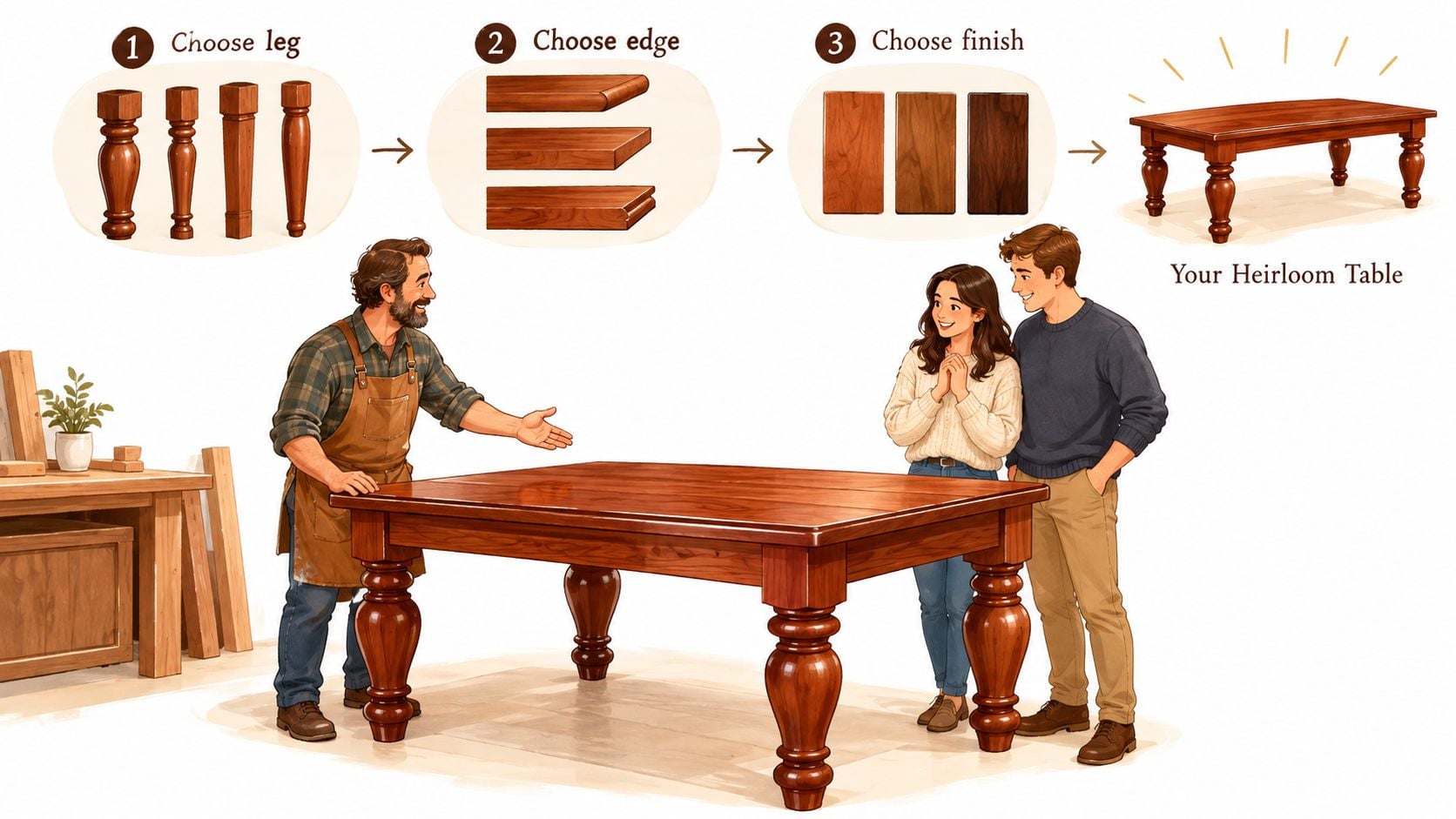
A made-to-order dining table gives a household control over the decisions that most strongly affect daily use. The process generally begins with the tabletop shape and length, then moves to the leg profile, edge treatment, breadboard end, wood species, and stain. That sequence turns a vague style preference into a piece with deliberate proportions.
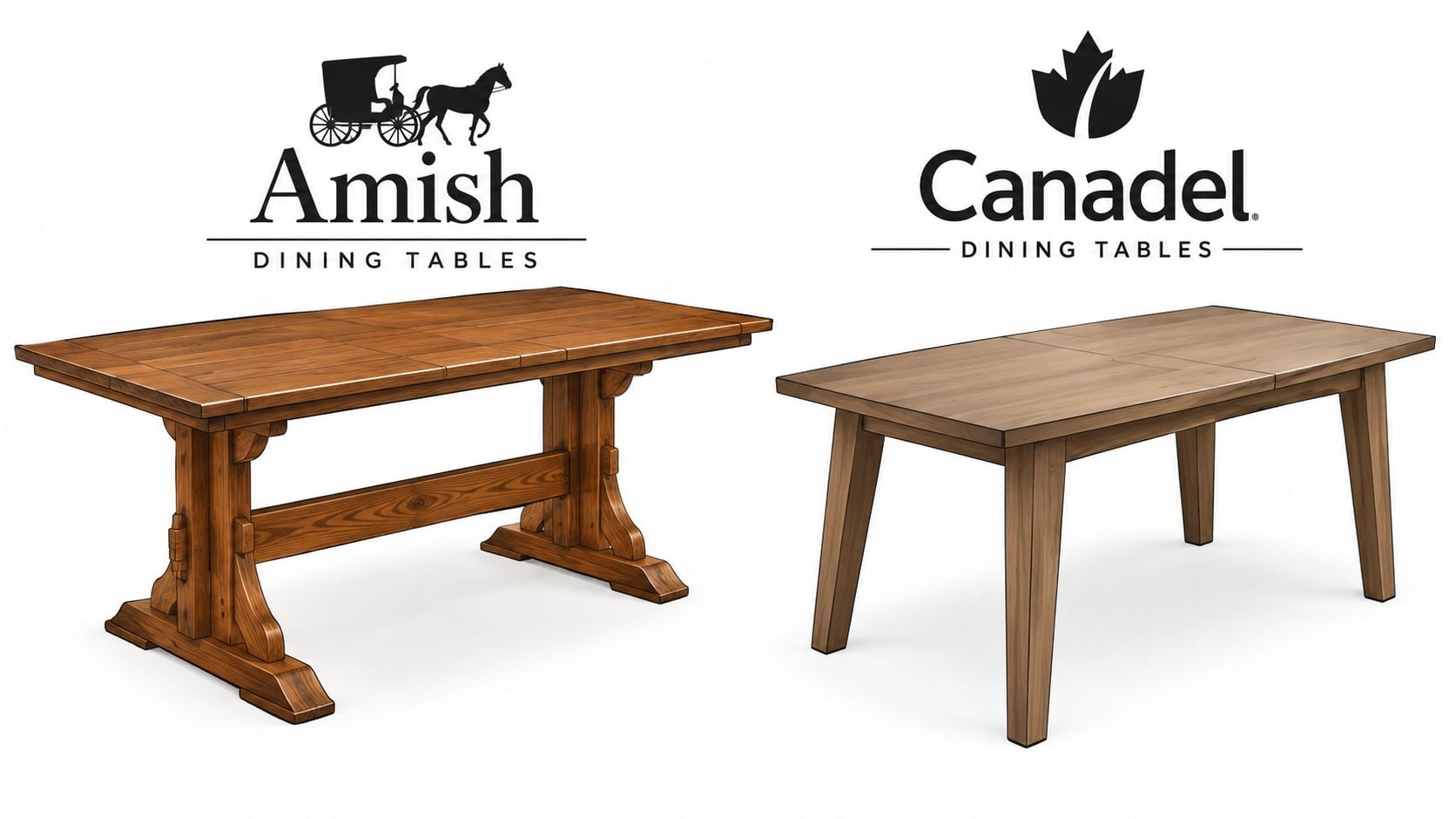
Canadel offers a broad range of coordinated leg silhouettes, chairs, and dining companions, making it useful for shoppers who want to develop an entire room around one design language. An Amish custom program emphasizes solid North American hardwood, hand-crafted construction, and joinery selected for long-term strength. The two approaches can look very different, but both allow a shopper to move beyond an in-stock compromise.
Where customization earns its place
The leg choice can change the entire behavior of the table. A tapered Shaker base keeps the room visually quiet. A turned base contributes ornament. A trestle supports a communal layout, while a pedestal gives chairs more freedom around the perimeter.
Finish samples matter because wood changes under the light in a real dining room. Cherry, oak, and maple each present different grain character, and a stain can appear warmer or cooler beside existing flooring and cabinetry. A sample viewed near the intended wall is more reliable than a digital swatch.
Design note: The most successful custom order solves a room problem before it adds decoration.
An Amish hand-crafted table also gives the buyer an opportunity to compare material integrity with mass-produced alternatives. Mortise-and-tenon joinery, dovetailed construction where appropriate, solid hardwood components, and carefully engineered aprons speak to craftsmanship. Those details support a cost-per-year perspective. A table that remains comfortable, level, and attractive through years of meals represents an investment in an heirloom rather than a temporary furnishing.
A clear order conversation
The custom solid wood dining table collection provides a starting point for discussing shape, base, finish, and seating. A design consultation can clarify whether a leg profile can be changed independently, how an extension mechanism affects the base, and whether a chosen bench will clear the apron.
Tyner Furniture, founded in 1957, serves Ann Arbor and the wider Southeast Michigan community with furnishings spanning the Home Office to Outdoor Spaces. Its custom programs include Canadel dining configurations, Amish solid wood furniture, custom upholstery, and ergonomic Stressless seating. Special Financing may be available subject to credit approval, and a Low Price Promise supports competitive value when the purchase becomes a significant household investment.
Planning Your Visit and Making the Investment
A productive showroom visit starts with information from the home. A shopper doesn't need a finished design board, but the design team should know the dining room dimensions, ceiling height, doorway widths, and the location of nearby walls or architectural transitions. Photos of the intended wall and floor are especially useful when a wood finish needs to coordinate with existing pieces.
Chair details matter just as much as room measurements. Arm height, seat width, and the intended bench length can determine whether a chosen apron and leg placement feel open or restrictive. A casual glance across a showroom won't reveal every conflict, but a sit test can show knee clearance, chair slide, corner comfort, and bench movement quickly.
A practical visit checklist
- Room measurements: Record the usable length and width, not only the wall-to-wall dimensions.
- Access points: Measure doorway widths and note turns, stairs, and tight hallways.
- Existing furniture: Photograph nearby case goods, flooring, lighting, and wall colors.
- Chair information: Bring arm height, seat width, and seat height when existing chairs will remain.
- Dining habits: Note whether the household uses a bench, hosts large gatherings, or needs flexible extension seating.
- Finish references: Bring a cabinet sample or clear photograph so wood and stain choices can be compared accurately.
Custom Amish and Canadel orders require planning because made-to-order craftsmanship follows a production schedule. The showroom can explain current lead times for the selected program rather than promising a generic delivery date. A design consultation is useful when the household is balancing a narrow room, oversized upholstered chairs, extension leaves, or several wood finishes.
Financing deserves careful reading
Tyner's financing options may include Synchrony, Acima, and Progressive Leasing, with availability and approval terms varying by program. Promotional furniture financing can use deferred-interest terms. That means interest isn't charged only when the promotional balance is paid in full within the required window. If a balance remains afterward, interest may be charged back to the original purchase date, as described in a furniture financing example.
Consumer finance guidance notes that furniture retailers often advertise 0% APR promotions for 12 to 24 months, but some offers use deferred interest rather than a simple interest-free loan. Furniture financing guidance recommends reviewing the payoff deadline, approval conditions, and consequences of missing the terms before signing.
A cost-per-year mindset keeps the conversation focused on value. A solid wood heirloom with sound joinery, an ergonomic seating plan, and a finish suited to the home may justify a larger initial investment when it remains useful for years. Special Financing can lower the immediate barrier, but the written terms should always guide the decision.
The final choice should connect the vocabulary, measurements, and structural checks already considered. A shopper who arrives with a preferred profile and a clear understanding of chair geometry can use the showroom sit test to confirm the details, then discuss made-to-order options, delivery, financing, and finish samples with confidence.
Tyner Furniture offers made-to-order Amish and Canadel dining tables with leg profiles, finishes, and configurations suited to real rooms, along with seating for a complete ergonomic sit test. Visit Tyner Furniture in Ann Arbor to compare leg dining tables in person and bring home a piece designed for lasting local living.