Custom Wood Stain Colors for Heirloom Furniture


A homeowner in Ann Arbor can spend an afternoon comparing stain samples, only to find that the warm brown chosen under showroom lighting looks gray beside a window and orange against the dining floor. That frustration is understandable. Custom wood stain colors aren't just paint chips for furniture. They're a coordinated decision involving species, grain, lighting, sheen, topcoat, and the way a solid-wood piece will age.
For a made-to-order dining table, bedroom set, desk, or cabinet, the right finish should feel connected to the home rather than merely fashionable. Tyner Furniture has served Southeast Michigan since 1957, helping households weigh craftsmanship, durability, comfort, and value across everything from the Home Office to Outdoor Spaces. The same showroom also offers customization beyond wood, including fabrics, configurations, Canadel dining selections, and Stressless ergonomic seating.
Why Custom Stain Colors Matter for Solid Wood Furniture
Two nearly identical sample boards can tell completely different stories. One may look like warm honey beneath showroom fluorescents, while another shifts toward muddy gray a few feet away by the window. A buyer who chooses from a rack of stock chips alone is making a decision under conditions that may never exist in the home.
A custom stain color is a finish developed toward a target undertone, pigment density, saturation, and sheen. A finisher may mix colors, tint a base, layer dye beneath pigment, or adjust the concentration before sealing the result with a protective topcoat. The objective isn't merely “lighter brown” or “darker walnut.” It's a controlled relationship between the wood, the room, and the intended character of the piece.
Solid wood absorbs the decision
On solid hardwood, color moves into the grain and pores instead of sitting on a printed decorative surface. That gives the finished piece depth, but it also means the same formula can appear different across boards, change as the wood matures, and respond differently to future repairs.
Veneer has a real place in furniture, but its thin hardwood surface gives the finisher less room for correction. Laminate behaves differently still, because its visible pattern is manufactured rather than absorbed into natural wood fibers. Solid hardwood gives a made-to-order piece a stronger long-term foundation, particularly when the construction uses durable joinery and the material is thick enough for careful refinishing.
For households comparing options for durable children's furniture, the distinction matters. A finish should support daily use, not disguise a surface that can't be meaningfully repaired later.
Showroom rule: Choose the finish for the actual species and room, not for the chip alone.
Four decisions shape the result
- Color family: Natural, honey, walnut, espresso, gray, or opaque paint each changes how the grain reads.
- Finish type: Penetrating oils, hardwax oils, varnishes, lacquers, and conversion finishes create different surface feels and repair paths.
- Species interaction: Oak, cherry, maple, and walnut bring different pore structures and undertones to the same formula.
- Topcoat: The protective layer affects sheen, depth, touch, and how the color looks after curing.
Tyner's Amish hand-crafted furniture makes this level of control practical because the buyer can select solid North American hardwood and a finish designed around the home. The result can be an heirloom rather than a merely coordinated purchase.
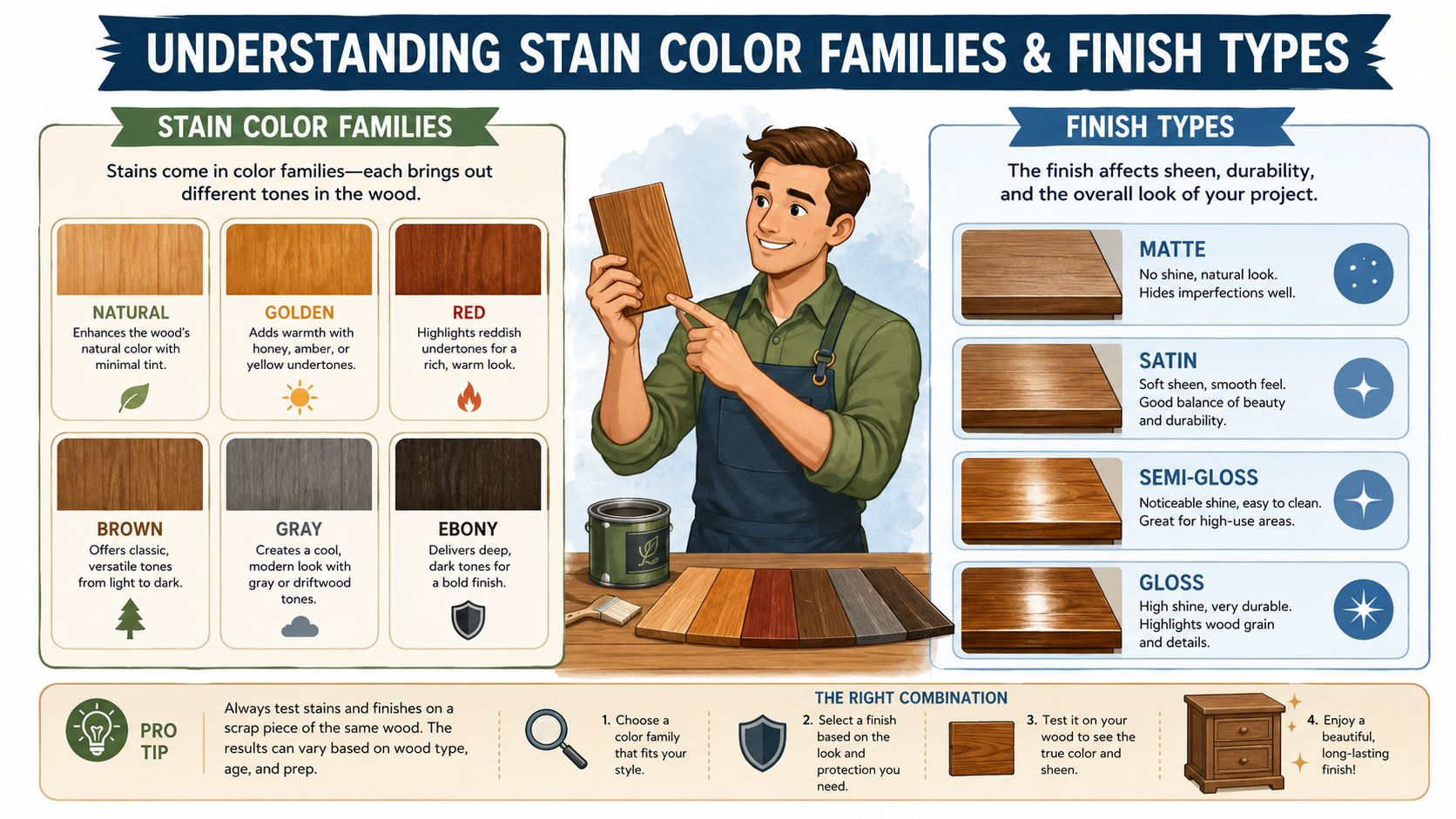
Understanding Stain Color Families and Finish Types
The easiest way to start is to identify the visual direction, then narrow the choice using wood behavior and room lighting. A color family gives the finish team a starting point, but the actual sample still has to be made on the species chosen for the piece.
Start with the room's visual language
- Natural and clear: Best when the goal is to preserve pale maple, ash, or light oak. A matte surface keeps the result quiet and contemporary.
- Light golden oak: Works well in traditional dining rooms and spaces with warm textiles. On naturally amber wood, it can become more golden than expected.
- Warm honey and amber: Adds richness to cherry, oak, and maple. It suits rooms with cream upholstery, woven rugs, and warmer wall colors, but can look overly orange beside red-toned flooring.
- Medium chestnut and walnut: A dependable middle ground for dining tables, desks, and bedroom case goods. It adds definition without fully obscuring grain.
- Deep espresso and ebony: Creates strong contrast and formality. It can be striking on open-grain oak, but dust, scratches, and edge wear may show more clearly.
- Driftwood and weathered gray: Fits restrained, coastal, and modern interiors. Gray washes need careful undertone testing because blue or green shifts can appear under cool light.
- Painted opaque finishes: Useful when a room needs a specific color or when the natural variation of the wood shouldn't dominate. Paint hides more grain, while the furniture's construction still determines its structural quality.
Pigment and dye behave differently
Pigment stains contain solid particles that lodge in pores and surface texture. They're especially useful on open-pored oak and ash, where they can emphasize or even out the grain. Dye stains use smaller colorants that penetrate more, often producing a clearer, more uniform result on dense maple and cherry, though they can be more vulnerable to fading in sunlight. This wood stain guide explains how colorant type and wood anatomy work together.
A blended dye-and-pigment approach can offer depth plus control, but it still requires testing. The finish category matters just as much:
- Penetrating oil: Rich, tactile, and relatively forgiving. It can often support localized maintenance, but it may offer less surface film protection than a hardened varnish.
- Wiping varnish: Easy to control and capable of a durable protective film. Repairs typically require more preparation.
- Conversion varnish: Tough and well suited to demanding furniture surfaces. Refinishing is generally a professional process.
- Lacquer: Smooth and efficient for controlled finishing environments. It can create an elegant surface, but the formulation and application need skilled handling.
- Hardwax oil: Low-build and natural to the touch, with a repair-friendly character when properly maintained. It still needs sensible care and compatible products.
For a deeper look at protective surfaces, the guide to table top finishes for heirloom-quality furniture is a useful companion. Matte and satin finishes are usually easier to live with visually than high gloss because they soften reflections and make minor handling marks less conspicuous.
How Wood Species and Grain Shape the Final Color
The same custom formula can read as three different colors on oak, cherry, maple, and walnut. Pore structure, density, grain direction, and natural extractives all influence absorption, so a stain sample on one species cannot serve as a reliable promise for another. A comparison of species-specific behavior is available in this overview of North American hardwoods.
Oak and ash have open pores that accept pigment readily. Their cathedral grain can become darker and more graphic, especially with a medium or deep stain. Maple has tighter grain and greater density, so it may resist pigment and appear lighter, while blotching can occur where absorption changes across the board. Cherry often starts with a warm natural color and develops additional richness over time, which means an amber stain can push the finished piece toward a stronger red-brown.
Walnut usually brings its own depth to the conversation. A medium stain may unify variation, but a heavy pigment load can conceal the contrast that makes walnut distinctive. Poplar and pine can also absorb unevenly, making preparation and conditioning more important.
Cut and grain direction change the reading
A flat-sawn board shows broad cathedral patterns and can create visibly varied bands under stain. Rift-sawn boards present a straighter grain, while quarter-sawn cuts can reveal distinctive figure and more controlled visual lines. These cuts don't merely affect style. They change how the finish meets the surface and how the eye interprets absorption.
| Species | Grain Type | Typical Result With Medium Stain | Refinishing Potential |
|---|---|---|---|
| Oak | Open, prominent grain | Strong contrast, visible pore darkening, often a predictable medium tone | Solid oak can generally support future sanding and refinishing when enough material remains |
| Cherry | Closed to moderate grain, naturally warm | Richer red-brown character, with natural variation remaining visible | Solid cherry offers meaningful long-term refinishing potential |
| Maple | Tight, dense grain | Lighter, more uniform appearance, with blotching possible without careful preparation | Solid maple can be refinished carefully, though aggressive sanding can remove valuable material |
| Walnut | Moderate grain, naturally dark | Deep, sophisticated result, with excessive pigment potentially hiding figure | Solid walnut can be renewed over time with appropriate professional methods |
Solid wood earns its heirloom designation partly because it can be sanded, re-stained, and spot-repaired across decades. Veneer and laminate are more limited. A bad color on a thin veneer surface may be difficult to correct without exposing the substrate, while laminate generally offers no natural grain to rework.
That's why custom finishing makes the most sense on solid hardwood built with enough material to support responsible refinishing. The flawless stained wood transformation discussion is helpful for understanding why preparation and surface condition matter before any color decision is finalized.
A bespoke finish has value only when the underlying material can carry it for the long term.
A Practical Method for Choosing and Testing Custom Stains
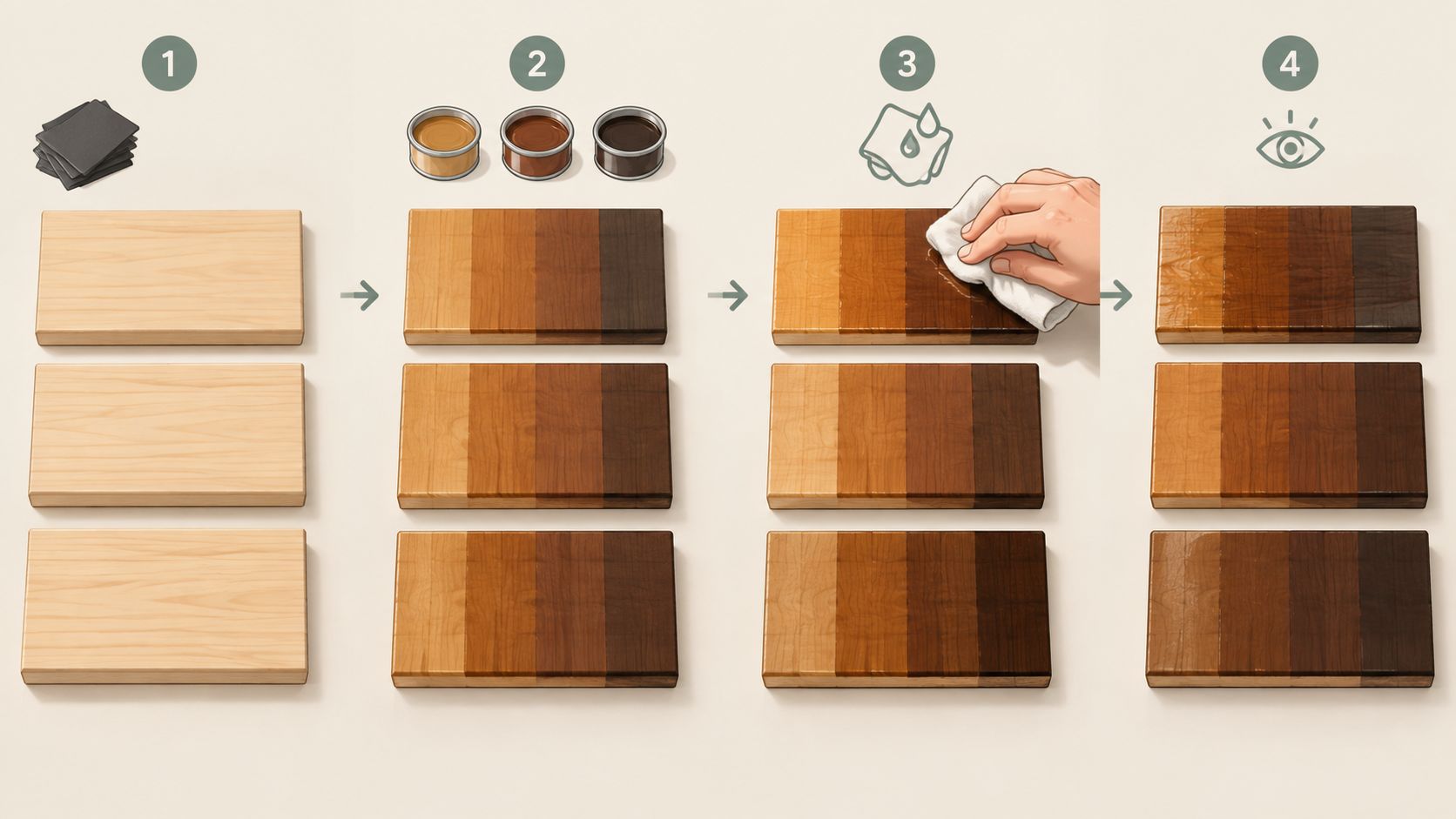
A reliable test board is more useful than a dozen attractive digital images. Custom stain development is sensitive to sanding, stain thickness, wipe-off timing, solvent evaporation, temperature, humidity, and the chosen topcoat, so the testing process needs to hold those variables steady.
Build a room-realistic sample
- Use the actual species. A generic pine board from a hardware store won't predict the result on maple, cherry, oak, or walnut. The sample should match the wood selected for the furniture.
- Sand consistently. Prepare every board with the same grit progression. Coarser scratches can exaggerate absorption differences, while inconsistent sanding makes one formula appear unfairly darker or lighter.
- Control application. Apply matched coat weights and hold wipe-off timing constant. A thicker application or longer dwell time can change color strength even when the formula stays the same.
- Apply the intended topcoat. Brush or spray the planned oil, wax, varnish, or other finish over every test. A wet stain is not the finished color, and the surface can shift after curing.
- Label the underside. Record the formula ratios, layering order, sanding sequence, and topcoat. A documented recipe lets the finishing team reproduce the selected result later.
A compatible solvent can be used to reduce color strength and improve control when the formula permits it. Technical guidance identifies a starting 1:1 thinning ratio for adjustment, but the finish team should confirm compatibility and test the diluted blend before applying it to furniture. The buyer shouldn't treat that ratio as a universal recipe.
Test in the real lighting
Place the cured samples in the dining room under warm evening lamps and beside the east-facing window in cool morning light. A finish that looks balanced at noon may feel too red at night or too gray early in the day.
Hold the board against the baseboard, flooring, rug, drapery, and a throw pillow. The finish should coordinate with the room's larger materials, not only look appealing against a white countertop. Guidance on matching wood stains reinforces the importance of comparing the finish with surrounding surfaces.
A sample should be confirmed on a hidden face of the actual piece or on a full-size offcut before final spraying. A practical Dublin house staining guide also provides useful background on preparation and application conditions. The strongest safeguard remains simple: let the buyer approve the cured sample under the home's actual light.
Matching Your Custom Stain to Existing Decor and Light
A dining table doesn't live alone. Its finish sits beside flooring, wall color, upholstery, rugs, drapery, metal accents, and the changing light that enters the room. The best custom wood stain colors act as connective tissue, allowing those elements to relate without forcing every surface to match.
Four room conditions deserve attention:
- Flooring: Identify the floor species, undertone, age, and sheen. A warm honey table can turn orange beside red oak flooring, while a slightly cooler brown may create a calmer relationship.
- Walls: Gray paint can cool a warm stain visually, especially when the wall has a blue or green undertone. Cream or beige walls may intensify amber and red.
- Large textiles: Rugs, curtains, and sofas occupy enough visual area to alter how the wood is perceived. A smoky brown can settle beside linen and charcoal textiles but feel heavy against strongly golden upholstery.
- Light sources: Warm bulbs can soften brown and amplify amber. Cooler daylight LEDs can reveal blue, green, or gray undertones that aren't obvious in the evening.
Watch the finish change across the day
A smoky driftwood tone may disappear under warm 2700K bulbs yet sharpen under 4000K daylight LEDs. Those color temperatures are practical reference points, not guarantees, so the finished sample still needs to be observed in the actual room.
Metamerism creates another problem. Two surfaces can appear to match under one light source and separate visibly under another. A sample board should therefore be viewed in morning, afternoon, and evening conditions, with the planned topcoat already applied.
| Stain Family | Pairs Best With | Watch Out For |
|---|---|---|
| Natural and clear | Pale walls, woven fabrics, light maple or ash | Can look unfinished beside strongly traditional furniture |
| Warm honey and amber | Cream upholstery, warm rugs, traditional rooms | May become orange beside red oak or red-toned decor |
| Chestnut and walnut | Mixed woods, neutral walls, leather seating | Can look flat if the room lacks enough light contrast |
| Espresso and ebony | Light walls, brass accents, pale textiles | Shows dust and edge wear more readily |
| Driftwood and weathered gray | Cool walls, linen, restrained modern interiors | Can turn blue or green under cool lighting |
| Painted opaque | Coordinated cabinetry, bold wall colors, transitional rooms | Hides natural grain and may be harder to blend during touch-up |
The goal isn't to create a single dramatic statement. It's to choose a finish that lets a dining table, bedroom case piece, or home office desk belong to the entire room. A coordinated result usually outlasts a color selected only because it looked striking in one photograph.
Custom Stain as a Long Term Investment in Heirloom Pieces
Custom finishing should be evaluated by cost per year, not by the initial upcharge alone. A custom blended finish costing $400 to $600 spread across a 30 to 50 year service life on solid hardwood represents a small annualized expense compared with replacing a veneer bookshelf more than once during that same period. Those figures are a planning comparison, not a promise of service life, and the actual result depends on construction, environment, use, and maintenance.
The central question is whether the furniture deserves a finish that can age with it. Amish hand-crafted solid wood pieces built with sound joinery and material integrity have a stronger case for custom stain work than mass-produced alternatives whose surface or construction limits future repair.
Prioritize repairability over novelty
A dye-and-pigment combination can create more nuanced depth than a single-note stain. Dye brings color into the wood, while pigment adds pore definition and visual control. The best blend depends on the species and the desired level of grain emphasis.
Penetrating oil finishes can often support local spot repair when the correct product and color are available. Film finishes such as varnish, lacquer, or conversion varnish create stronger surface protection, but a damaged area may require professional blending or broader refinishing so the repair doesn't flash under light.
Ultra-trendy gray and ebony washes deserve caution. They can look complex, but heavy pigment loads may date the piece and make future color correction more difficult. A restrained walnut, chestnut, or softened earth tone usually gives a family more flexibility as rugs, walls, and upholstery change.
The custom Amish furniture collection represents the kind of purchase where this reasoning matters. An heirloom dining table or bedroom piece isn't selected for one season. It should remain plausible through changing interiors, moves, family routines, and future maintenance.
Investment test: If the furniture is meant to serve a generation, choose the undertone and repair path before chasing the color of the year.
Special Financing, subject to credit approval, can help households plan for a higher-quality made-to-order piece, while Tyner's Low Price Promise addresses value without reducing the discussion to the lowest initial price. Promotional financing deserves careful reading. Consumer finance guidance explains that deferred-interest plans typically run six to 12 months, and remaining balances can trigger accrued interest retroactively from the purchase date, so the payoff deadline and full-balance requirement should be understood before signing.
Tyner's Made to Order Amish Finishes and Your Next Step
The process begins with a conversation at the South State Street showroom in Ann Arbor, not with a customer pointing at an isolated chart. A homeowner can bring a flooring sample, cabinet door, rug swatch, or room photograph. Those references help the design team identify whether the room needs more warmth, less red, stronger contrast, or a finish that bridges several existing woods.
The selected species comes next. Oak, cherry, maple, and walnut each respond differently, so a custom stain formula must be judged on the actual hardwood planned for the piece. The Amish craftsperson then builds the furniture using hand-crafted methods and traditional joinery, while the finishing process adjusts the color to the grain rather than treating the wood like a uniform printed panel.
From swatch to finished furniture
A typical made-to-order consultation includes:
- Room review: Existing flooring, paint, textiles, lighting, and adjacent furniture are considered together.
- Species selection: The wood's natural color and grain determine how the stain will develop.
- Sample approval: A cured, topcoated sample gives the buyer a realistic reference.
- Craft production: The Amish builder creates the table, bedroom piece, desk, or cabinet with solid-wood construction and selected details.
- Finishing-room checks: Coverage, sheen, color consistency, and visible surfaces are reviewed before delivery.
The custom order starting guide helps shoppers prepare for that conversation. Typical lead times depend on the selected builder, species, configuration, and finish schedule, so the showroom should confirm the current timeline for each order rather than offer a universal promise.
If the final color reads differently under a buyer's home lighting, the approved sample, recorded formula, and documented topcoat provide safeguards for reviewing the difference. That record gives the finishing team a clear benchmark instead of relying on memory or a phone photograph.
Tyner's broader selection also supports a coordinated home, from dining and bedroom furniture to the Home Office, living spaces, mattresses, ergonomic Stressless seating, Canadel configurations, and Outdoor Spaces. In-stock is just the beginning. Made-to-order finishes, fabrics, sizes, and configurations allow the piece to fit the room and the household.
Visit Tyner Furniture at the Ann Arbor showroom with a floor sample, cabinet door, or room photo for a sit test and a finish conversation based on the actual space. The showroom team can also help shoppers browse Quick Specs for special orders, compare solid-wood species, and discuss custom stains, Special Financing, and the Low Price Promise.