Transitional Bedroom Sets: A Smart Buyer’s Guide

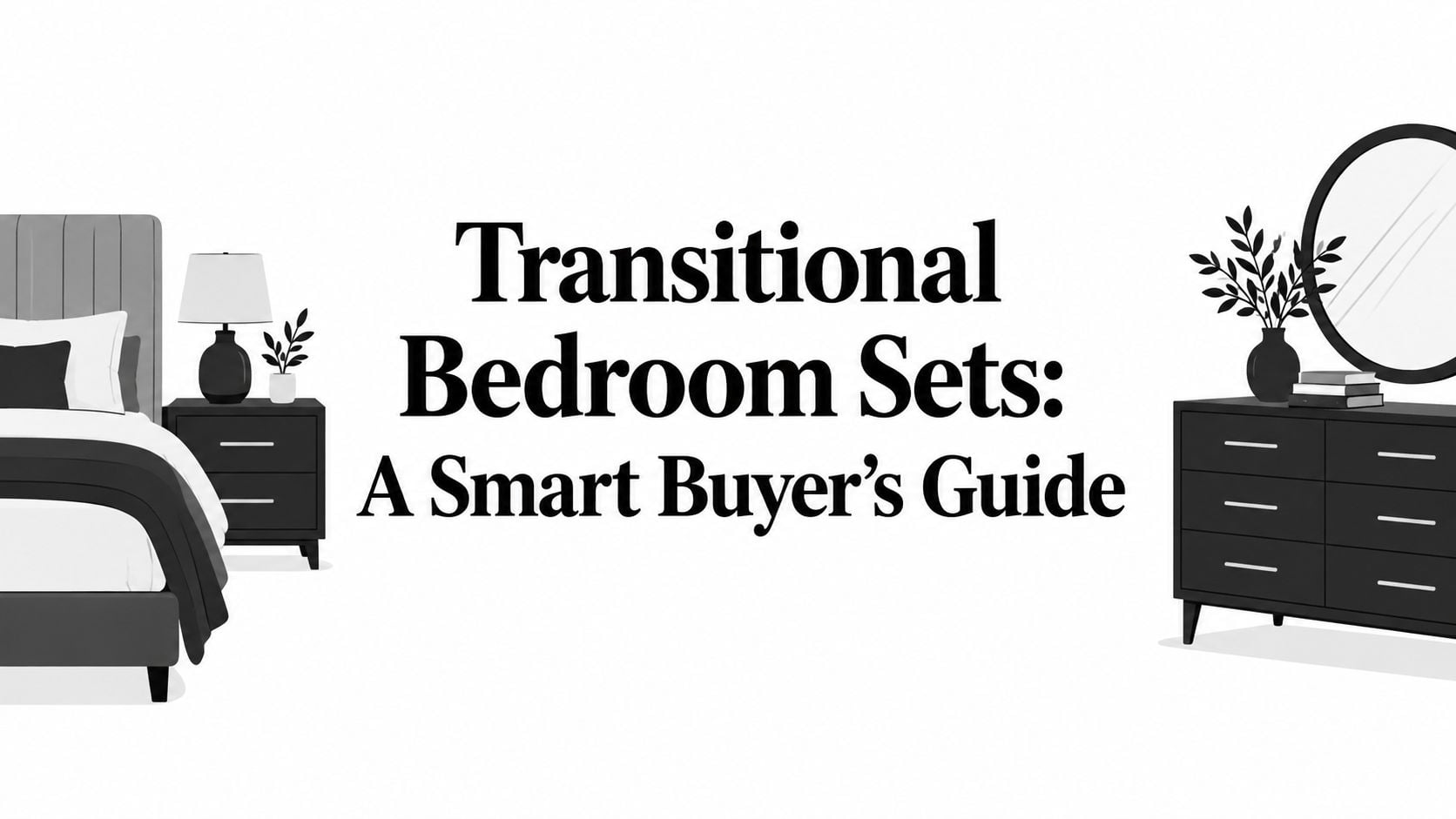
A transitional bedroom set is a coordinated system that blends traditional and contemporary cues, and its value comes from staying adaptable rather than chasing one decorating moment. For a purchase expected to serve 15 to 25 years, construction, sleep ergonomics, customization, and lifecycle value matter more than a showroom-perfect match.
Many shoppers reach the same decision point in an Ann Arbor showroom. One bed feels too formal, with a heavy sleigh profile and dark ornament. Another looks sleek and modern but seems disconnected from inherited furniture, familiar wood tones, or the warmth expected in a bedroom. Transitional bedroom sets remove that false choice by combining the comfort of traditional proportion with the restraint of contemporary design.
That flexibility matters in Southeast Michigan homes, where a bedroom may need to work through a move, a renovation, changing mobility needs, or a shift from starter home to forever home. The right set should coordinate without forcing every other piece in the room to match.
What Makes a Bedroom Set Transitional
Transitional style sits between traditional and contemporary furniture. It isn't a historical period or a standardized product category. Instead, it uses recognizable traditional cues, including balanced proportion, symmetry, wood construction, and restrained ornament, then simplifies them with contemporary details such as lower-profile headboards, lighter finishes, clean silhouettes, and mixed materials.
The result should feel settled, not decorated around a theme. A transitional bed can have a substantial wood frame, but its lines remain controlled. A dresser may include modest molding, but the hardware and profile won't dominate the room. A nightstand should look related to the bed without appearing as though every component came from one rigidly matched package.

The visual test
A farmhouse bedroom usually leans into casual rustic references, visible distressing, barn-inspired details, or pronounced natural texture. A rustic room makes the wood character part of the statement. A fully modern bedroom favors sharper minimalism, lower visual weight, and fewer traditional details. Transitional furniture can borrow warmth from both directions without becoming rustic or stark.
A useful test is to remove the bedding and accessories mentally. If the furniture still shows balanced proportions, calm profiles, and a finish that can live with different wall colors, the set is likely transitional. If the room depends on one theme, one matching collection, or one dramatic finish, it may have less staying power.
Practical rule: A transitional set should support the room's architecture and future changes, not dictate them.
The 2025 Las Vegas furniture market report described renewed buyer interest in transitional case goods, particularly bedroom groups with lighter finishes and lower-profile headboards, and connected that appeal with smaller homes, apartments, condominiums, and a move away from rigidly matched room sets. Furniture Today's market coverage also reflects why younger buyers are combining pieces for a collected look.
For shoppers refining a whole-home palette, this guide to room-by-room design balance offers a useful way to think about relationships between old and new pieces. Tyner's own discussion of contemporary versus traditional design styles can help clarify where a transitional choice fits.
The buying framework is straightforward: identify the working components, inspect materials and joinery, verify sleep-system compatibility, choose customization deliberately, calculate cost per year, and protect the furniture through proper care.
Components, Materials, and Finishes to Spec
A complete bedroom set may include a bed, headboard, nightstands, dresser, mirror, chest, bench, or occasional storage. A coordinated system doesn't require buying every piece at once. The stronger approach is to begin with the bed and storage needs, then add pieces whose proportions and finish support the room.
Start with the body, not the catalog
Mattress thickness changes the practical height of the bed. A high mattress on a tall frame may make sitting down or standing up awkward, while a lower mattress can create excessive bending for some adults. Nightstands should place lamps, books, and charging devices within comfortable reach, not merely line up with the top of the mattress in a showroom photograph.
Room measurements should include walking clearance around the bed, door swings, drawers pulled fully open, and the reach required to use upper storage. Queen, king, and California king layouts also need different circulation planning, so a set shouldn't be ordered from a floor plan that includes only the mattress footprint.
| Component | Typical Dimensions | What to Evaluate |
|---|---|---|
| Bed and headboard | Queen, king, or California king footprint | Mattress support, headboard height, rail clearance, adjustable-base compatibility |
| Nightstands | Sized to the bed and available reach | Drawer access, charging location, lamp surface, clearance beside the bed |
| Dresser | Width and height vary by drawer layout | Drawer extension, case stability, hardware, wall clearance, mirror relationship |
| Chest | Tall vertical storage format | Reach to upper drawers, anti-tip provisions, drawer capacity |
| Mirror | Sized to dresser and wall | Mounting method, visual proportion, safe placement |
| Bench or occasional piece | Based on foot-of-bed clearance | Circulation, upholstery durability, useful seating rather than visual filler |
Finish selection should begin with the floor and wall color, then move to bedding and lighting. Warm brown cherry adds depth and works naturally with traditional materials. Mid-tone walnut can give the room a more contemporary weight. Soft gray and painted linen create a lighter backdrop, but they require careful comparison with cool flooring and artificial light.
The custom wood finishes available through a furniture specialist can help shoppers compare samples rather than guessing from a screen. That tactile step matters. The weight of solid cherry wood, the variation in grain, and the way a finish catches evening light tell a buyer more than a small digital swatch.
Ask what sits beneath the finish
Surface appearance doesn't reveal indoor-air-quality considerations. The U.S. Environmental Protection Agency guidance on formaldehyde and indoor air quality identifies pressed-wood products made with urea-formaldehyde adhesives as likely significant household formaldehyde sources and recommends ventilation, humidity control, and lower-emitting alternatives where possible.
Buyers should ask:
- Case construction: Is the piece solid wood, veneer over a compliant panel, MDF, or particleboard?
- Drawer bottoms: Are they substantial enough for everyday use, and are they securely fitted?
- Bed components: What supports the mattress, and how are rails attached?
- Emissions: Are certifications or material disclosures available?
- Delivery: Will newly delivered furniture be ventilated before prolonged bedroom use?
Bedding changes comfort as well as appearance. Shoppers comparing breathable bedding can consult this guide to percale sheets for executives for a focused discussion of fabric choice. Furniture remains the structural foundation, but the complete sleep environment includes surfaces, lighting, temperature, and reach.
Solid Wood Versus Fast Furniture
The most important difference between bedroom pieces often sits where shoppers can't see it. A stain can make a weak case look handsome on a showroom floor, while strong joinery and sound material integrity determine how the piece behaves after years of drawers opening, beds shifting, and climates changing.
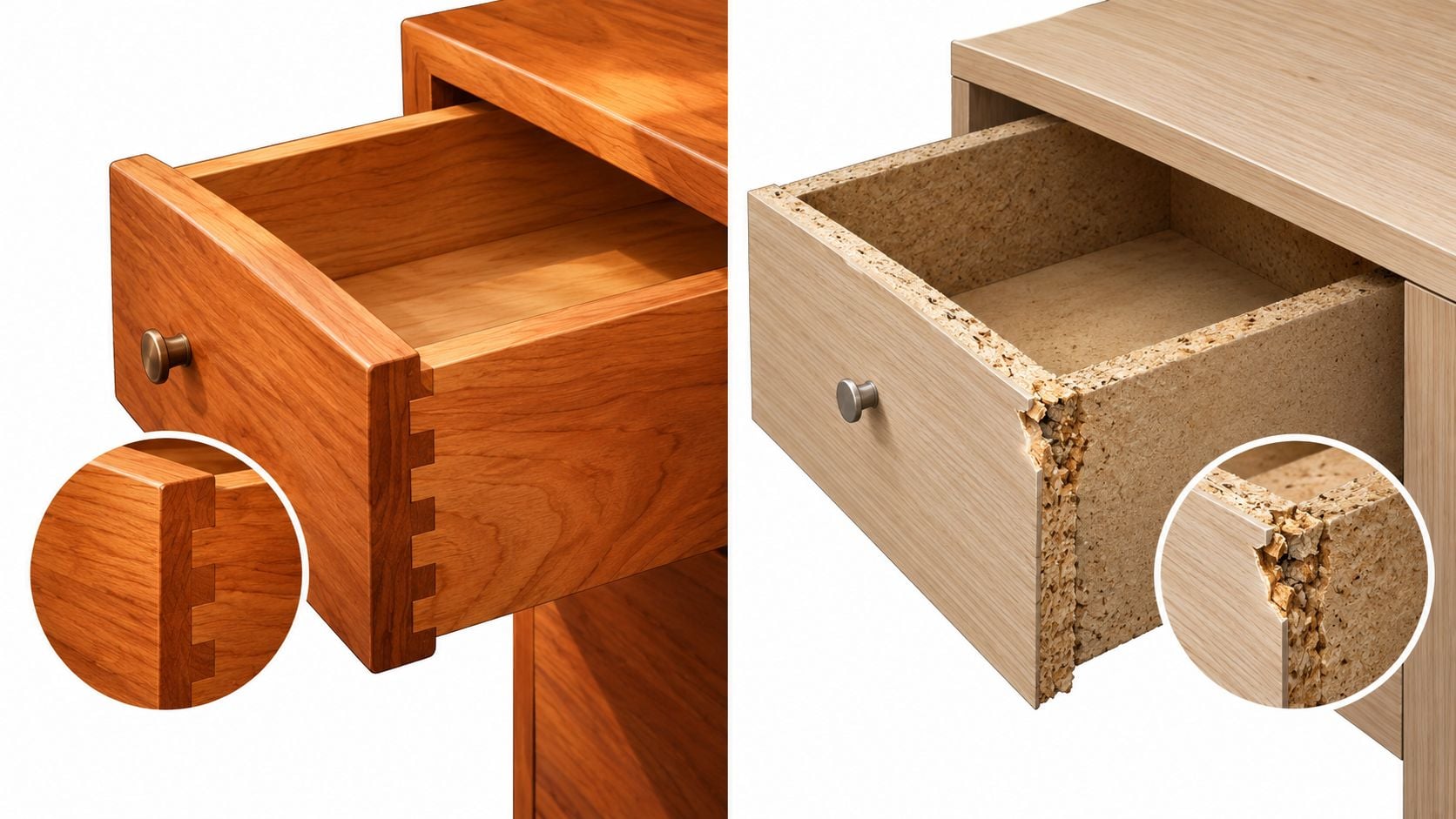
Tyner's Amish hand-crafted bedroom furniture uses solid North American hardwoods, including cherry, oak, and maple, with construction methods such as dovetailed drawers and mortise-and-tenon frames. Those details aren't decorative vocabulary. They describe how the parts transfer load and whether a damaged component can be repaired instead of discarded.
Inspect the hidden structure
Mass-produced veneer and engineered-panel furniture can be appropriate for a constrained budget or a short-term furnishing need, but it shouldn't be mistaken for the same construction category. Common concerns include peeling veneer, weakened drawer bottoms, and bed hardware that begins to wobble as joints loosen. The issue isn't that every composite piece fails in the same way. The issue is that repair options and material depth are often limited.
A solid-wood piece also requires better engineering. Wood exchanges moisture with surrounding air, and movement across the grain is substantially greater than movement along it. A technical summary based on USDA Forest Products Laboratory data reports that tangential shrinkage is commonly about twice radial shrinkage, while longitudinal shrinkage is comparatively small. The same summary places equilibrium moisture content at roughly 6% at 30% relative humidity and about 16% at 80% relative humidity. The technical explanation of solid-wood movement shows why construction must allow the material to move.
Wide dresser tops, headboards, and panels can cup, split, or stress fasteners when rigidly constrained across the grain. Good construction may use elongated screw holes, figure-eight fasteners, clips, floating panels, or other joinery that permits movement.
A solid-wood set isn't valuable merely because it is heavy. It is valuable when the builder understands how that weight, grain, and seasonal movement must be managed.
The solid wood versus engineered wood guide gives shoppers a useful vocabulary for examining the difference. In the Ann Arbor showroom, a buyer should open drawers, inspect the corner joints, feel the underside of a top, and ask how replacement hardware or future repairs are handled.
Calculate cost per year
A high-quality set should be judged as an heirloom investment, not only by its initial price. A piece that remains useful through a bedroom renovation, a move, new flooring, or a change in bedding has a lower practical cost per year than furniture that must be replaced when one component weakens or the style stops coordinating.
That doesn't make solid wood the right answer for every room. A renter with uncertain space, a guest room with infrequent use, or a household prioritizing immediate flexibility may choose differently. For a primary bedroom intended to serve a family for 15 to 25 years, repairability, finish depth, joinery, and material integrity deserve more weight than a low initial number.
Sleep Comfort and Everyday Functionality
A beautiful bed can still be a daily nuisance. The right transitional bedroom set should make getting in, getting out, reaching a nightstand, opening a drawer, and changing bedding easier for the people who use it.
Set the bed height around mobility
Bed height depends on the frame, foundation, mattress, topper, and the user's body. Older homeowners, people managing back pain, and anyone recovering from an injury may need a height that supports stable sitting and standing without forcing a deep bend. A lower-profile headboard can look contemporary while the actual mattress-access height remains comfortable and practical.
The bed frame also needs to work with the sleep system. Before ordering, shoppers should verify:
- Foundation clearance: Can an adjustable foundation fit between or above the side rails?
- Headboard attachment: Does the headboard mount to the wall, the frame, or a bracket system?
- Support spacing: Are slats compatible with the selected foundation?
- Drawer function: Will storage drawers remain accessible if the mattress height changes?
- Nightstand relationship: Will the top remain reachable beside the finished bed?
An adjustable base shouldn't be treated as an afterthought. A 2025 sleep-medicine conference study reported that participants using an adjustable base had 15% better perceived sleep quality, 18% greater morning refreshment, and 28% less back pain. The conference study details provide a reason to evaluate adjustable support as a functional feature rather than a decorative wellness claim.
Plan the room as a working system
Nightstands need enough surface area for a lamp, water, medication, reading material, and a charging device without becoming cluttered. Drawers should open without striking the bed, and a chest shouldn't place everyday clothing beyond comfortable reach. Upholstered headboards need secure backing and a shape that supports sitting up without creating an awkward pressure point.
Transitional styling can conceal modern sleep technology through proportion and material continuity. The headboard doesn't need to advertise the adjustable mechanism, but the frame must accommodate it. A design consultant can also help preserve the visual balance between a thicker mattress and a lower-profile headboard.
Moving or storing a mattress creates its own practical concerns. This mattress protection guide from Gentle Giant Removals & Relocations offers useful handling guidance for households planning a move or renovation. Furniture planning should account for the full ownership cycle, not just the day the set arrives.
Customization, Financing, and Local Service
A transitional bedroom set should be fitted like a long-term system, not bought like a quick room refresh. If you expect to live with it for 15 to 25 years, customization matters because small decisions now affect comfort, storage, traffic flow, and how well the set ages with the rest of the house.
In-stock is only the baseline. The better question is how far a collection can be tuned to your room, mattress height, finish palette, and daily routine. That can mean changing dimensions, wood species, finish, hardware, upholstery, or how individual pieces relate to each other.
Canadel gives shoppers real flexibility on selected pieces through options for color, shape, size, and finish, and its Signature Program allows dimension changes on certain products within the Canadel, Champlain, and Loft collections. Canadel's customization information also draws a clear line between configurable furniture and fully one-off construction. That distinction matters. It keeps expectations realistic before you fall in love with a floor sample that needs a few practical changes.
Stressless handles customization through fit and materials. Buyers can choose leather or fabric covers, along with different colors, textures, and finishes, and the company explains which covers meet furniture-industry requirements and heavy-duty use. Stressless materials information is useful if you are deciding between the softer hand of top-grain leather, the texture of woven fabric, and the upkeep each one demands over years of daily use.

Turn a room problem into a specification
Start with the problem. A home in Ann Arbor might need a narrower nightstand, a taller dresser, a bed that lands at the right mattress-access height, or a lighter finish that does not fight the flooring. Measure first, decide what the room must do every day, compare finish and fabric samples in person, and ask the retailer which changes the manufacturer will approve.
Canadel states that its furniture is made to customer specifications and that wood and fabric samples are available through authorized retailers. Its FAQ also makes clear that the company does not build completely custom furniture, so a good showroom consultant should separate realistic configuration from true bespoke work before an order is written. Canadel's retailer and ordering FAQ helps buyers prepare for that conversation.
Tyner Furniture has served Southeast Michigan since 1957, and its South State St. showroom gives local shoppers a place to test scale, upholstery, drawer access, and comfort in person. Its assortment also extends from the Home Office to Outdoor Spaces, which helps when you want the bedroom purchase to make sense within the way the whole home lives.
Good furniture is a serious purchase. Special Financing, subject to approval and program terms, can help pace the investment, and the Low Price Promise speaks to competitive value. Judge the monthly payment alongside durability, comfort, adaptability, and repairability before committing to financing.
Showroom Shopping Checklist
A buyer who takes the following list into a showroom can make a much better decision than someone matching a finish to a photograph. The checklist is deliberately practical.
Style fit
- Profile: Does the bed combine traditional proportion with simplified contemporary lines?
- Flexibility: Will the set work with inherited furniture, changed paint, and future bedding?
- Matching pressure: Can pieces be purchased incrementally without making the room look incomplete?
Component fit
- Measurements: Do the bed, drawers, doors, and walking paths fit the room?
- Reach: Can every household member reach nightstand surfaces and frequently used storage?
- Function: Does the chest add useful capacity, or does it only fill a wall?
Construction
- Joinery: Are drawer corners dovetailed, and are frames joined securely?
- Material: Is the piece solid wood, veneer over a panel, MDF, or particleboard?
- Movement: Does the design allow solid wood to expand and contract seasonally?
Finish and air quality
- Samples: Does the finish work in both daylight and evening lighting?
- Substrates: Are lower-emitting panels and emissions certifications available?
- Ventilation: What should the household do after delivery?
Sleep and mobility
- Height: Is the finished mattress height comfortable for sitting and standing?
- Technology: Does the bed accommodate an adjustable foundation?
- Access: Can drawers, outlets, and bedside items remain reachable?
Value and service
- Cost per year: Does the construction justify a 15-to-25-year ownership plan?
- Customization: Can dimensions, finishes, and hardware be adjusted?
- Operations: What are the delivery timing, white-glove service, warranty, and repair policies?
The guide to shopping for furniture smartly can help households organize measurements and priorities before visiting. Preparation makes the showroom conversation more productive and reduces the temptation to choose by appearance alone.
Care and Long-Term Value
A transitional bedroom set earns its long-term value through maintenance. Keep solid wood away from heat registers and prolonged direct sunlight, and maintain stable indoor humidity rather than allowing the room to swing between very dry and very damp conditions. Seasonal movement is normal, but unstable conditions increase stress on panels, joints, and finish continuity.
Use a soft cloth and finish-appropriate cleaning routine. Standing water, harsh cleaners, and abrasive pads can damage even well-built furniture. Small scratches or water marks should be addressed early, before moisture reaches unfinished areas or a minor blemish becomes a reason to replace an otherwise sound piece.
Solid wood also offers a lifecycle advantage. A skilled professional may be able to sand and re-stain a solid-wood transitional set, depending on its finish and condition. Mass-produced veneer generally offers less material depth for refinishing, so repair and reuse options can be narrower.
Durability is the strongest foundation for a sustainable decision. One furniture survey found that 95.5% of consumers considered durability important or very important, while only about 19% were willing to pay more for sustainability. The same market discussion reported that 52% of European consumers said sustainability influences furniture purchases. The furniture-market analysis of durable design and transparent supply chains shows why service life, repairability, sourcing, and finish emissions belong in the same conversation.
The guide to protecting wood furniture from scratches and stains offers additional care guidance. A transitional set should still feel appropriate after the trend cycle changes. That is the standard for an heirloom, not merely a coordinated purchase.
Tyner Furniture offers transitional bedroom furniture, Amish hand-crafted solid wood pieces, made-to-order finishes, and practical guidance for sleep-system compatibility. Visit Tyner Furniture in Ann Arbor for a sit test and finish comparison, or browse the online Quick Specs for special-order planning.