Custom Upholstery Fabric: Choose Smart for Lasting Results

The right sofa can look perfect on the floor and still feel wrong once it gets home. One fabric shows every fingerprint, another feels too delicate for a busy room, and a third sounds ideal until the first spill, pet paw, or sunny window changes the story. That's why custom upholstery fabric matters, it lets a buyer choose for real life, not just for a pretty showroom moment.
For homeowners in Ann Arbor and Southeast Michigan, that choice is often about more than style. It's about durability, comfort, and whether a piece is worth keeping for years instead of replacing too soon. A well-chosen fabric turns seating into a long-term investment, the kind that earns its place in a room through daily use, not just first impressions.
Why Custom Upholstery Fabric Matters for Your Home
A shopper walks into a showroom wanting a sofa that feels right, then spends ten minutes staring at four beautiful options that all raise the same question. Which one will still look good after family movie nights, afternoon sunlight, and the occasional coffee spill? That hesitation is exactly where custom upholstery fabric earns its keep.
When a piece is made to order, the fabric is part of the decision from the start. Instead of settling for whatever happened to come attached to an in-stock frame, the buyer can choose a material that fits the room, the household, and the way the furniture will be used. That's a big shift, because the fabric stops being an afterthought and becomes part of the furniture's long-term value.
Why the choice feels bigger than decoration
A sofa fabric does more than set the color story. It affects how long the piece keeps its shape, how often it needs attention, and whether it still feels welcoming after years of use. In a home that treats furniture as an heirloom rather than a stopgap, that matters.
For many families, the right upholstery decision also changes how they live with the room. A strong fabric can make a favorite chair usable every day, while a fragile one turns good seating into a protected object. The most useful mindset is simple, choose for the life the room really has, not the life shown in a staged photo.
Practical rule: If a piece will be sat on, leaned into, and lived with daily, the fabric needs to be evaluated like a working material, not just a color sample.
A local furniture guide can help translate that thinking into actual choices. At Tyner Furniture, serving the community since 1957, shoppers can also look beyond seating and see how upholstery decisions connect with the rest of the home, from the Home Office to Outdoor Spaces, while still keeping the conversation grounded in comfort and longevity.
What Separates Upholstery Fabric from Regular Textiles
Upholstery fabric isn't just “thicker cloth.” It's a heavier, tighter-woven textile made to handle compression, friction, and repeated contact in places where ordinary decor fabric would wear out quickly. Curtains, throw pillows, and light decorative textiles aren't built for seat fronts, cushion edges, or armrests that get touched all day.
The distinction shows up in the construction. The American Home Furnishings Alliance residential woven and knit guidance sets acceptable elongation at 1.0% to 5.0% for woven fabrics and 0.7% to 5.0% for flocked fabrics, which helps explain why upholstery textiles hold up differently from softer, looser decorative materials (AHFA fabric standards). In plain terms, the fabric is designed to stretch and recover within limits instead of relaxing into saggy wear.
The real job of upholstery construction
A good upholstery textile resists yarn breakage, fuzzing, and visible surface fatigue. That's why abrasion ratings matter so much. Industry guidance commonly places residential seating fabrics in the 15,000 to 30,000+ Martindale cycle range depending on how hard the piece will be used (AHFA fabric standards). If the fabric can't handle that kind of rubbing, the surface usually gives out before the frame does.
That's also where weave structure comes in. Independent textile research found that more complex weave structures and higher binding points improve abrasion resistance, and that complex weave upholstery fabrics perform better than plain or basket weaves in serviceability tests (textile engineering research). The lesson is practical, not academic, a fabric with better structure tends to stay handsome longer under real use.
What to ask a salesperson or fabric guide
- Is it upholstery-grade? Ask whether the cloth is intended for seating, not just decorative use.
- How tightly is it woven? Denser constructions usually perform better under pressure.
- What kind of wear does it fit? Daily family seating needs a different fabric than a bedroom accent chair.
- What happens at stress points? Seat fronts and arms tell the truth faster than the center panel.
For readers who want a broader overview of material categories, Tyner's upholstery materials guide is a useful companion before narrowing down fabric samples.
How to Read Upholstery Performance Numbers
A fabric spec sheet can look like something meant for an engineer, not a homeowner. In practice, it works more like a label on a tool, it tells you how hard the material can work before it starts to show strain. Once you know how to read those numbers, it becomes easier to match a fabric to a quiet reading chair, a family sofa, or a sectional that gets used every day.
The number shoppers see most often is the double rub count, which comes from abrasion testing. For home seating, fabrics below 10,000 double rubs are generally better for scatter cushions or drapery than for seats. The 15,000 to 25,000 range usually fits ordinary residential furniture, and 25,000 to 30,000 or above is the better pick for homes with children, pets, or heavier daily use (Lorfords upholstery guide). Another upholstery guide notes that residential use generally calls for at least 15,000 double rubs, while commercial use calls for 30,000+ (Fabric Mill upholstery guide).
A spec sheet usually carries a few other clues too.
Reading the spec sheet without getting lost
Width tells you how the fabric will cut and waste less, while GSM gives a quick sense of material density. Residential upholstery often falls around 54 to 60 inches wide and 150 to 250 GSM, while brighter or sunlit rooms benefit from stronger lightfastness, with Grade 4 treated as a common minimum and Grade 5+ preferred where sunlight is stronger (technical upholstery guide). For heavier use, the focus shifts to stronger tear resistance, because seams and high-contact areas carry more stress over time.
That is the part many shoppers miss. A fabric can sound durable on paper, yet still be a poor fit if the room puts stress in the wrong places. A formal chair that gets occasional use does not need the same performance target as a family sectional that handles constant sitting, shifting, and pet contact.
Decision rule: Set the rating by the room, not by the showroom display. A formal chair and a family sectional should rarely be shopping with the same performance expectations.
| Home situation | Better fabric target | Why it fits |
|---|---|---|
| Occasional-use chair | Lower-duty upholstery fabric | Style can lead, wear is lighter |
| Main living-room sofa | Mid to higher double rub range | Daily sitting needs stronger abrasion resistance |
| Busy household with pets or kids | Higher double rub range, stronger tear performance | Fabric faces repeated contact and more frequent cleaning |
| Sunlit room | Better lightfastness, ideally Grade 5+ | Slower fading helps the piece age evenly |
For households that need fabric to handle pet traffic as well as people, Tyner's durable furniture for pets guide is a useful way to connect the spec sheet to daily life.
Popular Upholstery Fabrics and Where They Excel
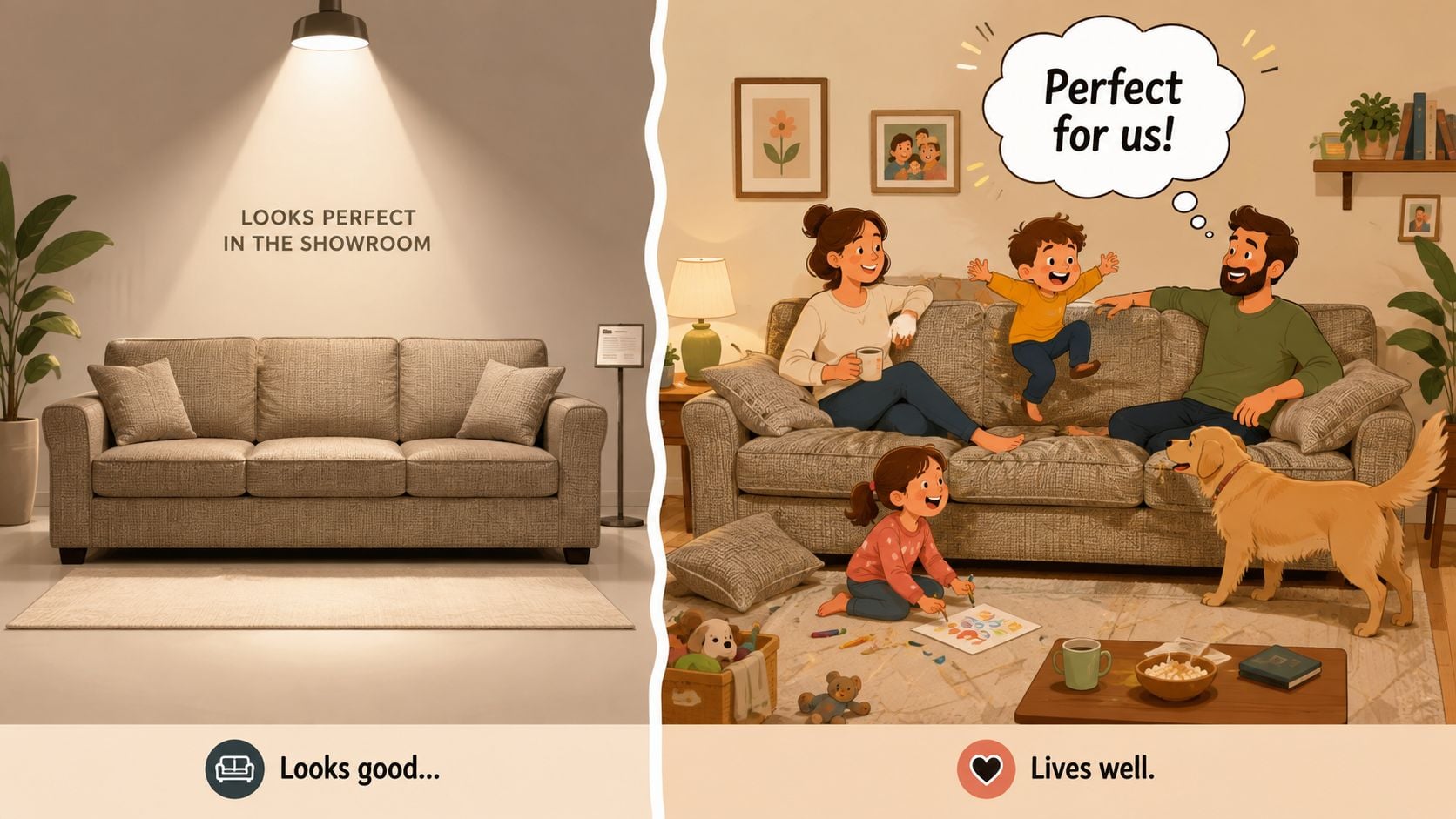
A couch that feels perfect in the showroom can still be the wrong fit at home. The fabric has to suit the way the room gets used, and that means balancing comfort, upkeep, and appearance instead of chasing one quality alone. A neighbor shopping for a reading chair and a family shopping for a main sofa are solving different problems, even if the furniture style looks similar.
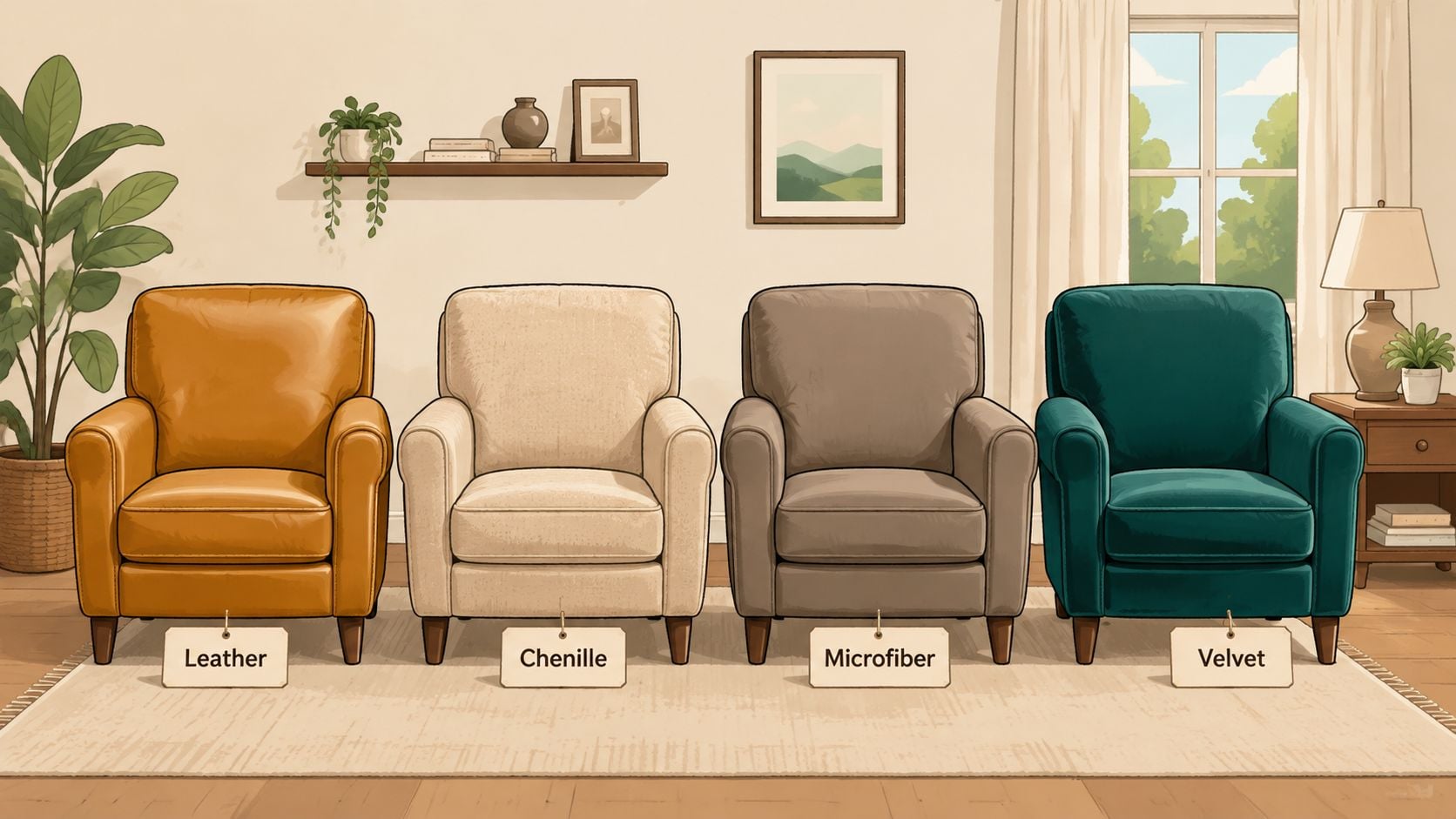
Leather is a practical choice in rooms where easy wipe-down care and long service matter most. Top-grain leather usually has a smooth hand and develops character with use, so the surface can age in a way that feels settled rather than worn out. In a family room that sees daily traffic, that kind of wear pattern often works well.
Performance polyester blends fit homes that need durability without giving up design range. These fabrics are often made for better color retention and easier cleaning, which helps in family spaces, rental settings, and everyday seating. They are useful when furniture has to look polished and hold up to regular use at the same time.
Where natural fibers shine
Wool brings warmth, spring, and a refined surface, but it usually belongs in rooms with lower to moderate traffic. Cotton and linen feel breathable and relaxed, with a natural look that suits calmer spaces, though they ask more from the owner in daily care. Velvet can work well as upholstery when it is made in a true upholstery-grade construction with an adequate rub count, because the pile adds depth without automatically sacrificing performance.
The broader market reflects how often shoppers are treating fabric as a real design and wear decision. One report values the global category at USD 46.2 billion in 2023 and projects USD 65.75 billion by 2032 at 4% CAGR (global upholstery fabric market). That same growth story shows up in the furniture segment too, which is estimated at USD 6.12 billion in 2025 and projected to reach USD 9.01 billion by 2032 at roughly 5.67% CAGR. Those numbers point to a simple reality, more people are choosing upholstery fabric as both a style decision and a performance decision.
For shoppers comparing sofa fabrics in one place, Tyner's best fabric for sofa upholstery guide gives a clear way to sort through the tradeoffs. It is also helpful to compare fabric choices against real routines, including housekeeping, pets, and even the kind of wear that shows up in keeping gym uniforms vibrant.
Matching Fabric to Your Real-Life Household
A fabric can look elegant on the floor and still fail the household that has to live with it. That's the mistake most buyers make, they choose by appearance first and only later realize the room has very different needs. The smarter move is to match fabric to the way the home functions.
A busy household with children or pets usually benefits from a higher-performing textile, especially on sofas, sectionals, and recliners that get daily use. A light-colored performance fabric with stronger abrasion resistance and a stain-friendly finish is often a far safer bet than a delicate natural fiber that would demand constant attention. In a sunlit living room, the lightfastness factor becomes even more important because fading can change the look of the entire space.
Different rooms, different rules
A formal dining room or an occasional-use bedroom chair can support a lower-duty fabric if the visual finish is the priority. That doesn't mean lowering standards, it means using the piece the way it will be used. A home office has a different pressure point again, because sitting, standing, and sliding in and out of the chair create a different kind of wear.
Custom upholstery has become more central to how many people buy seating. Furniture Today reported that custom orders rose to 26% of recliner sales and 21% of motion-sofa sales, up from 20% and 17% two years earlier, while custom orders for stationary sofas fell to 47% from 63% in 2018 (Furniture Today research and analysis). That shift makes sense, because shoppers want furniture to fit their routines, not force their routines to fit the furniture.
A good fabric choice solves a real household problem. It doesn't just make the room look finished.
The best way to think about it is by use pattern. A sofa that sees snacks, pets, and daily lounging needs a different spec than one used mostly for guests. When a buyer starts with the household, the fabric choice becomes much easier.
Protecting and Maintaining Your Custom Upholstery
The right fabric is only the first part of the investment. Good care keeps the piece looking and feeling right long after the first season of use, and most of that care is simple enough to become routine. The key is matching the maintenance to the material instead of treating every fabric the same way.
For leather, regular conditioning helps prevent drying and cracking while keeping the surface supple. For performance textiles and synthetic blends, a low-suction vacuum each week clears away dust before it settles into the fibers. Most of these fabrics handle spot cleaning with mild detergent and a damp cloth, but any cleaner should be tested in an inconspicuous area first.
Care habits that protect the finish
Natural fibers like wool and cotton often benefit from professional cleaning at longer intervals, rather than frequent home treatment that can be too aggressive. Across all upholstery, rotating and fluffing cushions helps spread wear evenly. Prompt spill response matters too, because blotting keeps fibers from matting and helps stains stay on the surface instead of setting deeper.
Sunlight is another quiet threat. Moving furniture away from direct exposure helps reduce fading, and protective treatments made for the specific fabric can add another layer of defense. For a seasonal checklist that keeps those habits from slipping, Tyner's fall furniture maintenance checklist gives a useful rhythm for the year.
A broader wellness question comes up here too. Shoppers who care about stain routines for clothing and household textiles sometimes look for guidance on preserving color after cleaning, and a useful read on keeping gym uniforms vibrant can make the point that test-first, fabric-specific care habits matter well beyond the sofa.
Care shortcut: The fastest way to shorten upholstery life is to clean it like a one-size-fits-all textile. Fabric-specific care always wins.
The aim isn't to make owners baby their furniture. It's to make maintenance easy enough that the piece stays beautiful without becoming a burden.
Creating Your Custom Piece at Tyner Furniture
Once a buyer understands fabric performance, the custom process gets a lot less intimidating. That matters in a place like Ann Arbor, where shoppers want informed guidance without pressure. Since 1957, Tyner Furniture has served Southeast Michigan with a focus on longevity, craftsmanship, and made-to-order choices that fit real homes.
The first step is usually simpler than people expect. Bring the room size, the way the furniture will be used, and the style direction, then let the showroom conversation narrow the options. The South State St. showroom gives shoppers a place to feel the difference between fabrics, compare finishes, and make sure the seating feels right before an order is placed.
What made-to-order opens up
Tyner's custom programs let shoppers move past the limits of in-stock selection. That includes custom finishes, fabrics, and configurations across seating, plus Canadel dining options and Stressless seating with ergonomic sizing that supports a more personalized fit. For bedroom and dining pieces, the conversation shifts to the solid wood standard, where Tyner's Amish hand-crafted furniture emphasizes joinery and material integrity over mass-produced shortcuts.
Some shoppers need a little more confidence before making a bigger purchase. That's where Special Financing and the Low Price Promise help lower the barrier without changing the quality standard. A custom piece can still be a practical decision when the cost is viewed over years of use, not just at checkout.
For readers who want to understand the process in more depth, Tyner's custom upholstery services page is a useful starting point. And for anyone who enjoys the hands-on side of making things, a sewing course for new quilters can be a helpful reminder that good materials and careful construction always matter, whether the project is a cushion seam or an entire room.
When the decision is finally ready, the next step is tactile, not theoretical. Sit on the pieces, feel the fabric, and compare how each sample looks in real light. Browse the online Quick Specs for special orders, then come into the Ann Arbor showroom for a sit test and a conversation that connects the numbers to the way the home lives.
Tyner Furniture helps shoppers in Ann Arbor and Southeast Michigan choose custom upholstery fabric, made-to-order seating, and heirloom-quality furniture that fits real life. Visit Tyner Furniture to browse Quick Specs for special orders, then stop by the South State St. showroom for a sit test and a closer look at the fabrics, finishes, and configurations that can make a piece last.