Sterling Heights Furniture Stores: A Local Buyer’s Guide

A Saturday in Sterling Heights can turn into a long loop fast. One minute the search starts near Lakeside Circle, then it spills over to Hall Road, then down Schoenherr, and by the end the cart is still empty while the questions keep piling up. That's the problem with sterling heights furniture stores, there are plenty of places to look, but very little guidance on what holds up after the truck leaves.
Sterling Heights didn't become a major shopping market by accident. The city was officially incorporated in 1968, after earlier milestones in 1818, 1827, and 1838, and its modern consumer base grew with postwar suburban expansion in Macomb County, especially as auto-industry workers settled there. By the 2000s, Sterling Heights had become the fourth largest city in Michigan (Sterling Heights history), which is exactly why furniture retailers keep planting showrooms here instead of treating it like a sleepy local strip.
The right way to shop this market is to stop asking, “Which store is closest?” and start asking, “Which format fits the project?” That shift matters whether the goal is a dining set, a recliner, a bedroom refresh, or a home office that won't feel tired in two years. The smarter buyer uses the local density as an advantage, then filters by construction, service depth, and cost-per-year value.
Why Shopping for Furniture in Sterling Heights Feels Overwhelming
A Sterling Heights shopper can do everything right and still leave frustrated. The showrooms are close together, the corridors are busy, and every stop seems to promise the same thing, until the customer starts comparing details and realizes the differences aren't obvious at all. That's what makes the local furniture hunt exhausting, not lack of choice, but too much choice without a clean way to sort it.
The city's retail pattern explains the confusion. Lakeside Mall opened in Sterling Heights on March 2, 1976 with four anchor stores and added a fifth anchor in 1978, helping establish the area as a regional shopping destination for Southeast Michigan (Lakeside history and local retail context). The modern furniture scene still reflects that mall-era logic, with showroom addresses clustered around Lakeside Circle and other auto-oriented corridors built for stop-and-go comparison shopping.
The market is dense, but density doesn't equal clarity
That density is visible in the store clusters around Hall Road, Schoenherr, Van Dyke, and Hayes. Retailers line up close enough that a shopper can test a chair, check a finish, and still make another stop before lunch. The downside is obvious. A directory-style search tells a person where stores are, not which one gives the best advice, the best build, or the best support after delivery.
Practical rule: if two stores sell a similar-looking sofa, the better store is the one that can explain the frame, the fabric, the delivery method, and the repair path without hesitation.
The market is also crowded enough to reward a more disciplined approach. The Better Business Bureau's Sterling Heights furniture category shows 28,864 results for furniture stores near Sterling Heights, and even the accredited-furniture subset still lists 197 results. That kind of competition means shoppers shouldn't rely on location alone. They should use the showroom as a test bench and the buying decision as a long-term investment.
A better shopping framework starts with three questions. What room is being furnished. How long does the piece need to last. What kind of help is needed with fit, delivery, or customization. Those answers cut through the noise faster than any flat list of store names ever will.
The Four Types of Furniture Stores Near Sterling Heights

Sterling Heights furniture shopping breaks into four basic formats, and each one solves a different problem. Treating them as interchangeable usually leads to the wrong kind of compromise, either paying too much for a basic floor model or settling for a piece that will not hold up. The smarter move is to match the store type to the room, the timeline, and the level of service you expect.
Big-format showrooms and mall anchors
Large-format showroom retailers such as those at Lakeside Mall show the value of a broad display floor. They work well for shoppers who want to compare style families, sit on multiple pieces in one trip, and keep the process straightforward. The trade-off is that a polished showroom can hide weak specification depth, so the buyer still needs to press on frame construction, fabric options, delivery terms, and service after the sale. The local store listings at local store listings are a reminder that convenience is easy to find, but convenience alone does not tell you whether the piece is worth keeping.
Regional chains
Regional specialty chains serve a narrower lane. They usually do well with seating or sleep, offer familiar product lines, and make it easy to compare models without a lot of guesswork. That predictability helps a buyer who already knows the category and wants a straightforward purchase path. It matters less when the room needs a specific configuration, a less common finish, or support that goes beyond the standard floor model.
Specialty Amish and direct-from-craftsmen showrooms
A local Amish furniture showroom on Hall Road shows how solid-wood, made-to-order work has a real place in this market. Its Hall Road presence proves that custom furniture has a real foothold in the local market. For shoppers trying to judge that kind of service model, the same discipline used in vetting fence installers properly applies here, because the brochure is never the whole story and the details separate careful craftsmanship from talk.
Made-to-order design hubs
A made-to-order hub like Tyner in Ann Arbor serves a different buyer. It helps when finish choices matter, the layout is awkward, or the room calls for a piece that fits the space instead of forcing the space around the piece. For shoppers who want to understand how broader interior projects get managed, Tyner's home interior companies resource gives useful context on the kind of planning that supports a custom order. In-stock inventory is fine for quick needs, but specification depth wins when the goal is long-term value, exact fit, and a result that holds up for years.
What to Look for in Materials and Craftsmanship
Furniture can look expensive and still be built lightly. Sterling Heights shoppers need to trust their hands more than the sales floor styling. If a piece is going to anchor a dining room, bedroom, or office for years, the inspection has to go beyond color and upholstery.
Start with the wood and the joints
Solid wood feels different the moment it's lifted. It has weight, steadiness, and a kind of density that veneer-covered composites rarely fake for long. On dining and bedroom pieces, look for the grain running through the entire part, not just across a surface layer, and ask how the corners are joined. Dovetail and mortise-and-tenon joinery tell a different story than stapled or heavily camouflaged fast assembly.
The same rule applies to drawers. A drawer that glides cleanly and closes with a solid feel usually signals better build quality than one that rattles or flexes. The simple drawer test catches more problems than fancy language ever will.
Practical rule: if the drawer side, back, and bottom all feel substantial, the piece is probably meant to last. If the frame sounds hollow, keep walking.
For a deeper wood guide, Tyner's explanation of hardwood selection at wood furniture choices for longevity and style is worth a look before shopping a bedroom or dining set.
Feel the upholstery, not just the pattern
Leather and fabric need separate checks. Top-grain leather has a buttery, natural feel that bonded materials can't really match. Fabric should look tight at the seams, aligned at the corners, and cleanly finished under pressure points where arms, backs, or cushions will take repeated use.
A chair or sofa should also tell the truth under load. Seat support matters, whether that comes from eight-way hand-tied construction, sinuous-wire support, or another frame system. The buyer doesn't need jargon for its own sake, just a clear sense of whether the suspension feels firm, even, and consistent.
Use the showroom like a lab
A single afternoon can reveal a lot. Sit, stand, open, close, and inspect. Run a hand along seams, check for wobble, and look underneath whenever the sales staff allows it.
- Wood Species: Ask whether the piece is solid wood, veneer, or a mix, then look for grain continuity.
- Joinery: Check for dovetails in drawers and solid corner construction in tables and case goods.
- Support: Press into the seat and edge, then judge whether the support feels even.
- Upholstery: Inspect stitching, seams, and the way fabric wraps corners.
- Finish: Look for consistent stain, smooth edges, and no rough patches where hands will touch most.
That's where heirloom furniture separates itself from the pieces that only look good under showroom lighting. A shopper who can feel the material difference in person usually makes a better decision than one chasing style photos alone.
Custom Orders Versus In-Stock Purchases
A showroom floor can make in-stock furniture look like the easy answer. The piece is sitting there, the price is plain, and the buyer can picture it in the house without waiting around. Custom order furniture asks for patience, but it solves room-fit, style, and comfort problems that floor models usually leave untouched.
The trade-off is speed versus fit
In-stock pieces work best when the room is standard, the dimensions are easy, and the shopper can live with the exact finish that happens to be on the floor. That path is efficient, but it also tempts people into settling. A made-to-order piece takes longer, yet it gives control over fabric, finish, size, and configuration, which lowers the odds of bringing home something that stays almost right and never quite fits.
For anyone weighing upholstered furniture against a retail-only option, custom upholstery vs retail furniture gives a clear way to judge the difference in finish and fit.
Why customization matters in real homes
Custom dining programs and ergonomic seating lines show why in-stock is only the starting point. Finishes, fabrics, leg styles, dimensions, and seating scale can decide whether a piece belongs in the room or fights the layout. That matters most in homes where the dining area pulls double duty or the living room has limited clearance.
A specialty showroom can offer that same logic through other lines as well. The documented presence of Amish furniture showrooms on Hall Road shows that custom thinking has a real foothold in the local market, not just an online one. The point is simple. Some buyers only need something ready today, while others need a piece built around a room, a body, or a daily routine. Custom work solves specific spatial and comfort problems with less compromise.
| Factor | In-Stock Showroom | Made-to-Order |
|---|---|---|
| Speed | Faster, because the piece is already built | Slower, because it's built to spec |
| Fit | Depends on what's on the floor | Better for tricky dimensions |
| Finish choice | Limited | Broader selection |
| Comfort tuning | Fixed | Better for ergonomics and sizing |
| Risk of settling | Higher | Lower |
When custom earns the wait
Custom makes sense when the room is expensive to get wrong. A dining set that blocks a walkway, a sofa that overwhelms the wall, or a recliner that misses the body's proportions will bother the household every single day. A made-to-order order can cost more attention up front, but it usually saves frustration later.
Tyner's custom order guide is a straightforward place to start if you want to see how that process works in practice.
How Financing and Delivery Work
The back office matters more than most directory pages admit. A strong furniture purchase can still go sideways if the payment terms are unclear, the delivery method does not match the building, or the setup assumptions are wrong. Sterling Heights shoppers should ask those questions before the receipt prints.
Financing should lower stress, not hide the math
Special financing can make a higher-quality piece easier to bring home, especially when the buyer wants to spread payments out instead of draining savings at once. The point is to read the terms closely, because promotional no-interest periods and other offers are subject to credit approval. That is the baseline rule.
A Low Price Promise also matters in a competitive market like this one. It gives the shopper a reason to compare calmly without assuming higher quality always means unchallenged pricing. Used well, financing and price protection reduce the friction around a long-term purchase without encouraging a careless one. If you want to see how the numbers are presented before you commit, start with Tyner's financing information.
Delivery is not one thing
Threshold delivery, white-glove delivery, and in-home assembly solve different problems. Threshold delivery gets the piece to the door or garage area. White-glove delivery goes further, carrying the furniture inside and often placing it where it belongs. In-home assembly is what turns a pile of parts into a usable room.
That distinction matters because furniture is a low-frequency, high-transport-cost purchase. If a size is wrong or a fit is off, the cost of remaking, redelivering, or rearranging rises quickly. Good shops spell out delivery before the payment plan, not after it.
Ask who carries the piece, where it gets placed, and what happens if the stairwell, doorway, or landing turns out to be tighter than expected.
For shoppers comparing options across living room, bedroom, home office, or reclining furniture categories, those details are worth checking before finalizing the order.
The In-Store Checklist Every Shopper Should Run
A good showroom visit doesn't need drama. It needs a repeatable script that keeps the shopper focused on fit, comfort, and construction instead of getting distracted by styling. The best questions are polite, direct, and easy for any real salesperson to answer.
Run the physical tests first
The sit test should be honest, not ceremonial. Thirty seconds is enough to tell whether a sofa, chair, or recliner supports the body in a way that feels natural. Tables need the wobble test, because a dining table that shifts under pressure will annoy the household for years. Drawers should glide smoothly and close cleanly without scraping.
Upholstery deserves a close look under bright showroom lights. Seams should stay straight, stitching should be even, and the fabric should meet corners without puckering. If the piece includes cushions, press them down and judge whether they recover cleanly or collapse too easily.
Ask questions that reveal the build
A shopper doesn't need to sound technical to get useful answers. Clear questions are better than vague compliments.
- Frame Construction: What is the frame made from, and where are the stress points reinforced?
- Warranty Terms: What does the warranty cover, and for how long?
- Return Policy: What happens if the piece arrives and the fit is wrong?
- Custom Options: Can the fabric, finish, or size be adjusted before ordering?
- Delivery Details: Does the team place, assemble, or remove packaging after setup?
Treat every answer as part of the value
Those questions protect against buyer's remorse. They also make it easier to compare a showroom piece on Lakeside Circle with a made-to-order option in Ann Arbor or anywhere else a long-term furniture shopper might travel. The point isn't to interrogate staff. The point is to buy with enough confidence that the room doesn't need a second round of corrections.
For a concise guide to smarter showroom behavior, Tyner's furniture shopping do's and don'ts is a solid reference before the next store visit.
Why Cost-Per-Year Beats Sticker Price in 2026
Sticker price tells only part of the story. In a market where households are staying put longer and furniture demand can be uneven, the smarter buyer looks at how long a piece will serve the home instead of how low the tag looks on day one. That's especially true for dining, bedroom, and seating pieces that get daily use.
The math is simple when the build is right
A solid-wood dining set that lasts for decades spreads its cost across many years of use. A lighter piece that needs replacing sooner looks fine on paper until delivery, disposal, and the time spent shopping again get added back in. The more often a household has to revisit the same purchase, the worse the value becomes.
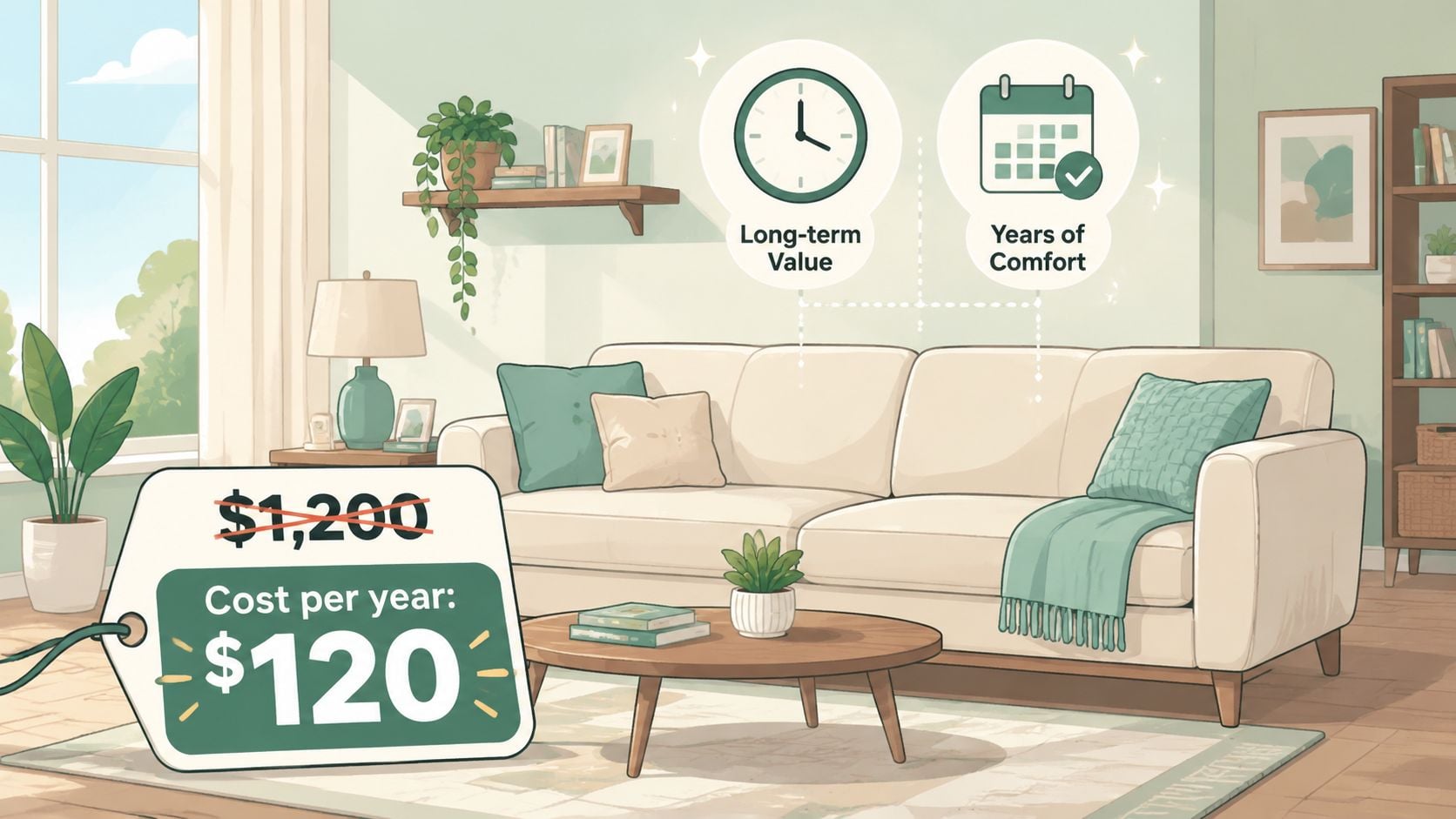
The better framework is cost-per-year. A piece built with stronger materials, better joinery, and a smarter fit can feel more expensive at the register and still be the sounder purchase over time. That's why solid wood, durable upholstery, and ergonomic construction keep coming back to the front of the conversation.
The current market rewards patience
The local shopping mindset should reflect that longer-horizon reality. Retail furniture demand doesn't always move smoothly, and buyers have become more careful about value, especially when home upgrades matter more than moving into a fully furnished new house. The result is a cleaner filter for shoppers, spend where the piece will get used hard and skip the shortcuts that create replacement cycles.
Value check: if a piece feels like a stopgap, the price is already too high, even if the sticker looks reasonable.
That's the reason long-term value beats bargain hunting in 2026. A household that buys once and buys well usually spends less energy, less frustration, and less money over the life of the room.
When the Ann Arbor Drive Is Worth It
Some Sterling Heights shoppers should stay close to home. Others should make the drive to Ann Arbor without overthinking it. The trip pays off when the room needs made-to-order upholstery, configurable Canadel dining, size-specific Stressless seating, or heirloom-quality Amish pieces built with the kind of solid wood and joinery that mass-market floors don't usually match on specification depth.
That's where a long local legacy matters. Tyner Furniture has served Southeast Michigan since 1957, and the business has built around more than one category. The selection spans everything from Home Office to Outdoor Spaces, which matters for households trying to furnish several rooms with one consistent standard of quality. For shoppers who care about Bespoke, Ergonomic, Hand-crafted, and Sustainable choices, that breadth is convenience.
The distance gap also shrinks when delivery and setup are handled properly. White-glove service, special order support, and clear product guidance make the Ann Arbor stop feel less like a detour and more like a better version of the same shopping day. The buyer gets the room fit, the material choices, and the confidence that comes with a true sit test instead of a guess.
If the goal is lasting comfort, not just a quick haul home, the smart move is to look past the nearest floor model and compare the long-term fit. Visit the Ann Arbor showroom for a sit test, or browse the online Quick Specs for special orders before settling on the next piece.
Tyner Furniture helps Southeast Michigan shoppers compare custom upholstery, Amish hand-crafted solid wood, ergonomic seating, and coordinated pieces for the rooms that matter most. For Sterling Heights furniture shoppers who care about long-term value, the Ann Arbor showroom and online Quick Specs make it easier to choose with confidence. Visit Tyner Furniture to plan a made-to-order piece, check special order details, and see what fits your home best.