Discover Quality Bedroom Furniture: Lasting Pieces for Your


A lot of shoppers arrive at the bedroom category after one frustrating lesson. A drawer starts sticking. A nightstand loosens at the corners. A bed frame that looked fine online starts making noise after a move. The room still needs to function every day, but the furniture already feels tired.
That's why quality bedroom furniture deserves a slower, more informed look. In Ann Arbor and across Southeast Michigan, many households aren't just buying for this season. They're furnishing first homes, growing families' spaces, and long-term homes. Since 1957, local furniture guidance has mattered because the wrong shortcut often costs more than it first appears.
Table of Contents
- Beyond the Price Tag Why True Quality Matters
- The Anatomy of Heirloom Furniture A Checklist
- Solid Wood and Master Joinery The Foundation of Durability
- Investing in a Legacy The Amish Hand-Crafted Difference
- Bespoke for Your Bedroom Custom and Ergonomic Solutions
- Your Showroom Guide A Hands-On Shopping Plan
- Protecting Your Investment Care Tips for a Lifetime of Use
Beyond the Price Tag Why True Quality Matters
The biggest mistake in bedroom shopping is treating the lowest ticket as the lowest cost. It often isn't. A dresser that needs replacing in a few years can end up costing more, and causing more aggravation, than a well-built piece that keeps working through moves, seasons, and style changes.
That's where cost-per-year becomes a smarter lens. A hand-crafted chest that stays square, opens smoothly, and still looks handsome years later can be a better value than a lower upfront purchase that quickly lands on a replacement list. Quality bedroom furniture is less about paying more and more about paying once with purpose.
Many shoppers know what they like visually, but they don't always know how to verify what's under the finish. A 2024 industry report found that 72% of consumers can't identify solid hardwood construction versus engineered veneer without expert assistance, which helps explain why so many careful buyers still feel uncertain in the showroom or online (Design News Now consumer bedroom furniture research).
A better question than What does it cost
Instead of asking only, “What's the price?”, it helps to ask:
- How long should this piece last?
- Can it handle everyday use without loosening or wobbling?
- Will the finish and material age well in a real bedroom?
- Can the buyer inspect the craftsmanship in person?
Practical rule: If a bedroom piece will be touched every day, opened every morning, or trusted every night, longevity matters more than the sale tag.
A calm, functional bedroom also depends on more than furniture alone. For readers building a restful space from the ground up, Protect-A-Bed for a calm bedroom offers useful ideas on creating a sleep-friendly environment around the bed itself.
For shoppers who want to get familiar with dependable makers before stepping into a store, this guide to high-quality furniture brands is a helpful starting point.
The Anatomy of Heirloom Furniture A Checklist
“Heirloom quality” sounds lofty until it gets broken into visible details. In practice, shoppers can evaluate bedroom furniture by checking a handful of clues that reveal whether a piece was built for daily life or built mainly to hit a price point.
Why shoppers get tripped up
Bedroom furniture often looks similar from across the room. A chest can have a rich stain, clean lines, and stylish hardware while still hiding weaker construction. That's why it helps to judge quality in layers, not from the finish alone.
One useful framework is the familiar tier system. Premium bedroom furniture is often categorized into tiers: “Best” features heirloom-quality solid hardwoods and handcrafted frames, “Better” uses solid wood with quality hardware, and “Good” relies on composite woods and basic mechanics for the lowest price rather than longevity.
The four checkpoints
Materials
Solid hardwood usually feels substantial in the hand. It has visible grain variation and honest weight. Composite-heavy construction often feels lighter and less substantial, especially in larger case pieces.Construction
Corners should look intentional, not hurried. Drawers should open steadily and align cleanly when closed. The case should sit firmly without rocking.Finish
A good finish feels smooth, not plasticky. The wood should still have character beneath the stain, whether the look is warm cherry, classic oak, or clean maple.Hardware
Pulls should feel secure. Drawer movement should be controlled, not jerky. Better mechanics usually reveal themselves in the first few seconds of use.
| Feature | Heirloom Quality (e.g., Amish) | Mass-Produced 'Fast Furniture' |
|---|---|---|
| Wood body | Solid hardwood with visible grain | Veneer or composite-heavy panels |
| Joinery | Hand-crafted joinery and reinforced construction | Stapled, glued, or simplified connections |
| Drawers | Smooth movement, clean alignment, full feel | Light action, uneven tracking, misalignment |
| Finish | Rich, hand-finished look with depth | Uniform surface that can mask lower-grade materials |
| Long-term value | Built with cost-per-year in mind | Often chosen for short-term price |
Quality becomes easier to spot when shoppers stop asking whether a piece is stylish and start asking whether it is mechanically convincing.
Readers who want a clearer sense of species, grain, and wear characteristics can use this wood furniture guide on choosing hardwood for longevity and style before visiting a showroom.
Solid Wood and Master Joinery The Foundation of Durability
A bedroom set can look polished under showroom lights and still fail the ultimate test. This ultimate test comes five winters later, after drawers have been opened thousands of times, the bed has been moved for cleaning, and the dresser still needs to sit square on the floor.
Why solid wood feels different
Solid wood has a steadiness you can feel with your hands. Cherry, oak, and maple carry natural density and structure, so the piece feels grounded instead of hollow. In a bedroom, that often shows up as less sway in a tall chest, more confidence in a bed frame, and fewer signs of fatigue as the years pass.
That matters for cost per year. A dresser that serves a household for decades often costs less per year than a cheaper piece that needs replacement after a short run. Families shopping in Southeast Michigan often discover this in person. One afternoon in the showroom can teach more than a dozen product listings because your hand can feel the difference between surface polish and real substance.
What joinery actually does
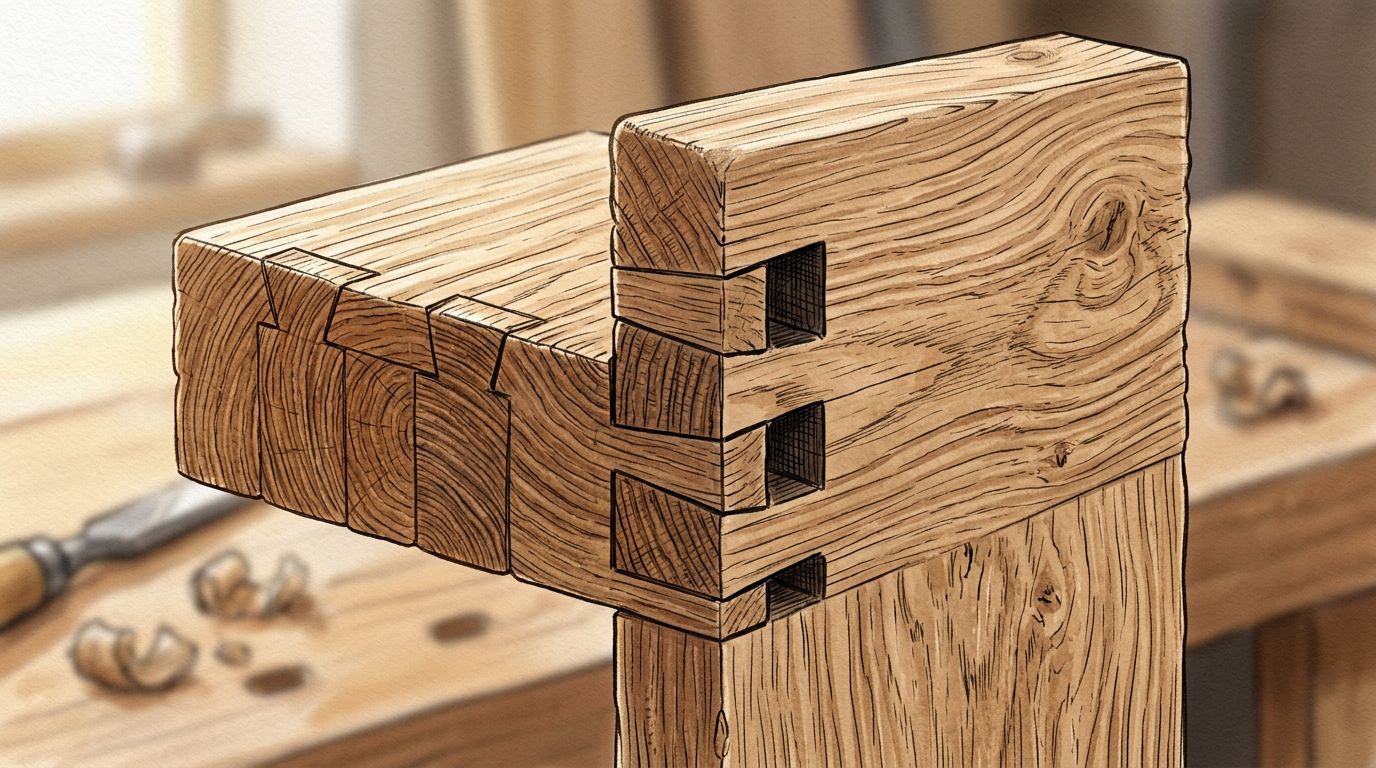
Joinery holds the piece together where stress collects. Corners, rails, drawer boxes, and bed connections all rely on it. If wood is the body, joinery is the skeleton.
A dovetail joint works like interlocked wedges that resist being pulled apart. A mortise-and-tenon joint fits one shaped wood member into a matching opening, which gives the connection mechanical strength before glue even enters the picture. The Wood Handbook published by the U.S. Forest Service explains that joint design and wood-to-wood fit strongly affect how well furniture connections handle repeated use and load over time (U.S. Forest Service Wood Handbook).
That is why good joinery tends to age gracefully. Drawers stay square. Bed rails stay firm. Case pieces are less likely to develop the twisted, loose feeling shoppers often notice in lower-grade construction after a few years of use.
At Tyner, where families around Ann Arbor have been testing furniture in person since 1957, this is one of the easiest quality checks to teach. You do not need woodworking training. You need a few simple habits and a willingness to slow down.
- Look underneath and inside. Drawer sides and interior corners often reveal more than the outside finish.
- Check for fitted joints. Joinery should look clean and intentional, not hurried or heavily filled.
- Press lightly on the case. A well-built piece should feel settled and composed.
- Notice how parts meet. Tight alignment at corners usually signals better workmanship throughout the piece.
Heirloom quality usually speaks through fit, silence, and staying power.
For readers who want a clearer picture of how American-made solid wood furniture is built for long-term use, that guide adds helpful background before an in-store visit.
Investing in a Legacy The Amish Hand-Crafted Difference
Quality bedroom furniture becomes more meaningful when craftsmanship has a clear origin. Amish hand-crafted furniture stands out because the value isn't limited to appearance. It shows up in the build method, the material honesty, and the made-to-order discipline that many mass-market pieces don't offer.

Built to order, not pulled from a pile
Amish bedroom furniture is often hand-crafted from solid North American hardwoods such as cherry, oak, and maple. Buyers can usually choose wood species and stain, which changes the relationship to the furniture. It becomes made-to-order, not merely selected.
That matters for households building a forever bedroom. The goal isn't just to fill a room. The goal is to create a space with pieces that feel settled, substantial, and personal. The grain pattern, the finish depth, and the steady movement of each drawer all support that sense of permanence.
Expert craftsmanship, especially dovetail and mortise-and-tenon joints, is identified as a primary indicator that a piece is built to last for generations. That preference for longevity also aligns with broader market behavior. The global bedroom furniture market was valued at USD 266.15 billion in 2025 and is projected to reach USD 383.12 billion by 2030 at a 6.5% CAGR (Grand View Research bedroom furniture market analysis).
A sustainable value story
There's also a practical sustainability argument here. A dresser that moves from one home to the next is a very different purchase from one that's replaced after a short ownership cycle. Durable furniture reduces repeat buying, repeated delivery, and the weariness that comes from furnishing the same room twice.
In Southeast Michigan, shoppers looking for that kind of local legacy often explore Amish furniture options in Michigan to compare woods, finishes, and case piece designs before they buy.
Bespoke for Your Bedroom Custom and Ergonomic Solutions
A bedroom usually shows its weaknesses at the end of a long day. The dresser top feels crowded. The nightstand sits a little too low. The reading chair looks good in the corner but never quite feels right once you sit down. Those small mismatches add up, and they often explain why a room feels unfinished even after the furniture arrives.

Customization starts after the floor sample
A showroom sample is a starting point, not the whole decision. In a long-established Ann Arbor store, shoppers often learn that the visible piece can represent a wider made-to-order program with choices for wood tone, finish, hardware, fabric, scale, and storage layout.
That matters because a bedroom has to work like a well-fitted coat. The overall style may be right, but the fit still decides whether you reach for it every day. A chest that is two drawers taller, a warmer stain, or a different pull can change how the room functions and how settled it feels.
Tyner Furniture helps shoppers review special-order options before they buy, which is especially useful for households trying to match an existing bed, solve a spacing problem, or furnish a primary bedroom with long-term use in mind. That local guidance has real value. Since 1957, the advantage of shopping close to home has never been just selection. It has been the chance to ask better questions, compare samples in person, and order with more confidence.
Ergonomic comfort belongs in the quality conversation
Bedroom furniture is not limited to the bed and dresser. Many rooms include a reading spot, a bench, a vanity seat, or a nearby chair for putting on shoes and starting the day slowly. In those pieces, comfort should fit the body as carefully as finish fits the room.
Seat depth, back support, arm height, and overall scale all shape whether a chair becomes part of daily life or turns into decoration. A well-sized ergonomic seat supports you the way a good mattress supports sleep. You notice it less because your body stops working around it.
Materials matter here too. Supple top-grain leather, supportive cushioning, and a frame proportioned for the person using it can improve a morning routine and a nighttime routine in practical ways. Comfort is part of quality because furniture that feels right gets used, and furniture that gets used well earns its place over many years.
That is also where cost per year becomes a useful test. A custom bedroom bench or properly sized chair may cost more upfront, but if it serves you comfortably for fifteen or twenty years, the annual cost can be lower than replacing a cheaper piece every few years. That is the same logic many Southeast Michigan families use when they shop for furniture they expect to keep, not just tolerate.
For readers planning a calmer room around furniture, color, lighting, and texture, REM-Fit's soothing bedroom guide offers practical ideas.
A thoughtful furniture store should also help you coordinate beyond a single purchase. Bedroom choices often connect to nearby spaces such as a dressing area, reading nook, or home office, and seeing those relationships in person can make the final room feel intentional rather than assembled piece by piece.
Your Showroom Guide A Hands-On Shopping Plan
Furniture still rewards in-person shopping. That's especially true for bedroom pieces, where feel, alignment, and comfort can't be fully judged from a product photo. Verified market data shows that offline retail channels account for about 74 to 75% of total furniture revenue because consumers want to physically evaluate comfort, texture, and build quality before making a significant investment (Mordor Intelligence bedroom furniture market report).

In Ann Arbor, that's why a showroom visit still matters. A walk through the South State St. showroom gives shoppers something the internet can't fully supply. Texture, scale, finish depth, and the stance of a piece in space.
What to test in person
- Open every drawer. The movement should feel smooth and steady, not loose or jerky.
- Press lightly on the corners. A well-built case piece should stay settled.
- Notice the wood's weight and grain. Solid wood has presence. It doesn't feel thin or hollow.
- Check the hardware. Pulls should feel firm in the hand, not wobbly.
- Do the sit test. If the room includes upholstered pieces or a bench, comfort needs a real trial.
Bring measurements, wall photos, and a few finish samples from home. Good showroom conversations get easier when the room itself is part of the discussion.
Questions worth asking
A shopper doesn't need technical jargon to ask smart questions. These are enough:
- Is this solid wood, veneer, or a mix?
- What kind of joinery is used?
- Can this be customized in finish or configuration?
- What does special order look like for this piece?
- Are Special Financing and a Low Price Promise available on this selection?
Those last questions matter because accessibility is part of good guidance. High-end pieces can feel more manageable when shoppers understand timing, payment options, and available value protections. That helps turn a long-term purchase into a realistic one.
Protecting Your Investment Care Tips for a Lifetime of Use
Once quality bedroom furniture is in the home, care keeps the investment working. Good construction does the heavy lifting, but daily habits still shape how a piece looks and feels over the years. Hand-crafted wood, durable hardware, and expertly crafted upholstery all benefit from simple, steady attention.
Daily habits that help
- Dust gently and often. A soft dry cloth helps prevent buildup that can dull a finish.
- Keep moisture in check. Bedrooms don't need extreme swings in humidity. Steadier conditions are kinder to wood.
- Use products sparingly. Harsh cleaners can leave residue or wear down protective finishes.
- Lift, don't drag. Moving a chest or nightstand by dragging can stress joints and legs.
- Protect the top surface. Lamps, trays, and everyday items can scratch without felt or soft barriers.
For a deeper maintenance overview focused on prevention, this guide to protecting wood furniture from scratches and stains is a useful companion.
When to call in help
Not every care issue should be handled at home. Upholstered benches, fabric headboards, and accent seating sometimes benefit from professional cleaning, especially when stains set or odors linger. For readers weighing that option, this article on professional upholstery cleaning explains when outside help makes sense.
The real goal of maintenance isn't perfection. It's preserving function, finish, and comfort so the piece still earns its place year after year.
That's the heart of the investment mindset. Quality bedroom furniture should support sleep, storage, and daily routines without demanding replacement on a short cycle. In a community that has valued trustworthy furniture guidance since 1957, that standard still matters.
For shoppers ready to compare woods, test drawer movement, and feel the difference in person, Tyner Furniture offers a practical next step. Visit the Ann Arbor showroom for a sit test, or browse the online Quick Specs for special orders in bedroom, dining, home office, and outdoor spaces.