Solid Wood vs Veneer Furniture: Which Is Worth Buying?

Two dining tables stand three feet apart under the same warm light, and from a normal walking distance they finish in nearly the same cherry tone. One is solid hardwood at an heirloom price. The other is real wood veneer over a plywood core at a friendlier one. A shopper with a tape measure, a paint swatch and a free Saturday has to choose between them, and the paper tags hanging off each won't do the choosing.
That's the honest starting point for any solid wood vs veneer furniture decision. The material name is a beginning, not a verdict. What separates a piece that's still tight in 2050 from one that's wobbling in 2032 is construction, core quality and how the wood answers the moisture inside your house. Here's how to read those signals before money changes hands.
Solid Wood and Veneer at a Glance
Moisture sorts solid wood from veneer before price or finish does. A wide solid board grows and shrinks across the grain as indoor humidity swings through the year, so a skilled maker leaves room for that travel with floating panels or a little slack in the joinery. A veneered panel is usually several thin layers with the grain directions crossed. That cross-layer core holds width more steadily, and swelling stays smaller. Species, thickness, and the joint still decide how much load a shelf or a leg can take. Two engineering problems, two workable answers, and a different fit depending on the room.
I would not trust color alone.
Cherry stain on a solid top and cherry veneer over plywood can match from a normal standing height. The difference shows at a lifted corner, an unfinished back, or the edge where the banding meets the core.
Tyner Furniture has served Southeast Michigan since 1957. The Amish hand-crafted solid wood in the Ann Arbor showroom is built from North American hardwoods such as cherry, oak, and maple, and each piece is fully customizable at order. Veneer carries real commercial weight on its own. The global wood-veneer market was valued at $4.8 billion in 2025, according to Dataintelo's wood-veneers report.
Solid wood vs veneer by key criterion
| Criterion | Solid wood | Well-built veneer |
|---|---|---|
| Moisture response | Expands and contracts across the grain; needs floating or allowance joinery | Lower movement, because the cross-layered core restrains swelling and shrinkage |
| Joinery | Dovetails and mortise-and-tenon visible at edges and corners | Joinery sits in the core and edge banding; quality depends on how the panel is built |
| Upfront cost | Generally higher for the same footprint | Generally lower for the same footprint |
| Cost per year | Falls steadily as service life grows | Depends on core quality and finish; replacement risk is higher if the bond fails |
| Repairability | Can be sanded, refinished and re-glued repeatedly | Surface repair is limited; deep scratches and delamination are hard to hide |
| Core and indoor air | Solid boards, though drawer bottoms and backs may be composite | Plywood, MDF or particleboard core; check formaldehyde compliance |
| Edges and appearance | Grain runs through the whole piece | Grain on the face only; edges show the banding and core |
| Customization | Species, stain and dimensions chosen at order | Veneer species and finish options vary by maker |
Read every row as a question. A seller should be able to answer it, and a buyer can check it with a hand on the drawer or a spec sheet on a screen. Ask how the piece is joined, what sits under the face, and what a chair leg does to a tile floor in year twelve.
How Humidity Moves Solid Wood and Veneer
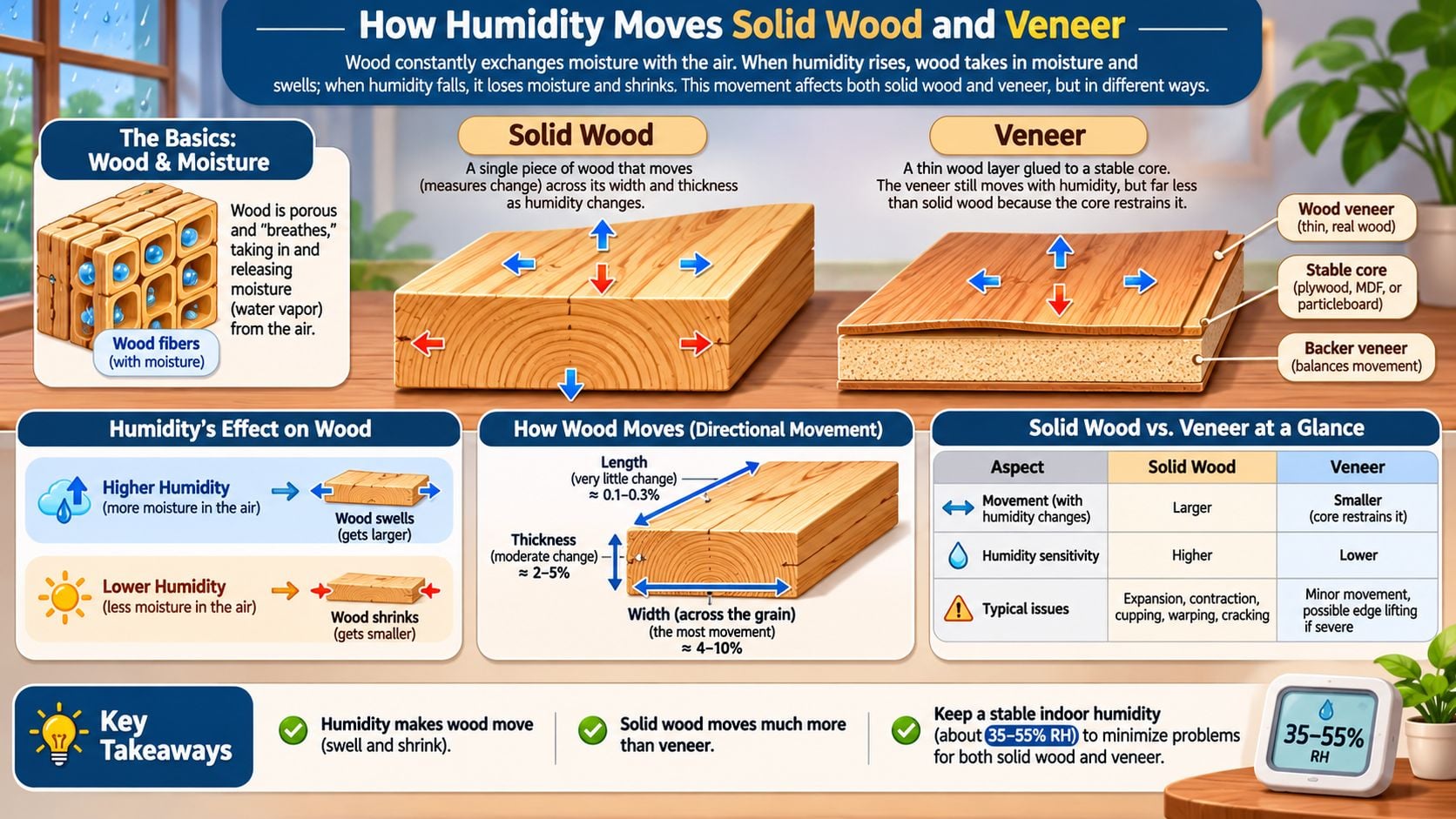
A Southeast Michigan house lives through two different climates every year. Summer air is heavy and humid, and the windows are open. Winter air runs dry through a furnace for five months. Wood answers both. It takes up moisture and swells through the humid stretch, then loses moisture and shrinks when the air dries out.
The infographic below traces that cycle in both directions and shows why a veneered panel and a solid board don't respond the same way.
The number that sizes the problem
Dimensional stability is the engineering distinction that matters most for wide panels. Purdue University Extension reports that a 6-percentage-point moisture-content change in sugar maple can produce approximately 2.5% dimensional change in a furniture component. Two and a half percent sounds harmless until it meets real width.
Run that percentage against a 36-inch-wide solid tabletop and the arithmetic lands near 0.9 inch of movement across the top if the full change took hold. A top glued rigidly to its rails at both ends has nowhere to put that travel, so the wood splits instead. Makers who understand the material solve it with floating panels, elongated fastener holes, breadboard ends and fitted frame-and-panel construction. The grain moves and the piece stays square.
Where veneer panels answer differently
A veneered panel, particularly veneer bonded to cross-laminated plywood, moves substantially less across the face width. The core's alternating grain directions hold seasonal expansion in check, so a 48-inch cabinet side stays close to 48 inches. Broad flat surfaces are natural veneer territory for exactly this reason.
Veneer's failure mode runs through the bond rather than the board. A peer-reviewed study of decorative veneer bonded to MDF found that bond strength varied with both the wood species (beech and oak) and the substrate (regular versus moisture-resistant MDF), as reported in BioResources. When the face and the core respond to humidity at different rates, the panel buckles or the finish cracks.
The rule that follows is simple enough to use in the aisle. Choose solid wood where visible edges, structural members and future refinishing matter. Choose a plywood-core veneer for large cabinet sides, doors and broad tabletops in a house with wide seasonal swings. Judge the core before the face: plywood generally holds screws better and tolerates moisture better than fiberboard, while any core suffers from prolonged wetting or unsealed edges.
Pro-Tip: Put an inexpensive hygrometer in the dining room and hold indoor humidity between 35% and 50% year round. A humidifier set to that band costs far less than a replacement top, and it protects veneer edges, drawer bottoms and solid joints at the same time.
Joinery Checks That Predict Longevity
A loaded drawer that sticks, or a tabletop already cracked along a glued seam, says more about the next twenty years than the species name on the tag. Joinery is how a piece carries load, and a shopper can inspect it by hand in under five minutes.
Seven checks, ordered by how quickly they can be performed on a showroom floor.
- Open a drawer and study the front corners. Dovetails should interlock with no daylight between pins and tails. That mechanical lock resists being pulled apart every time a loaded drawer opens. Staples, nails, or a glued butt corner tell a different story about the price.
- Find a leg-to-rail joint and check the tenon. Mortise-and-tenon construction seats a projecting tenon inside a matching mortise, a broad, aligned connection rather than one that leans on fasteners or adhesive alone. The tenon should fill its mortise, with shoulders meeting flush.
- Ask how the tabletop is attached. A floating top on elongated holes, or breadboard ends, gives the top somewhere to go as it expands. A top glued solid to the rails has no escape route and will crack at the seam.
- Slide a drawer bottom and a back panel. Both should sit in grooves so they can move with the seasons. Panels nailed straight through the face will split once winter air pulls the moisture out.
- Look for short grain near edges and corners. Wood is weakest where the grain runs out at an edge. A thin sliver of short grain snaps under a load that a long-grain section would carry. Thin, run-out corners are where chairs and table aprons fail first.
- On veneer, inspect every exposed core edge. Sealed and banded edges protect the panel. Lifting, bubbling, or a raw particleboard rim gives moisture an entrance and leaves a repair you cannot hide.
- Ask one question out loud. How does this maker allow for seasonal movement, and where can you see it? A confident answer points at a specific joint. A vague one points at the tag.
Pro-Tip: Bring a small flashlight. Raking light across a drawer corner reveals gaps that a straight-on view hides, and it makes veneer lifting visible while the piece is still on the floor.
Amish furniture hand-crafted from solid wood is built for exactly this inspection. The drawers come out, the tops are attached so they can move, and the joints are meant to be looked at. Testing them in person beats trusting a description.
A solid board joined badly can crack or loosen sooner than a well-built veneer panel with a sound core. I would spend those five minutes on the joints before I spent them on the species name. Fit, grain direction at the corners, and a top that is free to move decide how long the piece stays tight.
Indoor Air, Core Materials and Certification
The claim that solid wood is natural and veneer is artificial survives about ten seconds of inspection. The face of a veneered panel is a thin layer of real wood. What sits underneath it, and the adhesive binding the layers together, is what determines how a piece affects indoor air.
The EPA's consumer guidance on formaldehyde standards defines composite wood as wood strands, particles, fibers, veneers or boards bound with adhesives. The regulated categories include hardwood plywood, MDF and particleboard, all of which turn up routinely in furniture. Sorting out solid wood vs engineered wood starts with knowing which of those three is inside the piece.
EPA formaldehyde limits for composite wood
| Composite category | Formaldehyde limit (ppm) | Where it appears in furniture |
|---|---|---|
| Hardwood plywood | 0.05 | Cabinet sides, drawer boxes and veneer cores |
| Particleboard | 0.09 | Shelves and carcass panels in some furniture |
| MDF | 0.11 | Doors, drawer fronts and veneer substrates |
Three questions worth asking
The label on the tag is less useful than three plain questions, and any knowledgeable seller can answer all three without leaving the desk. What is the substrate? Which adhesive system was used? Is the finished product TSCA Title VI compliant?
Compliance has a date behind it. Since March 22, 2024, certain laminated products that put wood veneer over a composite core must be tested and certified as compliant unless exempted. A well-made veneer panel can therefore carry documented emissions compliance, which is more than a slogan can offer.
The blind spot in a solid wood piece
Solid construction isn't automatically composite-free. Drawer bottoms, back panels and shelving are often thinner manufactured sheet goods even in a piece with solid faces and solid rails, so the same compliance question applies to those parts. A buyer who only asks about the visible surface misses the components most likely to contain an adhesive-bound core.
A short inspection list covers it:
- Identify the core: plywood, MDF or particleboard, named plainly by the seller rather than described as "wood."
- Ask for certification: TSCA Title VI compliance for the finished product, not just the raw panel.
- Check the edges: sealed and banded edges keep moisture out of the core and hold the panel together.
- Ventilate after delivery: unpack in a well-aired room and let the piece air out for a few days before it goes into a closed bedroom.
Documented compliance beats a blanket health claim in either direction. A certified veneer panel can be the cleaner answer, and a solid piece with uncertified drawer bottoms isn't.
Environmental Impact of Solid Wood and Veneer
One question rarely makes it onto a showroom tag: what does each option cost the forest? Solid wood uses the full section of a log, so a cherry or oak board carries its grain and its footprint in one piece. Veneer slices that same log into thin sheets, letting one log cover far more panels and stretching a scarce or valuable species across more furniture.
Where the energy goes
Veneer isn't free of impact, and the honest number is an energy number. A U.S. Forest Service life-cycle assessment of laminated veneer lumber, recorded in FAO's reporting on wood-panel production, measured total primary-energy consumption of 9.98 gigajoules per cubic meter in the southeastern United States and 8.97 gigajoules per cubic meter in the Pacific Northwest, with veneer production alone accounting for 75.3% of the northwestern total. Those figures describe structural laminated veneer lumber rather than a finished dining table, so they aren't a shopping comparison. They do show that engineered panels trade lower material use for adhesive and processing energy.
That trade-off is why the whole life cycle matters: core material, adhesive, finish, durability, repairability and service life all sit on the same ledger. Three questions get a shopper most of the way there.
- Which species, and where from? A named North American hardwood with a known source beats an unnamed import every time.
- What is the core, and what bonds it? A plywood core with a documented adhesive system is easier to assess than an unlabeled composite.
- Can it be refinished or repaired rather than replaced? A piece that takes a new finish at year twenty avoids a second manufacturing cycle entirely.
The thinking behind sustainable wood furniture is lifespan, not marketing language. The Amish-built cherry and oak pieces in this showroom are designed to be refinished and handed down, which spreads their manufacturing cost across generations instead of a decade. No material is automatically green, and lifespan plus repairability usually matter more than the species on the label.
What Solid Wood and Veneer Really Cost per Year
The sticker price is the least useful number on the tag. Divide it by the years a piece serves and the comparison usually flips. A $3,000 hand-crafted dining piece that lasts ten years costs $300 a year. The same piece over twenty years costs $150, over thirty years $100, and over fifty years $60.
Cost per year of service by piece and lifespan
| Piece | Years of service | Cost per year |
|---|---|---|
| Hand-crafted solid wood dining piece at $3,000 | 10 years | $300 |
| Hand-crafted solid wood dining piece at $3,000 | 20 years | $150 |
| Hand-crafted solid wood dining piece at $3,000 | 30 years | $100 |
| Hand-crafted solid wood dining piece at $3,000 | 50 years | $60 |
Figures assume regular care and a stable indoor environment. Flip the comparison and the logic holds: a $1,800 veneered piece replaced after eight years costs $225 a year, and it buys another piece and another delivery in the process. How much a table costs depends on species, joinery, finish and size, which is why the annual figure is the one worth carrying out of the store.
Where financing changes the math
Furniture Today's analysis of furniture financing draws the distinction that matters, because "no interest" covers two very different products. A true 0% installment loan specifies the financed amount, the number of payments and the payoff date, with no interest accruing during the promotional period. Deferred-interest financing can accrue interest from the purchase date and waive it only if the entire balance clears by the deadline. Miss that date by even a small amount and the previously accrued interest becomes payable.
On a $3,000 custom dining order, a 12-month true 0% plan runs $250 per month before taxes and fees. The same order on a deferred-interest plan could show no finance charge across those months while building a retroactive obligation.
Special Financing at the Ann Arbor showroom (subject to credit approval) applies to floor models and custom orders alike, and it pairs with a Low Price Promise that keeps the local number competitive with what's online. The store also guarantees the lowest price on furniture it procures for design projects, so a whole-room plan doesn't get more expensive for being planned properly.
Pro-Tip: Ask for the full payoff schedule in writing before signing. Confirm whether the plan is true 0% APR or deferred interest, note the minimum monthly payment and the exact payoff date, and set a calendar reminder a week early.
Total cost divided by expected years of service stays the number to compare. The promotional payment is a cash-flow detail, not a value measure.
Repairability, Customization and the Amish Solid Wood Case
Repair is where the two categories separate in practice, and where the tidy answers fall apart. A piece can be built from beautiful material and still be impossible to service, which is why the repair path deserves as much attention as the wood species.

A 2025 comparative study of furniture durability and repair found furniture had an average repair rate of 42.3%, and reported that dining tables, chairs, cabinets and shelves, often made from massive wood, were repaired more frequently. The finding cuts both ways. Furniture that gets repaired is furniture still in service, and the repair is what keeps it there.
What each material can survive
Solid wood takes a sanding, a new stain, a re-glue and a replacement part without losing its identity. Veneer is durable when its substrate and edge protection are sound, but deep scratches, swollen particleboard and delamination are difficult to restore invisibly. The picture isn't one-sided either. A U.S. Forest Service publication on solid and veneered furniture notes that properly cared-for veneered furniture can last as long as solid furniture, and that correctly made glue joints can be as strong as the wood under ordinary service conditions.
What separates a serviceable piece from an orphan is paperwork and part supply. Keep a record of the finish, the joinery, the manufacturer and whether matching veneer, hardware, legs and drawer parts stay available years later. Refinishing itself is often simpler than the damage suggests, and reviving old furniture with paint walks through the prep, primer and topcoat sequence for a structurally sound piece whose finish has dated.
Tyner Furniture repairs or replaces the defective component rather than the entire product, which is the right structure for furniture built to be serviced rather than landfilled.
Customization beyond the showroom floor
In-stock is only the starting line. Made-to-order upholstery opens hundreds of premium fabrics and top-grain leathers, the kind that feel buttery under a hand and hold their shape through years of movie nights. Canadel dining combinations stretch across leg styles, table edges, finishes and distress levels, so a table can be sized to a room instead of a room squeezed around a table. Stressless recliners come in Small, Medium and Large so the fit follows the body rather than the other way around. The Custom Order route exists precisely because most pieces can be matched to a personal style and comfort level.
The Amish case rests on construction rather than romance. Master craftsmen dovetail drawers and cut mortise-and-tenon joints by the same methods their shops have used for generations, and a solid cherry piece carries a weight and warmth that mass-produced alternatives can't replicate. What is Amish furniture covers those techniques in more depth. It's a local legacy since 1957, and it's the reason a bedroom set bought this year can still be serviced in 2060.
Choosing Solid Wood or Veneer for Each Room
Saturday dinner leaves rings, crumbs and chair legs on the same tabletop. The media cabinet beside it mostly holds a screen and collects dust. Those two jobs should not share one material.
| Room or piece | Lean toward | Why it matters |
|---|---|---|
| Dining table | Solid wood | Visible top under heavy daily use; refinishable and suited to a floating top |
| Bedroom dresser or chest | Solid wood | Dovetailed drawers and heirloom value across generations |
| Large cabinet sides, doors or wide media walls | Plywood-core veneer | Broad flat faces move less with seasonal humidity |
| Home office desk | Either, verified by core | Top moves less when veneered; check certification and edge sealing |
| Entertainment center | Plywood-core veneer | Wide flat panels; confirm the core and sealed edges |
| Recliners and sofas | Frame and sizing matter more than material | Ergonomic fit and frame joinery determine comfort over years |
| Outdoor patio | Materials built for exposure | Moisture beyond indoor humidity; neither indoor option suits it untreated |
Solid wood where visible edges, heavy use and future refinishing matter; plywood-core veneer where broad flat panels and seasonal movement are the concern; certified core materials wherever a composite appears.
Read that as a use map. A dining top takes heat, wiping and daily wear, and you may refinish it later, so solid wood earns the spot. Wide cabinet doors and a media wall are mostly flat area, and plywood-core veneer moves less when indoor air swings from dry heat to summer humidity. A home office desk can go either way once you know the core, the certification and whether the edges are sealed. Recliners and sofas are a different test: frame joinery and seat size decide the years of comfort.
Living Room, Bedroom, Dining Room, Home Office, Entertainment, Mattresses and Outdoor are separate paths because the exposure changes. Outdoor pieces are built for sun, rain and freeze cycles. Indoor solid wood and indoor veneer do not cross that line, however good the finish looks under a roof.
Why the sit test still wins
A photograph cannot show whether a seat fits your back, how heavy a solid cherry dining chair is in the hand, or how top-grain leather feels after twenty minutes on a forearm. I treat that sit as the deciding data.
The showroom has no high-pressure sales experience, so you can stay in the chair until the fit is obvious. For a made-to-order piece, narrow finishes, fabrics and configurations first, then use Custom Order once the shortlist is real. What Solid Wood and Veneer Really Cost per Year already covers price and financing. Settle the material before the payment.
Bring a drawer to open, a table edge to run a hand along, and a room measurement. Visit Tyner Furniture and plan that sit test before solid wood or veneer becomes the order.