Luxury Office Desk: Premium Craftsmanship Awaits


Somewhere in Ann Arbor, a laptop is open on a dining table, the chair is too low, the cords are everywhere, and the workday keeps stretching longer than it should. By noon, your shoulders are tight. By evening, the room still looks like a temporary setup, even though you’ve been using it for months.
That’s usually when people start looking for a luxury office desk. Not because they want something flashy, but because they’re tired of furniture that feels temporary. They want a desk that looks right in the room, supports real work, and still feels solid years from now.
That shift is happening in a bigger way across the market. The luxury office furniture market was valued at USD 18.4 billion in 2024 and is projected to reach USD 32.7 billion by 2033, with North America leading market share, according to Data Horizzon Research’s luxury office furniture market analysis. People are investing in workspaces with more permanence.
If your home office still feels like a stopgap, you’re not alone. A more grounded workspace often starts with understanding what makes a desk worth keeping. For more ideas on shaping a room that feels focused and personal, this guide on creating an inspiring home office is a helpful place to start.
Table of Contents
- Beyond the Temporary The Search for a Lasting Home Office
- What Defines a Luxury Desk Materials and Craftsmanship
- Fusing Form with Function Design and Ergonomics
- Choosing the Right Desk for Your Space and Work
- The Art of a Bespoke Desk Customization and Finishes
- Understanding the True Value Longevity and Financing
- Experience Craftsmanship at Our Ann Arbor Showroom
Beyond the Temporary The Search for a Lasting Home Office
A lot of home offices begin by accident.
A spare bedroom gets a folding table. A corner of the living room gets a slim desk that looked fine online. A kitchen chair stands in for office seating. At first, that feels practical. Then the work becomes daily, and the furniture starts showing its limits.
In Southeast Michigan, that story is common with hybrid professionals, small business owners, remote managers, and retirees building a more intentional workspace at home. They’re not always looking for “luxury” in the abstract. They’re looking for less wobble, better storage, a calmer room, and a desk that belongs in the house instead of borrowing space from it.
A lasting office usually starts when the room stops feeling temporary.
A well-made luxury office desk changes more than the surface you work on. It can anchor the room, reduce visual clutter, and make the workday feel more settled. That matters when your office shares space with family life, design goals, and long-term plans for the home.
Since 1957, families across Ann Arbor and Southeast Michigan have turned to local furniture stores not just for products, but for help sorting through choices that can feel confusing. Desk shopping gets overwhelming fast because photos don’t tell you enough. You can’t feel the drawer glide, test the knee space, or sense the weight of the wood through a screen.
That’s why it helps to think of a desk less like office equipment and more like foundational furniture. The right one doesn’t need to chase trends. It needs to support your work, fit your room, and age with dignity.
What Defines a Luxury Desk Materials and Craftsmanship
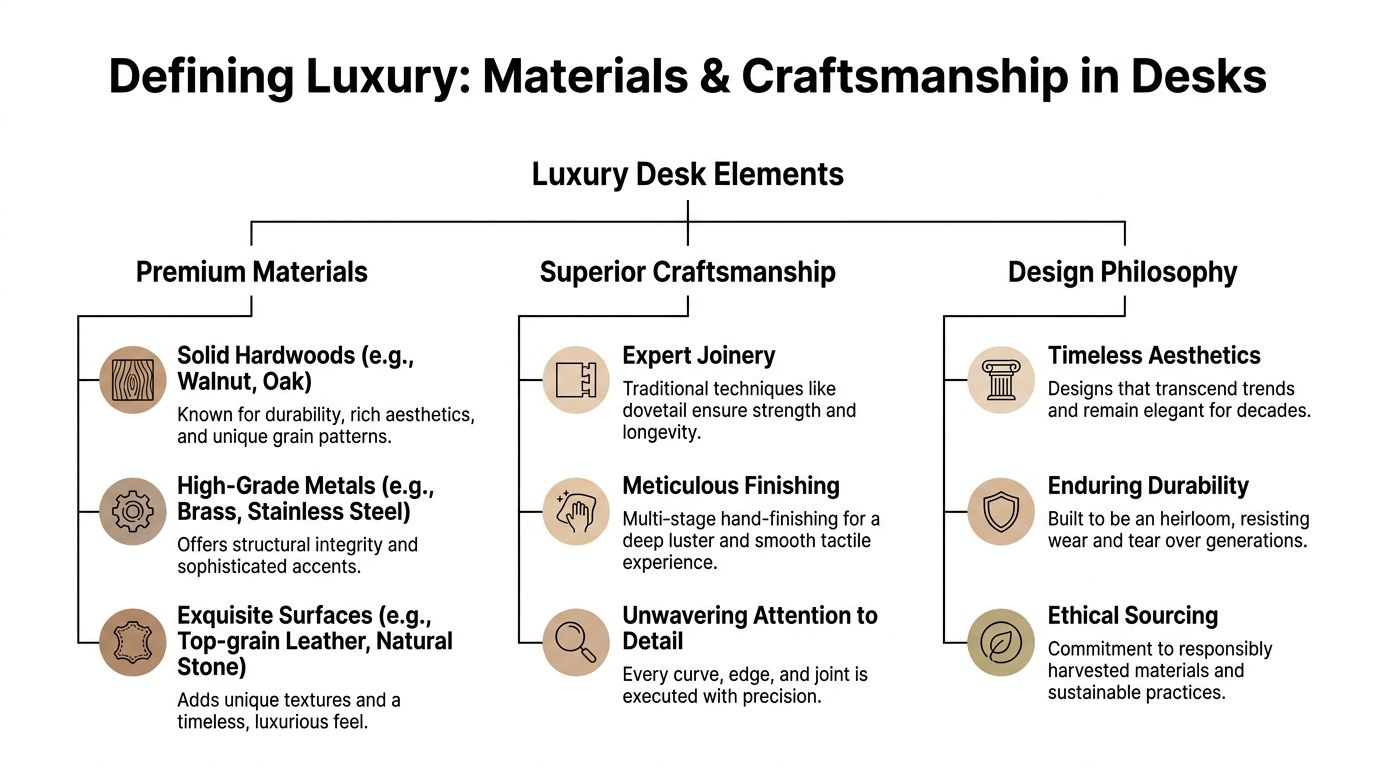
Luxury isn’t a carved edge or a dark stain by itself. It’s the combination of material integrity, construction quality, and a design philosophy that doesn’t cut corners.
This visual captures that idea well:
Start with what you can touch
The first clue is usually the material. A desk made from solid hardwood feels different the moment you place your hand on it. There’s substance there. The weight of solid cherry wood, the steady grain of oak, the smoother, tighter look of maple. These aren’t just style choices. They affect how the desk holds up over time.
Veneers and engineered materials can look attractive in a photo. But many shoppers get confused here because surface appearance isn’t the same as structure. A desk can photograph like wood and still lack the depth, repairability, and long-term resilience of a hand-crafted solid wood piece.
If you’re trying to sort out species, grain, and durability, this guide on choosing the right hardwood for longevity and style is useful background.
Construction tells the story
A luxury office desk earns its name in the unseen places too.
Look for details like:
- Joinery that’s built to hold. Dovetail drawers and mortise-and-tenon construction are signs that the piece was designed for repeated use, not quick assembly.
- Drawers that feel deliberate. They should open smoothly, close cleanly, and sit square within the case.
- Edges and corners with care. Run your hand along the front edge. It should feel finished, not sharp or thin.
- A finish with depth. Better desks don’t just have color. They have a layered surface that lets the grain show through and gives the wood a richer, quieter glow.
Amish hand-crafted desks stand out here because the focus is usually on joinery, solid wood integrity, and made-to-order construction. That’s part of why they often feel more like heirloom furniture than office equipment.
Practical rule: If a desk feels light, hollow, or flimsy when you open a drawer, it probably won’t grow more convincing with age.
Surface materials matter too
Not every luxury desk is all wood. Some executive and standing desk designs use advanced materials for the top surface.
According to Eureka Ergonomic’s explanation of what defines a luxury executive desk, sintered stone is prized for scratch, stain, and heat resistance because of its high-pressure manufacturing process. That sets a strong durability benchmark for modern executive surfaces.
Here’s a simple comparison:
| Surface choice | What people often like about it | What to think about |
|---|---|---|
| Solid hardwood | Warm feel, repairable character, classic heirloom look | Needs proper care and a good finish |
| Sintered stone | Strong resistance to scratches, stains, and heat | Cooler visual feel, more modern look |
| Leather inlay or wrapped details | Soft tactile contrast, executive character | Best for specific design styles, not every room |
The key is not picking the “fanciest” material. It’s choosing a combination that fits your work habits and your taste. If you want a desk that feels traditional and enduring, solid wood often wins. If you use a larger adjustable desk with demanding daily wear, a highly resistant top surface may make more practical sense.
Fusing Form with Function Design and Ergonomics
A desk can be beautiful and still be wrong for your body.
That’s where many online guides fall short. They talk about style on one side and ergonomics on the other, as if you have to pick between a room you love and a setup that supports your posture. You don’t.

A desk should fit the way you work
Some people need a broad executive desk because they spread out papers, use a second monitor, and take video calls all day. Others need a quieter writing desk with cleaner lines because the office also functions as a guest room or library.
A luxury office desk works best when its design supports the actual tasks happening there.
Ask yourself:
- Do you work mostly on a laptop or with multiple screens?
- Do you need deep drawers, file storage, or just a clean writing surface?
- Does the desk need to face into the room, sit against a wall, or wrap a corner?
- Will you stay seated all day, or do you want an adjustable setup?
The answers change the right shape, depth, and layout.
A broad traditional executive desk may project authority and offer generous storage. A modern adjustable desk may better support movement throughout the day. An L-shaped configuration can separate computer work from paperwork without requiring two rooms.
Luxury includes wellness
The overlooked truth is simple. A premium desk should help you feel better after a day's work, not just impress you at the start of it.
That gap is worth noting because this discussion of desk types and the missing link between luxury aesthetics and ergonomic health points out that a premium desk should integrate with ergonomic accessories and seating to improve posture and reduce workplace injury risk.
A few details matter more than shoppers often realize:
- Height relationship. Your desk, chair, and keyboard position should work together, not fight each other.
- Depth for screens. If the desk is too shallow, monitor placement becomes awkward.
- Legroom and apron clearance. A beautiful desk with cramped knee space gets old quickly.
- Chair compatibility. Arm height, seat height, and desk edge design all have to cooperate.
For people building a fuller workspace system, this guide to multifunctional home office furniture helps when you’re trying to make style, storage, and comfort live in the same room.
The best office doesn’t just photograph well. It lets you work for hours without constantly adjusting yourself.
A complete setup often includes a desk paired with ergonomic seating. Stores that carry customizable seating systems, such as Stressless sizing options, can help shoppers think beyond the desk alone and build a workspace with more whole-body support.
Choosing the Right Desk for Your Space and Work
Most mistakes happen before anyone looks at finishes. They happen when the desk is the wrong size, wrong shape, or wrong tool for the job.
Think about the room first
Start with the room as it really is, not as it looked empty.
Measure:
- Wall length where the desk will sit
- Door swings and traffic paths
- Window placement and glare
- Reach to outlets for lamps, monitors, and charging
- Clearance for the chair when you push back
If measuring feels tedious, it’s worth doing anyway. One of the most useful planning steps is learning how to measure furniture before you fall in love with a desk that won’t fit the room or the walkway.
A desk can fit the wall and still fail the room.
That confuses people all the time. A piece may match the available width but leave no breathing room beside a bookcase, file cabinet, or window trim. In smaller Ann Arbor homes, condos, and studies with double-duty layouts, proportion matters as much as dimensions.
Match the desk type to the job
Here’s a practical way to compare common options:
| Desk type | Works well for | Watch for |
|---|---|---|
| Standard writing desk | Light computer work, flexible rooms, cleaner visual lines | Limited storage |
| Executive desk | Full-time office use, statement presence, paperwork and storage | Needs more floor space |
| L-shaped desk | Multi-tasking, corner use, separating tasks | Can dominate a small room |
| Standing or adjustable desk | Movement during the day, ergonomic flexibility | Needs planning for cable management and accessories |
A few real-world examples help.
If your office doubles as a guest space, a lighter desk profile may keep the room from feeling crowded. If you handle documents, supplies, and regular calls, a larger executive desk usually feels calmer because everything has a place. If you shift between focused solo work and household management, an L-shaped desk can create zones without adding more furniture.
One factual example from the local market is the Sloane 66" Executive Desk, offered in the home office desks category, alongside options such as the Sinclair L-shaped Desk I224HOGRP1 and the Cortland Double Pedestal Jr. Executive Desk. Those names are useful because they show how varied the category really is, from straight executive formats to corner-friendly layouts.
The Art of a Bespoke Desk Customization and Finishes
The desk on the showroom floor is often just the first draft.
That surprises people. They assume the visible piece is the whole offer, when in many cases the deeper value is in the made-to-order options. A bespoke desk lets you stop compromising between “close enough” and “I guess this works.”
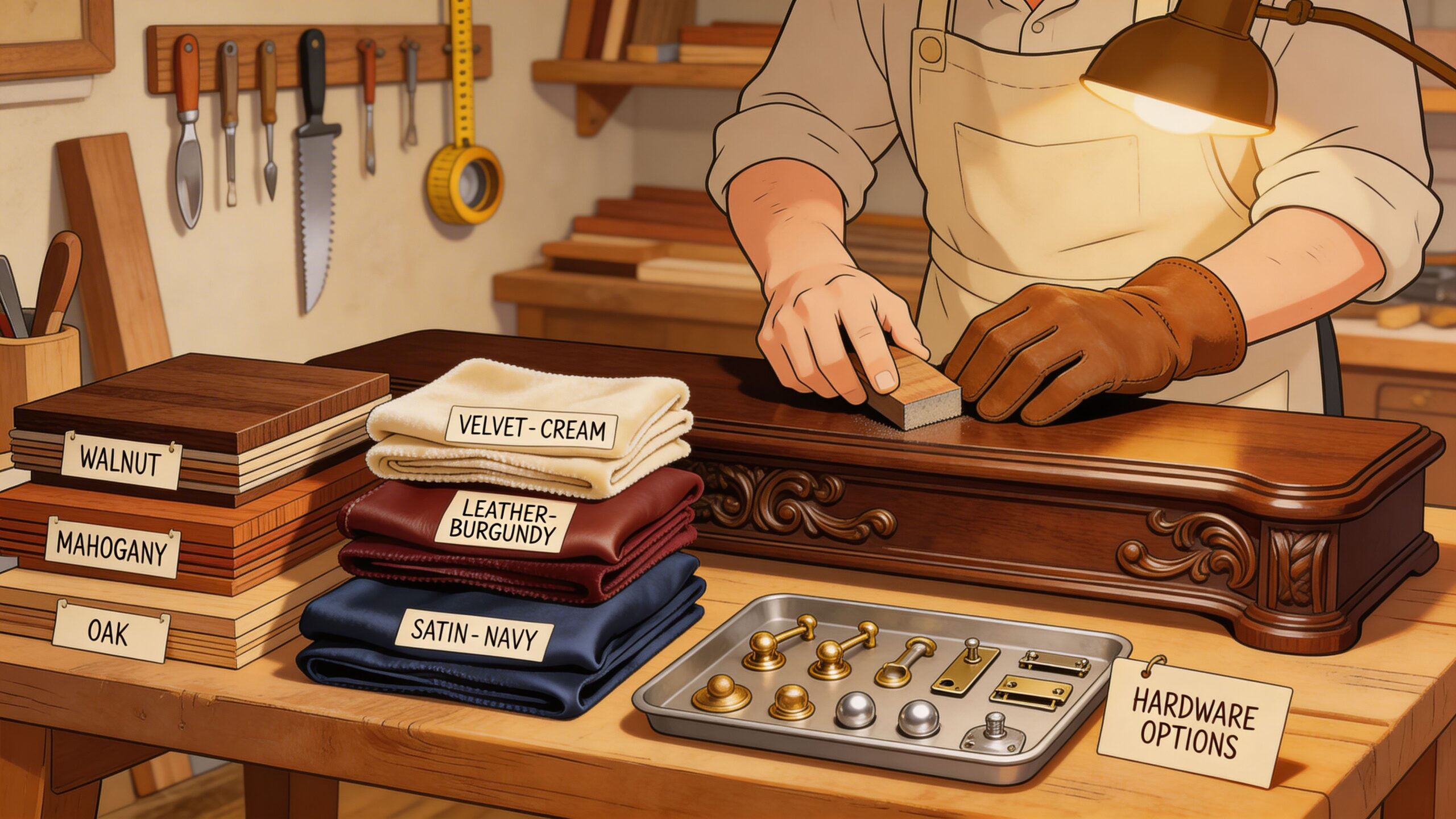
In stock is only the starting point
Customization matters because every home office has different light, wall color, flooring, and surrounding furniture. The desk that looked perfect under showroom lighting may need a different stain in your home. A drawer bank that works for one person may be awkward for another.
With made-to-order furniture, you can often adjust details such as:
- Wood species like cherry, oak, or maple
- Finish tone from light and natural to deeper traditional stains
- Hardware including pulls and knobs that lean classic or modern
- Configuration such as pedestal placement, return orientation, or storage mix
That same philosophy shows up across the store in other categories too. Canadel gives shoppers broad made-to-order flexibility in dining, and Stressless allows ergonomic personalization through sizing and upholstery choices. The broader lesson is simple. Good furniture doesn’t always ask you to settle.
For a closer look at the process, custom furniture made simple walks through how special orders become more manageable than many shoppers expect.
Small choices change the whole desk
A custom desk doesn’t have to become ornate to feel personal.
Sometimes the most important decisions are quiet ones. A matte finish can soften glare in a bright room. A darker stain can ground an office with pale walls. Black hardware can sharpen a modern silhouette, while warm metal tones can make a traditional desk feel more fitting.
One option in this category is Tyner Furniture, which offers made-to-order furniture programs and Amish hand-crafted solid wood selections in addition to in-stock pieces. For desk buyers, that matters because the visible model may be only one version of what can be built.
Customization isn’t about adding more. It’s about removing the parts that don’t fit your life.
If you’ve ever liked the shape of a desk but disliked the finish, or wanted the storage but not the hardware, bespoke ordering solves a problem that online filtering usually can’t.
Understanding the True Value Longevity and Financing
The price tag gets attention first. The longer story is what the desk costs you over time.
Think in cost per year
A lot of luxury desk content misses that point. As Caretta Workspace’s discussion of the content gap around total cost of ownership and ROI notes, buyers want help understanding the long-term financial justification for a premium desk, especially when durability changes the cost-per-year picture.
That’s a more useful lens than sticker shock.
Here’s the basic idea:
- A lower upfront price can still cost more if the desk wears out, loosens, chips, or needs replacement sooner.
- A solid wood heirloom desk can spread its value over many years of use and may continue to look better as it ages.
- Repairability matters. Surface wear on quality wood can often be addressed in ways that aren’t realistic with thin veneers or weaker substrates.
You don’t need a spreadsheet to understand this. If a desk stays structurally sound, fits your space long term, and still belongs in your home after tastes evolve, that’s value.
Care and access matter too
Longevity also depends on maintenance.
For solid wood desks, simple habits go a long way:
- Use coasters and desk pads for routine protection
- Dust with a soft cloth rather than harsh cleaners
- Keep the desk away from extreme dryness or direct heat
- Treat small surface issues early before they become bigger finish problems
The other part of value is accessibility. A better desk may still be the right choice even if you’d prefer to spread out the purchase. That’s where Special Financing can help, subject to credit approval. A Low Price Promise also matters because shoppers shouldn’t have to choose between local guidance and competitive value.
For many Southeast Michigan households, that combination makes a premium workspace feel more reachable. It also helps when you’re furnishing beyond the office. A store covering Home Office to Outdoor Spaces lets you plan the house more cohesively instead of solving one room at a time.
Experience Craftsmanship at Our Ann Arbor Showroom
Online research gets you only so far.
At some point, you need to open the drawer, stand beside the desk, and feel whether the piece has the weight and balance you’ve been looking for. A luxury office desk is tactile furniture. The smoothness of the finish, the sound of the drawer close, the visual depth in the grain, and the way your chair tucks underneath all matter in person.

Why seeing it in person helps
Photos flatten everything.
In a showroom, you can compare a crisp modern profile against a more traditional executive shape. You can see whether the wood reads warm or red in real light. You can test chair height, knee clearance, and whether the desk feels commanding, compact, or right.
That matters even more if you’re considering matching pieces elsewhere in the home. A store with broad selection across living, dining, bedroom, home office, and outdoor furniture gives you a fuller design picture.
A local place to compare and decide
For shoppers in Ann Arbor and Southeast Michigan, the South State St. showroom offers something the internet can’t. Context. You can ask practical questions, compare finishes side by side, and do a sit test with seating that complements the desk.
Since 1957, that kind of in-person guidance has been part of the local legacy. It’s less about being talked into something and more about leaving with clearer judgment.
If you’ve been working at a desk that feels temporary, this is often the point where the decision gets easier. Once you experience the weight of solid wood, the buttery feel of top-grain leather on nearby seating, and the confidence of furniture built for long use, the difference becomes easier to trust.
Visit Tyner Furniture in Ann Arbor for a sit test and a closer look at hand-crafted home office options, or browse the online Quick Specs if you’d rather start with dimensions, finishes, and special-order possibilities before coming into the showroom.