A Buyer’s Guide to Coffee Table Metal Bases


You’re likely starting at a common point. You want a coffee table that looks right, fits the room, and doesn’t become the piece everyone apologizes for after a year of daily use.
That sounds simple until you start shopping. One table feels too bulky. Another looks great online but seems flimsy in person. A third has the right top, but the base makes it wobble the moment someone props up their feet. For a piece that sits at the center of a living room, the wrong choice gets noticed fast.
The part many shoppers overlook is the coffee table metal base. It isn’t just the support underneath. It sets the visual tone, determines how stable the table feels, and plays a major role in how well the piece ages. When you’re pairing metal with a hand-crafted solid wood top, the base becomes the foundation of an heirloom, not an afterthought.
That’s also where local experience matters. The move toward metal bases was a major turning point in furniture design during the Industrial Revolution, and Michigan grew into a furniture manufacturing capital around 1903, a history reflected in the region’s long connection to durable, customizable furnishings, as noted in this history of the modern table base. In Ann Arbor and across Southeast Michigan, shoppers still want the same thing they wanted generations ago. They want a piece that works hard, looks grounded, and lasts.
Table of Contents
- The Foundation of Your Living Room
- Exploring Common Metal Base Styles
- Choosing Your Material and Finish
- Getting the Size and Structure Right
- Styling a Metal Base with a Custom Wood Top
- Heirloom Care for Your Metal Base
- Create Your Bespoke Coffee Table at Tyner
The Foundation of Your Living Room
A coffee table gets used more than generally realized. It catches mugs, books, remotes, trays, game-night clutter, and the occasional tired pair of feet. If the base is poorly chosen, every one of those small moments exposes it.
Why the base matters more than shoppers expect
The base does three jobs at once.
- It defines the silhouette. A light, open frame makes a room feel airier. A bold pedestal gives the table more presence.
- It controls stability. A beautiful top won’t save a table that rocks on the rug or feels unsafe near kids and guests.
- It affects long-term value. A solid base can carry a substantial wood top for years. A weak one usually shows its limits early.
That’s why the base deserves as much attention as the wood species or finish. When shoppers browse living room essentials, they often focus on the top first because that’s what they see. In practice, the foundation under it often determines whether the table feels reassuring or frustrating.
Practical rule: If a coffee table feels visually right but physically uncertain, the issue usually starts at the base.
A good coffee table should feel settled
The best pieces don’t call attention to their engineering, but you can feel it. The table sits flat. The proportions make sense beside the sofa. The weight of the top and base feel balanced instead of forced.
That’s part of why metal became such an important material in furniture design. It allowed makers to create cleaner lines, stronger structures, and forms that fit modern rooms without the visual heaviness of older support systems. For today’s homes in Ann Arbor, that matters whether the room is a downtown condo, a family room in the suburbs, or a carefully layered interior design project with bespoke details.
Why a long view helps
Furniture shopping gets easier when you stop asking only, “Does it match?” and start asking, “Will I still trust this piece years from now?”
Since 1957, Tyner has served Southeast Michigan with that longer view in mind. That local legacy matters because a coffee table isn’t an isolated purchase. It lives among sectionals, recliners, home office pieces, dining rooms, and even outdoor spaces. The right metal base helps the whole room feel intentional, not pieced together.
Exploring Common Metal Base Styles
Style names can sound technical, but in a showroom they translate into mood. One base makes a room look crisp and architectural. Another softens the table and lets the wood take the lead.
Sled and U shaped frames
A sled base is one of the easiest styles to live with. It reads clean, open, and structured.
It works especially well in:
- Contemporary rooms where you want crisp lines and visual order
- Smaller living rooms where bulky legs would crowd the floor area
- Wood tops with strong grain because the simple frame doesn’t compete for attention
This style often suits Ann Arbor homes that lean modern but still want warmth from natural materials.
Hairpin and tapered leg looks
Hairpin legs feel lighter and more casual. They give a coffee table a mid-century note without making the room feel themed.
They tend to work best when:
- the top is visually substantial,
- the surrounding upholstery has softer lines,
- and you want the table to feel mobile rather than anchored.
Tapered metal legs create a similar sense of lift, though they usually feel more refined than hairpin designs. If your room already has a lot of visual weight from a sectional, bookcase, or media unit, this kind of coffee table metal base can keep things from feeling crowded.
A lighter-looking base can make a solid wood top feel less formal, which is often the right move in family living rooms.
Pedestal bases
Pedestal styles solve a different problem. They concentrate support in the center and create easier movement around the table.
That can be useful if you want:
- Cleaner traffic flow around seating
- A more sculptural look in a focused seating area
- Less visual interruption from multiple legs at the corners
Pedestal coffee tables often fit transitional spaces well because they bridge traditional and modern furniture without looking too severe.
Geometric and sculptural forms
Some bases are meant to be seen. Angular frames, intersecting bars, and bold geometric forms bring energy into the room.
These are the styles I’d reserve for spaces where the table is doing some design work, not just filling a gap. They pair well with restrained upholstery, neutral rugs, and simple accessories. If everything in the room is already competing, a sculptural base can tip the space into visual noise.
Which style usually ages best
Here’s the trade-off. The more distinctive the base, the more personality it gives the room now. The simpler the base, the easier it usually is to live with through future changes in upholstery, rugs, and wall color.
A good rule is to decide where you want the drama:
- in the wood grain,
- in the base shape,
- or in the styling around the table.
Trying to make all three loud at once rarely works.
Choosing Your Material and Finish
Material is where short-term shopping and long-term ownership separate. Two coffee tables can look nearly identical from across the room, yet age very differently once daily life begins.
Steel, iron, and aluminum in real homes
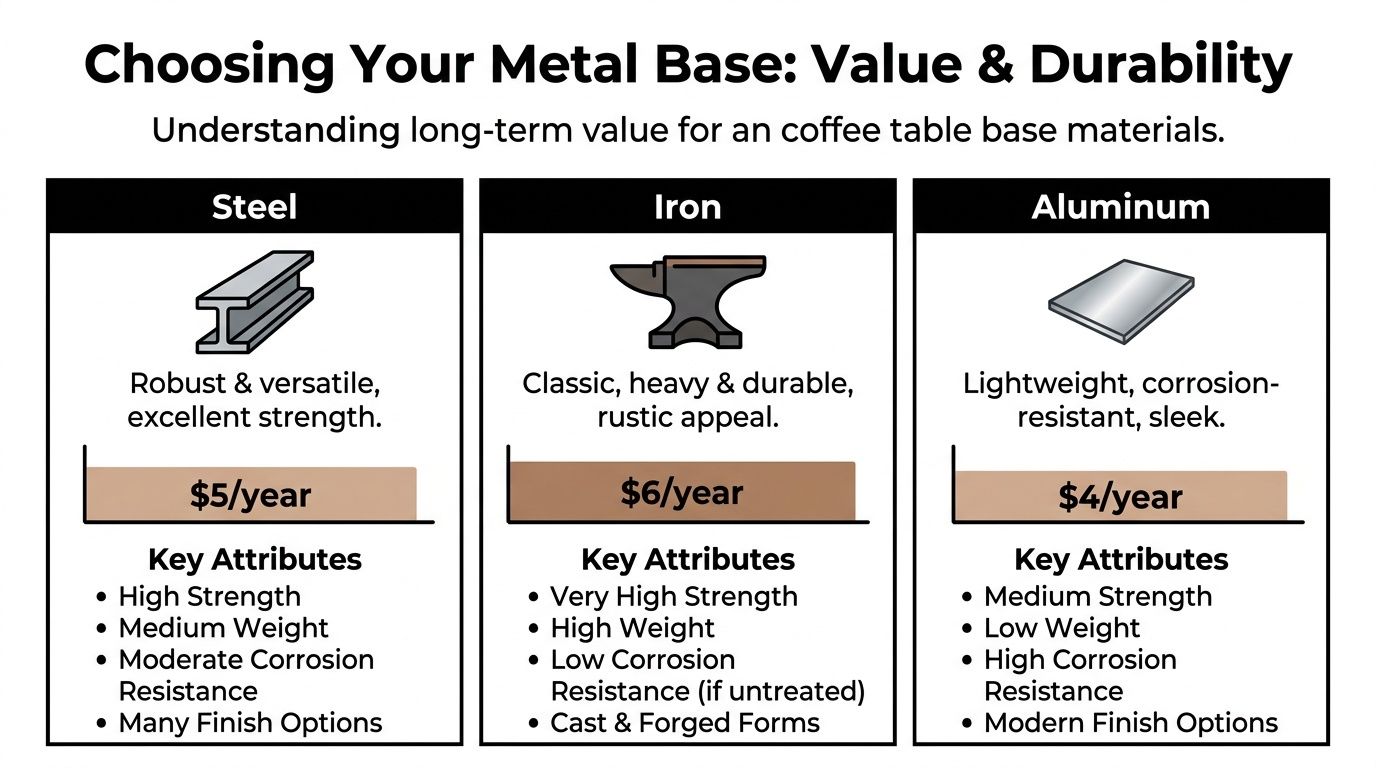
Each common material brings a different feel.
| Material | What it tends to offer | Best fit |
|---|---|---|
| Steel | Strong, versatile, easy to shape into clean lines | Most custom coffee table applications |
| Iron | Heavier visual presence, classic character | Rustic or old-world interiors |
| Aluminum | Lighter in weight and appearance | Sleek, lighter-duty modern settings |
Steel is usually the most balanced choice for a bespoke coffee table. It has the visual discipline many buyers want, and it works well under substantial solid wood tops. Iron can be appealing when you want more traditional heft. Aluminum has its place, but it usually isn’t the first material I’d choose when the goal is a grounded heirloom feel with a weighty wood slab.
For shoppers comparing options, this guide to metal accents is useful because it helps connect finish choices to the broader room.
Why powder-coated steel stands out
If you want practical value, powder-coated steel is the finish and material combination worth understanding.
Powder coating is applied electrostatically and fused to the metal at 400°F, creating a finish that resists chips and scratches and can last up to 5 times longer than standard paint, according to this product reference on powder-coated steel table bases.
That matters in real households. Coffee tables aren’t delicate display pieces. People set down ceramic mugs, slide trays, bump the base with shoes, and vacuum around the legs. A finish that shrugs off normal use is part of the value equation.
What works and what doesn’t
Some trade-offs are straightforward.
Works well
- Matte black powder coat if you want a finish that hides visual noise and pairs with almost any wood tone
- Simple welded steel forms when the top is the star
- Consistent finish quality across all visible surfaces, especially at corners and joints
Usually disappoints
- Thin painted metal that looks good at first but shows wear quickly
- Overly glossy finishes in busy family rooms, where fingerprints and scuffs become more obvious
- Bases selected only by appearance without considering the weight of the top they need to support
The right finish should let you stop worrying about the base. That’s the point of a durable surface.
Think in cost per year, not just sticker price
A coffee table gets touched constantly. If the base still looks composed after years of traffic, pets, rearranging, and regular cleaning, the purchase often feels smarter over time than a lower-cost piece that starts looking tired early.
That’s why I tell shoppers to focus on cost per year of satisfaction. A strong steel base under a hand-crafted wood top often makes more sense than replacing an entire table when the original finish or structure gives out.
Getting the Size and Structure Right
Many otherwise attractive coffee tables often fail on this point. The proportions may look acceptable in a photo, but if the structure underneath is undersized, the table never feels settled.
Start with the width rule
For stability, a metal coffee table base should be sized with a practical engineering guideline in mind. The base width should be the tabletop width minus 24 inches, which helps prevent wobbling and allows the base to safely support a substantial wood top, as noted in these sizing guidelines for metal table bases.
That rule gives shoppers something concrete to check before they fall in love with a shape.
Here’s how to use it:
- Measure the full tabletop width at its widest point.
- Subtract 24 inches.
- Treat that result as your minimum base width.
- Go wider when the design tapers inward or when the top is especially weighty.
A coffee table with generous overhang can still look elegant. It just can’t ask too little of the base.
Height should serve the seating
A coffee table also has to work with the way you sit. That matters even more now because many living rooms combine deep sectionals, motion seating, and ergonomic recliners.
Look at these fit questions:
- Can you reach the surface comfortably without hunching forward every time you set down a drink?
- Does the table clear the sightlines in the room instead of interrupting them?
- Is there enough space for feet, rugs, and movement around the base?
If the room includes lower, lounge-like seating, the wrong table height makes the piece feel awkward even when the styling is right.
Structure matters more with solid wood tops
Hand-crafted solid wood has presence. You feel it in the weight of maple. You see it in the richer movement of cherry grain. That kind of top deserves a base that doesn’t twist, flex, or visually disappear under the load.
A helpful measuring reference is this furniture measuring guide, especially if you’re trying to fit a custom table into a room with existing seating and area rugs.
Quick fit checklist
Before ordering, confirm these points:
- Top size matches the seating footprint instead of floating too small in the center.
- Base width respects the stability rule above.
- Leg placement doesn’t interfere with feet or floor cleaning.
- Height works with your actual sofa cushions, not just the listed sofa dimension.
- Rug compatibility has been considered, especially with thicker pile.
A coffee table should feel easy to use from every seat around it. If one side feels awkward, the proportions need another look.
Styling a Metal Base with a Custom Wood Top
A table becomes personal when these elements are combined. Metal brings definition. Solid wood brings warmth, variation, and the kind of depth that photographs never fully capture.
Why this pairing works so well
A metal base gives the table structure and visual discipline. A hand-crafted wood top softens that structure.
That contrast is the appeal:
- black steel against warm brown walnut,
- a geometric frame under a thick maple slab,
- a quiet rectangular base beneath a live-edge top with natural movement.
The result can feel both modern and timeless. That’s a rare combination, and it’s exactly why this format works so well in homes that don’t want to choose between clean lines and comfort.
Wood adds character metal can’t imitate
Good solid wood has a physical presence. You notice the weight when the table is moved. You notice the grain shift in changing light. Cherry has a flowing, refined look. Oak feels grounded. Maple reads clean and sturdy.
That’s where Amish hand-crafted work changes the conversation. Instead of choosing from a narrow set of fixed options, buyers can build around the species, edge detail, stain, and overall tone that fits the room. In-stock is only the beginning.
For homeowners who want the coffee table to coordinate with dining, bedroom, or home office pieces, custom programs also create continuity across the house. The same thinking that applies to a bespoke Canadel dining set or the ergonomic fit of Stressless seating can carry into the living room.
A combination that tends to age well
Some pairings are easier to live with than others.
- Matte black base plus medium wood tone usually stays versatile through changing rugs and upholstery.
- Sculptural base plus highly figured wood can be striking, but it needs a calmer room around it.
- Very pale wood plus ultra-thin metal looks light and current, though it can feel too slight if the room already lacks visual weight.
One real example in this category is the Waverly Coffee Table, which pairs a live-edge acacia solid top with a metal base. It shows how organic wood character and a clean metal structure can coexist without feeling forced.
Styling the finished piece
Once the table is in place, don’t bury the craftsmanship.
A few styling moves usually work best:
- Use a tray to organize small items without covering the whole surface.
- Leave some wood visible so the grain remains part of the room.
- Keep decor low and tactile. A ceramic bowl, a stack of books, or a small natural accent often feels better than tall clutter.
If you need help finishing the surface once the piece is in place, this coffee table decorating guide offers practical ideas without overfilling the top.
Heirloom Care for Your Metal Base
A well-made metal base shouldn’t ask for much. That’s part of its appeal. A little regular care keeps it looking composed without turning ownership into a project.
The main thing to avoid
Uncoated steel is the risky choice in a fluctuating climate. In Southeast Michigan, where humidity can exceed 60%, uncoated steel can corrode 40% faster, while professionally powder-coated bases are rated to last 5 to 10 times longer, according to this market overview on metal coffee table bases.
That doesn’t mean you need to worry constantly. It means the finish you choose at the start matters.
Simple care habits that help
Use straightforward maintenance.
- Dust regularly with a soft dry cloth so grit doesn’t build up on the finish.
- Wipe spills promptly instead of letting condensation or drips sit along joints and corners.
- Use a damp cloth, not a soaking one for routine cleaning.
- Skip abrasive pads that can dull or scratch the protective surface.
For homes with kids, pets, or heavy daily traffic, that basic routine is usually enough if the base was finished properly in the first place.
A durable finish reduces maintenance, but it doesn’t replace sensible care. Quick wipe-downs beat deep restoration every time.
What to watch for over time
Check the base occasionally where hands don’t usually look:
- near welds,
- along the inside corners,
- and where the base meets the floor.
If you catch a finish issue early, it’s far easier to address than if moisture keeps working underneath the surface.
This is especially important in homes where doors open often, wet boots come in seasonally, or the table sits near windows with condensation swings. None of that should scare you away from metal. It just reinforces why a properly finished base is the wiser forever-home choice.
Create Your Bespoke Coffee Table at Tyner
A custom coffee table shouldn’t feel complicated. It should feel clarified.
The process usually starts with a few grounded decisions. What size does the room need? What seating does the table need to serve? Do you want the wood to lead, or the base to make more of the statement? Once those answers are clear, the design gets much easier.
What custom solves that stock often doesn’t
Many shoppers don’t need more options. They need the right options.
A growing need in living rooms is custom-height metal bases in the 12 to 20 inch range so the table fits modern sectionals and ergonomic seating such as Stressless recliners, a need reflected in this custom base market page. That’s one of the clearest places where bespoke ordering outperforms mass-market inventory.
You can also tune the piece around:
- top shape for traffic flow,
- base style for the room’s visual weight,
- wood species and finish for coordination with existing casegoods,
- height and scale for comfort beside deeper seating.
Why showroom guidance still matters
Online browsing is useful, but furniture is physical. You need to see proportions, feel finish texture, and compare tones in real light. In the South State St. showroom in Ann Arbor, that hands-on step helps shoppers decide whether they want a more architectural frame, a quieter minimalist base, or a table with more organic wood character.
That same design mindset carries across the whole home. Tyner has served Southeast Michigan since 1957, and the selection reaches beyond the living room into dining, bedroom, home office, and outdoor spaces. Customization also extends into other categories, including made-to-order Canadel dining and personalized ergonomic fit with Stressless.
Making the investment manageable
A better-built coffee table usually costs more upfront than a temporary solution. That doesn’t make it less practical. It often makes it more practical.
Special Financing and a Low Price Promise can help remove some of the friction from buying a piece you plan to live with for years. And if you want to begin with dimensions, finishes, or special-order details, this custom order starting guide is a useful first step.
Visit Tyner Furniture to browse Quick Specs for special orders or stop by the Ann Arbor showroom on South State St. for a sit test and design conversation. If you’re building a bespoke coffee table around a solid wood top and the right metal base, seeing the materials in person makes the decision far easier.