Custom Amish Bedroom Sets with Mirrors


You’re probably in one of two places right now. Either the bedroom still feels unfinished, with a dresser that works but doesn’t belong, or you’re planning a full refresh and realizing how quickly the options blur together.
That’s where bedroom sets with mirrors tend to split into two very different categories. One is built to fill a room for now. The other is built to stay with the home, age well, and still feel right years later. If you’re furnishing a primary bedroom in Ann Arbor or anywhere in Southeast Michigan, that difference matters more than most shoppers expect.
A mirror can do a lot in a bedroom. It helps with daily routines, reflects light, and gives a room a sense of openness. But the mirror only works as well as the furniture supporting it. A beautiful reflective surface attached to a weak case piece is still a weak investment.
There’s a reason buyers continue to put real money into the category. The U.S. bedroom furniture market was valued at USD 48.25 billion in 2023 and is projected to reach USD 90.57 billion by 2033, at a 6.5% CAGR, according to Nova One Advisor’s U.S. bedroom furniture market report. People still want complete bedroom spaces that feel intentional, durable, and worth living with.
Table of Contents
- Your Bedroom Furniture Should Be an Investment Not a Placeholder
- Beyond Reflection The Functional Beauty of Mirrored Sets
- Choosing Your Mirror Type and Style
- How to Measure for a Perfect Fit
- The Solid Wood Difference Amish Craftsmanship Meets Mirrored Design
- Bespoke Beauty Customizing Your Set at Tyner Furniture
- Your Investment for a Lifetime Care Safety and Smart Purchasing
Your Bedroom Furniture Should Be an Investment Not a Placeholder
A bedroom gets used in quiet ways that hide wear until it’s too late. Drawers open every day. Mirror frames get bumped during cleaning. Case pieces absorb seasonal changes in humidity. What looks fine on a sales floor can feel very different after a few Michigan winters and summers.
That’s why I tell shoppers to think in cost per year, not just purchase price. A lower upfront price can feel comfortable in the moment, but if the set loosens, swells, or looks tired after a relatively short run, the value wasn’t really there.
What a placeholder purchase usually looks like
Most placeholder purchases share the same pattern:
- The finish looked appealing online but felt flat or overly glossy in person.
- The mirror helped sell the set but the dresser underneath lacked substance.
- The storage solved today’s problem without considering how the room would function long term.
- The style chased a trend that didn’t age well with the rest of the home.
A bedroom should settle you, not nag at you. If you already suspect you’ll want to replace the furniture after the next move, renovation, or life stage, you’re likely shopping in the wrong category.
A well-bought bedroom set doesn’t just match the room. It supports your routine without calling attention to itself.
What works better in a forever home
The stronger approach is to buy for permanence. That doesn’t mean formal or overly ornate. It means choosing pieces with enough design restraint and enough construction integrity to stay relevant.
For many homeowners, that comes down to a few questions:
| Decision area | Placeholder mindset | Investment mindset |
|---|---|---|
| Material | Looks good today | Holds up over time |
| Mirror choice | Included because it’s bundled | Chosen for function and scale |
| Finish | Trend-led | Meant to live with flooring, trim, and light |
| Storage | Just enough | Planned around real habits |
That mindset is especially useful if you’re furnishing a primary suite, a guest room you want to enhance, or a home you expect to keep. Since 1957, Southeast Michigan shoppers have leaned on local legacy stores for exactly this kind of guidance because the bedroom purchase is rarely as simple as “pick a set and move on.”
And this isn’t only about bedrooms. The same long-view thinking applies across the home, from the home office to outdoor spaces, where daily use exposes weak construction fast.
Beyond Reflection The Functional Beauty of Mirrored Sets
A mirror isn’t just decoration. In a bedroom, it changes how the space behaves.
The right mirror makes morning light travel farther. It softens heavy furniture. It can keep a solid wood set from feeling visually dense, especially in rooms with darker finishes or limited window exposure.

Why mirrors earn their place
Bedroom sets with mirrors work best when the mirror is treated as a design tool, not an afterthought. In practice, that usually means three benefits.
Light return
A mirror catches daylight and lamp light, then redistributes it into corners that would otherwise read flat.Visual breathing room
In a room with substantial furniture, reflection introduces contrast. The room feels less crowded even when the storage stays generous.Daily utility
A dresser mirror becomes part of the routine. Hair, jewelry, grooming, getting dressed. If it’s in the right spot, it saves steps and keeps the bedroom functioning smoothly.
Where people go wrong
The common mistake is assuming any mirrored set will create elegance. It won’t.
Highly reflective, heavily glam pieces often dominate the room instead of supporting it. In smaller bedrooms, that can create visual noise. In more traditional homes, it can also clash with the architecture. A mirror should brighten the room, not make the furniture feel louder.
Practical rule: The mirror should make the woodwork and the room look better. If the mirror is the only thing you notice, the balance is off.
Another mistake is forgetting scale. A modest dresser with an oversized mirror can feel top-heavy. A large case piece with a tiny mirror looks unfinished. Good mirrored design feels composed. You notice the room first, then the furniture.
Why the category keeps growing
Buyers continue to choose these pieces because they solve two needs at once. They add storage and visual lift. That’s one reason dressers and mirrors represented 17.4% of the global bedroom furniture market in 2023, according to Market.us bedroom furniture market data.
That number tracks with what experienced furniture people see every day. Bedrooms need practical storage, but shoppers also want the room to feel calm, layered, and pulled together. Mirrors help bridge those goals when they’re paired with the right case goods.
In the best rooms, the effect is subtle. Morning light catches a beveled edge. A solid wood dresser gains elegance without losing its grounded feel. The bedroom feels more open, but still warm.
Choosing Your Mirror Type and Style
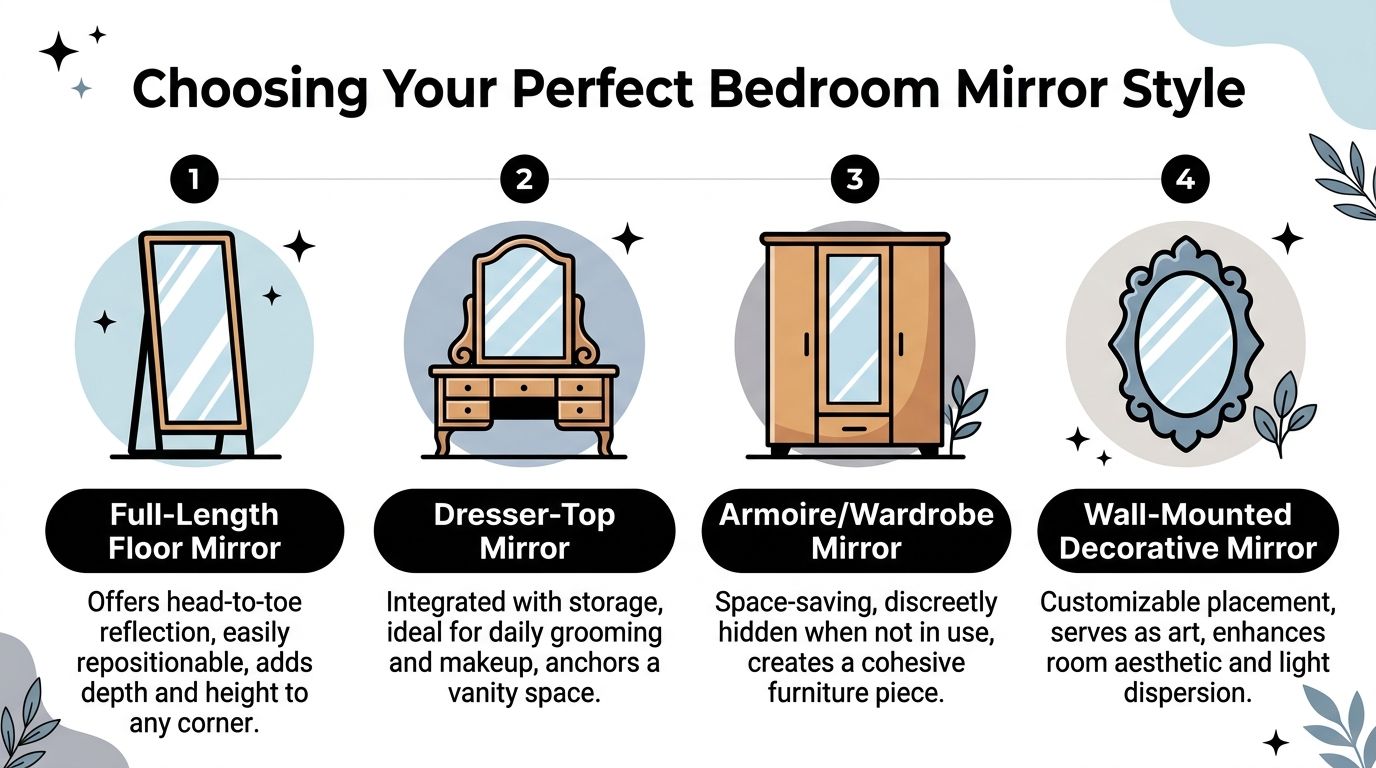
Not every bedroom mirror should sit on a dresser. The best choice depends on how you dress, how much floor space you have, and whether you want the mirror to read as furniture, architecture, or accent.
Dresser-top mirrors
This is the classic choice in bedroom sets with mirrors, and for good reason. It keeps storage and reflection in one place, which makes the room easy to use day to day.
A dresser-top mirror usually works best when:
- you want a natural getting-ready zone
- the dresser is already the main visual anchor in the room
- you don’t want to dedicate separate floor space to a standing mirror
It’s also the most natural fit for coordinated solid wood bedroom suites. If you’re browsing more traditional or transitional options, this is often where the craftsmanship shows. The frame profile, wood grain, and proportion all matter.
For shoppers who want a softer shape in the room, something like the Avaline round mirror shows how a mirror can break up the straight lines of case goods without looking trendy for trend’s sake.
Full-length floor mirrors
A floor mirror does a different job. It gives you a full outfit check and can be moved as the room changes.
This style makes sense when the dresser is already busy with lighting, decor, or a television above it. It also helps in rooms where wall placement creates a better reflection angle than a dresser-top setup would.
The trade-off is footprint. A floor mirror asks for real space around it so it doesn’t feel wedged into a corner.
Wall-mounted mirrors
Wall-mounted mirrors give you the most freedom. You can center one above a chest, place one near a dressing area, or use it to bounce light where the room needs it most.
This option works well if:
| Best for | Why it helps |
|---|---|
| Smaller rooms | Keeps the floor clear |
| Custom layouts | Lets you place the mirror where the architecture supports it |
| Layered design | Can act more like wall art than a furniture attachment |
The downside is commitment. Once it’s mounted, the room layout gets less flexible.
Armoire and wardrobe mirrors
These are practical and often underrated. If the bedroom needs more vertical storage, a mirrored wardrobe door can keep the room functional without adding another separate reflective surface.
That said, this style only works if the room benefits from the added storage. If not, it can feel heavier than necessary.
The best mirror type isn’t the most dramatic one. It’s the one that fits your routine so well that the bedroom becomes easier to live in.
When buyers slow down and choose based on room use, not just showroom appeal, the result is almost always better.
How to Measure for a Perfect Fit
Most furniture mistakes happen before the furniture arrives. The problem usually isn’t style. It’s proportion.
A bedroom set can be beautifully made and still feel wrong if the mirror sits too high, the dresser crowds a walkway, or the room loses breathing room around the bed. Good measuring prevents that.
Start with the wall and the pathway
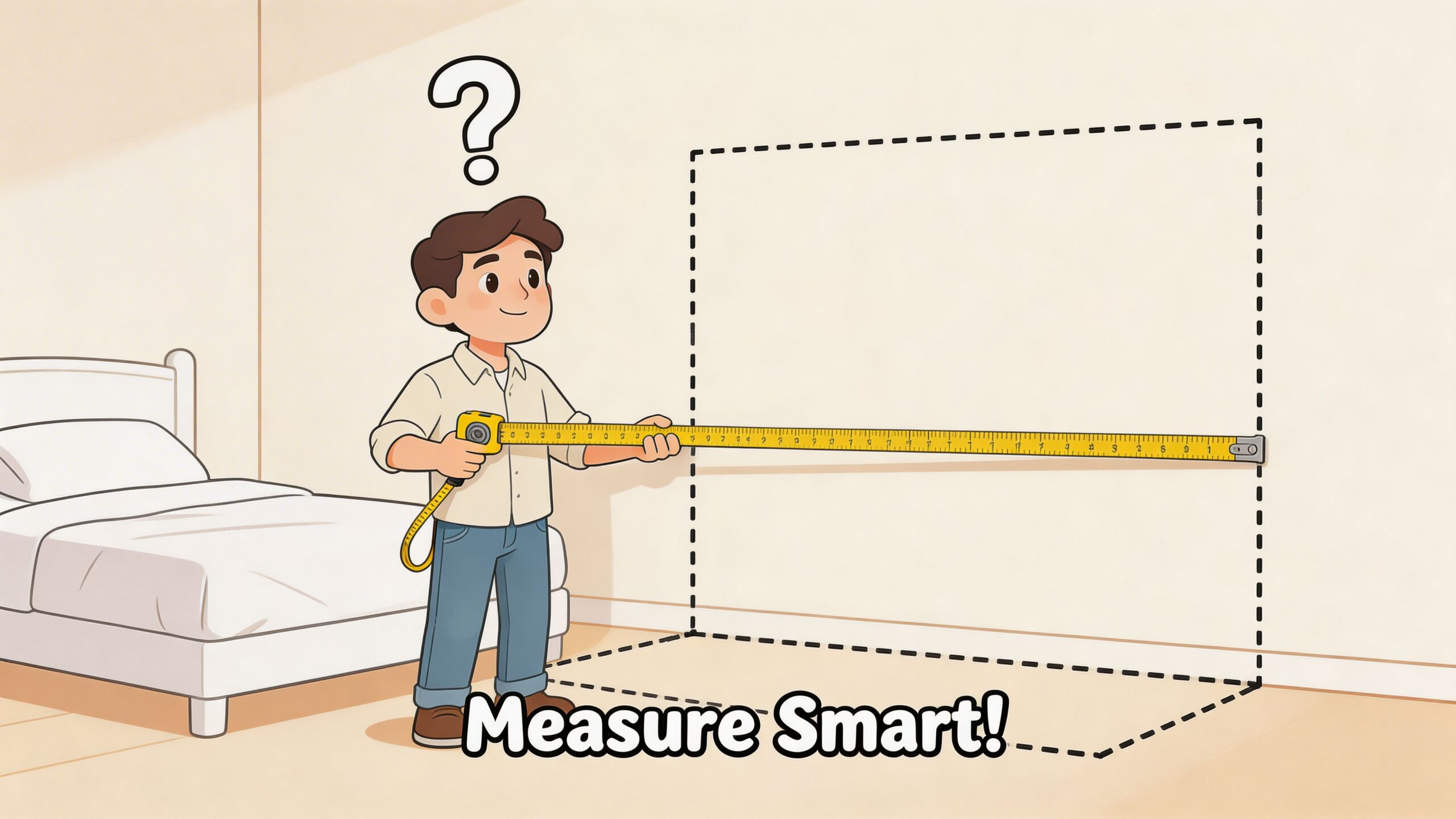
Before you look at any dresser or mirror, measure the wall where it will live. Then measure the path to it. That includes door openings, stair turns, hallway pinch points, and the space between the foot of the bed and the dresser.
Use this order:
Wall width
Know your usable width, not just the total wall dimension.Dresser depth
Check that drawers can open comfortably without trapping traffic flow.Standing zone
Leave enough room for a person to stand at the dresser and use the mirror without backing into the bed.
If you want a good starting framework, this furniture measuring guide is useful before you commit to a set.
Use mirror proportion, not guesswork
Industry guidance is more helpful than many people realize here. Dresser mirrors typically range from 35 to 52 inches wide and are often chosen to create a 1:1 visual balance with the dresser, while placement aligns with an average eye level of 60 to 66 inches from the floor for effective reflection, based on these mirror dimension standards.
You don’t need to memorize the numbers. You just need to respect the relationship.
- Too narrow and the mirror feels skimpy over the case piece.
- Too wide and the composition starts to feel unstable.
- Too high and daily use becomes awkward.
- Too low and the furniture can feel compressed.
A simple showroom-ready checklist
Bring these measurements with you:
- Overall room size
- Bed size and bed placement
- Usable wall width for the dresser
- Distance from bed to dresser
- Ceiling height
- Window and outlet locations
If you can’t open every drawer comfortably and still stand in front of the mirror naturally, the piece doesn’t fit the room, no matter how good it looks.
One more point matters in Southeast Michigan homes. Older houses often have charming proportions, but not always generous pathways. That’s where careful measuring pays off. It keeps a thoughtful purchase from turning into a compromise on delivery day.
The Solid Wood Difference Amish Craftsmanship Meets Mirrored Design
This is where bedroom sets with mirrors either become lasting furniture or a short-term visual fix.
The mirror gets attention first. The case construction reveals its quality later. You feel it when you pull a drawer, when you move the dresser slightly for cleaning, and when the piece goes through seasonal shifts without loosening or wobbling.
What solid wood changes
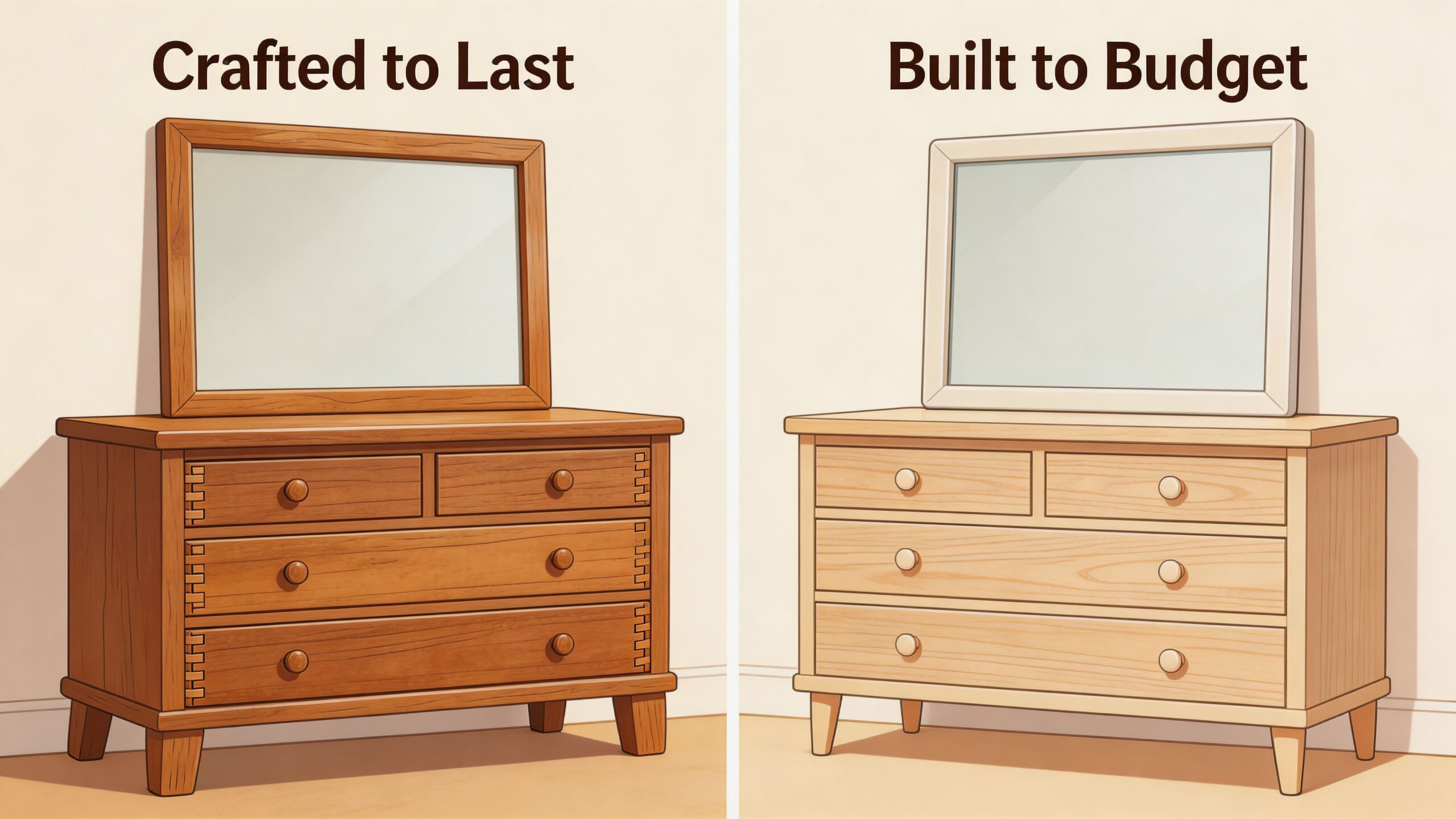
A solid wood dresser has presence. You notice the weight of cherry, oak, or maple. You notice how the grain carries through the frame instead of stopping abruptly at a printed surface. You notice the drawer action, especially when the interior is finished with care.
That matters because the dresser is doing the heavy lifting. The mirror depends on a stable, well-built base.
According to this construction comparison for bedroom furniture, solid hardwood bedroom sets maintain structural integrity for 20 to 30+ years, while MDF-based alternatives often deteriorate within 7 to 10 years, especially in humid climates. That’s a practical distinction, not just a marketing one.
What mass-produced alternatives get wrong
Mass-produced mirrored sets often lead with surface appeal. Bright finish. Flashy trim. Reflective accents everywhere. The problem is that the visual drama can hide weaker fundamentals.
Common issues include:
- Lighter case construction that doesn’t support repeated use as well
- Less stable surfaces in rooms with moisture swings
- Mirror attachments that feel more decorative than integrated
- Shorter aesthetic life because the look is tied to a narrow trend
In Michigan homes, especially those with seasonal humidity and lower-level bedrooms or storage, material choice isn’t theoretical. It affects how the furniture ages.
Why Amish craftsmanship pairs well with mirrors
Some shoppers worry that adding a mirror to an Amish hand-crafted bedroom set will cheapen the piece. In well-designed sets, the opposite happens.
A mirror can lighten the visual weight of solid wood. It can sharpen a classic silhouette. It can add practicality without changing the honest character of the furniture.
That pairing works best when the craftsmanship stays in charge:
| Construction detail | Why it matters in a mirrored set |
|---|---|
| Dovetail joinery | Helps drawers stay dependable under daily use |
| Solid hardwood frame | Gives the mirror a stable visual and structural partner |
| Thoughtful finish work | Keeps the wood and reflection feeling cohesive |
| Balanced frame design | Prevents the mirror from looking added on |
You see the difference in the details. The frame looks intentional. The proportions feel settled. The mirror doesn’t fight the wood.
For shoppers exploring this category, the Amish furniture collection is a useful reference point for what heirloom construction looks like when it’s done with restraint.
Good mirrored furniture isn’t about adding shine. It’s about adding function and light to furniture that already has substance.
That’s the combination that lasts. Not a glam look that dates the room, but a composed piece that still feels grounded after years of use.
Bespoke Beauty Customizing Your Set at Tyner Furniture
Customization matters most when you already know the room deserves better than an off-the-rack answer.
A made-to-order bedroom set lets you shape the final result around your home instead of hoping a stock piece lands close enough. That’s especially important when you want bedroom sets with mirrors to feel personal, not mass-issued.
What you can actually customize
The process is more approachable than many people expect. In a strong custom program, you’re not designing from scratch. You’re making smart decisions within a proven framework.
That usually includes:
Wood species
Oak, cherry, and maple each carry light differently and give the mirror a different visual partner.Finish selection
The stain can either warm the room, brighten it, or help it relate to existing flooring and trim.Mirror frame profile
A cleaner frame feels quieter. A more defined profile adds formality and presence.Configuration
You may prefer a broader dresser with a lower mirror, or a taller chest paired with a separate wall mirror.
Why this matters in real homes
Customization is often what keeps a room from feeling pieced together. If the bedroom already includes painted trim, warm floors, or older architectural details, the furniture needs to belong there.
That same custom mindset shows up in other parts of the home too. Shoppers who value fit and finish often appreciate bespoke options beyond the bedroom, including Canadel dining and ergonomically sized Stressless seating, because the principle is the same. Buy once, and buy with intention.
For anyone new to the process, this custom order starting guide helps make the sequence clearer.
The best custom choices feel calm
The strongest custom bedrooms don’t look over-designed. They feel settled.
That usually means:
- the wood tone supports the room’s light
- the mirror shape relates to the lines of the furniture
- the scale suits the wall
- the whole set feels like it was always meant for that space
That’s the main advantage of bespoke furniture. It doesn’t just fit dimensionally. It fits visually and emotionally too.
Your Investment for a Lifetime Care Safety and Smart Purchasing
Once the set is in your home, a few habits make a big difference.
Solid wood and mirrors don’t ask for complicated care. They ask for consistency. Dust with a soft cloth. Clean glass without soaking the wood frame. Don’t let moisture sit on the surface. If the bedroom gets strong direct sun, use window treatments to moderate the exposure.
Care that protects the finish
Keep the routine simple:
- Dust regularly so grit doesn’t dull the finish over time.
- Wipe mirrors carefully and avoid overspray onto wood joints and edges.
- Use felt or protective pads under objects that stay on the dresser.
- Lift decor instead of dragging it across the top.
Safety matters more than style
Dressers with mirrors need proper setup. If the case piece is tall or the household includes children, anchoring the furniture matters. A beautiful bedroom isn’t successful if the installation stops short of safe.
Also check that drawers operate smoothly and that the mirror sits securely after delivery. A quality set should feel planted, not delicate.
Buy the furniture you want to maintain, not the furniture you’ll eventually feel obligated to replace.
The financial side of buying well
High-quality furniture is easier to pursue when the payment path matches the long-term value. That’s why financing matters in this category. According to Cascade Home Decor’s financing-related market summary, furniture financing sees a 15% to 20% annual uptake, and buy now pay later use for custom pieces has also surged, which reflects how many households prefer to spread out a meaningful investment.
That approach can make sense when the purchase is built for longevity. It’s one way buyers protect quality instead of settling for a lower standard up front.
Warranties matter too. Before you buy, read what’s covered, what isn’t, and how the retailer supports the product after delivery. A clear furniture warranty guide helps separate real value from vague reassurance.
A good bedroom set should serve your routine, suit your home, and still make sense years from now. That’s what turns a purchase into part of the home’s long-term design.
If you’re ready to compare bedroom sets with mirrors in person, visit Tyner Furniture in Ann Arbor on South State St. Since 1957, Tyner has helped Southeast Michigan shoppers furnish everything from the bedroom and home office to dining rooms and outdoor spaces with a focus on craftsmanship, value, and long-term comfort. If you want to feel the weight of solid wood, see bespoke finish options up close, or review Quick Specs for special orders, the showroom is the right place to start.