Six Light Chandelier a Complete Buyer’s Guide

A lot of homeowners reach the same point with a room. The table is in place, the rug feels right, the wood tones are beautiful, and yet the ceiling still leaves the space unfinished. The room needs more than light. It needs presence.
That's where a Six Light Chandelier often earns its keep. It has enough visual weight to anchor a dining room, foyer, or living area, but it usually doesn't demand the scale of a grand stair hall or oversized ceiling. For many homes in Ann Arbor and across Southeast Michigan, that middle-ground scale is exactly the sweet spot.
Choosing one can still feel complicated. Shape, finish, hanging height, bulb base, brightness, glare, wood tone, ceiling height. Those details matter, especially when the goal is a room that feels settled and lasting, not trendy for a season.
Table of Contents
- The Art of Illuminating Your Home
- Finding the Perfect Size and Placement
- Matching Styles with Heirloom Finishes
- Choosing the Right Bulbs and Dimmers
- Installation and Care in Your Michigan Home
- More Than a Light An Heirloom Investment
- Find Your Perfect Light at Tyner Furniture
The Art of Illuminating Your Home
A well-chosen chandelier does two jobs at once. It gives needed light, and it tells the room what kind of space it wants to be. Subtly formal. Relaxed but polished. Traditional with fresh edges. That's why a Six Light Chandelier so often becomes the hinge point in a room's design.

For homes throughout Southeast Michigan, six lights usually lands in a very practical place. It's substantial enough to read as a centerpiece over a dining table or in an entry, yet it still feels at home in rooms with everyday ceiling heights. That balance is part of its appeal.
The emotional side matters too. Over a solid wood dining table, a chandelier creates a pool of light that draws people together. In a foyer, it makes arrival feel intentional. In a living room, it can soften the architecture and give the eye a place to rest. Homeowners exploring living room lighting ideas that improve comfort and balance often discover that overhead lighting works best when it feels integrated with the room's furnishings rather than dropped in as an afterthought.
A chandelier shouldn't feel borrowed from another house. It should look like it belongs to the scale, mood, and materials already in the room.
That's especially true in homes built to last. Since 1957, families in Ann Arbor have gravitated toward pieces that carry visual substance, whether that means a hand-crafted dining table, ergonomic seating, or lighting that doesn't date itself too quickly. A chandelier may hang overhead, but it still needs to relate to everything below it, from the grain of the wood to the finish on the hardware.
Finding the Perfect Size and Placement
Sizing troubles usually come from one simple mistake. People shop by photo first and room proportion second. A fixture can look elegant online and still feel too small, too busy, or oddly low once it's in an actual house.
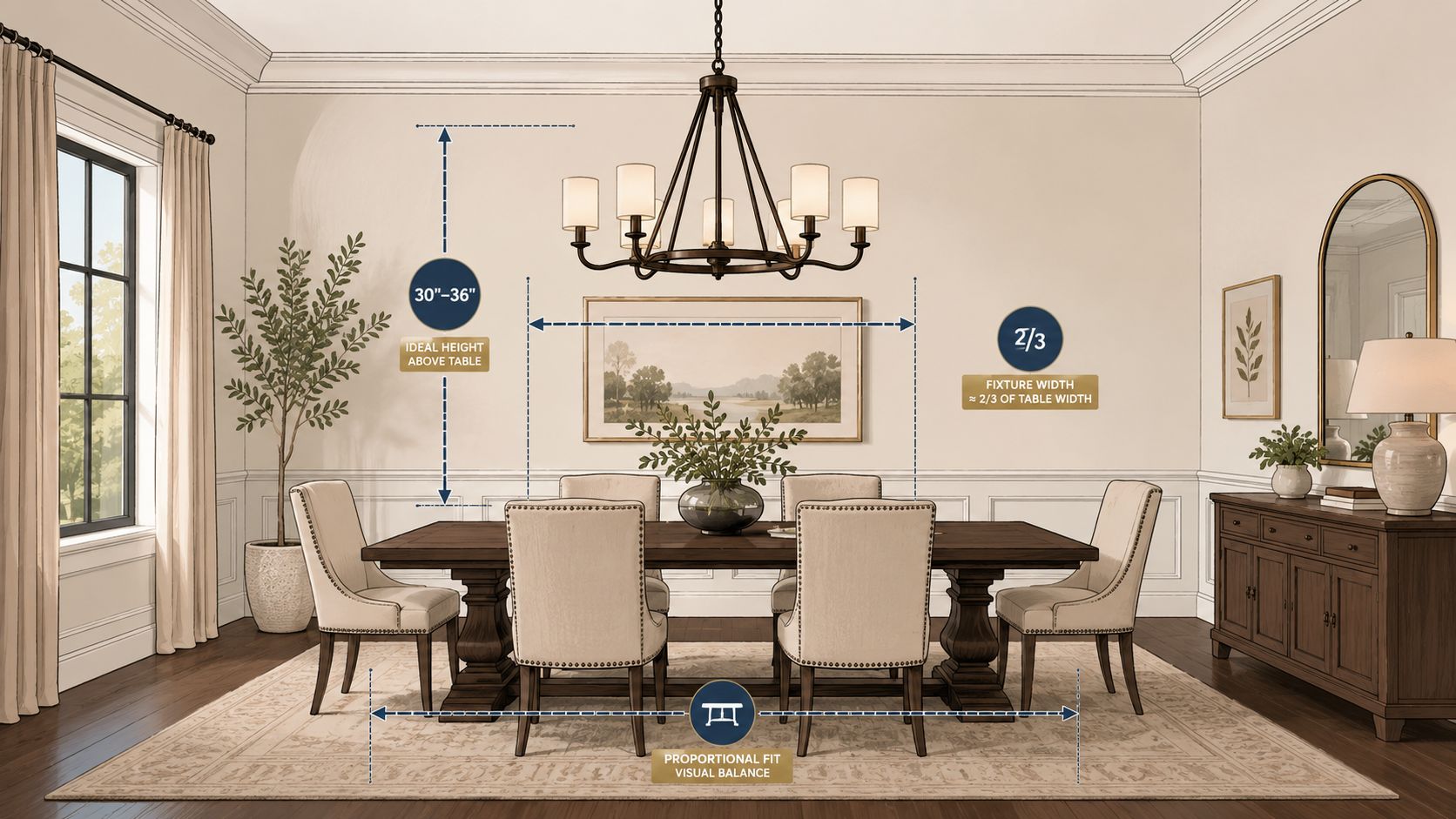
Why six lights often feels balanced
Published dimensions for comparable six-light fixtures show a useful range. Six-light fixtures typically range from 22.75 to 27.6 inches in width and 23 to 24.9 inches in height, which is why room proportion matters so much when choosing one (fixture dimension reference from Lamps Plus).
That range explains why one six-light model can feel airy over a breakfast-area table while another feels better suited to a broader dining room. A few inches in diameter can change how evenly light spreads, how much visual weight hangs over the table, and how crowded the room feels.
A practical way to evaluate size is to ask three questions:
- What sits underneath it. A rectangular dining table, a round pedestal table, or open floor space will each want a slightly different visual relationship.
- How much ceiling volume the room has. An open-plan room can visually absorb more fixture mass than a tight enclosed nook.
- What other elements compete for attention. A tall hutch, exposed beams, or nearby pendants can make the same chandelier feel larger.
Practical rule: A six light chandelier should look centered not only to the room, but to the furniture grouping that gives the room its purpose.
Placement choices by room type
Over a dining table, the chandelier needs to feel low enough to connect with the table, but not so low that it blocks conversation or dominates the sightline. In open-plan homes, that judgment matters even more because the fixture may be visible from the kitchen, living area, and entry at the same time.
In a foyer, the challenge shifts. There may be less furniture to visually “catch” the chandelier, so hanging height and scale need to relate more directly to ceiling height and the openness of the surrounding walls. In a living room, the fixture often works best when it supports the seating arrangement rather than trying to overpower it.
For homeowners working with compact rooms, broader visual strategies can help the chandelier feel more intentional. A thoughtful residential design guide for spaciousness can be useful when wall color, reflectivity, and visual clutter all affect how large the room feels around the fixture.
A quick room-by-room guide
| Room | What matters most | Common mistake |
|---|---|---|
| Dining room | Relationship to table width and sightline | Hanging it too high so it floats |
| Foyer | Ceiling volume and first impression | Choosing a fixture that disappears |
| Living room | Connection to seating area | Using a formal fixture in a casual room |
| Small nook | Visual openness | Picking ornate arms that crowd the space |
Many homeowners in Ann Arbor also deal with older room proportions, modest ceiling heights, and mixed-use spaces. A formal fixture can work beautifully there, but only if it respects the architecture. Those planning a furniture-and-lighting update often find it helpful to think through the room from the table up, especially when using a dining room planning approach that starts with layout and focal points.
Matching Styles with Heirloom Finishes
The chandelier shouldn't be chosen in isolation. It lives with wood, upholstery, metal accents, wall color, and daylight. If those elements don't speak the same design language, the room can feel assembled rather than composed.

Finish should answer the furniture
A matte black chandelier often works well when the room needs definition. Against pale walls or lighter oak, it gives the ceiling a crisp outline. Over darker woods, it can feel architectural and steady, especially when nearby metal details repeat the tone.
Warm metallic finishes move differently. Aged brass and soft gold tend to flatter cherry, walnut-like stains, and warm painted finishes because they echo the natural warmth already present in the room. Polished nickel usually reads cooler and cleaner, which can help balance heavier traditional wood forms.
The tactile side matters in furnished homes. The glow from a warm finish can play beautifully against the weight of solid cherry wood, while a darker transitional frame may sharpen the silhouette of a bespoke dining set. That relationship is especially important with made-to-order furniture, where the stain, sheen, and edge detail have already been chosen with care.
Style harmony matters more than strict matching
A common point of confusion is whether everything needs to “match.” It doesn't. A room usually looks more refined when materials coordinate rather than duplicate one another.
A useful perspective is:
- Traditional fixture with hand-crafted wood works when both have visual depth, curved lines, or a sense of history.
- Transitional chandelier with Canadel dining furniture often succeeds when the table has a cleaner profile and the finish still carries warmth.
- Sleek metal form near top-grain leather seating can sharpen a room that might otherwise feel too heavy.
A fixture's behavior in the room matters as much as its silhouette. Product listings often skip that point, but it's an important one: a six-light chandelier can create an elegant focal point in a dining room but might feel cluttered in a smaller space, which is a design concern often missed in generic listings (room-behavior note in product guidance).
The right chandelier doesn't fight the dining table. It completes the sentence the furniture has already started.
Customization proves especially valuable. In-stock is only the beginning for many homes. A made-to-order Canadel table or an Amish hand-crafted dining piece may have a specific stain depth, edge shape, or hardware story that changes which fixture finish makes sense. The same goes for surrounding upholstery and leather. Homeowners comparing those details often benefit from a closer look at how metal accents interact with wood and upholstery finishes.
Tyner Furniture includes lighting among its broader home categories, alongside spaces ranging from the home office to outdoor areas, which makes it possible to evaluate a chandelier in the context of the rest of the home rather than as a standalone object.
Choosing the Right Bulbs and Dimmers
A chandelier frame gets most of the attention, but the bulbs determine whether the room feels flattering, harsh, soft, bright, or underlit. That's the part many buyers discover only after installation.
Start with the bulb base
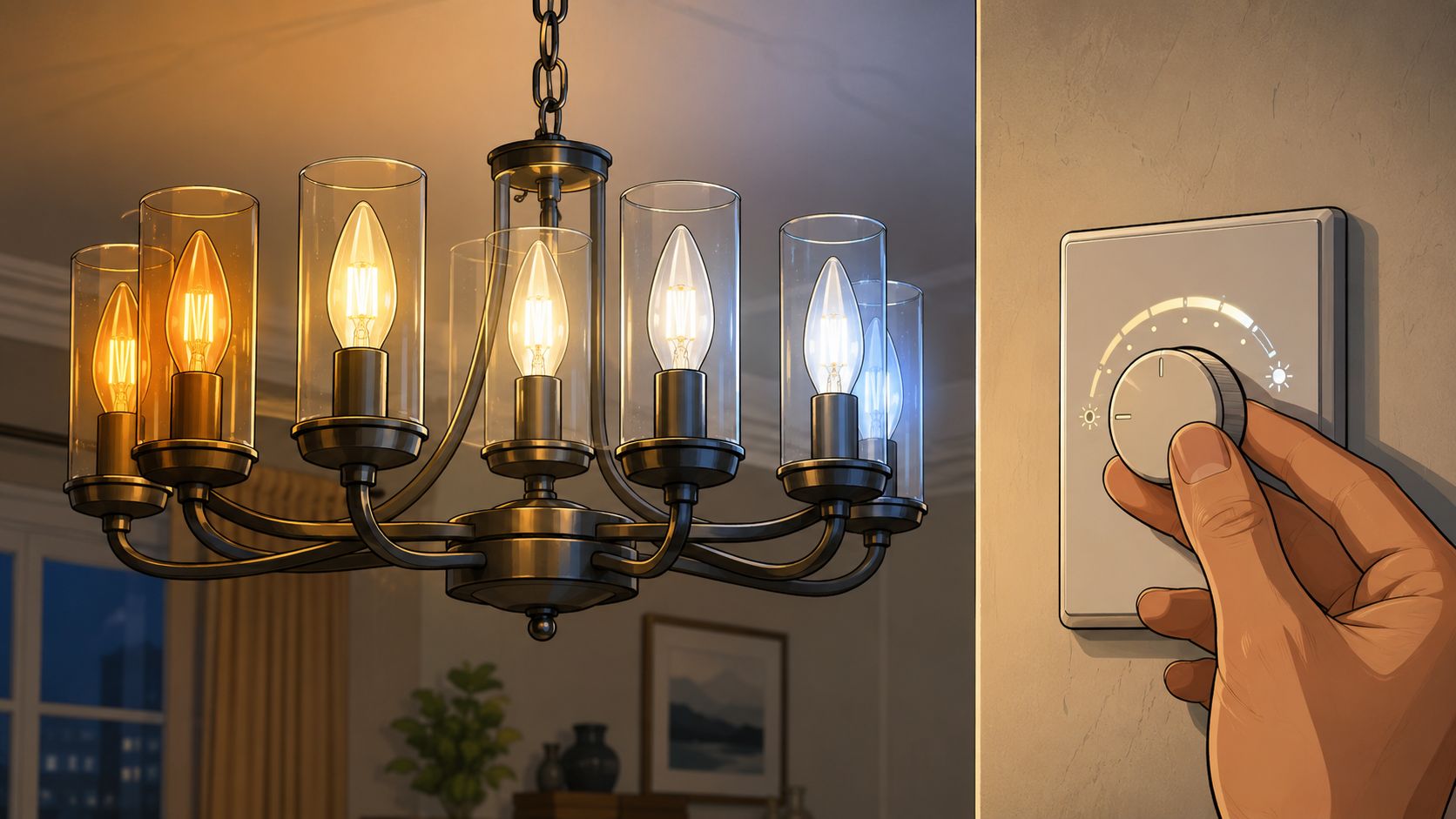
One small technical detail changes a lot. Six-light chandeliers can use either E26 medium bases or E12 candelabra bases, and that affects bulb availability, shape, and whether the fixture leans toward general illumination or decorative effect (bulb base example from Relight Depot).
That distinction is useful in plain language:
- E26 medium base tends to offer broader bulb availability and often makes replacement simpler.
- E12 candelabra base usually supports slimmer decorative bulbs and a more traditional chandelier look.
- The fixture design often hints at the intention. Broader shades and simpler arms may lean practical. Exposed candle sleeves often lean decorative.
If the room already has recessed lights, sconces, or lamps, the chandelier may not need to carry the full lighting load. In that case, decorative bulb shape and warm glow may matter more than maximum output.
Dimming changes everything
A six-light fixture can feel very different at breakfast, during homework, and at dinner. That's why a dimmer often matters as much as the chandelier itself. It gives the room range.
For homeowners using LED bulbs, compatibility deserves a quick check before purchase and installation. A clear overview of residential LED dimmer compatibility tips can help avoid flicker, limited dimming range, or mismatched components.
A practical approach works well in most homes:
- Choose the chandelier first and confirm the base type.
- Decide whether the room needs decorative light, working light, or both.
- Add a dimmer so the fixture can shift with the moment.
- Test the atmosphere in the evening, when glare and shadow are easiest to judge.
Softer, layered light usually makes a dining room feel more welcoming than a fixture run at full brightness all the time.
That same thinking helps in bedrooms and adjacent spaces too. Homeowners interested in a calmer whole-home lighting plan often appreciate guidance on how lighting and temperature support a restful room.
Installation and Care in Your Michigan Home
A chandelier can look straightforward in a box and still be a complicated installation in the ceiling. Older homes around Ann Arbor often prove that quickly. Existing wiring may be dated, ceiling boxes may not be ideal for the new fixture, and placement that looked fine for a simple light may not serve a chandelier well.
When a simple swap isn't simple
If the new fixture is replacing an existing one in the same location, the project may be fairly direct. If the chandelier is heavier, hangs differently, or is being added where no fixture existed before, a licensed electrician is usually the safer route.
This matters even more in homes with plaster ceilings, uncertain wiring history, or rooms where the fixture needs to be visually centered over furniture rather than centered on the original electrical box.
For homeowners who need help evaluating the job, a local lighting installation electrician resource can offer a useful baseline for what professional installation typically involves.
A quick installation checklist
- Check the ceiling box for compatibility with the chosen fixture.
- Confirm the final center point based on the room layout, not just the existing wiring spot.
- Review switch planning early if dimming is part of the goal.
- Use extra care in older homes where hidden surprises are common.
Care that protects the finish
Maintenance doesn't have to be complicated. It just needs consistency. Dust allowed to build up can dull metal, cloud crystal, and make a well-designed fixture look older than it is.
A gentle routine usually works best:
- Turn power off first before cleaning.
- Use a soft cloth for regular dusting.
- Avoid harsh sprays directly on the fixture, especially on mixed materials and finished metal.
- Clean with the fixture's material in mind. Crystal, painted metal, and natural wood details won't all want the same approach.
Seasonal care is often enough to preserve appearance in most homes, especially when the chandelier is part of a broader routine for preserving furniture, finishes, and textiles. A thoughtful fall furniture maintenance checklist can help homeowners protect the rest of the room with the same long-view mindset.
More Than a Light An Heirloom Investment
Some pieces earn their value slowly. A quality chandelier is one of them. It doesn't just fill a practical need. It becomes part of the architecture of daily life, seen at breakfast, during celebrations, on ordinary weeknights, and on holidays when the table is full.
A long design history in one fixture
The chandelier has deep roots. Early forms trace back to medieval Europe, and by the 15th and 16th centuries chandelier design had become more refined, moving toward the ring and crown forms that still shape the category today. The major turning point for the modern residential fixture came with Thomas Edison's 1879 invention of the light bulb, which allowed chandelier arms and stems to become hollow for wiring and made the form far more practical for homes (history of chandelier development).
That history explains why the six-light format feels so familiar and so adaptable. It carries the visual language of an older decorative tradition, but it suits modern residential life. It can be formal, transitional, rustic, metal-forward, or softly traditional without losing its identity.
Why quality still matters
There's also a structural idea behind every chandelier. It is, at heart, a cluster of lights organized into a single composition. At the monumental end of that idea, public installations have stretched engineering to remarkable scales. One widely cited example is the chandelier in the Sheikh Zayed Grand Mosque in Abu Dhabi, installed in 2007, measuring 10 meters in diameter, 15.5 meters tall, weighing nearly 12 tonnes, and lit with 15,500 LED lights. Another reported benchmark describes a chandelier weighing 18,000 kg and containing 165,000 LED units (chandelier scale examples on Wikipedia).
Those record-setting pieces are far from a dining room in Southeast Michigan, but they reveal the same design principle at residential scale. A six-light chandelier is the approachable home version of that clustered-light architecture.
For homeowners who care about long-term value, that matters. A well-made light fixture has the same appeal as hand-crafted furniture with solid joinery. It's not disposable. Its cost-per-year improves the longer it remains relevant, functional, and beautiful. That's why heirloom thinking works so well in a dining room. The chandelier and the table can age together.
Find Your Perfect Light at Tyner Furniture
By this point, the decision usually becomes clearer. The right Six Light Chandelier needs to fit the room physically, support the way the room is used, and relate to the wood tones and finishes already doing the visual heavy lifting.
That often leads buyers away from impulse choices and toward steadier ones. A cleaner fixture may be better for an open-plan layout. A warmer finish may better complement cherry or maple. A dimmer may matter more than an extra decorative detail. These are the kinds of decisions that create a home that feels cohesive instead of crowded.
For many Southeast Michigan households, lighting also sits inside a bigger furnishing plan. A chandelier over a dining table rarely acts alone. It works with the surrounding chairs, the sideboard, the rug, and the nearby upholstery. That's one reason heirloom-quality rooms benefit from seeing materials together in person, especially when comparing bespoke options like Canadel dining, Amish hand-crafted solid wood pieces, or ergonomic seating from Stressless.
Since 1957, the South State Street showroom has served families furnishing more than one room at a time, from dining spaces and bedrooms to home office settings and outdoor areas. That long local legacy matters because many shoppers don't need pressure. They need clarity, durable craftsmanship, and confidence that a purchase will still feel right years from now. Special Financing and the Low Price Promise can also make a long-term decision easier to stage responsibly, especially for made-to-order pieces built for longevity rather than quick replacement.
For homeowners ready to see how a six-light chandelier plays against solid wood, custom finishes, and the scale of a real room, Tyner Furniture is a practical next stop. Visit the Ann Arbor showroom on South State Street to compare materials in person, or browse the online Quick Specs for special-order options and room planning details.