
Does Cherry Wood Darken Over Time? What to Expect

Yes, cherry wood darkens over time, and it does most of that shifting early. Expose American black cherry to intense ultraviolet and visible light and the surface loses about 16 CIELAB units of lightness and gains 3.5 units of redness in roughly 15 hours of exposure, which is why a piece delivered in spring can read as a different table by the following winter. The direction of travel is consistent, toward a warmer reddish-brown, and the speed is not.
What surprises new owners isn't the darkening itself. It's the starting point. Solid cherry arrives lighter, pinker, and more uneven than the deep red-brown tone people picture from a grandparent's house or a showroom sample that has stood under lights for two years. That gap between day one and year five is normal chemistry, not a defect, and understanding the pace takes most of the worry out of it.
Yes, Cherry Darkens, and Usually Fastest at First
Run a hand across the top of a solid cherry dining table and the wood feels cool, dense, and faintly satiny under the finish. That surface is chemically active. The U.S. Forest Service Wood Handbook describes black cherry heartwood as ranging from light to dark reddish brown, and it credits heartwood extractives, the compounds formed as the tree builds heartwood, for that color. Those same extractives are why a freshly finished piece can look pale, salmon-toned, or patchy on delivery day before it deepens into a warmer red-brown.
Two details explain the surprise. Cherry begins lighter than most shoppers expect: the same weathering study measured black cherry samples with initial lightness values of approximately 58 to 64 on its color scale, against 68 to 72 for red oak and 80 to 85 for red pine. And the nearly white sapwood at the edge of a board holds far fewer of the color compounds, so it starts paler and moves on its own schedule.
Light is the trigger, not the calendar. A cherry panel kept in a dark closet ages on a completely different curve than the same panel in a bright kitchen.
Ultraviolet and visible light accelerate reactions in lignin and in the surface extractives, and early exposure can break them down into darker quinone compounds. The change isn't the wood getting older. It's the wood reacting to what reaches it. The North American hardwoods used in hand-crafted casegoods each age on their own curve, and cherry sits among the most responsive of the group.
There's comfort in the mechanics. A darker, richer top on a solid cherry table is normal aging, not a faulty finish, and not a sign the wrong species arrived. How fast it happens depends on finish chemistry, light intensity, the direction a panel faces, and how much of the piece stays covered by a runner, a lamp base, or a fruit bowl. The rest of this guide covers the pace, the accelerators, the limits, and the way to guide the patina instead of fighting it.
The Darkening Timeline from First Months to Decades
Fifteen hours. That's all the time a controlled test needed. Researchers exposing American black cherry (Prunus serotina) to artificial UV and visible radiation recorded lightness dropping by 16 CIELAB units, redness climbing 3.5 units, and yellowness climbing 4.0 units, a result the authors of the wood color study in Wood Science and Technology called rapid and extensive darkening. Real rooms deliver gentler doses, but the surface chemistry is the same.
The table below maps how that chemistry plays out in a home, from the first bright afternoon to the decades mark.
Darkening stages for solid cherry furniture
| Period | Typical change | What drives it |
|---|---|---|
| First 15 hours of intense UV and visible light (lab test) | Lightness drops about 16 CIELAB units; redness rises about 3.5 | Light acting directly on heartwood extractives |
| First months in a bright room | Pale new wood warms to a noticeably redder-brown | Continued light exposure at the surface |
| First year | Fastest change early, then steadily slower | Front-loaded reaction, described as logarithmic by USDA expert Mark Knaebe |
| Years two to five | Gradual deepening of the warm red-brown tone | Ongoing light exposure and slower surface reactions |
| Decades in protected interior zones | Interior slowly approaches the exposed surface tone | Slow internal change with little light |
| Prolonged intense sun | Possible fading toward a lighter, grayer surface | Long UV exposure breaking down lignin |
The First Months in a Bright Room
This is the stretch that alarms people. A newly built table, hutch, or bed starts noticeably pale and then reddens within weeks, and the change is uneven because the light in a room is uneven. A corner near a window can pull ahead of the same top six inches inland.
The First Year Sets the Habit
USDA expert Mark Knaebe describes the reaction as approximately logarithmic, which the Forest Products Laboratory wood handbook chapter sets out plainly: cherry changes rapidly at first, then progressively more slowly. Year one carries the bulk of the visible movement, so placement decisions made in those first months matter more than anything done later.
Year Two Through the Decades
From year two to year five the tone settles into a deeper red-brown. After that, the surface keeps developing slowly, and covered interior zones creep toward the tone of the exposed faces over decades. A cabinet door that sat in shade for years will look lighter than the door beside it, not because one is older, but because one saw less light.
Read the table as a diagnostic. If a piece is still pale after a full year in a bright room, question the placement before questioning the finish.
What Speeds Up or Slows Down the Change
Seven variables set the pace. Most of them are in the owner's control, and the order below runs roughly from strongest influence to weakest.
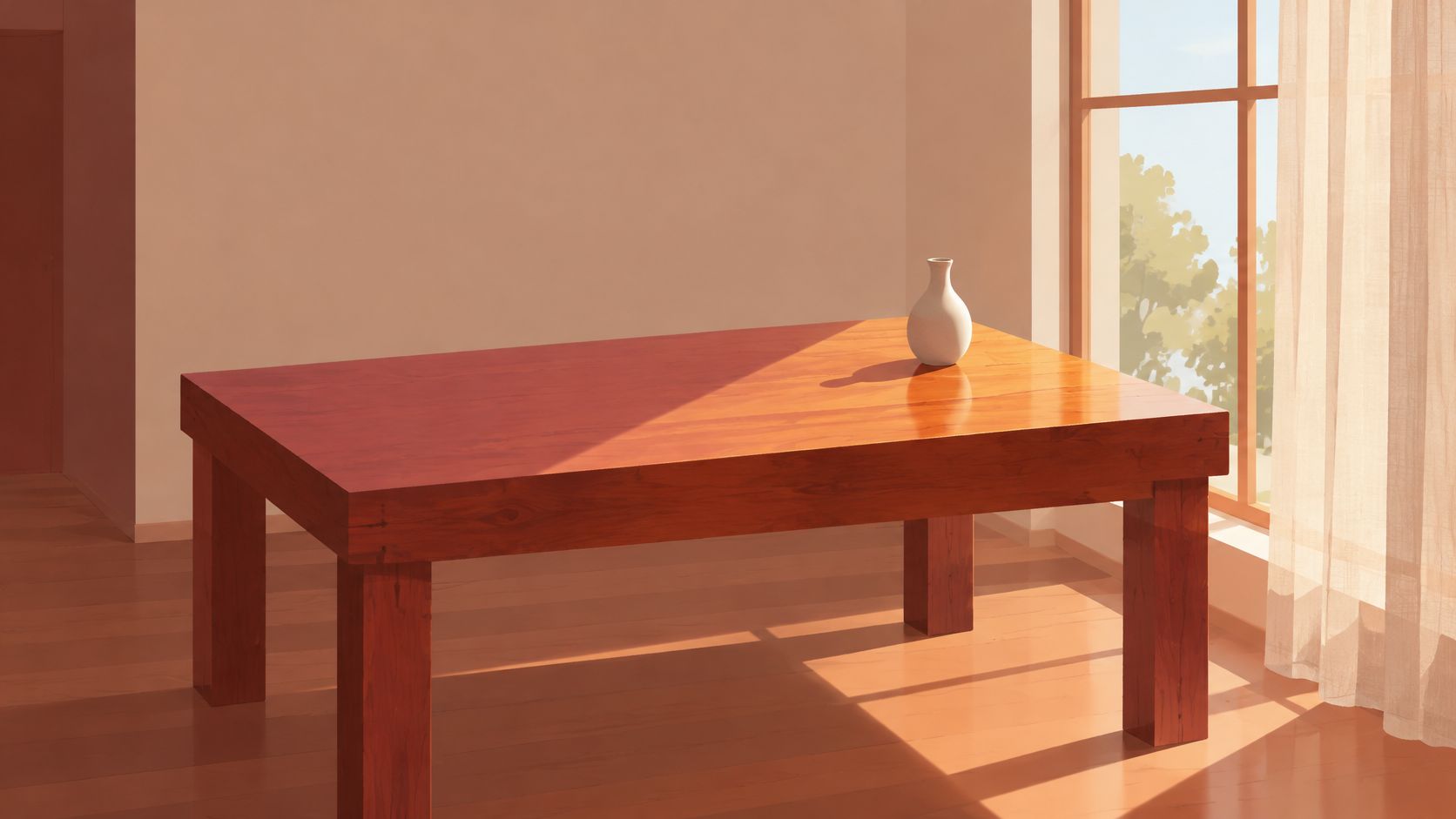
- Direct sun dominates. A south or west window with unfiltered light will move a tabletop faster than anything else in the house. Two cherry pieces of the same age, one by that window and one in a dim hallway, can look five years apart after a single summer.
- Ambient daylight still counts. Visible light drives the reaction even without a sunbeam, so a bright open living room in Ann Arbor matures faster than a shaded den.
- Heartwood content decides the ceiling. Boards cut closer to the heart hold more light-sensitive extractives. Sapwood-heavy boards start lighter and follow a different path, which is one reason two boards from the same log can finish differently.
- Oxygen and moisture assist. Both feed the chemistry, and indoor humidity swings change how the surface behaves, but neither replaces light as the main trigger.
- Timing front-loads the work. Because the reaction slows as it goes, the first year of placement is worth more than any five years after it.
- Covered areas fall behind. Hardware, rugs, chargers, lamps, and decorative objects create shade, and shade creates pale silhouettes that persist.
- Finish moderates rather than freezes. A tinted stain or a clear topcoat changes how dramatic the shift appears, because the full range of cherry wood stain colors runs from near-natural to deep cordovan and each one masks the change differently. The extractives underneath stay light-sensitive regardless.
Sort these into two groups and the strategy gets simple. The wood will do what it does; the room decides how fast. Everything about reacting to these factors, from rotating accessories to choosing a topcoat, belongs to care and finish rather than to the wood itself.
Whether Cherry Ever Stops Darkening or Fades
The common assumption is that cherry reaches a mature shade in a year or two and then holds. It doesn't hold. A 2025 study tracked UV-irradiated wood through 14 years of storage in darkness and found redness still climbing: a 21% increase for UV-irradiated American cherry and 28% for cherry, reported in the Springer paper on photostability and natural aging. Those are relative measurements inside an experiment, not a promise about a dining table in Saline, but they settle the underlying question. The red character keeps developing long after the last bright afternoon.
The same research found that American cherry, cherry, and larch ranked among the more photostable species tested, because their natural extractives resist photodegradation better than many woods do. That cuts against the folk belief that more sun always means a faster, better patina. Sunlight moves the color; it doesn't improve the wood.
Then there's the reversal. Prolonged, intense weathering can eventually push a surface toward a lighter, grayer tone as lignin breaks down, so cherry doesn't travel a single road. An owner sees the evidence in ordinary ways:
- An even warm tone across a top that has lived in balanced light
- A faded strip on the edge nearest a window that takes sun all afternoon
- A distinctly darker band revealed when a leaf is pulled from storage or a board is turned
Patina is a stage of solid cherry, not a finish line to cross. The goal is management, and a made-to-order heirloom table gives the owner decades to manage it. Homeowners weighing a stained finish against natural cherry can also compare palettes side by side using this stain colour advice from Aqua Painting, since a deeper stain blurs the visible shift while a natural or lightly toned finish lets it show.
How Finishes and Care Shape the Patina
Decide what the wood should look like in five years before choosing a finish, because the finish you pick on delivery day is really a decision about year five. Three goals cover most buyers, and each carries a trade-off worth naming up front.
Goals for cherry color and the trade-off of each approach
| Goal | What to do | Trade-off |
|---|---|---|
| Keep the original pale color | Limit direct sun with window treatments and choose a UV-filtering finish | Color still shifts, only more slowly |
| Encourage an even patina | Rotate removable objects and use table leaves periodically | Some uneven zones remain during the first year |
| Prevent fading after long intense sun | Move pieces away from direct sun and use a UV-protective coating | Clear coatings can yellow over time, which changes the look |
Choosing a Finish for Year Five, Not Day One
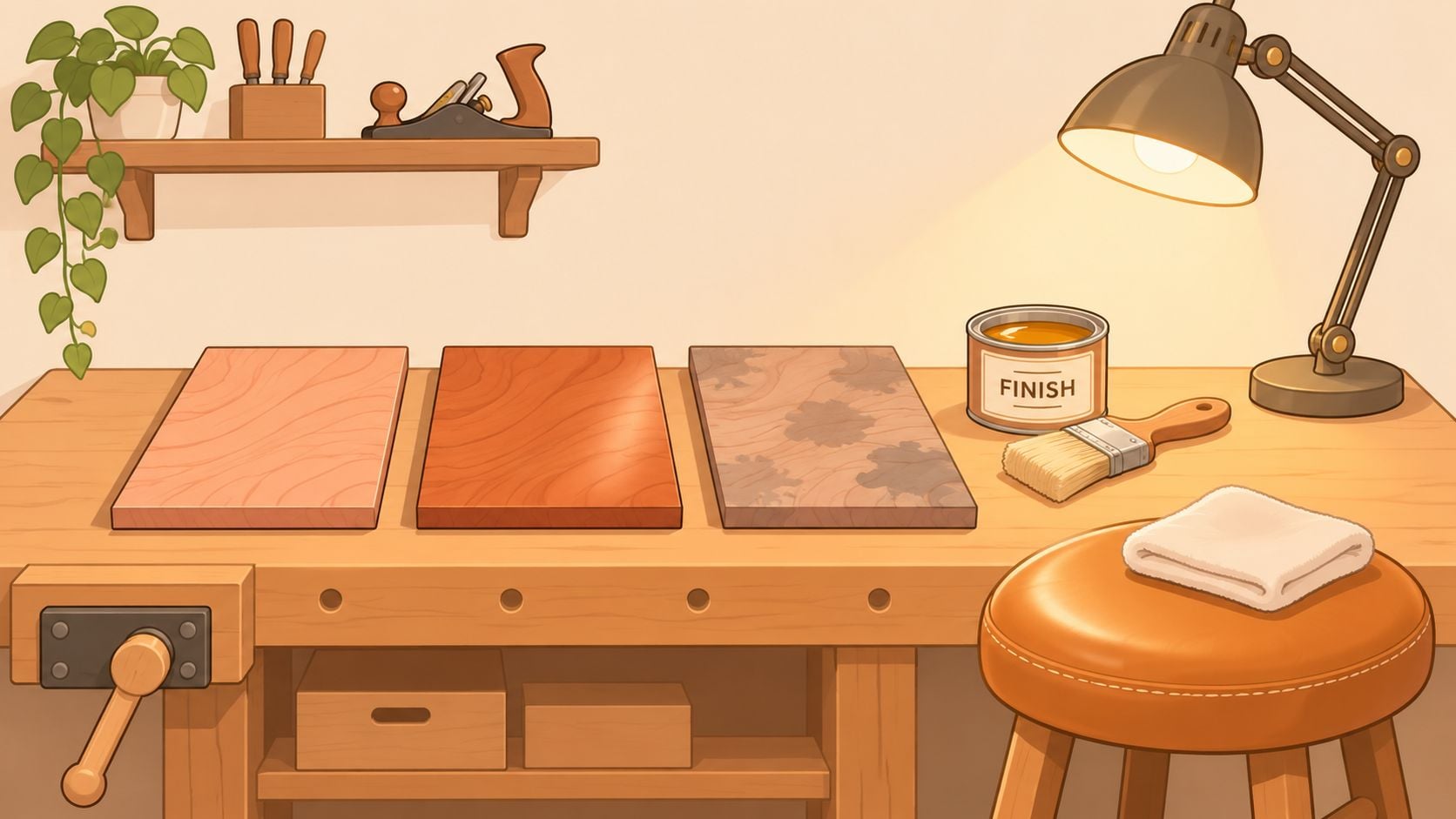
Here's where expectations usually go wrong. A clear coat reduces exposure intensity, then yellows and darkens along with the wood beneath it, so the piece warms twice over. Experimental UV-coating work published in 2025 shows continuing measurable color differences on coated cherry surfaces, which the wood flooring Q&A on why some woods darken uses to make the broader point: protective systems modify change, they don't cancel it. No finish on the market freezes cherry at its pale pink starting tone, and any claim otherwise is sales talk.
Coating behavior is familiar from other woodwork. A topcoat that looks glassy in year one can dull, yellow, or show wear by year eight, much as a varnished wooden staircase makeover guide describes how film finishes age on high-traffic surfaces. Plan on refreshing the topcoat eventually and the wood underneath will be a little further along.
Care Steps That Keep Color Even
- Rotate removable objects every few months during the first year, so silhouettes never harden into place.
- Use table leaves periodically. An extension leaf stored in a closet for three years will come out pale against a sun-darkened top.
- Soften the strongest window hours with blinds or sheer curtains, especially on south and west exposures.
- Dust with a soft cloth and a mild cleaner. Heavy polish builds a film that traps dust and dulls the grain.
- Check placement before reapplying any finish. A pale patch is usually a shade problem, not a coating failure.
A well-kept cherry top under a lamp has a specific look: a warm amber glow in the grain, a surface that feels smooth and slightly cool, and edges that have caught up with the center. Getting there is a matter of patience and a little rotation, and the table-top finishes chosen at Tyner's table top finishes guide set the tone for how that glow develops.
Pro-Tip for the first year: photograph the piece on delivery day, then again at three, six, and twelve months. The change that feels alarming week to week looks orderly and predictable across a year.
Matching Panels, Leaves, and Replacement Parts
Uneven color across one piece almost never comes from age alone. It comes from placement. Panels that face different directions, or that spend time in different light, will not match at first and may not mature at the same rate. A 2024 technical Q&A reported cherry veneer showing a color difference of approximately 10.87 after just one month of sunlight exposure, a figure recorded in the Fine Woodworking technical note on cherry color change. Weeks, not decades, are enough to separate two panels.
The predictable trouble spots are few. A leaf stored in a closet while the top sits in daylight. A cabinet door replaced years after its neighbors. A board turned so a sun-faded face ends up beside a fresh one.
- Ask for a starting-tone sample before ordering a matching part, so the comparison happens on paper rather than after delivery.
- Store spares in the same light as the top, or deliberately expose them during the first year so they age together.
- Use leaves periodically, keeping edges on the same schedule as the center.
- Compare panels side by side under the room's real lighting before finalizing any replacement.
- Accept a small difference as normal for solid wood rather than as evidence of a bad match.
Before you order a replacement: set the new part in the room's brightest spot for a few weeks and check it against the original in daylight, not under a lamp.
Made-to-order construction gives an owner an advantage here, because wood species and finish can be planned up front and replacement parts sourced against a known specification. Matching a stain to an existing piece is its own skill, and this guide to matching wood stains covers the comparison steps that keep a new component close to its neighbors from the start.
Visit the Ann Arbor Showroom for a Sit Test
Choosing solid cherry means accepting that the wood will change. That's the deal, and it's a good one. Color variation is expected in solid cherry rather than a defect, and heirloom pieces built to order reward owners who plan finish and placement early instead of reacting after the first summer.
Seeing the starting tone in person settles more questions than any photograph can. The showroom on South State St. in Ann Arbor keeps cherry tones on the floor under real lighting, and a sit test lets a buyer judge the weight of a solid cherry chair or the feel of a finished tabletop edge. Tyner Furniture has served Southeast Michigan since 1957 and covers everything from the home office to outdoor spaces.
The customization edge goes further than the floor. Cherry dining room sets can be planned around the room's light, not just its dimensions. Amish furniture at Tyner is hand-crafted from solid wood and fully customizable, so species, stain, and finish are decisions rather than accidents, and a Custom Order lets a household specify exactly what it wants. Canadel dining offers a wide set of table, edge, leg, and finish combinations, while Stressless seating adds ergonomic sizing and comfort options for anyone furnishing a living room alongside the dining room. Special Financing and the Low Price Promise make an heirloom purchase easier to plan than the sticker suggests.
A solid cherry dining table, bedroom set, or living room piece from Tyner Furniture is built to be lived with for decades, which means the color you choose on the showroom floor is only the opening scene. Visit Tyner Furniture on South State St. in Ann Arbor to see how cherry tones read under real light and to talk through finish options before ordering. If a made-to-order piece is the better fit, browse the online Quick Specs and let the team plan the wood, stain, and delivery around your room.